Table of Contents
Introduction: Where to Get a 3D Product Configurator for Ecommerce?
Imagine a customer not just viewing your product online, but co-creating it. Guided by an AI assistant, they interact with a photorealistic, dynamic 3D model—changing materials with a voice command, viewing it in their own space via real-time augmented reality, and receiving smart recommendations for optimal configurations. This is the state of 3D product configuration in 2026, a critical driver of conversion, loyalty, and competitive advantage in an increasingly immersive digital marketplace.
The ecommerce landscape has evolved beyond the simple transactional website. We are now firmly in the era of immersive commerce, where customer experience is the primary battleground. A 2025 Gartner report predicted that by 2026, 30% of all digital commerce interactions will be “context-aware and immersive,” heavily leveraging 3D and AR technologies. The static 2D image is becoming obsolete for considered purchases. Today’s customers demand engagement, hyper-personalization, and absolute confidence. A modern 3D product configurator is no longer a luxury for niche markets; it’s a foundational tool for any brand selling complex, customizable, or high-value goods.
This guide is your definitive resource for navigating the rapidly advancing ecosystem of 3D configuration solutions in 2026. We will move beyond just listing vendors to providing a strategic framework for selecting, implementing, and maximizing the return on investment (ROI) from a configurator that will future-proof your ecommerce business.
What is a 3D Product Configurator in 2026?
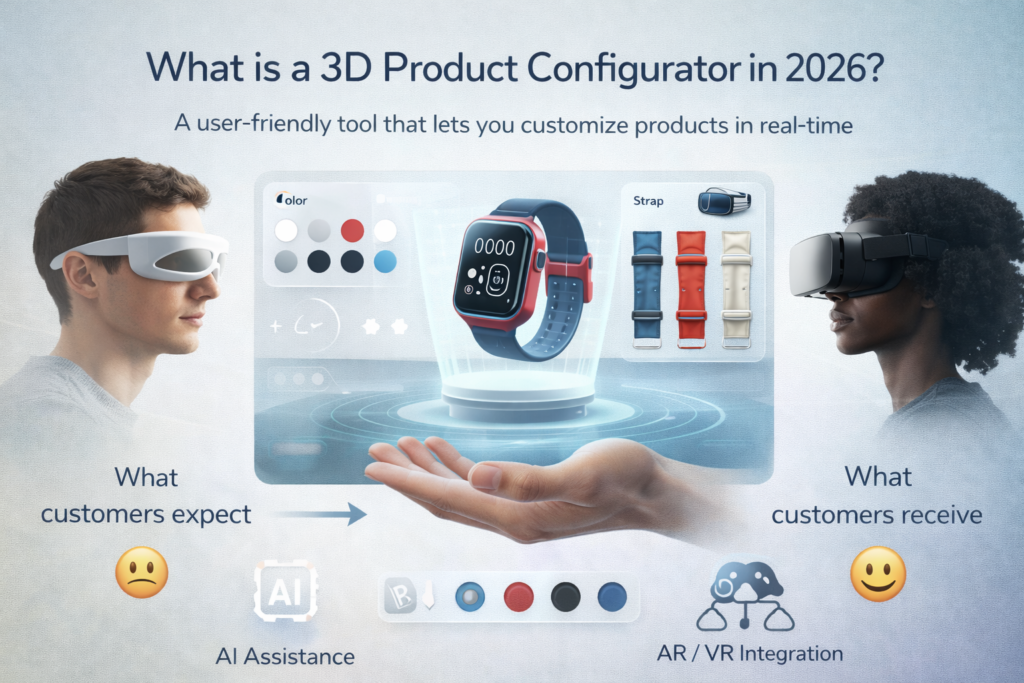
A 3D product configurator is a sophisticated software application, typically integrated into an ecommerce website or app, that allows customers to visualize, personalize, and customize a product in real-time using interactive 3D models.
In 2026, the definition has expanded significantly. It is now an AI-powered, immersive commerce engine. Core functionalities have evolved to include:
- Real-Time 3D Visualization: Photorealistic rendering that occurs instantly in the browser or app, powered by WebGPU and advanced real-time ray tracing, eliminating pre-rendered limitations.
- Interactive Customization: Users modify colors, materials, textures, components, engravings, and dimensions through an intuitive UI.
- AI-Guided Configuration: Integrated AI suggests compatible options, prevents invalid combinations, and can even generate novel designs based on user preferences or past behavior.
- Seamless AR Integration: A native “View in Your Room” feature is standard, using device cameras for true-scale product placement.
- Dynamic Pricing & Inventory Updates: Each modification automatically updates the price, availability, and lead time, often connected directly to ERP/PIM systems.
- Photo-Realistic Scene & Lighting Control: Users can place the configured product in different environmental “scenes” (e.g., a lamp in a modern living room vs. a traditional study) to assess its look and feel.
- Social & Collaboration Tools: Share configurations via a link for feedback, or collaborate on a design in a multi-user session for B2B sales.
The Compelling Business Case: Benefits Backed by 2026 Data
Investing in a 3D configurator is a strategic decision with a clear, quantifiable impact. The benefits extend across marketing, sales, and operations.
1. Skyrocketing Conversion Rates & Average Order Value (AOV):
Interactive 3D experiences dramatically reduce purchase hesitation. A 2025 Shopify Plus study found that products with 3D/AR content saw a 94% higher conversion rate on average than those without. Configurators empower upselling and cross-selling within the experience itself. When a customer builds their perfect product, they are more invested and less price-sensitive, leading to AOV increases of 20-40% for configurable goods.
2. Drastic Reduction in Returns & Pre-Sales Inquiries:
Returns due to “product not as expected” are a massive ecommerce cost. A 3D configurator acts as a digital product twin, setting accurate expectations. Brands report up to a 35% reduction in return rates for configured products. Furthermore, it deflects routine “can I get it in blue?” inquiries, freeing up customer service teams.
3. Enhanced Brand Perception & Competitive Differentiation:
In a crowded market, a seamless, cutting-edge configuration experience positions your brand as innovative, customer-centric, and trustworthy. It’s a powerful marketing asset that boosts engagement time on site and increases social sharing of unique creations.
4. Streamlined Sales Processes (Especially for B2B & Complex Sales):
For B2B, complex machinery, or B2C products like custom kitchens, configurators automate the quotation process. Sales reps and customers alike can build accurate, price-validated specifications that flow directly into order management systems, reducing errors and sales cycles.
5. Valuable Data & Consumer Insight Generation:
Every interaction is a data point. Configurators reveal what combinations are most popular, where users get stuck, and what features are ignored. This is invaluable R&D and marketing intelligence for future product development, inventory planning, and targeted promotions.
Primary Avenues: Where to Get Your 3D Product Configurator in 2026
The solution landscape in 2026 is diverse, catering to different technical capabilities, budgets, and strategic goals. Here are the main avenues to explore.
1. Specialized SaaS (Software-as-a-Service) Platforms
This is the most popular and rapidly evolving route for most mid-to-large-sized businesses. These cloud-based platforms offer an end-to-end solution: hosting, 3D viewer technology, configuration logic, ecommerce integrations, and analytics, typically for a monthly/annual subscription.
Why Choose SaaS in 2026?
- Speed to Market: Deployment can take weeks, not months.
- Continuous Innovation: You benefit from automatic updates in AI, rendering, and AR without extra development cost.
- Scalability & Reliability: Cloud infrastructure handles traffic spikes.
- Reduced Overhead: No need for deep in-house 3D/WebGL engineering teams.
Leading & Emerging SaaS Contenders (2026 Landscape):
- Threekit: A leader for enterprise brands, offering a robust Virtual Photographer platform and strong PIM/ERP integrations.
- Vntana: Excels in optimizing and streaming very complex 3D CAD data for ecommerce, popular in industrial and manufacturing sectors.
- Cylindo: Known for its deep, seamless integrations with major ecommerce platforms (Shopify Plus, BigCommerce, Salesforce Commerce Cloud) and high-performance viewer.
- JigSpace & Augment: While strong in AR, their 2026 offerings include robust configuration toolkits aimed at product storytelling.
- Zakeke & iDesign: Strong options for SMBs and mid-market brands, offering user-friendly interfaces and competitive pricing.
2. Integrated Features within Your Ecommerce Platform
Major platforms now offer native or deeply partnered 3D configuration tools, simplifying the tech stack.
- Shopify (with Native 3D & App Ecosystem): Shopify’s core now supports 3D model uploads. For advanced configuration, apps like Product Customizer and Zakeke offer deep integration. Shopify Plus merchants have access to dedicated configuration partners.
- Adobe Commerce (Magento): Leverages extensions from the marketplace (e.g., Product Configurator by LimeSoda) and partnerships with SaaS providers for enterprise-grade solutions.
- BigCommerce: Features strong API support for headless commerce, making it a favorite for pairing with a best-in-breed SaaS configurator like Cylindo or Threekit.
- Salesforce Commerce Cloud: Typically requires implementation through certified partner agencies who integrate leading SaaS solutions.
3. Custom Development (In-House or Agency)
For businesses with unique, highly complex configuration needs (e.g., engineering-grade B2B products) or a desire for complete brand and code ownership.
- In-House Development: Requires a dedicated team of 3D artists, WebGL/Three.js developers, and backend engineers. This offers maximum flexibility but has high upfront and ongoing costs. Best for: Tech giants and manufacturers with existing 3D engineering teams.
- Agency/Boutique Development: Hire a specialized digital agency or development studio. They handle strategy, 3D modeling, and full-stack development.
- Pros: Tailored solution, expert guidance, hands-off implementation.
- Cons: Higher initial investment, potential for longer timelines, ongoing maintenance costs.
- How to Find Them: Search for agencies specializing in “immersive commerce,” “3D web development,” or “WebGL applications.”
4. 3D Modeling & CAD Software with Publishing Suites
Some companies start with their 3D design assets. Certain software packages now include tools to create basic interactive viewers or configurators.
- Blender (with Add-ons like Blend4Web): A powerful, open-source option for tech-savvy teams.
- Autodesk (Fusion 360, 3ds Max + VRED): Offers pipelines to create interactive product visuals, often used in conjunction with a developer to build the final web front-end.
- Clara.io & Sketchfab: While primarily 3D model viewers/hosts, they offer basic configuration parameters and embedding, suitable for simple use cases.
This avenue often requires significant technical bridging to become a full-fledged, ecommerce-integrated configurator.
Your Step-by-Step Selection Framework for 2026
Choosing the right solution is a strategic process. Follow this framework to make an informed decision.
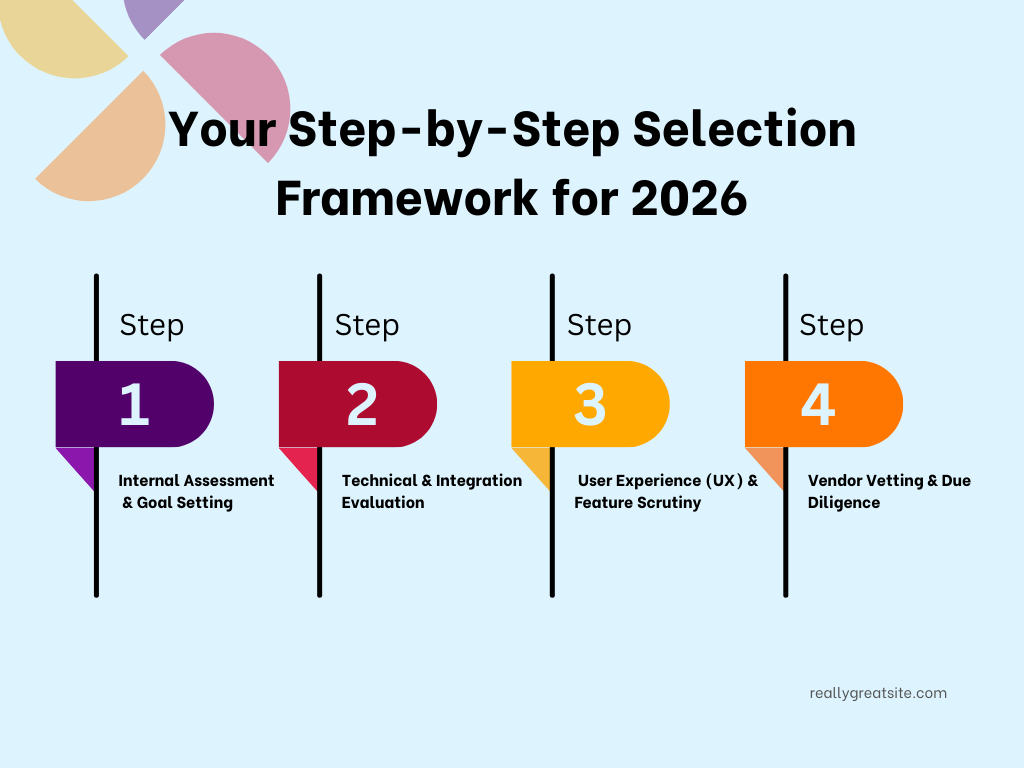
Step 1: Internal Assessment & Goal Setting
- Define Use Cases: Is it for B2C sneakers, B2B furniture, or industrial equipment? Complexity varies wildly.
- Audit Your 3D Assets: Do you have high-quality 3D models (CAD files, sculpted models)? If not, factor 3D creation costs ($$$) into your budget.
- Set KPIs: What are you measuring? (e.g., Conversion Lift, AOV Increase, Support Ticket Reduction).
- Budget Realistically: Consider total cost of ownership: platform subscription, 3D asset creation/management, integration, and maintenance.
Step 2: Technical & Integration Evaluation
- Ecommerce Platform Compatibility: Does it have a native plugin for your platform (Shopify, etc.) or robust APIs for a headless setup?
- PIM/ERP/CRM Integration: Can it connect to your source of truth for pricing, inventory, and customer data?
- 3D File Format Support: Does it support your native file formats (e.g.,
.step,.obj,.glb) and automate optimization? - Performance & Scalability: Test the viewer on multiple devices. It must load quickly (under 3 seconds) and run smoothly.
Step 3: User Experience (UX) & Feature Scrutiny
- Intuitiveness: The configuration UI must be self-explanatory. Request a demo account and try it yourself.
- Visual Fidelity: Is the real-time rendering photorealistic? Can it show material properties like gloss, roughness, and fabric texture accurately?
- Mobile & AR-First Design: Over 60% of commerce traffic is mobile. The mobile experience must be flawless, with one-tap AR.
- AI & Smart Features: Look for smart rules (dependency logic), recommendation engines, and tools that prevent invalid combinations.
Step 4: Vendor Vetting & Due Diligence
- Request Case Studies: Ask for examples in your specific industry.
- Check References: Speak to existing clients about support, uptime, and roadmap delivery.
- Evaluate the Roadmap: In 2026, AI integration and spatial computing (Vision Pro, Meta glasses) readiness are key. Is the vendor innovating?
- Review SLAs & Support: Understand response times, uptime guarantees, and the quality of technical support.
Common Implementation Mistakes and How to Avoid Them
- Mistake: Prioritizing Fidelity Over Performance.
- Result: A stunning configurator that loads too slowly, causing high bounce rates.
- Avoidance: Insist on optimized 3D assets (polygon count, texture resolution). The best SaaS platforms automate this.
- Mistake: Ignoring the Mobile & AR Experience.
- Result: Alienating the majority of your traffic.
- Avoidance: Make “mobile-first” a non-negotiable requirement in your vendor selection. Test AR placement on various devices.
- Mistake: Underestimating 3D Asset Creation & Management.
- Result: Project delays, budget overruns, and inconsistent visual quality.
- Avoidance: Partner with a vendor that offers 3D content services or has a vetted network of 3D studios. Plan for ongoing asset updates for new products.
- Mistake: Building a “Black Box” with No Data.
- Result: Inability to measure ROI or gain customer insights.
- Avoidance: Ensure the solution integrates with your analytics stack (Google Analytics 4, Mixpanel) and provides its own dashboard for configuration analytics.
- Mistake: Over-Complicating the User Interface.
- Result: User confusion and abandonment.
- Avoidance: Adopt a progressive disclosure design. Show essential options first; advanced options can be behind a “More Options” tab. User test relentlessly.
Expert Tips and Best Practices for 2026 and Beyond
- Adopt a Phased Rollout: Start with your flagship or most configurable product. Prove the ROI, learn the process, then expand to other product lines.
- Treat 3D Models as Core Product Data: Integrate your 3D asset management with your PIM (Product Information Management) system. They are as important as titles and descriptions.
- Leverage AI for Personalization: Go beyond configuration. Use AI to analyze a user’s interactions and suggest a “Perfect Match” configuration based on popular combinations or their browsing history.
- Bridge Online and Offline: Use the configurator in physical stores on tablets for sales associates. Allow customers to save an online configuration and retrieve it in-store, or vice-versa.
- Plan for Spatial Computing: The lines between AR on a phone and true mixed-reality headsets (Apple Vision Pro, Meta Quest Pro) are blurring. Choose a partner whose technology stack is built for this evolution, allowing users to visualize products at true scale in their environment with natural interaction.
- Focus on the “Post-Purchase” Experience: Send a render of the customer’s unique configuration in their order confirmation email. Allow them to share it on social media. This turns the transaction into a proud brand moment.
Frequently Asked Questions (FAQ)
Q1: How much does a 3D product configurator cost in 2026?
A: Costs vary widely. SaaS platforms can range from $500 to $5,000+ per month, based on features, traffic, and products. Custom builds start at $50,000+. A critical, often equal or greater cost is 3D model creation, which can be $500-$5,000 per product model, depending on complexity.
Q2: Can I add a 3D configurator to my existing Shopify/WooCommerce/Adobe Commerce store?
A: Absolutely. Most SaaS solutions offer plugins or apps for major platforms like Shopify Plus, BigCommerce, and Adobe Commerce (Magento). For WooCommerce and other open-source platforms, API-based integration is standard.
Q3: Do I need a special team to manage a 3D configurator?
A: With a SaaS solution, you don’t need in-house 3D developers. You will need a marketing or ecommerce manager to run the platform, and you’ll need a process to create and supply 3D models (either in-house 3D artists or an outsourced partner).
Q4: What’s the difference between 3D configuration and Augmented Reality (AR)?
A: They are complementary. 3D configuration is the tool for customizing the product. AR is a viewing mode that places the configured 3D model into the user’s real-world environment via their camera. The best configurators have AR viewing as a built-in feature.
Q5: How long does implementation typically take?
A: For a SaaS solution with existing 3D models, integration can take 4-12 weeks. If 3D models need to be created from scratch, add 1-3 months to the timeline. Custom development projects can take 6-18 months.
Q6: What file formats are needed for 3D models?
A: Start with your highest-quality source files (e.g., .stp, .iges for CAD; .fbx, .obj for sculpted models). The configurator platform will then optimize them into web-friendly formats like .glb or .gltf (the standard for WebGL).
Q7: How does a 3D configurator impact SEO?
A: Positively. Interactive content increases dwell time and reduces bounce rates—strong positive ranking signals for Google. You can also create dedicated landing pages for “Configure Your X” which can rank for long-tail commercial keywords. Ensure the configurator is implemented with semantic HTML and accessible controls for optimal SEO.
Q8: Is this only for big enterprises?
A: No. The democratization of 3D technology means solutions now exist for businesses of all sizes. SMB-focused platforms offer affordable entry points, making it viable for boutique furniture makers, custom jewelry brands, and electronics modders.
Q9: Can it handle complex B2B products with thousands of parts?
A: Yes, but this is a specialized segment. Look for providers like Vntana or Threekit that excel in handling complex CAD data and have strong logic engines for managing intricate rules, dependencies, and engineering constraints.
Q10: What’s the next evolution after the 2026 configurator?
A: The convergence of Generative AI and configuration. Imagine describing your ideal product (“a mid-century modern armchair in green velvet with walnut legs”) and the AI generates a unique, purchasable 3D model on the fly. Furthermore, integration with the metaverse and digital twins will allow your configured physical product to have a companion digital asset in virtual spaces.
Conclusion and Key Takeaways for 2026
The question is no longer if you need a 3D product configurator, but when and how you will implement one to stay relevant. In 2026, it is a cornerstone technology for immersive commerce, directly driving revenue growth, operational efficiency, and brand strength.
Your Actionable Takeaways:
- Start with Strategy: Define your goals, audience, and KPIs before looking at vendors.
- SaaS is the Default for Most: For balance of speed, innovation, and cost, specialized SaaS platforms are the recommended starting point for the majority of brands.
- The 3D Asset is Fundamental: Your budget and timeline must account for high-quality 3D model creation and management.
- Mobile & AR are Non-Negotiable: Any solution you choose must deliver a flawless experience on smartphones with one-tap AR.
- Think Beyond the Transaction: The configurator is a data goldmine and a brand differentiator. Use it to learn about customers and create shareable moments.
- Future-Proof with AI & Spatial: Select a partner with a clear roadmap in AI-driven personalization and readiness for spatial computing platforms.
The future of ecommerce is interactive, personalized, and visual. By strategically investing in a modern 3D product configurator in 2026, you are not just adding a feature—you are building the immersive storefront of the future, today. Begin your assessment, engage with vendors, and take the first step toward transforming how your customers discover, create, and connect with your products.
For advanced ecommerce growth strategies, technical insights, and scalable content frameworks, explore professional resources at rankifycontent.com.