Table of Contents
Introduction
As ecommerce stores grow, managing products efficiently becomes more complex. Customers expect fast search results, relevant recommendations, and easy navigation. This is where product tagging ecommerce plays a crucial role. Product tagging helps organize products using labels or attributes that describe features, categories, use cases, and customer intent. When implemented correctly, tagging improves both customer experience and backend store management.
In modern ecommerce, product tagging is not just an organizational tool—it directly impacts search accuracy, personalization, recommendations, and conversions. Online stores with well-structured tagging systems enable customers to find exactly what they are looking for in less time, which increases satisfaction and sales.
What Is Product Tagging in Ecommerce?
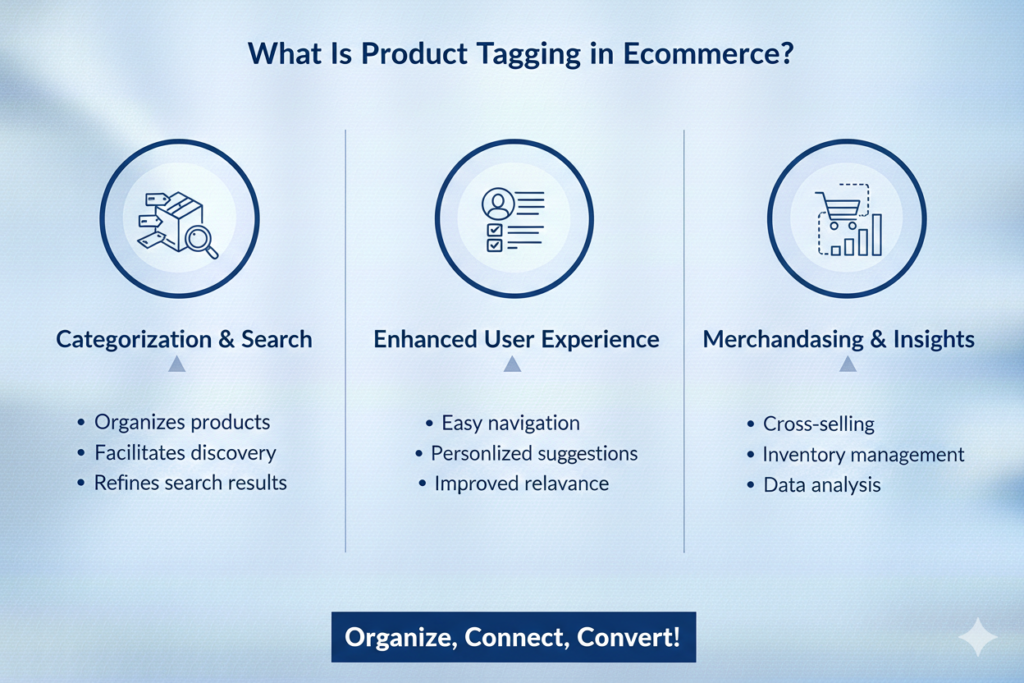
Product tagging ecommerce refers to the process of assigning descriptive labels (tags) to products in an online store. These tags can represent product attributes such as color, size, material, brand, style, season, gender, use case, or special features. Unlike rigid categories, tags are flexible and allow products to belong to multiple groups at the same time.
For example, a single product can be tagged as “summer,” “organic,” “skincare,” and “best seller” simultaneously. This flexibility makes product tagging a powerful system for improving product discoverability and personalization in ecommerce platforms.
Why Product Tagging Ecommerce Is Important
The importance of product tagging ecommerce lies in how customers interact with online stores. Most shoppers do not browse category by category; instead, they search, filter, and expect instant relevance. Proper tagging ensures that products appear correctly in search results, filters, and recommendations.
From a business perspective, tagging simplifies catalog management, supports automation, and improves data accuracy. It allows ecommerce teams to manage large product catalogs without creating unnecessary duplicate categories or pages.
Difference Between Product Categories and Product Tags
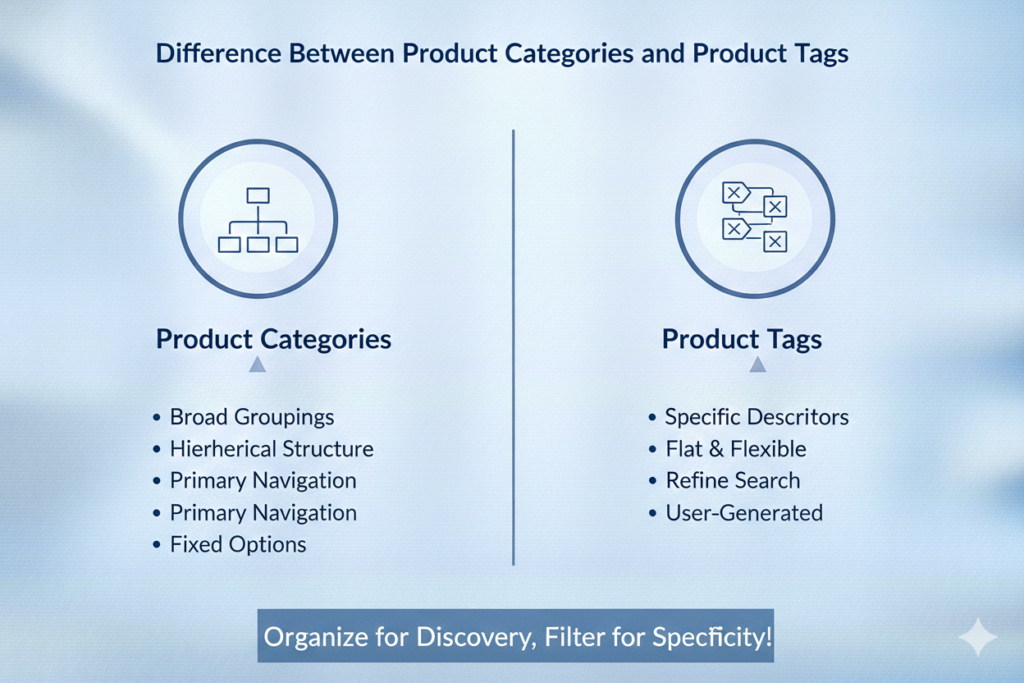
Product categories and product tags serve different but complementary purposes in ecommerce. Categories define the main structure of the store and are usually limited in number. Tags, on the other hand, are flexible labels that provide additional context and attributes.
In product tagging ecommerce, tags allow deeper product connections beyond basic categories. For example, two products in different categories can share the same tag such as “eco-friendly” or “new arrival,” enabling cross-category discovery and smarter filtering.
How Product Tagging Improves Customer Experience
A strong product tagging ecommerce strategy significantly improves customer experience. Tags power advanced filters, search refinement, and personalized product displays. When customers can filter products by relevant tags such as size, color, skin type, or occasion, they find suitable products faster.
This reduced friction leads to longer session durations, lower bounce rates, and higher conversion rates. Customers are more likely to complete purchases when navigation feels intuitive and tailored to their needs.
Role of Product Tagging in Ecommerce Search
Search functionality is one of the most critical components of ecommerce success. Product tagging ecommerce enhances on-site search by improving search relevance. When products are accurately tagged, search queries match tags more effectively, delivering precise results.
For example, if a customer searches for “wireless headphones,” products tagged with “wireless,” “Bluetooth,” or “noise cancelling” are more likely to appear correctly. This relevance increases user satisfaction and reduces abandoned searches.
Product Tagging Ecommerce and Personalization
Personalization relies heavily on data, and product tagging ecommerce provides structured data that personalization engines can use. Recommendation systems analyze tags to suggest related or complementary products based on user behavior and preferences.
For instance, a customer browsing products tagged “vegan skincare” may receive recommendations for other products with similar tags. This targeted personalization improves engagement, average order value, and repeat purchases.
Managing Large Catalogs with Product Tagging
For ecommerce stores with large or growing catalogs, product tagging ecommerce becomes essential for scalability. Without tagging, managing thousands of products becomes inefficient and error-prone. Tags allow bulk actions, automation, and dynamic product grouping.
Well-planned tagging systems also support seasonal campaigns, promotions, and inventory management. Products can be quickly grouped using tags such as “sale,” “limited edition,” or “holiday collection” without restructuring the entire catalog.
Common Use Cases of Product Tagging in Ecommerce
Product tagging ecommerce is used across many store features. Tags support product filters, internal search, related products, upselling and cross-selling, landing pages, and marketing campaigns. They also help teams analyze performance by tracking which tags generate the most engagement or conversions.
These use cases make product tagging one of the most versatile tools in ecommerce operations.
SEO Benefits of Product Tagging Ecommerce
One of the most valuable yet underestimated benefits of product tagging ecommerce is its contribution to search engine optimization through improved site structure and user behavior signals. While product tags themselves are usually not meant to rank as independent pages, they play a vital role in strengthening internal navigation. When users click on tag-based filters or related products, they naturally explore more pages, increasing session duration and reducing bounce rates—both of which are strong indicators of content relevance for search engines.
Additionally, product tagging ecommerce helps prevent SEO issues such as duplicate content and keyword cannibalization. Instead of creating multiple similar category pages, tags allow ecommerce stores to dynamically group products without harming site architecture. This cleaner and more logical structure makes it easier for search engines to crawl, index, and understand product relationships, supporting long-term organic growth.
Product Tagging Ecommerce on Shopify
Shopify heavily relies on product tagging ecommerce to power advanced store functionality. Product tags in Shopify allow merchants to create automated collections, smart filters, and promotional sections without manually assigning products each time. This flexibility is especially useful for stores with frequently changing inventories, seasonal products, or flash sales.
From a customer perspective, Shopify product tags enhance browsing by enabling refined filtering options. Customers can quickly narrow down results based on tags such as size, color, material, or popularity. From a business perspective, this improves operational efficiency while delivering a smoother shopping experience that leads to higher engagement and conversions.
Product Tagging Ecommerce on WooCommerce
WooCommerce offers even greater flexibility in product tagging ecommerce, especially for stores with complex catalogs or custom requirements. Product tags in WooCommerce can be combined with categories, attributes, and advanced search plugins to create highly refined browsing experiences. This is particularly beneficial for niche stores, B2B ecommerce, or websites with technical products.
When implemented correctly, WooCommerce product tagging improves product discoverability and supports advanced recommendation engines. Tags can be used to display related products, build custom landing pages, and enhance internal linking. This structured data approach not only improves usability but also strengthens backend analytics and reporting.
Role of Product Tagging in Conversions and Sales
Product tagging ecommerce has a direct and measurable impact on conversion rates. When customers can quickly filter and find products that match their exact needs, frustration is reduced and purchase intent increases. Tags such as “best seller,” “new arrival,” “limited stock,” or “customer favorite” also influence buying decisions by adding urgency and social proof.
Tags further support upselling and cross-selling strategies by connecting complementary products. For example, products tagged with similar features or use cases can be displayed together, encouraging customers to add more items to their cart. Over time, this leads to higher average order value and improved overall revenue.
Product Tagging Ecommerce and Recommendation Engines
Modern recommendation systems rely heavily on structured product data, making product tagging ecommerce a foundational element for personalization. Tags act as signals that recommendation engines analyze to match products with customer preferences, browsing history, and purchasing behavior.
For instance, if a customer consistently interacts with products tagged “wireless,” “gaming,” or “eco-friendly,” the recommendation engine can prioritize products with similar tags. This results in more relevant suggestions, higher engagement, and stronger customer loyalty. Accurate tagging directly improves the intelligence and effectiveness of personalization systems.
Common Product Tagging Ecommerce Mistakes
Despite its benefits, product tagging ecommerce can become ineffective if not managed properly. One common mistake is over-tagging, where products are assigned too many tags, many of which may be irrelevant or redundant. This weakens filter accuracy and confuses both customers and recommendation systems.
Another frequent issue is inconsistent tagging practices. Using different formats for the same concept—such as “eco friendly,” “eco-friendly,” and “green”—creates fragmented data. Successful ecommerce businesses establish clear tagging guidelines, standardized naming conventions, and regular audits to maintain accuracy and consistency.
Best Practices for Effective Product Tagging Ecommerce
An effective product tagging ecommerce strategy starts with understanding customer intent. Tags should reflect how customers search, filter, and think about products rather than internal business terminology. Practical, descriptive, and consistent tags always perform better than vague or generic ones.
Regular maintenance is equally important. As products, trends, and customer behavior evolve, tagging systems must be updated. Removing outdated tags and adding new relevant ones ensures the system remains clean, scalable, and effective over time.
Data Insights from Product Tagging
Product tagging ecommerce also unlocks valuable data insights. By analyzing tag performance, businesses can identify which attributes drive the most engagement, conversions, or revenue. This data helps ecommerce teams understand customer preferences, optimize product assortments, and improve marketing strategies.
Over time, tag-based analytics support smarter decision-making. Businesses can identify emerging trends, plan promotions more effectively, and continuously refine their product strategy using real behavioral data.
Tools and Automation for Product Tagging Ecommerce
As ecommerce catalogs grow, manual product tagging becomes time-consuming and prone to errors. This is where tools and automation play a vital role in product tagging ecommerce. Modern ecommerce platforms and third-party tools allow businesses to automate tag assignment based on predefined rules, product attributes, or historical data. Automation helps maintain consistency and accuracy across large product catalogs while significantly reducing manual workload.
Many ecommerce businesses use Product Information Management (PIM) systems to centralize product data and manage tags efficiently. These tools enable bulk tagging, real-time updates, and synchronization across multiple sales channels. With automation, businesses can ensure that tags remain up to date even as products, prices, or attributes change.
AI-Based Product Tagging and Machine Learning
Artificial intelligence is transforming product tagging ecommerce by making tagging smarter and more scalable. AI-powered systems analyze product descriptions, images, customer behavior, and sales patterns to automatically generate relevant tags. This reduces dependency on manual input and improves tagging accuracy, especially for large and dynamic catalogs.
Machine learning-based tagging systems continuously improve over time. As customers interact with products, the system learns which tags perform best and refines its tagging logic accordingly. This adaptive approach enhances search relevance, personalization, and recommendation accuracy, giving ecommerce businesses a strong competitive advantage.
Cost and Scalability Considerations
The cost of implementing product tagging ecommerce depends on catalog size, complexity, and the level of automation required. Small stores may rely on built-in tagging features offered by platforms like Shopify or WooCommerce. Larger businesses with thousands of SKUs often invest in advanced tools or AI-powered solutions to manage tagging at scale.
From a scalability perspective, a well-designed tagging system saves costs in the long run. Instead of restructuring categories or rebuilding product pages, businesses can quickly adapt to growth, seasonal changes, and new trends using flexible tags. This scalability makes product tagging one of the most cost-effective ecommerce optimization strategies.
Role of Product Tagging in Multichannel Ecommerce
Modern ecommerce businesses sell across websites, marketplaces, and social commerce platforms. Product tagging ecommerce supports multichannel consistency by ensuring that product attributes and labels remain aligned across all channels. Tags help standardize how products are presented, filtered, and recommended regardless of where customers interact with the brand.
Consistent tagging across channels improves brand credibility and reduces customer confusion. It also supports centralized reporting and analytics, allowing businesses to track performance across platforms more effectively.
Future Trends in Product Tagging Ecommerce
The future of product tagging ecommerce is closely tied to AI, personalization, and real-time data processing. Intelligent tagging systems will increasingly predict customer intent and dynamically adjust tags based on browsing behavior, location, or trends. This will enable hyper-personalized shopping experiences where product discovery feels effortless and intuitive.
Another emerging trend is visual tagging, where AI analyzes product images to generate tags automatically. This is especially useful in fashion, beauty, and lifestyle ecommerce, where visual attributes strongly influence purchasing decisions.
External Industry Insights and Validation
Leading ecommerce platforms emphasize the importance of structured product data and tagging. Shopify highlights that well-organized product data, including tags, improves store navigation, filtering, and automation (external dofollow link: https://www.shopify.com/enterprise/product-information-management). Similarly, BigCommerce explains that effective product tagging enhances search accuracy and customer experience in large ecommerce catalogs (external dofollow link: https://www.bigcommerce.com/articles/ecommerce/product-catalog-management/).
These industry insights confirm that product tagging ecommerce is not just a backend feature but a core driver of performance and scalability.
Internal Growth Strategy Integration
To maximize the impact of product tagging ecommerce, businesses should integrate tagging with broader strategies such as SEO, recommendation engines, and catalog management. You can explore more in-depth ecommerce optimization techniques, growth strategies, and data management guides in our dedicated resources section (internal dofollow link example: https://rankifycontent.com/ecommerce-growth-strategies). When combined with these strategies, product tagging becomes a powerful engine for long-term ecommerce success.
Frequently Asked Questions (FAQs)
What is product tagging in ecommerce?
Product tagging in ecommerce is the process of assigning descriptive labels or tags to products to represent attributes such as features, use cases, style, material, season, or customer intent. These tags help organize products, improve search accuracy, enable advanced filtering, and enhance personalization across online stores.
How is product tagging different from product categories?
Product categories define the main structure of an ecommerce store and are usually limited in number. Product tagging ecommerce, on the other hand, uses flexible labels that allow products to belong to multiple groups at the same time. Tags provide deeper context and improve discoverability beyond rigid category structures.
Why is product tagging important for ecommerce SEO?
Product tagging ecommerce improves SEO indirectly by enhancing site structure, internal linking, and user engagement. Well-tagged products help customers find relevant items faster, leading to longer sessions and lower bounce rates. These positive engagement signals support better search engine performance over time.
Can product tagging improve ecommerce conversions?
Yes, product tagging ecommerce directly improves conversions by making navigation easier and product discovery faster. When customers can filter products using relevant tags such as size, color, or features, they reach suitable products quickly, reducing frustration and increasing purchase confidence.
How does product tagging support personalization and recommendations?
Product tagging ecommerce provides structured data that personalization and recommendation engines rely on. Tags help identify product similarities and customer preferences, enabling more accurate recommendations. This leads to higher engagement, increased average order value, and improved customer retention.
Is product tagging ecommerce useful for small online stores?
Yes, product tagging ecommerce is valuable for stores of all sizes. Small businesses benefit by organizing products efficiently from the beginning, while larger stores use tagging to manage scale and automation. A strong tagging foundation makes growth easier and prevents data issues later.
What are common mistakes in product tagging ecommerce?
Common mistakes include over-tagging products, using inconsistent tag names, creating irrelevant tags, and failing to maintain or audit the tagging system. These issues reduce the effectiveness of filters, search, and recommendations. Consistency and regular updates are key to successful tagging.
Can product tagging be automated?
Yes, product tagging ecommerce can be automated using rules-based systems, Product Information Management (PIM) tools, or AI-powered tagging solutions. Automation helps maintain accuracy, saves time, and scales effectively for large product catalogs.
How often should product tags be reviewed or updated?
Product tags should be reviewed regularly, especially when new products are added, trends change, or customer behavior evolves. Periodic audits ensure tags remain relevant, consistent, and aligned with business goals and customer search intent.
What types of ecommerce businesses benefit most from product tagging?
All ecommerce businesses benefit from product tagging, but it is especially valuable for stores with large catalogs, multiple variations, seasonal products, or personalization strategies. Fashion, beauty, electronics, and marketplace-style stores see particularly strong benefits.
Final Conclusion:
Product tagging ecommerce is a strategic foundation for modern online stores. By organizing products with flexible, meaningful, and consistent tags, ecommerce businesses improve search accuracy, personalization, conversions, and scalability. As catalogs grow and customer expectations increase, effective product tagging becomes essential rather than optional.
Industry leaders like Shopify and BigCommerce consistently emphasize the value of structured product data and intelligent tagging systems (external dofollow links included above). When paired with strong SEO practices, recommendation engines, and automation tools, product tagging ecommerce enables businesses to deliver seamless customer experiences and achieve sustainable growth.
For ecommerce brands aiming to scale efficiently and compete in data-driven markets, investing in a robust product tagging ecommerce strategy is a smart and future-ready decision.