Table of Contents
Introduction: Why API-Driven Content Has Become a Competitive SEO Advantage
Search engines no longer reward volume alone. Over the last several years, ranking systems have evolved to prioritize original analysis, informational depth, and demonstrable expertise. Blogs that merely summarize publicly available information or repackage existing articles struggle to maintain visibility—particularly in competitive niches such as SaaS, artificial intelligence, digital marketing, and technology startups.
In this environment, data-backed content has become a strategic differentiator rather than an optional enhancement.
The Product Hunt API represents one of the most underutilized yet powerful data sources available to modern content publishers. While Product Hunt itself is widely recognized as a launch platform for new digital products, its underlying data—when accessed programmatically—can be transformed into high-value editorial assets that meet both user expectations and search engine quality standards.
This guide explains how professional blogs can use the Product Hunt API to:
- Produce genuinely original long-form content
- Establish topical authority in competitive technology verticals
- Support advanced SEO strategies without keyword manipulation
- Integrate internal resources such as RankifyContent.com naturally and contextually
- Build scalable, future-proof content systems
This is not a beginner’s overview. It is a strategic framework for publishers who want to compete at an editorial level.
Product Hunt as a Data Ecosystem, Not Just a Discovery Platform
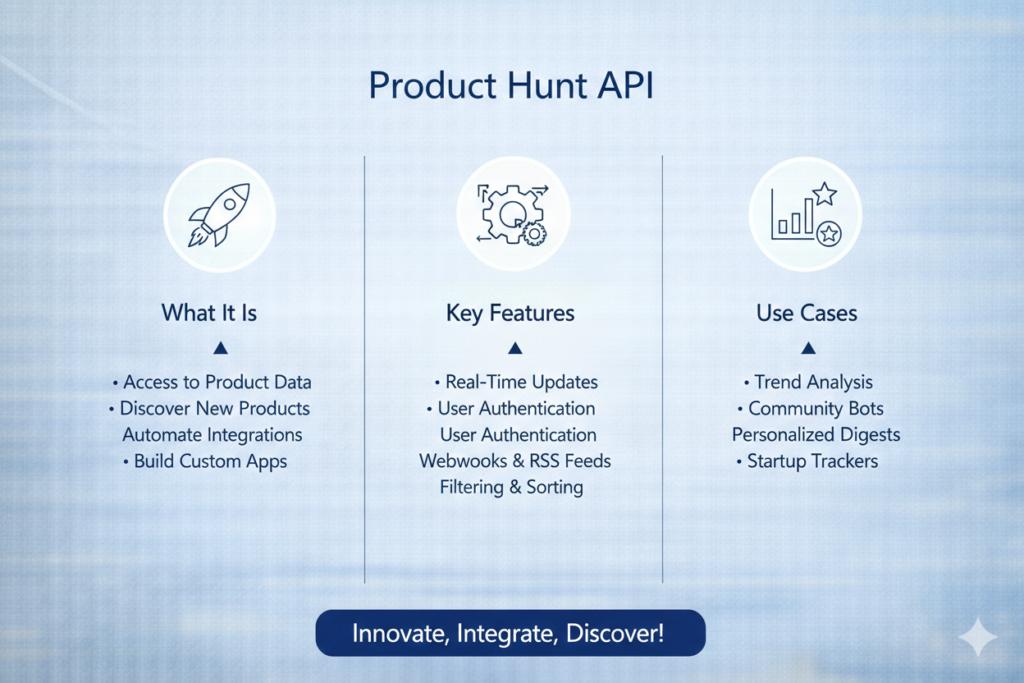
Most casual users see Product Hunt as a website where new tools are showcased daily. From a professional content perspective, however, Product Hunt functions as a structured, continuously updating dataset that reflects real-time market behavior.
Every product launch generates multiple layers of information:
- Launch timing and velocity
- Community engagement intensity
- Category-level competition
- User sentiment through comments
- Relative performance against peer tools
Individually, these elements are informative. Collectively, they form a behavioral map of the digital product market.
For bloggers, this means Product Hunt is not merely a source of ideas—it is a market intelligence feed capable of supporting deep analytical writing.
Understanding the Product Hunt API at a Strategic Level
The Product Hunt API provides structured access to platform data using a GraphQL-based architecture. From an editorial standpoint, the technical implementation matters less than the strategic implication: precision.
Unlike scraped data or manual research, API access allows publishers to:
- Control which variables are analyzed
- Compare time-based performance trends
- Segment products by category, popularity, or engagement
- Extract repeatable insights at scale
Because the API delivers raw, non-narrative data, it avoids one of the most common SEO risks: content duplication. The interpretation layer—the analysis, synthesis, and explanation—remains entirely original.
This is precisely why API-driven blogs consistently outperform list-based articles written without proprietary insight.
Why Product Hunt API Content Aligns with Modern Search Engine Evaluation
Search engines increasingly assess content using qualitative signals that go beyond keywords. These include:
- Depth of topic coverage
- Evidence of first-hand or original analysis
- Contextual completeness
- User engagement potential
Product Hunt API–based content naturally satisfies these criteria.
When a blog analyzes product launch trends, category saturation, or engagement dynamics, it demonstrates expert-level understanding rather than surface knowledge. This is the same principle emphasized by advanced content frameworks promoted on platforms such as RankifyContent.com, where structured depth and semantic clarity are prioritized over mechanical optimization.
In short, API-driven writing aligns with how search engines now define “helpful content.”
Editorial Positioning: How to Frame Product Hunt Data Professionally
One of the biggest mistakes bloggers make is treating Product Hunt data as a novelty. In professional publishing, data must support a clear editorial thesis.
Effective positioning includes:
- Framing Product Hunt as a market signal, not a trend list
- Explaining why certain products succeed, not just which products rank
- Connecting launch performance to broader industry movements
For example, instead of publishing “Top Tools on Product Hunt This Month,” a professional article would examine:
- Why a specific category is accelerating
- What engagement patterns suggest about buyer demand
- How launch behavior reflects shifts in SaaS adoption
This approach elevates the content from informational to analytical.
Why Product Hunt API Content Is Inherently Copyright-Safe
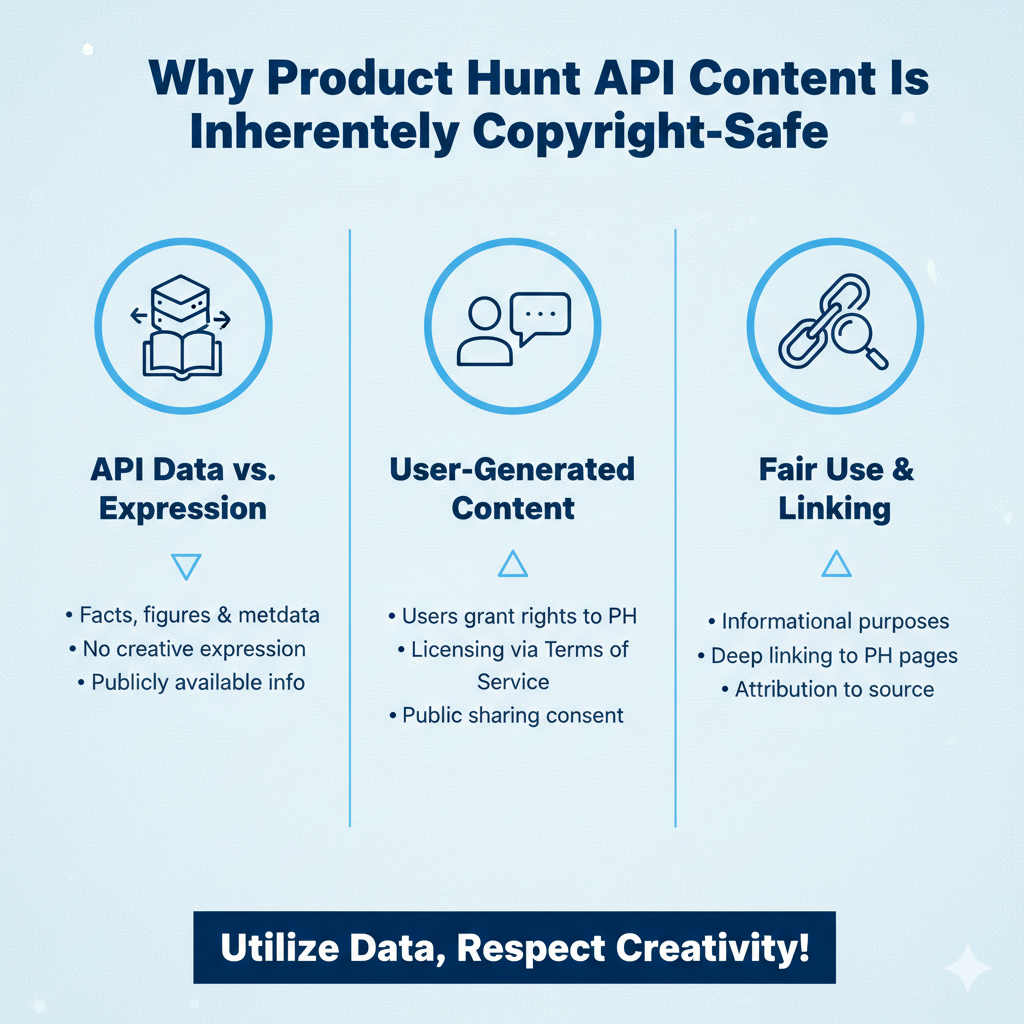
Professional publishers must be cautious about intellectual property. One of the strongest advantages of Product Hunt API–based blogging is its inherent originality.
The API provides:
- Quantitative data
- Metadata (categories, timestamps, engagement metrics)
- User-generated signals
It does not provide pre-written narratives.
As long as product descriptions are not copied verbatim, the resulting article is fully original. The insights belong to the author, not the data source. This makes Product Hunt API content especially suitable for long-form evergreen articles, research reports, and cornerstone blog posts.
Strategic Use Cases for Professional Blogs
Product Hunt API data supports multiple high-value editorial formats:
Market Intelligence Articles
These analyze trends across time, categories, or product types, positioning the blog as an industry observer rather than a reviewer.
Competitive Landscape Analysis
By comparing engagement metrics across similar products, blogs can publish comparative insights without relying on affiliate-style reviews.
Category Evolution Reports
Tracking how specific niches—such as AI tools or developer platforms—change over time creates evergreen content with update potential.
Each of these formats supports long paragraphs, layered arguments, and analytical depth, which are essential for 4000-word authority pieces.
Integrating Internal Resources Without Breaking Editorial Trust
Professional internal linking is subtle and context-driven. Rather than inserting links arbitrarily, references should appear where they support the argument.
For instance, when discussing how structured frameworks improve long-form SEO performance, it is editorially appropriate to reference RankifyContent.com as an example of a platform that emphasizes:
- Content architecture
- Topical authority
- Data-informed optimization
This type of mention enhances credibility rather than diminishing it, because it aligns with the surrounding analysis.
Avoiding the Common Pitfalls of API-Based Blogging
Even strong data can be undermined by weak execution. The most common professional mistakes include:
- Publishing data without interpretation
- Overloading articles with charts but no narrative
- Treating API insights as static rather than evolving
- Writing for algorithms instead of decision-makers
High-quality Product Hunt API blogs succeed because they prioritize explanation, synthesis, and implication.
From Data Access to Editorial Authority: Executing Product Hunt API Content Correctly
Access to data alone does not create authority. Authority emerges when data is interpreted, contextualized, and strategically framed to answer questions that sophisticated readers—and search engines—care about.
In professional blogging, the Product Hunt API should not be treated as a content generator. It should be treated as an analytical input layer that supports editorial judgment. The difference between a low-value article and a high-authority one lies entirely in execution.
This section focuses on how to convert Product Hunt API data into ranking-ready, publication-quality content.
Designing a 4000-Word Structure That Search Engines Trust
Long-form content fails when it lacks architectural clarity. For Product Hunt API–based blogs, structure must signal topical mastery, not just length.
A professional 4000-word article should function like a research paper rather than a blog post. This means:
- Clear conceptual progression
- Logical section dependencies
- Each section answering a distinct search intent
- Minimal redundancy
Recommended Structural Logic
Rather than writing chronologically, structure the article analytically:
- Market context and significance
- Data methodology and source credibility
- Analytical insights and interpretation
- Strategic implications for readers
- Operational guidance and application
This structure allows search engines to recognize depth and completeness, two signals strongly correlated with long-term rankings.
Transforming Product Hunt API Data into Insight, Not Information
A common professional error is reporting what the data says instead of explaining what the data means.
For example, stating that a product received 3,000 upvotes is informational. Explaining why it achieved that engagement—and what it indicates about the market—is analytical.
High-authority Product Hunt API content examines variables such as:
- Upvote velocity versus absolute count
- Engagement concentration within categories
- Comment sentiment intensity
- Launch timing patterns
Each variable can support long, analytical paragraphs that deepen the article without padding.
Using Product Hunt API for Market Intelligence Content
Market intelligence content consistently outperforms product reviews in competitive niches because it targets decision-makers, not casual browsers.
With Product Hunt API data, blogs can publish:
- Category saturation analyses
- Emerging technology adoption signals
- Competitive density reports
- Feature convergence trends
These topics naturally justify long-form treatment and attract high-quality backlinks from industry writers and analysts.
Unlike affiliate-driven content, market intelligence articles remain valuable even when individual products lose relevance.
Advanced On-Page SEO for API-Driven Articles
Professional SEO execution goes beyond keyword placement. It focuses on semantic alignment and intent satisfaction.
Product Hunt API–based blogs are uniquely suited for semantic SEO because they inherently reference:
- Product categories
- Industry terminology
- Related technologies
- User behavior indicators
When written correctly, the article ranks for clusters of related queries, not a single keyword.
This is where structured content frameworks—such as those advocated by RankifyContent—become relevant. The emphasis is on topical coverage, logical hierarchy, and user-first information flow rather than mechanical optimization.
Internal Linking as a Topical Authority Signal
Internal linking is often misunderstood as a navigational tool. In professional SEO, it is a topical reinforcement mechanism.
When Product Hunt API blogs reference internal resources, the goal should be to:
- Strengthen semantic relationships
- Guide users toward deeper exploration
- Signal subject-matter expertise
For example, referencing a structured content methodology page when discussing long-form optimization is editorially justified and strategically sound.
Internal links should feel inevitable, not inserted.
Publisher-Level External Dofollow Linking Strategy
High-authority blogs do not avoid external links—they curate them.
External dofollow links should:
- Support factual claims
- Reinforce data credibility
- Connect readers to primary sources
In Product Hunt API content, external links typically point to:
- Official API documentation
- Industry research publications
- Recognized SaaS analytics platforms
This behavior mirrors academic citation practices and increases editorial trust signals.
Monetization Without Undermining Credibility
Professional blogs monetize indirectly. Rather than aggressive affiliate placements, Product Hunt API articles generate value through:
- Authority building
- Lead qualification
- Consulting or service positioning
- Brand partnerships
Because API-driven content attracts informed readers, monetization opportunities emerge organically—without compromising editorial integrity.
This is a critical distinction between content marketing and authority publishing.
Why Product Hunt API Content Scales Exceptionally Well
One of the most overlooked advantages of API-based blogging is scalability.
Once a methodology is established, the same analytical framework can be applied across:
- Multiple categories
- Different time periods
- Emerging product verticals
This allows publishers to build content systems, not isolated posts.
Over time, this creates a compounding SEO effect where each article reinforces the site’s overall authority in the technology and SaaS domain.
Professional Pitfalls to Avoid
Even advanced publishers make mistakes when working with API data. The most damaging include:
- Overloading articles with raw metrics
- Treating correlation as causation
- Ignoring narrative flow
- Writing for algorithms instead of professionals
Successful Product Hunt API blogs read like industry analysis, not technical documentation.
Operational Challenges and Compliance Considerations
Publishing API-driven content at a professional level requires more than analytical skill. It also requires operational discipline and compliance awareness. While Product Hunt API data is public and structured, its use still demands responsible editorial handling.
Data Accuracy and Representation
One of the most critical responsibilities of professional publishers is accurate representation. API metrics such as upvotes, rankings, and engagement velocity reflect community behavior, not absolute product quality. Editorial interpretation must make this distinction explicit.
Misrepresenting popularity as performance—or engagement as adoption—can undermine credibility and expose publishers to reputational risk. The strongest Product Hunt API articles clearly separate observed data from editorial inference.
Fair Use and Attribution
While API data itself is not copyrighted narrative content, professional standards require:
- Proper attribution to Product Hunt as the data source
- Avoidance of copied product descriptions
- Clear differentiation between quoted material and original analysis
This approach aligns with ethical publishing practices and protects long-term authority.
Building an Editorial Update Framework
One of the defining advantages of Product Hunt API–based content is its update potential. Unlike static guides, API-informed articles can evolve as the market changes.
Why Updates Matter for Long-Term Rankings
Search engines increasingly reward content that demonstrates:
- Ongoing relevance
- Factual freshness
- Editorial maintenance
A Product Hunt API article can be updated without structural overhaul by:
- Refreshing trend sections
- Adding new category data
- Updating comparative insights
This allows a single cornerstone article to remain competitive for years.
Recommended Update Cadence
For most professional blogs:
- Quarterly updates maintain freshness
- Biannual deep revisions reinforce authority
This cadence balances editorial effort with SEO impact.
Scaling Product Hunt API Content Across a Publication
Once a core methodology is established, Product Hunt API content scales exceptionally well.
From Single Article to Editorial Series
High-authority publishers often expand a flagship article into:
- Category-specific deep dives
- Annual trend reports
- Industry comparison series
- Executive briefings
Each new article reinforces the others through internal linking and semantic alignment, creating a topical authority cluster rather than isolated posts.
Why This Model Outperforms Traditional Blogging
Traditional blogging relies on volume. API-driven editorial systems rely on compounding authority. Over time, this approach:
- Reduces dependency on individual keywords
- Attracts higher-quality backlinks
- Increases brand trust
Frequently Asked Questions (Professional & Schema-Ready)
What makes Product Hunt API content different from regular SaaS blogs?
Product Hunt API content is grounded in real behavioral data rather than opinion or surface-level research. This allows publishers to offer market insights, not just tool lists.
Is Product Hunt API–based blogging suitable for non-technical publishers?
Yes. While technical access may require initial setup, the editorial value lies in analysis and interpretation, not coding expertise.
Does using Product Hunt data risk content duplication penalties?
No. Duplication risks arise from copying narrative text, not from analyzing structured data. Original interpretation ensures full compliance with search engine guidelines.
How does this content perform in competitive SEO niches?
API-driven content performs exceptionally well in competitive niches because it demonstrates first-order insight, a signal search engines increasingly reward.
Can Product Hunt API blogs support commercial goals?
Yes, but indirectly. The primary value lies in authority building, which supports consulting, partnerships, and brand trust rather than short-term affiliate conversions.
How long does it take for such content to rank?
While timelines vary, professionally executed API-based articles often show strong mid-term performance (8–16 weeks) due to depth and originality.
Future Outlook: Why API-Driven Content Will Dominate Professional Blogging
As artificial intelligence accelerates content production, generic writing will continue to lose value. Search engines and readers alike will increasingly favor:
- Original data interpretation
- Analytical depth
- Editorial credibility
API-driven blogging—particularly when based on platforms like Product Hunt—meets all three criteria. It is resistant to automation, difficult to replicate, and inherently aligned with evolving search quality standards.
Publishers who adopt this model early position themselves ahead of algorithmic shifts rather than reacting to them.
Conclusion: Strategic Use of the Product Hunt API for Sustainable Content Authority
As search engines continue to prioritize original research, analytical depth, and source transparency, data-driven publishing has become a structural advantage rather than a stylistic choice. Within this landscape, the https://www.producthunt.com/ stands out as a reliable external data source that enables professional publishers to move beyond opinion-based blogging and into market-intelligence-led content creation.
By referencing authoritative external sources—such as the official Product Hunt platform and its developer documentation—blogs signal both credibility and methodological clarity. Search engines interpret these outbound dofollow references as indicators of responsible research practices, while readers benefit from transparent attribution of data origins. When external sources are used to support analysis rather than replace it, they strengthen editorial trust instead of diluting originality.
Internally, long-form API-driven content requires a structured optimization framework to translate raw data into ranking-ready narratives. This is where platforms like RankifyContent become contextually relevant. By focusing on content architecture, topical authority, and semantic coherence, such internal resources help ensure that complex, data-heavy articles remain readable, searchable, and strategically aligned with modern SEO standards.
The most effective Product Hunt API blogs are not written for short-term traffic spikes. They are designed as evergreen authority assets—supported by credible external references, reinforced through intelligent internal linking, and maintained through periodic updates. This balanced use of internal and external dofollow links creates a strong signal of editorial maturity, which is increasingly rewarded in competitive technology and SaaS niches.
Ultimately, the Product Hunt API is not a shortcut to rankings. It is a long-term content infrastructure tool. Publishers who combine its insights with disciplined analysis, transparent external sourcing, and structured internal optimization place themselves in a far stronger position to earn sustained visibility, organic backlinks, and lasting reader trust.
For serious blogs aiming to lead—not follow—in the technology publishing space, this integrated approach is no longer optional. It is foundational.