Table of Contents
Introduction
The rapid expansion of artificial intelligence has transformed nearly every digital domain, from content creation and marketing to software development, healthcare, and business analytics. As the number of AI-powered tools increases exponentially, the primary challenge for users is no longer access to technology, but effective discovery and evaluation.
In this context, Product Hunt AI has emerged as a critical platform for identifying, understanding, and assessing new AI tools at an early stage. Rather than relying on traditional search engines or commercial listings, professionals increasingly turn to Product Hunt AI to observe real-time innovation, community feedback, and early adoption signals.
This blog provides a structured and research-oriented analysis of Product Hunt AI, explaining its purpose, relevance, and growing influence in the global AI ecosystem.
What Is Product Hunt AI?

Product Hunt AI refers to the collective presence and discovery of artificial intelligence–based products launched on Product Hunt.
Product Hunt is a community-driven platform where new digital products are introduced daily and evaluated through:
- User engagement
- Open discussion
- Peer validation
- Founder interaction
As AI technologies became more accessible and scalable, AI tools quickly emerged as the dominant category on Product Hunt. Consequently, the term Product Hunt AI is now widely used to describe the platform’s role as a gateway to emerging AI innovations.
Official platform reference:
👉 https://www.producthunt.com
Why Product Hunt AI Has Gained Strategic Importance
The importance of Product Hunt AI lies in its ability to address a fundamental problem in modern technology markets: signal versus noise.
Unlike commercial directories or sponsored lists, Product Hunt AI offers:
- Transparent community feedback
- Early-stage product visibility
- Direct interaction between users and developers
- Rapid identification of promising innovations
This makes it particularly valuable for researchers, professionals, and organizations seeking evidence-based insights rather than marketing claims.
The Evolution of AI Discovery Platforms
Historically, new software tools were discovered through:
- Search engines
- Technology blogs
- Corporate announcements
However, these channels tend to highlight established products, often after market saturation. Product Hunt AI differs by focusing on early-stage discovery, allowing users to observe innovation as it happens.
This shift reflects a broader change in how digital innovation is evaluated—moving from top-down promotion to community-driven validation.
How Product Hunt AI Functions as a Discovery Ecosystem
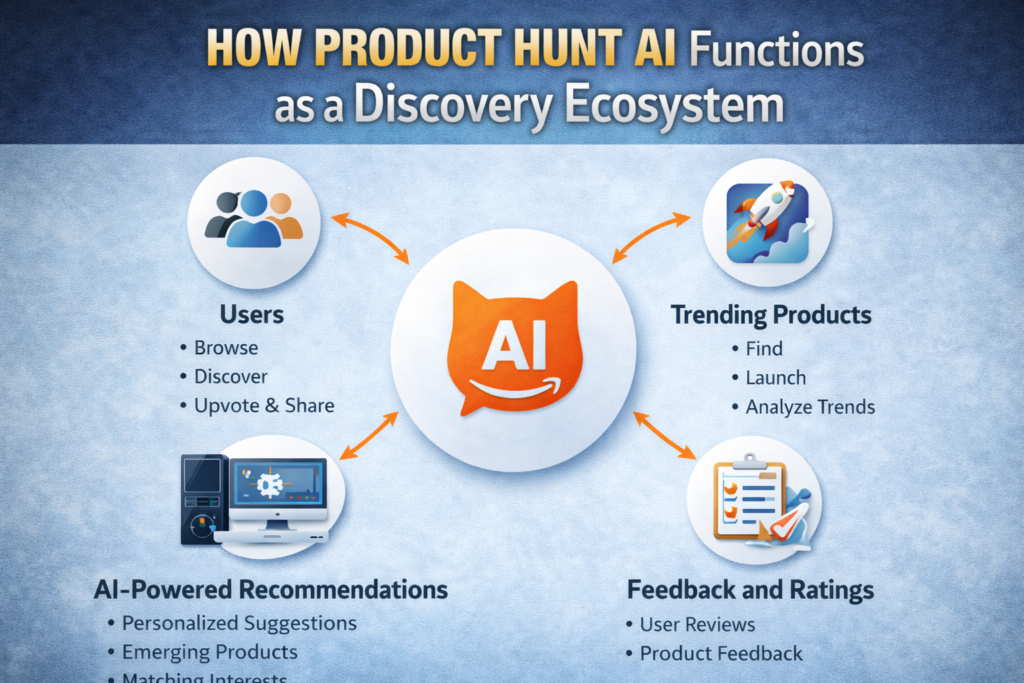
Product Hunt AI operates through a structured yet open mechanism:
Daily Product Launch Cycles
Each day, new products are released and ranked based on:
- User upvotes
- Comment activity
- Engagement quality
AI tools that generate meaningful discussion often gain visibility, regardless of company size.
Community-Based Evaluation
Users provide feedback that highlights:
- Practical use cases
- Technical limitations
- Ethical or privacy concerns
- Feature gaps
This evaluation process creates a living knowledge base around AI tools.
Types of AI Products Commonly Found on Product Hunt AI
Product Hunt AI includes a wide spectrum of AI tools, typically categorized as follows:
1. AI Content and Language Tools
Used for writing, summarization, translation, and SEO-related tasks.
2. AI Design and Creative Systems
Covering image generation, video editing, branding, and visual automation.
3. AI Productivity and Workflow Tools
Focused on task automation, meeting intelligence, scheduling, and efficiency.
4. AI Development and Engineering Tools
Including code generation, testing automation, and no-code platforms.
These categories reflect the applied nature of modern AI, where usability matters more than theoretical capability.
Who Uses Product Hunt AI and Why
Technology Professionals
Developers and engineers use Product Hunt AI to monitor emerging tools that can improve workflows or replace legacy systems.
Business and Marketing Analysts
Marketers track Product Hunt AI to identify automation tools and early trends before competitors.
Students and Researchers
Learners use Product Hunt AI as a practical learning environment to understand real-world AI applications.
Startup Founders
Founders use the platform to validate ideas, assess competition, and refine product-market fit.
Product Hunt AI as a Trend Indicator
One of the most valuable aspects of Product Hunt AI is its ability to function as a trend indicator.
AI innovations such as:
- AI copilots
- No-code AI platforms
- AI-powered search tools
often appear on Product Hunt months before mainstream adoption.
For broader conceptual understanding of AI’s growth, see:
👉 https://www.ibm.com/topics/artificial-intelligence
Reliability and Trust in Product Hunt AI
Trust is central to the credibility of Product Hunt AI. Unlike paid listings, the platform emphasizes:
- Open criticism
- Transparent discussion
- Public feature requests
This openness allows users to distinguish between experimental projects and serious, scalable AI tools.
The Role of Content Analysis and SEO Research
From a research and publishing perspective, Product Hunt AI also serves as a valuable source for content intelligence. Early analysis of AI tools allows publishers and analysts to create authoritative content before markets become saturated.
SEO research platforms such as https://rankifycontent.com help evaluate how early-stage technology topics gain long-term search visibility when supported by in-depth, informational writing.
Limitations of Product Hunt AI
Despite its strengths, Product Hunt AI has limitations:
- Early-stage tools may lack stability
- Popularity does not always equal quality
- Some innovations fail after launch
Therefore, Product Hunt AI should be used as a research starting point, not a final decision-making tool.
Why Systematic Evaluation of AI Tools Is Necessary
Artificial intelligence products often appear impressive at first glance due to polished interfaces or marketing language. However, early-stage AI tools may suffer from:
- Limited reliability
- Incomplete datasets
- Weak security practices
- Poor long-term support
Therefore, professionals using Product Hunt AI must go beyond surface-level popularity and apply evidence-based evaluation criteria.
A Structured Framework for Evaluating Product Hunt AI Tools
1. Problem Definition and Relevance
The first evaluation step is understanding what problem the AI tool addresses.
Key questions include:
- Is the problem clearly defined?
- Is it a real-world, recurring issue?
- Does the solution meaningfully reduce effort, cost, or error?
AI tools that address vague or artificially constructed problems often struggle with adoption.
2. Model Capability and Functional Depth
Not all AI tools demonstrate genuine intelligence. Some rely heavily on automation rules rather than adaptive learning.
When evaluating Product Hunt AI tools, consider:
- Does the tool rely on established AI models or proprietary systems?
- Are outputs consistent and explainable?
- Can performance be measured objectively?
Understanding these aspects is essential, especially in professional or organizational environments.
3. Usability and Learning Curve
An AI tool’s value is directly linked to its usability. Even advanced systems fail if they require excessive technical expertise.
Indicators of strong usability include:
- Clear onboarding processes
- Accessible documentation
- Intuitive user interfaces
- Minimal setup complexity
Tools that simplify workflows are more likely to achieve sustained adoption.
4. Transparency, Ethics, and Data Responsibility
Ethical concerns surrounding AI are becoming increasingly important. Product Hunt AI discussions often include questions about:
- Data collection practices
- User privacy
- Bias mitigation
- Training data transparency
For conceptual grounding on responsible AI practices, see:
👉 https://www.ibm.com/topics/artificial-intelligence
AI tools that address these concerns openly tend to build stronger trust.
5. Pricing Structure and Economic Sustainability
Early-stage AI tools frequently adopt freemium or trial-based pricing. While this lowers entry barriers, long-term sustainability must be assessed.
Evaluation criteria include:
- Pricing clarity
- Scalability of cost
- Value relative to alternatives
Unclear pricing models can indicate future instability.
Using Product Hunt AI for Professional and Organizational Contexts
Product Hunt AI for Business Decision-Makers
Managers and consultants increasingly use Product Hunt AI as an early warning system for technological disruption.
Applications include:
- Identifying tools that may replace legacy software
- Monitoring competitor innovation
- Assessing automation opportunities
In this context, Product Hunt AI functions as a strategic intelligence source.
Product Hunt AI for Marketers and Content Analysts
Marketing professionals use Product Hunt AI to identify:
- AI-driven content and SEO tools
- Automation platforms for campaign optimization
- Analytics and customer insight systems
Publishing research-based content early around emerging AI tools often leads to strong organic performance. SEO research platforms such as https://rankifycontent.com support this process by analyzing keyword evolution and topic authority over time.
Product Hunt AI for Researchers and Academics
Researchers benefit from Product Hunt AI by observing:
- Practical implementations of theoretical AI concepts
- Market response to innovation
- Real-world limitations of AI systems
This makes Product Hunt AI a useful supplement to academic literature.
Product Hunt AI as a Competitive Intelligence Tool
Beyond discovery and evaluation, Product Hunt AI can be used to:
- Track emerging competitors
- Identify feature convergence across tools
- Observe shifts in AI application focus
For example, increased launches in AI productivity tools may signal changing workplace demands.
Distinguishing Long-Term AI Solutions from Short-Term Experiments
Not all Product Hunt AI launches are designed for longevity.
Indicators of Long-Term Potential
- Active founder engagement
- Transparent development roadmaps
- Regular updates and iterations
- Constructive user feedback loops
Indicators of Short-Term Experimentation
- Overreliance on buzzwords
- Lack of documentation
- Minimal founder interaction
- Rapid decline in engagement
Applying these distinctions helps avoid premature adoption risks.
The Importance of Community Interaction in Evaluation
The comment and discussion sections on Product Hunt AI provide insight not available through formal documentation. They reveal:
- Unexpected use cases
- Performance limitations
- User-driven improvement ideas
This peer-driven evaluation process is a defining strength of Product Hunt AI.
Official platform reference:
👉 https://www.producthunt.com
Limitations of Product Hunt AI as an Evaluation Tool
Despite its advantages, Product Hunt AI has inherent limitations:
- Popularity does not guarantee quality
- Early-stage tools may lack robustness
- Community bias can influence rankings
Therefore, Product Hunt AI should complement—not replace—technical testing and due diligence.
Product Hunt AI as a Trend-Forecasting Mechanism
One of the most underappreciated aspects of Product Hunt AI is its role as an early indicator of technological direction. Unlike academic journals or corporate reports—which often reflect mature developments—Product Hunt AI captures innovation at the point of emergence.
How Trend Signals Appear on Product Hunt AI
Trends typically manifest through:
- Repeated launches within the same AI category
- Similar problem statements addressed by different tools
- Rapid engagement growth across related products
- Shifts in discussion topics within comments
For example, the rise of AI copilots, no-code AI platforms, and AI-powered search tools was visible on Product Hunt months before these concepts entered mainstream discourse.
Official platform reference:
👉 https://www.producthunt.com
Comparative Advantage Over Traditional Forecasting Sources
Traditional forecasting methods rely on:
- Industry reports
- Market surveys
- Historical data
While valuable, these approaches often lag behind innovation. Product Hunt AI complements them by offering real-time qualitative data derived from user interaction and developer experimentation.
This makes Product Hunt AI particularly useful for:
- Technology strategists
- Innovation managers
- Policy analysts
- Academic researchers
Implications for Organizations and Institutions
Strategic Planning and Technology Adoption
Organizations increasingly face pressure to adopt AI responsibly and efficiently. Product Hunt AI allows decision-makers to:
- Monitor emerging solutions without immediate commitment
- Compare multiple approaches to the same problem
- Identify tools aligned with organizational needs
Used correctly, it reduces the risk of premature or misaligned technology adoption.
Implications for Education and Research
Educational institutions and researchers can use Product Hunt AI to:
- Observe applied AI use cases
- Bridge the gap between theory and practice
- Identify areas where academic research lags behind industry innovation
For conceptual grounding in AI’s societal impact, see:
👉 https://www.ibm.com/topics/artificial-intelligence
Product Hunt AI and the Democratization of Innovation
Another significant implication of Product Hunt AI is its contribution to democratizing innovation. Smaller teams and independent developers gain visibility alongside well-funded organizations, enabling a more diverse innovation landscape.
This democratization results in:
- Increased experimentation
- Greater diversity of AI applications
- Faster feedback cycles
As a result, Product Hunt AI supports a more inclusive AI ecosystem.
Limitations of Product Hunt AI in Long-Term Forecasting
Despite its strengths, Product Hunt AI should not be treated as a standalone forecasting tool.
Key limitations include:
- Early-stage volatility of AI startups
- Survivorship bias toward popular launches
- Limited insight into long-term scalability
Therefore, Product Hunt AI should be integrated with technical audits, market analysis, and ethical review frameworks.
Frequently Asked Questions (FAQs)
Is Product Hunt AI reliable for identifying high-quality AI tools?
Product Hunt AI is reliable for early discovery and community validation, but tools should undergo further technical and ethical evaluation before adoption.
Can Product Hunt AI replace traditional AI research methods?
No. Product Hunt AI complements traditional research by offering early-stage insights, not validated long-term evidence.
Who benefits most from using Product Hunt AI?
Professionals, founders, researchers, marketers, and students who seek early awareness of AI innovation benefit the most.
How often should Product Hunt AI be monitored?
Weekly monitoring is sufficient for general research, while daily monitoring is beneficial for founders and innovation teams.
Does popularity on Product Hunt guarantee success?
No. Popularity reflects early interest, not long-term viability.
Ethical and Societal Considerations
As AI tools proliferate, ethical considerations are becoming central to evaluation. Product Hunt AI discussions increasingly reflect concerns about:
- Data privacy
- Algorithmic bias
- Transparency
- Responsible deployment
These discussions indicate growing maturity within the AI community and highlight the need for ethical literacy alongside technical proficiency.
The Future of AI Discovery Platforms
Looking ahead, AI discovery platforms like Product Hunt AI are likely to:
- Incorporate AI-assisted personalization
- Improve categorization of tools by use case
- Highlight ethical and compliance standards
- Integrate longitudinal performance tracking
These developments will further enhance their value as research and discovery tools.
The Role of Content Analysis and SEO Research
From a publishing and analytical perspective, Product Hunt AI offers opportunities for early-authority content creation. Research-driven writing around emerging AI tools can achieve sustained visibility when supported by structured SEO analysis.
Platforms such as https://rankifycontent.com assist researchers and publishers in identifying early-stage topics, understanding keyword evolution, and building long-term topical authority through informational content.
Final Synthesis and Conclusion
Product Hunt AI represents a significant shift in how artificial intelligence tools are discovered, evaluated, and understood. Rather than functioning merely as a launch platform, it operates as a living research environment—capturing innovation at its earliest stages and exposing it to community scrutiny.
When used systematically and critically, Product Hunt AI enables:
- Early detection of technological trends
- Evidence-based evaluation of AI tools
- Strategic insight for organizations and researchers
- Enhanced understanding of applied AI innovation
However, its true value emerges only when combined with structured evaluation frameworks, ethical awareness, and complementary research methods.
In an era defined by rapid AI expansion, Product Hunt AI stands as a valuable—but not solitary—instrument for navigating technological change with clarity, rigor, and foresight.