Table of Contents
Introduction
The ecommerce industry has evolved rapidly, and modern consumers now prefer simplicity, clarity, and trust when shopping online. In this changing landscape, the one product ecommerce store has emerged as a highly effective business model. Instead of overwhelming customers with dozens or hundreds of products, this approach focuses entirely on selling a single product through a dedicated online store.
A one product ecommerce store allows entrepreneurs to concentrate all their efforts on one offer—perfecting messaging, branding, user experience, and marketing. This focused strategy often results in higher conversion rates, lower operational complexity, and faster scalability, especially for beginners and solo founders.
What Is a One Product Ecommerce Store?
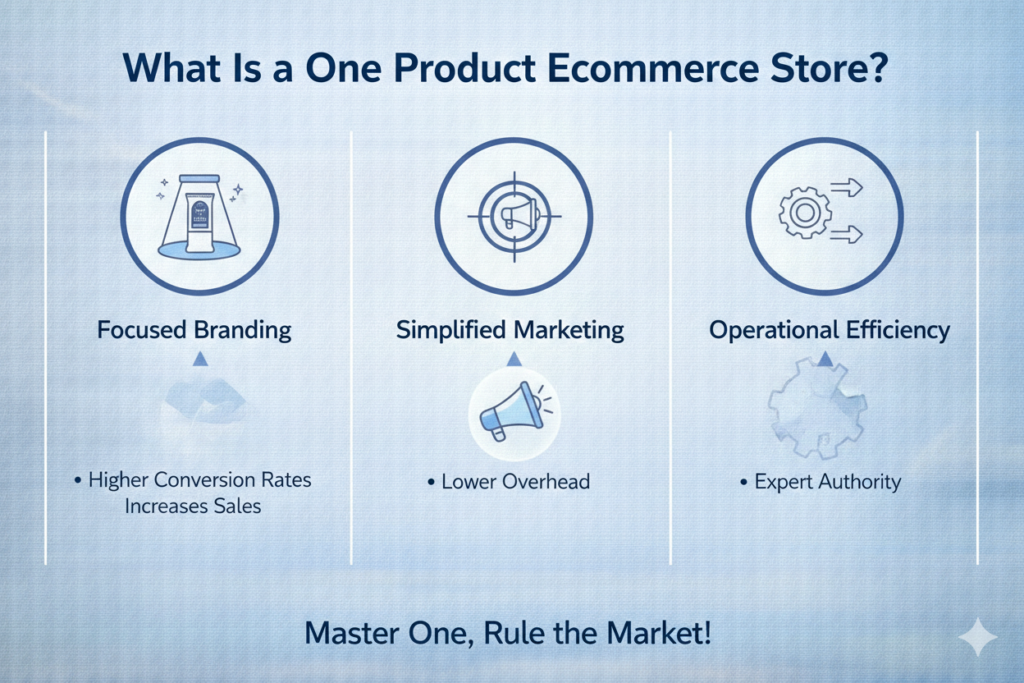
A one product ecommerce store is an online store designed to sell only one main product, sometimes with slight variations such as color, size, or bundles. Unlike general ecommerce stores, every page, section, and design element supports a single conversion goal: selling that one product.
This model transforms a product page into a complete sales experience. Instead of navigating through categories, customers move through a carefully crafted story that explains the problem, presents the solution, builds trust, and encourages purchase. When executed correctly, a one product store feels more like a branded landing page than a traditional ecommerce website.
Why One Product Ecommerce Stores Are Gaining Popularity
One product ecommerce stores are gaining popularity because they align perfectly with modern buying behavior. Customers today want quick answers and clear solutions. Too many choices create confusion and decision fatigue, which leads to abandoned sessions. A one product store eliminates this friction by presenting a single, focused offer.
From the seller’s perspective, this model reduces complexity. Inventory management, customer support, product updates, and marketing campaigns all revolve around one product. This makes it easier to test ideas, optimize performance, and scale winning campaigns without spreading resources too thin.
How One Product Ecommerce Stores Improve Conversion Rates
One of the biggest advantages of a one product ecommerce store is its ability to convert visitors into customers more effectively. Since the entire website is optimized around one product, the user journey is clear and distraction-free. Customers are guided step-by-step toward the checkout without unnecessary links or options.
Long-form product pages work exceptionally well in this model. Businesses can include detailed explanations, benefits, comparisons, testimonials, FAQs, guarantees, and strong calls to action—all on one page. This storytelling approach builds trust and answers objections before customers even ask them.
One Product Ecommerce Store vs Multi-Product Store
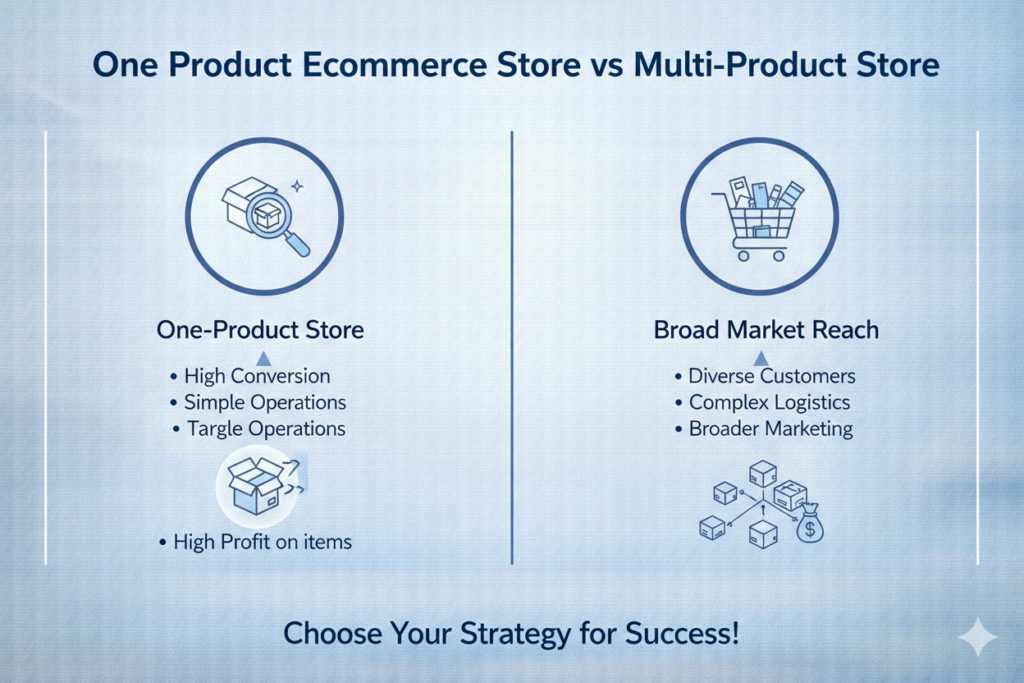
Multi-product ecommerce stores offer variety, but they also introduce complexity. They require category management, product comparisons, broad marketing strategies, and complex navigation. This often leads to diluted branding and lower conversion rates, especially for new stores.
In contrast, a one product ecommerce store focuses on clarity over variety. The brand message is sharper, marketing is more targeted, and optimization is easier. While multi-product stores may be suitable for established brands, one product stores are ideal for testing markets, launching new ideas, or building a strong brand around a flagship product.
Best Types of Products for a One Product Ecommerce Store
Not all products are suitable for a one product ecommerce store. The best products usually solve a clear problem, offer a visible transformation, or provide strong emotional appeal. Products that are innovative, trending, or difficult to find locally often perform well.
Examples include beauty tools, fitness accessories, home improvement gadgets, wellness products, and lifestyle solutions. Products with clear before-and-after benefits or strong use cases are easier to market through ads and content. Proper product research is essential before committing to this model.
Branding Strategy for a One Product Ecommerce Store
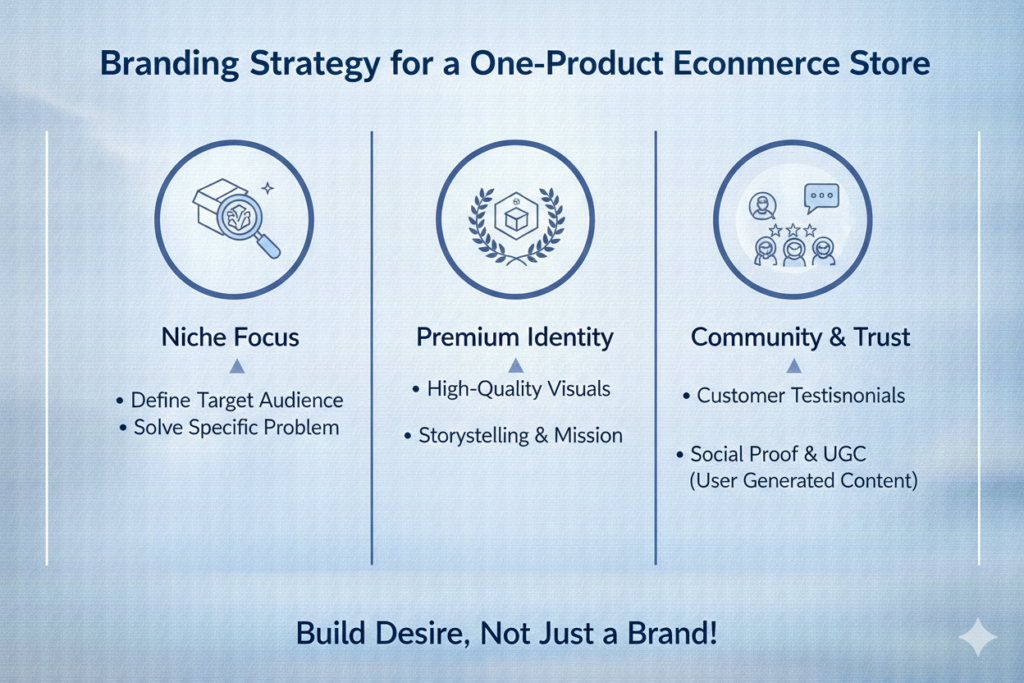
Branding is one of the most important success factors in a one product ecommerce store. Since there is only one product, the brand must create trust and authority quickly. A strong brand helps differentiate the product from competitors selling similar items.
Elements such as brand name, logo, color palette, tone of voice, and storytelling should resonate with the target audience. Successful one product stores often feel like premium, specialized brands rather than generic ecommerce websites, allowing them to command better pricing and loyalty.
Website Design and User Experience
Design plays a critical role in a one product ecommerce store. The layout should be clean, modern, and conversion-focused. Visual hierarchy, spacing, and mobile responsiveness are especially important since a large portion of traffic comes from mobile devices.
A well-designed one product store guides users naturally through the page—from headline to benefits, proof, and checkout. Poor design, slow loading speed, or cluttered layouts can break trust and reduce conversions, even if the product itself is strong.
Marketing Focus in One Product Ecommerce Stores
Marketing becomes more efficient in a one product ecommerce store because all campaigns promote the same offer. Paid ads, social media content, email flows, and influencer collaborations all reinforce the same message, improving consistency and brand recall.
Testing and optimization are also easier. Store owners can quickly identify what works, refine messaging, and scale successful campaigns. This focused approach often leads to better ad performance and lower customer acquisition costs.
Common Mistakes to Avoid
Despite its simplicity, many one product ecommerce stores fail due to common mistakes. Choosing a low-demand or highly saturated product is one of the biggest errors. Weak product presentation, poor branding, and lack of trust signals also hurt performance.
Another mistake is relying only on ads without optimizing the product page. Successful one product ecommerce stores continuously improve design, messaging, and user experience based on data and customer feedback.
How to Choose the Right Product for a One Product Ecommerce Store
The success of a one product ecommerce store depends heavily on product selection. Since your entire business revolves around one product, choosing the wrong item can limit growth from the start. A winning product usually solves a clear problem, offers visible or emotional benefits, and has proven demand in the market.
Strong one product ecommerce store products often fall into categories such as problem-solving gadgets, beauty and wellness tools, fitness accessories, or lifestyle improvements. Products that demonstrate transformation—before and after results—are easier to market and explain through ads and content. Market research, competitor analysis, and customer feedback are essential before committing to a product.
Product Validation Before Launch
Product validation is a critical step many beginners skip. Before fully building a one product ecommerce store, it’s important to validate demand. This can be done by testing ads, analyzing search trends, studying competitor sales, and reviewing customer pain points.
Validation reduces risk and ensures you’re not relying on assumptions. Even a simple landing page test or small ad budget can reveal whether people are interested enough to click, engage, and potentially buy. A validated product dramatically increases the chances of long-term success.
Store Design Strategy for One Product Ecommerce Stores
Design plays a powerful role in the effectiveness of a one product ecommerce store. Since visitors have only one buying option, the design must guide them smoothly toward conversion. Clean layouts, strong visual hierarchy, and distraction-free navigation are essential.
Successful one product stores often use a long-form, scroll-based design rather than traditional category navigation. Each section of the page builds on the previous one—introducing the problem, presenting the solution, showing benefits, adding proof, and closing with a call to action. This structure mimics a sales funnel and significantly boosts conversions.
Optimizing the Product Page for Maximum Conversions
The product page is the heart of a one product ecommerce store. It must act as a complete sales presentation. High-quality images, demonstration videos, benefit-focused headlines, and persuasive copy all work together to convince visitors.
Social proof such as reviews, testimonials, and user-generated content is especially important. Since customers cannot compare multiple products, trust becomes the deciding factor. Clear guarantees, return policies, and secure checkout indicators further reduce hesitation and increase purchase confidence.
Pricing Strategy for One Product Ecommerce Stores
Pricing in a one product ecommerce store requires balance. The price must reflect value while remaining competitive. Underpricing can damage perceived quality, while overpricing without strong branding can reduce conversions.
Many successful one product stores use value-based pricing—highlighting benefits, outcomes, and exclusivity rather than cost alone. Bundles, limited-time offers, and quantity discounts can increase average order value without overwhelming customers with multiple product choices.
Marketing Channels for One Product Ecommerce Stores
Marketing a one product ecommerce store is more focused than traditional ecommerce. Paid advertising on platforms like social media works particularly well because messaging is consistent and easy to optimize. One strong ad concept can be tested and scaled rapidly.
Content marketing also plays an important role. Short videos, demonstrations, influencer collaborations, and testimonials create credibility and demand. Email marketing supports remarketing, abandoned cart recovery, and customer retention even in a single-product setup.
Dropshipping vs Private Label for One Product Stores
One product ecommerce stores can operate using different sourcing models. Dropshipping is often used by beginners due to low upfront costs and fast setup. However, it limits control over quality, packaging, and delivery times.
Private labeling offers more control and stronger branding. With private labeling, businesses can customize packaging, improve product quality, and build a unique brand identity. For long-term growth, many successful one product ecommerce stores eventually move from dropshipping to private label sourcing.
Customer Experience and Support
Customer experience is especially important in a one product ecommerce store because the entire brand reputation depends on one product. Fast responses, clear communication, and transparent policies build trust and reduce refund requests.
Providing detailed FAQs, usage guides, and post-purchase support improves satisfaction and encourages repeat purchases. A strong customer experience turns a one-time buyer into a brand advocate.
Common Challenges in One Product Ecommerce Stores
Despite its simplicity, the one product ecommerce store model has challenges. Market saturation, copycat competitors, and ad fatigue can limit growth if not addressed strategically. Continuous optimization and differentiation are necessary.
Another challenge is over-dependence on a single traffic source. Successful one product stores diversify marketing channels and focus on brand-building to protect long-term performance.
Scaling a One Product Ecommerce Store
Scaling a one product ecommerce store requires a strategic shift from testing to optimization and expansion. Once the product is validated and conversions are consistent, the focus moves toward increasing traffic, improving efficiency, and maximizing customer lifetime value. Scaling is not just about spending more on ads—it involves strengthening the entire business system.
Successful scaling includes improving website speed, refining product messaging, and optimizing checkout flows. Backend operations such as supplier reliability, inventory planning, and shipping timelines must also be ready to handle increased demand. Many one product ecommerce stores fail at scale because operational systems are not prepared for growth.
Advanced Marketing Strategies for Scaling
As a one product ecommerce store grows, marketing strategies must evolve. Initially, paid ads may drive most sales, but long-term growth requires diversification. Expanding into content marketing, email sequences, influencer partnerships, and retargeting campaigns builds stability and reduces dependency on a single channel.
Retargeting plays a crucial role in scaling. Since customers may need multiple touchpoints before buying, remarketing ads and email follow-ups increase conversions without increasing traffic costs. Strong creatives, fresh angles, and continuous testing help prevent ad fatigue and maintain performance.
Branding and Trust Building for Long-Term Growth
Branding is the biggest differentiator in a competitive one product ecommerce store market. Many stores sell similar products, but only a few succeed long-term because they invest in trust and brand identity. A strong brand creates emotional connection and justifies pricing beyond basic functionality.
Trust signals such as customer reviews, testimonials, real images, video demonstrations, guarantees, and transparent policies are essential. Over time, branding transforms a one product ecommerce store from a “product seller” into a recognized brand, opening opportunities for repeat sales and expansion.
Customer Retention in a One Product Ecommerce Store
Retention is often overlooked in one product ecommerce stores, but it is critical for profitability. Even with one product, businesses can encourage repeat purchases through bundles, refills, accessories, or limited editions. Email marketing and post-purchase education keep customers engaged.
Providing excellent post-purchase experience—clear usage instructions, follow-up emails, and responsive support—builds loyalty. Satisfied customers often become repeat buyers or brand advocates, reducing reliance on paid advertising.
When and How to Expand Beyond One Product
While the one product ecommerce store model focuses on a single product, expansion becomes a natural step for successful brands. Expansion does not mean abandoning the model; instead, it involves adding complementary products that enhance the original offer.
For example, accessories, upgrades, or bundles related to the main product can increase average order value without complicating the store. The key is to maintain focus and avoid turning the store into a generic multi-product shop too quickly.
Common Mistakes That Cause One Product Ecommerce Stores to Fail
Many one product ecommerce stores fail due to avoidable mistakes. One major issue is relying entirely on paid ads without building brand trust or organic traffic. Another mistake is ignoring customer feedback and failing to improve the product or presentation.
Poor supplier reliability, slow shipping, weak customer support, and lack of differentiation also lead to failure. Successful store owners treat their business as a brand, not a short-term trend.
Legal, Policy, and Compliance Considerations
As the business scales, compliance becomes more important. Clear privacy policies, refund terms, and product disclaimers protect the business from disputes. Payment processor and platform policies must also be followed to avoid account restrictions.
Ensuring compliance builds credibility and protects long-term operations, especially as sales volume increases.
Future of One Product Ecommerce Stores
The future of one product ecommerce stores lies in branding, personalization, and community-building. Consumers are becoming more selective, favoring brands that provide value, authenticity, and trust rather than generic products.
AI-driven personalization, video commerce, and social proof will play larger roles. One product ecommerce stores that adapt to these trends will continue to thrive even in competitive markets.
Frequently Asked Questions (FAQs)
What is a one product ecommerce store?
A one product ecommerce store is an online store that focuses on selling a single core product, sometimes with minor variations such as color, size, or bundles. The entire website, branding, and marketing strategy are designed around that one product to maximize conversions and clarity.
Is a one product ecommerce store profitable?
Yes, a one product ecommerce store can be highly profitable when the right product is selected and marketed properly. Focused branding, clear messaging, and optimized conversion paths often lead to higher profit margins compared to multi-product stores.
How do I choose the best product for a one product ecommerce store?
The best products solve a clear problem, have strong demand, and offer visible or emotional benefits. Successful products are often innovative, trending, or difficult to find locally. Proper market research and product validation are essential before launching.
Can beginners start a one product ecommerce store?
Yes, the one product ecommerce store model is beginner-friendly because it reduces complexity. New entrepreneurs can focus on one product, one audience, and one marketing message, making it easier to test and optimize without large budgets.
Is dropshipping suitable for a one product ecommerce store?
Dropshipping is suitable for starting a one product ecommerce store due to low upfront costs and fast setup. However, for long-term success and better branding, many store owners later switch to private labeling or bulk sourcing.
How do I market a one product ecommerce store?
Marketing typically involves paid ads, social media content, influencer collaborations, and email marketing. Since there is only one product, messaging stays consistent, making campaigns easier to optimize and scale.
How important is branding in a one product ecommerce store?
Branding is extremely important. Strong branding builds trust, differentiates the product from competitors, and allows for better pricing. A well-branded one product store feels like a specialized brand rather than a generic online shop.
Can I add more products later to a one product ecommerce store?
Yes, once the store is successful, you can add complementary or related products. The key is to expand carefully and maintain focus, rather than turning the store into a general multi-product shop too quickly.
What are the biggest mistakes to avoid in one product ecommerce stores?
Common mistakes include choosing a low-demand product, weak product presentation, poor supplier quality, slow shipping, and relying only on paid ads without building trust or brand value.
What is the future of one product ecommerce stores?
The future lies in branding, personalization, video content, and community-driven marketing. One product ecommerce stores that focus on trust, authenticity, and customer experience will continue to succeed in competitive markets.
Conclusion
A one product ecommerce store is one of the most focused and effective ecommerce business models available today. By centering your entire store, brand message, and marketing strategy around a single product, you eliminate distractions, reduce operational complexity, and create a clear buying journey for customers. This clarity is one of the main reasons why one product stores often achieve higher conversion rates than traditional multi-product ecommerce websites.
As explained throughout this guide, success with a one product ecommerce store depends on several key factors: selecting the right product, validating demand, building strong branding, optimizing the product page, and implementing scalable marketing strategies. Entrepreneurs who rely only on ads without investing in trust, storytelling, and customer experience often struggle to sustain growth. In contrast, stores that focus on long-term brand value build loyal audiences and stable revenue streams.
Industry leaders also support this focused approach. According to Shopify’s ecommerce insights, niche and focused stores often outperform general stores because they deliver clearer value propositions and stronger brand identity (external dofollow link: https://www.shopify.com/blog/one-product-store). Similarly, BigCommerce highlights that simplified product offerings reduce decision fatigue and improve conversion performance in online stores (external dofollow link: https://www.bigcommerce.com/articles/ecommerce/single-product-store/).
From a growth perspective, a one product ecommerce store can also serve as a foundation for a larger brand. Once the core product succeeds, businesses can expand carefully by adding complementary products, bundles, or accessories—without losing focus. Many successful ecommerce brands started with a single hero product and scaled strategically over time.
For deeper guidance on ecommerce growth strategies, product sourcing, and store optimization techniques, you can explore our detailed ecommerce resources and step-by-step guides here (internal dofollow link example: https://rankifycontent.com/ecommerce-growth-strategies). Integrating product selection, branding, sourcing, and marketing creates a complete system rather than a short-term store.
In conclusion, a one product ecommerce store is not just a trend—it is a proven business model that rewards focus, clarity, and execution. When built with the right product, strong branding, and customer-first mindset, it can scale into a profitable and sustainable ecommerce business in today’s competitive digital marketplace.