Table of Contents
Introduction
Selling on Amazon remains one of the most attractive online business opportunities, but success depends heavily on choosing the right products. With millions of sellers competing on the platform, understanding the most profitable Amazon products is essential for building a sustainable and scalable business. Profitability on Amazon is not just about high sales volume—it is about strong margins, consistent demand, manageable competition, and efficient operations.
As Amazon continues to evolve, profitable products are increasingly driven by data, customer behavior, and niche demand. Sellers who focus on product research rather than guesswork are far more likely to succeed. This guide explores what makes a product profitable on Amazon and highlights key categories that consistently perform well.
What Makes Amazon Products Profitable?
Before identifying the most profitable Amazon products, it is important to understand what profitability actually means in the Amazon ecosystem. A profitable product typically has steady demand, healthy pricing, low return rates, and reasonable competition. It should also have manageable sourcing costs and acceptable Amazon fees.
Profitability is not defined by selling the cheapest item. In fact, many high-margin products succeed because they solve specific problems, offer convenience, or target niche audiences. Sellers who focus on value rather than price competition often achieve better long-term results.
Why Product Selection Is Critical on Amazon
Amazon is a highly competitive marketplace where product selection determines success or failure. Choosing the wrong product—even with excellent marketing—can result in low margins and high ad costs. On the other hand, selecting one of the most profitable Amazon products gives sellers room to invest in branding, advertising, and scaling.
Product selection affects everything from sourcing and logistics to customer reviews and repeat purchases. This is why experienced sellers spend significant time analyzing trends, customer feedback, and market gaps before launching new products.
High-Margin Amazon Product Categories
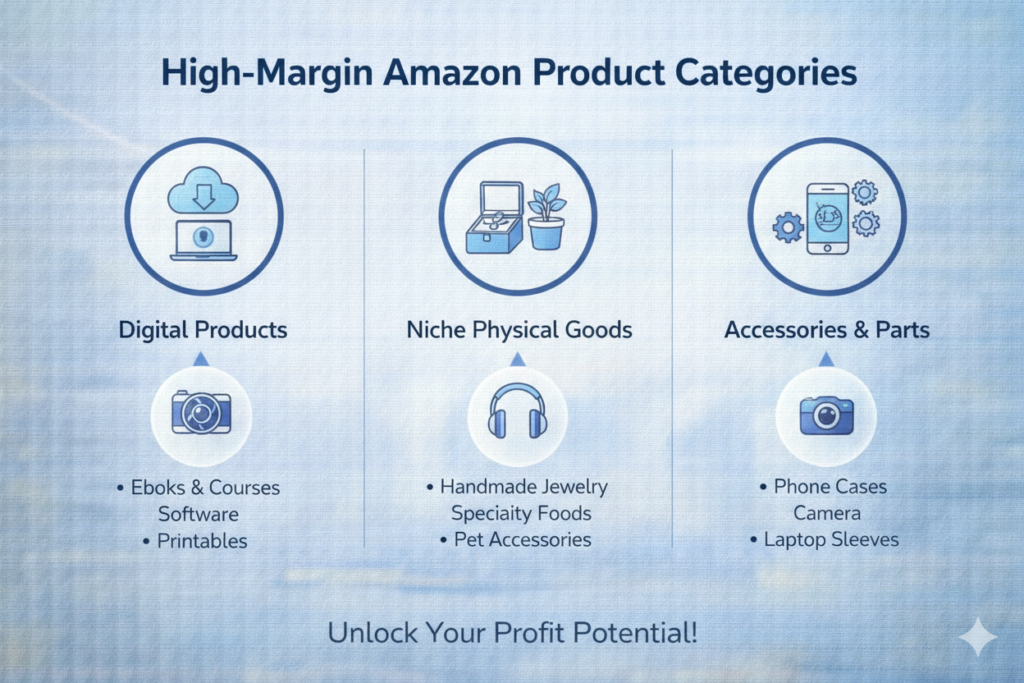
Certain categories consistently contain some of the most profitable Amazon products due to strong demand and pricing flexibility. Health and personal care products often perform well because customers are willing to pay for quality and effectiveness. Home and kitchen items that solve everyday problems also generate steady sales.
Beauty tools, fitness accessories, pet products, and office or productivity items frequently offer strong margins when properly differentiated. These categories allow sellers to add value through branding, packaging, or small improvements that justify premium pricing.
Private Label and Profitability on Amazon
Private labeling is one of the most effective strategies for selling the most profitable Amazon products. By creating your own brand, you avoid direct price competition and gain control over pricing, presentation, and customer experience.
Private label products allow sellers to improve packaging, add bundles, and tell a brand story. This increases perceived value and profit margins. Many of Amazon’s top sellers rely on private labeling rather than reselling generic products.
Evergreen vs Trend-Based Amazon Products
When researching the most profitable Amazon products, sellers must choose between evergreen and trend-based items. Evergreen products have consistent demand year-round, making them more predictable and stable. Examples include household items, fitness basics, and personal care essentials.
Trend-based products can generate rapid profits but carry higher risk. While trends can produce quick sales spikes, they often fade quickly. Long-term sellers typically balance evergreen products with occasional trend opportunities to stabilize income.
Importance of Reviews and Customer Demand

Customer reviews play a major role in determining whether a product can be profitable. Products with strong demand but poor reviews indicate opportunities for improvement. Analyzing reviews helps sellers identify weaknesses in existing products and create better versions.
The most profitable Amazon products often emerge when sellers solve common complaints such as poor durability, confusing instructions, or weak packaging. This customer-driven approach increases the likelihood of positive reviews and repeat purchases.
Pricing Strategy for Profitable Amazon Products
Pricing is a critical factor in profitability. Products priced too low may generate sales but leave little margin after Amazon fees and ads. Products priced too high without clear value struggle to convert.
Successful sellers price their products based on perceived value, competition, and total cost structure. Many of the most profitable Amazon products fall within a mid-price range where customers expect quality but are still comfortable purchasing online.
Common Mistakes When Choosing Amazon Products
Many beginners fail by choosing oversaturated products or competing solely on price. Another common mistake is ignoring Amazon fees, shipping costs, and ad expenses when calculating profitability.
Focusing only on sales volume instead of net profit leads to poor decisions. Sellers who analyze margins, reviews, and long-term demand are far more likely to identify truly profitable products.
Most Profitable Amazon Product Categories (In-Depth)
When analyzing the most profitable Amazon products, patterns consistently appear across specific categories. These categories succeed not just because of high demand, but because they allow sellers to add value, differentiate, and maintain healthy margins. Categories that solve daily problems or improve lifestyle outcomes tend to perform best.
Home & Kitchen remains one of the strongest categories due to constant demand and repeat purchases. Small problem-solving items—such as organizers, cleaning tools, and storage solutions—often have low production costs but strong perceived value. Similarly, Health & Personal Care products perform well because customers prioritize quality and are willing to pay premium prices for trusted solutions.
High-Profit Amazon Products in Health & Personal Care
Health and personal care products consistently rank among the most profitable Amazon products due to recurring demand and emotional buying behavior. Products like posture correctors, massage tools, grooming accessories, and wellness devices often command higher prices while remaining lightweight and easy to ship.
What makes this category especially profitable is the ability to build trust and branding. Sellers who invest in professional packaging, clear instructions, and compliance standards often outperform generic competitors. However, sellers must carefully follow Amazon’s category regulations to avoid listing issues.
Beauty, Skincare & Grooming Products
Beauty and grooming products are among the highest-margin items on Amazon when done correctly. Tools such as facial rollers, hair styling accessories, nail care kits, and grooming devices frequently appear in lists of the most profitable Amazon products.
This category benefits from strong visual marketing and social proof. Customers rely heavily on reviews, before-and-after visuals, and brand credibility. Private labeling allows sellers to stand out by offering better design, improved materials, or bundled value, which directly increases profitability.
Pet Products: A High-Emotion, High-Profit Category
Pet products are another excellent example of the most profitable Amazon products. Pet owners are highly emotionally invested and often willing to spend more on comfort, health, and convenience. Products such as pet grooming tools, toys, feeders, and travel accessories generate strong margins when properly positioned.
The pet niche also benefits from repeat purchases and brand loyalty. Sellers who create reliable, safe, and durable products often build long-term customer relationships, reducing reliance on ads and increasing lifetime value.
Fitness, Wellness & Lifestyle Accessories
Fitness and wellness products remain strong performers due to increasing health awareness worldwide. Resistance bands, yoga accessories, posture aids, and home workout tools are commonly included among the most profitable Amazon products.
These products are often lightweight, durable, and easy to bundle, making them cost-effective to ship and store. Sellers can increase profitability by offering instructional content, digital guides, or bundled accessories that enhance perceived value.
Office, Productivity & Work-From-Home Products
With the rise of remote work, office and productivity items have become increasingly profitable. Ergonomic accessories, desk organizers, laptop stands, and lighting solutions are now considered some of the most profitable Amazon products.
Customers in this category prioritize comfort, efficiency, and design. Sellers who focus on ergonomic benefits, durability, and aesthetics can command premium pricing while maintaining low return rates.
Evergreen vs Trend-Based Profitable Products
Understanding the difference between evergreen and trend-based products is critical when selecting the most profitable Amazon products. Evergreen products maintain steady demand throughout the year, making them ideal for long-term brand building and predictable income.
Trend-based products can generate rapid profits but come with higher risk. These products often require fast sourcing, aggressive marketing, and precise timing. Experienced sellers sometimes mix both strategies, using evergreen products for stability and trends for short-term boosts.
How to Research the Most Profitable Amazon Products
Product research is the backbone of profitability. Sellers should analyze demand, competition, pricing, and customer feedback before launching. Studying bestseller lists, keyword trends, and review patterns helps identify opportunities where demand exists but customer dissatisfaction is high.
The most profitable Amazon products often emerge where sellers improve on existing listings—better quality, clearer instructions, improved packaging, or added features. This approach reduces risk and increases the chance of positive reviews.
Validating Profitability Before Launch
Validation is essential to avoid costly mistakes. Sellers should calculate all costs, including sourcing, shipping, Amazon fees, advertising, and returns. Many products appear profitable at first glance but fail once fees and ads are included.
Testing demand through small ad campaigns or limited inventory runs helps confirm whether a product truly belongs among the most profitable Amazon products. Sellers who validate before scaling protect capital and improve long-term success.
Common Pitfalls in Profitable Product Selection
A frequent mistake is choosing products solely based on sales volume rather than net profit. Another error is entering saturated niches without differentiation. Competing on price alone often leads to shrinking margins and unsustainable businesses.
Successful sellers focus on value creation, branding, and customer satisfaction. This mindset separates consistently profitable sellers from short-lived competitors.
Scaling the Most Profitable Amazon Products
Once a product proves profitable, the next challenge is scaling without destroying margins. Scaling the most profitable Amazon products requires more than increasing inventory or ad spend. Sellers must ensure consistent product quality, reliable suppliers, and optimized logistics to handle higher demand. Poor scaling decisions often lead to stockouts, negative reviews, or increased returns, which can quickly reduce profitability.
Successful sellers scale gradually by improving listings, expanding keyword coverage, and increasing ad budgets only after conversion rates stabilize. Many also introduce product variations or bundles to increase average order value rather than relying solely on higher sales volume. Controlled scaling protects margins and maintains long-term growth.
Branding: The Key to Long-Term Profitability
Branding is one of the biggest factors that separates short-term sellers from long-term Amazon businesses. The most profitable Amazon products are rarely generic—they are branded, differentiated, and trusted. Strong branding allows sellers to charge premium prices, reduce price wars, and build customer loyalty.
Elements such as professional packaging, clear instructions, strong visual identity, and consistent messaging increase perceived value. Over time, branded products receive better reviews, higher conversion rates, and more organic sales, reducing reliance on paid advertising.
Pricing Strategy for Sustainable Profits
Pricing is a critical lever in maintaining profitability. Many sellers lose money by underpricing products to compete with low-cost competitors. However, the most profitable Amazon products are often not the cheapest—they offer better value.
Value-based pricing focuses on benefits, quality, and trust rather than price alone. Sellers should regularly review Amazon fees, advertising costs, and supplier pricing to ensure margins remain healthy. Strategic price testing helps identify the optimal balance between conversion rate and profit per sale.
Amazon PPC and Advertising Optimization
Advertising is essential for launching and scaling profitable products, but poorly managed ads can quickly erase profits. Successful sellers treat Amazon PPC as a data-driven process rather than guesswork. Keyword performance, conversion rates, and return on ad spend must be monitored continuously.
The most profitable Amazon products often rely more on organic ranking over time. Ads are used strategically to support launches, defend rankings, and target high-intent keywords. Sellers who optimize listings and focus on relevance reduce ad dependency and improve long-term profitability.
Inventory Management and Cash Flow Control
Inventory planning is critical when selling high-margin products. Overstocking ties up cash, while understocking leads to lost sales and ranking drops. Sellers of the most profitable Amazon products use sales data and forecasting tools to plan inventory efficiently.
Healthy cash flow allows reinvestment into ads, branding, and product expansion. Sellers who manage inventory strategically avoid unnecessary fees and maintain consistent profitability.
Expanding a Profitable Product Line
Many top Amazon sellers start with one profitable product and expand into related items. Expanding within the same niche builds brand authority and reduces customer acquisition costs. Complementary products, accessories, or upgraded versions increase lifetime customer value.
This expansion strategy turns a single winning product into a profitable Amazon brand. Sellers who expand thoughtfully avoid diluting focus and maintain strong brand positioning.
Common Mistakes That Kill Profitability
Even profitable products can fail due to poor decision-making. Common mistakes include aggressive price wars, ignoring customer feedback, poor supplier quality, and scaling too quickly. Another major error is relying entirely on ads without investing in organic ranking or branding.
The most profitable Amazon products remain successful because sellers continuously optimize listings, improve products, and adapt to market changes. Long-term profitability requires ongoing attention, not one-time success.
Risk Management and Amazon Policy Awareness
Amazon policies evolve frequently, and compliance is critical. Sellers must ensure accurate listings, proper documentation, and category compliance to avoid suspensions. Many profitable sellers diversify traffic and build brands outside Amazon to reduce platform risk.
Risk management protects long-term income and business stability. Sellers who plan beyond short-term profits build more resilient businesses.
Frequently Asked Questions (FAQs)
What are the most profitable Amazon products?
The most profitable Amazon products are those with consistent demand, healthy profit margins, and manageable competition. These often include home and kitchen items, health and personal care products, beauty tools, pet supplies, fitness accessories, and productivity products that solve specific customer problems.
How do I identify profitable products on Amazon?
To identify profitable products, sellers should analyze demand, competition, pricing, customer reviews, and total costs (including Amazon fees and advertising). Product research tools, bestseller lists, and review analysis help uncover opportunities where demand exists but current products fail to fully satisfy customers.
Are private label products more profitable on Amazon?
Yes, private label products are often more profitable because sellers control branding, pricing, packaging, and product quality. This reduces direct price competition and allows higher margins compared to reselling generic or branded products.
What price range is best for profitable Amazon products?
Many of the most profitable Amazon products fall in the mid-price range, where customers expect quality but are still comfortable purchasing online. Pricing too low can hurt margins, while pricing too high without strong value can reduce conversions.
Can beginners sell profitable products on Amazon?
Yes, beginners can sell profitable products on Amazon if they focus on research and validation. Starting with a well-researched niche, low-risk inventory, and clear differentiation increases the chances of success for new sellers.
How important are customer reviews for profitability?
Customer reviews are extremely important. Positive reviews improve conversion rates and organic rankings, while negative reviews highlight product weaknesses. Many profitable products are created by improving on common complaints found in existing reviews.
Are evergreen products more profitable than trend-based products?
Evergreen products are generally more stable and profitable long-term because they have year-round demand. Trend-based products can generate quick profits but carry higher risk. Most successful sellers focus primarily on evergreen products.
How does Amazon advertising affect product profitability?
Amazon advertising can increase visibility and sales, but poor ad management can reduce profits. The most profitable Amazon products rely on optimized listings and organic rankings over time, using ads strategically rather than excessively.
What are common mistakes that reduce Amazon profitability?
Common mistakes include choosing oversaturated products, competing only on price, ignoring Amazon fees, scaling too fast, and neglecting branding. These mistakes often lead to low margins and unstable businesses.
Is selling profitable Amazon products sustainable long-term?
Yes, selling profitable Amazon products is sustainable when approached as a real business. Sellers who focus on branding, customer satisfaction, inventory planning, and continuous optimization build long-term, scalable Amazon businesses.
Final Extended Conclusion (With External & Internal Dofollow Links)
Identifying and selling the most profitable Amazon products is not about luck or copying what others are doing—it is a strategic process that combines data-driven research, customer insight, and long-term brand thinking. As the Amazon marketplace becomes more competitive, sellers who focus only on sales volume often struggle with shrinking margins, rising advertising costs, and unstable growth. True profitability comes from choosing products with healthy margins, consistent demand, and clear opportunities for differentiation.
Throughout this guide, we explored how profitable Amazon products are built around value rather than price wars. Categories such as home & kitchen, health and personal care, beauty, pet products, fitness, and productivity continue to offer strong opportunities when sellers improve quality, presentation, and customer experience. Successful sellers analyze reviews, identify gaps, and launch better versions of existing products instead of blindly entering saturated niches.
Industry insights also support this approach. According to Amazon’s official seller education resources, sellers who focus on private labeling, branding, and customer satisfaction are more likely to build sustainable businesses rather than short-term wins (external dofollow link:
https://sell.amazon.com/learn). Similarly, data published by Jungle Scout shows that high-margin products with clear differentiation outperform low-priced, highly competitive items over time (external dofollow link:
https://www.junglescout.com/blog/amazon-product-research/).
From a growth perspective, the most profitable Amazon products often serve as the foundation of a broader brand. Sellers who reinvest profits into branding, optimized listings, and controlled scaling reduce dependence on ads and protect margins. Expanding into complementary products within the same niche further increases customer lifetime value and brand authority.
For sellers who want to go deeper into Amazon FBA strategies, product research frameworks, and ecommerce growth models, you can explore our detailed guides and step-by-step resources in our Amazon and ecommerce learning section (internal dofollow link example:
https://rankifycontent.com/amazon-fba-product-research). Aligning product selection with sourcing, pricing, and branding strategies is essential for long-term success.
In conclusion, selling the most profitable Amazon products requires patience, research, and a business-first mindset. Sellers who prioritize value creation, customer trust, and sustainable margins—rather than chasing trends—are the ones who build resilient and profitable Amazon businesses. With the right strategy, Amazon can remain a powerful platform for long-term ecommerce growth.