Table of Contents
Introduction: How to Make E-commerce Website Seo Friendly

Imagine opening a physical store in the world’s largest mall, only to hide it in the basement with no signs, no directory listing, and locked doors. This, in essence, is what happens when you launch an ecommerce website without a robust SEO strategy. With over 2.14 billion digital buyers worldwide and Google processing trillions of searches annually, search engines have become the primary discovery channel for online shoppers. If your ecommerce site isn’t optimized to be found, you are invisibly competing in a multi-trillion dollar arena.
Ecommerce SEO transcends mere keyword insertion. It is a holistic discipline that intertwines technical website architecture, compelling content creation, user experience (UX) optimization, and strategic link acquisition. The goal is singular yet powerful: to align your website so perfectly with both search engine algorithms and user intent that you attract high-quality, conversion-ready traffic at scale. This comprehensive, 4000-word guide will demystify the process, providing you with a battle-tested, step-by-step blueprint to transform your ecommerce website into a search engine magnet and a revenue-generating powerhouse.
Laying the Foundation –Technical SEO for Ecommerce
Before you write a single product description, your site’s technical health must be impeccable. Search engines need to crawl, understand, and index your site efficiently. Technical issues are the silent killers of ecommerce potential.
1.1 Site Speed & Core Web Vitals: The Non-Negotiables
Google has explicitly stated that page experience, including speed, is a ranking factor. For ecommerce, where milliseconds impact conversion rates, this is critical.
- Optimize Images: Use next-gen formats like WebP. Implement lazy loading so images below the fold load only as the user scrolls. Compress without sacrificing quality using tools like ShortPixel or directly via plugins.
- Minimize Code: Minify CSS, JavaScript, and HTML files. Remove unused code and leverage browser caching.
- Choose a Performance-Optimized Host: Shared hosting often crumbles under ecommerce traffic. Invest in managed hosting solutions like WP Engine for WordPress, Shopify Plus, or cloud solutions (AWS, Google Cloud) that offer scalability and integrated CDNs (Content Delivery Networks).
- Monitor Core Web Vitals: Use Google Search Console and PageSpeed Insights to track:
- Largest Contentful Paint (LCP): Should occur within 2.5 seconds. Optimize by upgrading hosting, using a CDN, and caching.
- First Input Delay (FID): Should be less than 100 milliseconds. Achieve this by reducing JavaScript execution time.
- Cumulative Layout Shift (CLS): Should be less than 0.1. Always include size attributes (width/height) for images and videos, and avoid inserting content above existing elements.
1.2 Mobile-First Indexing & Responsive Design
Google predominantly uses the mobile version of your site for indexing and ranking. A non-responsive site is a death sentence.
- Ensure your theme or platform (Shopify, BigCommerce, Magento) uses a truly responsive design.
- Test mobile usability rigorously in Google Search Console. Buttons must be tappable, text readable without zooming, and navigation intuitive.
1.3 Secure Your Site with HTTPS
An SSL certificate (resulting in https://) is a basic ranking signal and fundamental for user trust, especially during checkout. It’s non-negotiable. Most hosting providers offer free SSLs via Let’s Encrypt.
1.4 Masterful Site Architecture & Navigation
A logical, flat site architecture helps users and search engines find content within 3-4 clicks.
- Logical Category & Subcategory Structure:
domain.com/category/subcategory/product. Avoid deep nesting likedomain.com/cat1/cat2/cat3/cat4/product. - Intuitive Navigation: Use clear, descriptive labels (e.g., “Men’s Running Shoes,” not just “Footwear”). Implement mega-menus for large catalogs and include a prominent search bar.
- Breadcrumb Navigation: This secondary navigation trail (
Home > Electronics > Headphones > Wireless) improves user experience and provides Google with clear contextual signals.
1.5 XML Sitemap & robots.txt
- XML Sitemap: This file acts as a roadmap of your important pages for search engines. Ensure your sitemap includes product pages, category pages, and key informational content (blogs, guides). Dynamically generate and submit it via Google Search Console. Exclude low-value pages like filtered views or search result pages.
- robots.txt: This file instructs crawlers on which parts of your site to avoid. Use it wisely to prevent indexing of duplicate content (like admin pages, session IDs) but never block CSS or JS files, as this hinders Google’s ability to render your pages correctly.
The Heart of Ecommerce SEO – Keyword & On-Page Optimization
This is where you speak the language of your customers and search engines simultaneously.
2.1 Advanced Ecommerce Keyword Research
Move beyond simple head terms. Build a keyword universe.
- Buyer Intent Tiers:
- Informational: “what are running shoes good for”
- Commercial Investigation: “best running shoes for flat feet 2024”
- Transactional: “buy Nike Air Zoom Pegasus 39”
- Navigational: “Brooks running shoes official store”
- Tools: Use Ahrefs, Semrush, or Moz to find keywords, analyze competitor gaps, and assess difficulty. Leverage Google Keyword Planner for search volume.
- Focus on Long-Tail & Semantic Keywords: These have lower competition and higher conversion intent. E.g., “women’s waterproof hiking boots size 7” instead of just “hiking boots.”
2.2 Product Page Optimization: The 10-Point Checklist
Each product page is a landing page for a specific search intent.
- Keyword-Optimized Title Tag:
< 60 characters. Include primary keyword, brand, and key attribute (size, color).Example: “Nike Dri-FIT Men’s Running Top – Moisture Wicking Tee | Nike Store” - Compelling Meta Description: `< 160 characters. A persuasive ad copy summarizing benefits and including a call-to-action (CTA).* Example: “Stay dry & comfortable with the Nike Dri-FIT Running Top. Engineered for peak performance. Shop now with free shipping.”*
- URL Structure: Clean, readable, and keyword-inclusive.
domain.com/category/product-name. Avoid numbers and IDs. - H1 Tag: The main page heading. Should be similar to the Title Tag but can be more user-friendly.
- High-Quality Product Images & Video: Optimize alt text for every image with descriptive keywords (
alt="Nike Dri-FIT running top blue side view"). Include videos demonstrating the product in use. - Unique, Benefit-Driven Product Descriptions: Avoid manufacturer’s generic copy. Write for the customer. Answer: What problem does it solve? How does it feel? What are the key features and benefits? Use bullet points for scannability.
- Structured Data (Schema Markup): This code helps Google understand your content and often leads to rich results. For ecommerce, implement:
- Product Schema: Includes price, availability, rating, SKU.
- AggregateRating Schema: For review stars in SERPs.
- BreadcrumbList Schema.
Use Google’s Rich Results Test to validate.
- Customer Reviews & Ratings: Social proof is a massive ranking and conversion factor. Encourage reviews and display them prominently.
- Clear, Prominent Calls-to-Action (CTA): “Add to Cart” buttons should be high-contrast and above the fold.
- Related Products/Upsell/Cross-sell Sections: Keep users engaged and increase average order value.
2.3 Category & Collection Page Optimization
These pages are your powerhouses for capturing broad, high-volume traffic.
- Treat them as “topical hub” pages. Include unique introductory content (200-300 words) explaining the category, its benefits, and how to choose products.
- Optimize title tags, meta descriptions, H1s, and URLs just like product pages.
- Use filters and facets wisely (e.g., filter by size, color, brand). Ensure filtered pages (
?color=blue) are blocked from indexing viarel="canonical"tags or robots.txt to prevent duplicate content, while the main category page (/mens-shirts) is indexed.
2.4 The Duplicate Content Challenge & Canonical Tags
Ecommerce sites are duplicate content minefields: product variants (same product, different color), printer-friendly pages, session IDs, and similar product descriptions.
- The solution is the canonical (
rel="canonical") tag. It tells Google, “Of all these similar pages, this is the main, original one you should index and rank.” - Always set the canonical URL to the most authoritative version (typically the main product page). Most modern ecommerce platforms handle this semi-automatically, but audit regularly using a crawler like Screaming Frog.
Content is King – Building Authority & Capturing Intent
Your blog and resource center are not “nice-to-haves”; they are essential for capturing early-funnel traffic, building topical authority, and earning links.
3.1 The Ecommerce Content Marketing Funnel
- Top of Funnel (TOFU): Informational blog posts. Example (for a camping gear store): “10 Essential Tips for Backpacking in the Rain.”
- Middle of Funnel (MOFU): Comparison guides and detailed reviews. Example: “The Ultimate Guide to Choosing a 4-Season Tent: Marmot vs. The North Face.”
- Bottom of Funnel (BOFU): “Best X for Y” lists and direct product comparisons. Example: “The 5 Best Lightweight Sleeping Bags for Summer Hiking in 2024.”
3.2 Creating “10x Content”
Aim to create content that is ten times better than the best result currently ranking for your target keyword. This means more comprehensive, better designed, more actionable, and more engaging. This is your primary weapon for earning backlinks—a critical ranking factor.
3.3 Optimizing Blog Content for SEO
Apply all standard on-page SEO practices: keyword research, optimized titles/headings, internal linking to product/category pages, high-quality images, and compelling meta descriptions.
The Power of Links & User Experience (UX)
4.1 Ecommerce Link Building: Quality Over Quantity
Backlinks are votes of confidence from other websites. For ecommerce, this is challenging but crucial.
- Strategies:
- Digital PR: Launch a new product? Have interesting data? Pitch to relevant journalists and bloggers.
- Broken Link Building: Find broken links on relevant industry blogs and suggest your superior resource as a replacement.
- Guest Posting: Write authoritative articles for reputable sites in your niche, including a contextual link back to a relevant page on your site.
- Link-Worthy Content: As mentioned, create exceptional guides, infographics, and tools that people naturally want to link to.
4.2 Internal Linking: The Unsung Hero
This is the network of links within your own site. It distributes “link equity” (ranking power), helps Google discover pages, and keeps users engaged.
- Link from blog posts to relevant product and category pages.
- Link from high-authority pages (like your homepage) to important new category or product launches.
- Use descriptive anchor text (e.g., “check out our guide to running shoe pronation” instead of “click here”).
4.3 UX & SEO: The Inseparable Duo
Google’s algorithms increasingly measure user engagement as a proxy for quality.
- Reduce Bounce Rate & Increase Dwell Time: Create engaging, easy-to-use pages that keep visitors exploring.
- Intuitive Site Search: A poor on-site search function leads to exits. Implement a smart, typo-tolerant search with filters.
- Trust Signals: Display security badges, guaranteed return policies, and contact information clearly. This reduces cart abandonment and builds domain authority.
Local SEO for Ecommerce (If Applicable)
Even if you’re not purely a local business, local SEO can be vital for “near me” searches or if you have physical stores.
- Google Business Profile: If you have a physical location, claim and optimize it meticulously with photos, products, and posts.
- Local Keywords: Incorporate location-based keywords into your content if serving specific areas.
- Local Link Building: Get listed in local directories, chamber of commerce sites, and local news blogs.
Advanced Strategies & Continuous Optimization
SEO is not a one-time project.
6.1 Analytics & Measurement
- Google Analytics 4 (GA4): Track key ecommerce events:
view_item,add_to_cart,begin_checkout,purchase. Set up goals to track micro-conversions. - Google Search Console: Your direct line to Google. Monitor indexing status, search queries, click-through rates (CTR), and crawl errors. Use the data to refine your strategy.
6.2 Voice Search Optimization
With the rise of smart speakers, optimize for conversational, long-tail, question-based queries (“Hey Google, where can I buy organic coffee beans online?”).
6.3 International SEO (For Global Stores)
If selling in multiple countries/languages, implement:
- hreflang tags: Tells Google which language and regional version of a page to serve to users.
- Country-Specific Top-Level Domains (ccTLDs): e.g.,
.co.uk,.de, or subdirectories with geotargeting in Search Console (yoursite.com/uk/).
Common Ecommerce SEO Mistakes & How to Avoid Them
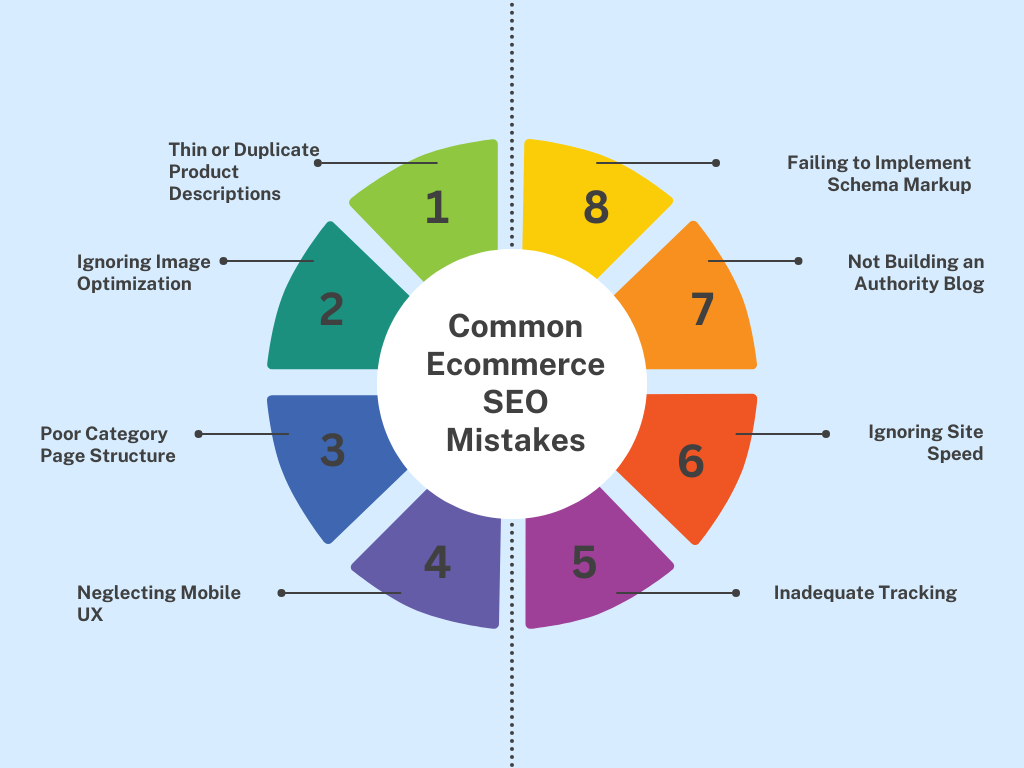
- Thin or Duplicate Product Descriptions: Solution: Invest in writing unique, detailed copy for every product.
- Ignoring Image Optimization: Solution: Compress images, use WebP format, and write descriptive alt text.
- Poor Category Page Structure: Solution: Add unique content, optimize metadata, and manage filters with canonicals.
- Neglecting Mobile UX: Solution: Adopt a mobile-first design philosophy and test constantly.
- Failing to Implement Schema Markup: Solution: Use plugins or developer resources to add Product and Review schema.
- Not Building an Authority Blog: Solution: Develop a content calendar targeting all stages of the buyer’s journey.
- Ignoring Site Speed: Solution: Conduct regular audits with PageSpeed Insights and fix priority issues.
- Inadequate Tracking: Solution: Configure GA4 and Search Console correctly to make data-driven decisions.
Expert Tips & Best Practices
- Start with a Technical Audit: Use tools like Screaming Frog or Sitebulb to crawl your site like Google does, identifying critical issues first.
- Prioritize User Intent Above All: Every page should satisfy a clear searcher intent. If it doesn’t, it won’t rank.
- Create “Pillar-Cluster” Models: For your blog, create a comprehensive “pillar” page on a broad topic (e.g., “Complete Guide to Home Coffee Brewing”) and link it to multiple “cluster” articles on subtopics (e.g., “French Press Techniques,” “Choosing Coffee Grinders”). This signals deep topical authority to Google.
- Optimize for “Product Listing” Rich Results: Beyond standard rich snippets, aim to get your products directly into Google Shopping listings (requires a Google Merchant Center feed).
- Be Patient and Consistent: Ecommerce SEO, especially for competitive niches, is a long-term game. Expect to see meaningful traction in 6-12 months of sustained effort.
Frequently Asked Questions (FAQ)
1. How long does it take to see results from ecommerce SEO?
Typically, 4 to 12 months to see significant organic traffic growth. Technical fixes can yield results quicker (weeks), while building authority through content and links is a long-term strategy.
2. Is Shopify or WooCommerce better for SEO?
Both are excellent when configured correctly. Shopify handles core technical SEO well out-of-the-box but has some limitations (e.g., URL structure flexibility). WooCommerce on WordPress offers unparalleled control but requires more manual technical management. The platform matters less than the skill of the implementer.
3. How do I handle SEO for thousands of product pages?
Focus on template-level optimization (ensuring every product page automatically follows the 10-point checklist) and prioritize your best-selling or highest-margin products for additional, manual content enhancement. Use bulk editing tools and maintain clean data feeds.
4. What’s the most important SEO factor for ecommerce sites?
There is no single “most important” factor. It’s a synergy. However, if foundational elements are broken (site speed, mobile usability, crawlability), no amount of content or links will allow you to rank well. Start with technical health.
5. How important are backlinks for ecommerce SEO?
Extremely important. They are a primary domain authority signal. For competitive product categories, the sites with the strongest, most relevant link profiles will dominate. A content-led link building strategy is essential.
6. Should I write a blog for my ecommerce store?
Absolutely. A blog is your primary tool for capturing early-stage search traffic, answering customer questions, building brand authority, and earning natural backlinks. It feeds the top of your sales funnel.
7. How can I improve my product page’s click-through rate from search results?
Craft compelling, benefit-driven title tags and meta descriptions that include your primary keyword, a key benefit, a call-to-action, and, if applicable, a trust signal (e.g., “Free Shipping,” “Top Rated”).
8. What is the biggest technical SEO challenge for ecommerce sites?
Duplicate content, caused by product variants, filters, session IDs, and similar descriptions. This is systematically solved through the proper use of canonical tags, parameter handling in Search Console, and creating unique content.
9. How do I optimize category pages that only show products?
Add a unique text section (200+ words) at the top of the category page. Explain what the category is, who it’s for, key considerations when buying, and link to relevant blog posts or buying guides. This provides context for search engines and users.
10. Do customer reviews impact SEO directly?
Yes. They create fresh, user-generated content, improve engagement metrics (dwell time), and when marked up with AggregateRating Schema, can generate rich snippets (star ratings in search results), which significantly boost click-through rates.
Conclusion:
Transforming your ecommerce website into an SEO-friendly powerhouse is a marathon, not a sprint. It requires a strategic blend of technical precision, user-centric content creation, and relentless measurement. The journey begins with a solid technical foundation—ensuring your site is fast, secure, and crawlable. From there, you layer on deep keyword understanding, crafting each product and category page to perfectly answer a searcher’s query. You build authority and a sustainable traffic engine through a strategic, helpful content hub. Finally, you amplify it all by earning trust through links and providing a flawless user experience.
Remember, ecommerce SEO’s ultimate goal is not just rankings, but revenue. Every optimization you make should serve the dual purpose of pleasing both Google’s algorithms and your potential customers. By following the comprehensive, step-by-step strategies outlined in this guide, you are not just chasing algorithms; you are building a more usable, trustworthy, and discoverable business. Start today by conducting a technical audit, prioritize one section at a time, and commit to the long game. The organic visibility, traffic, and sales growth that follow will be the ultimate reward for your diligence.
For advanced ecommerce growth strategies, technical insights, and scalable content frameworks, explore professional resources at rankifycontent.com.