Table of Contents
Introduction: How 3d visualization helps reduce product returns E-commerce?
In the bustling digital marketplace, a silent crisis drains profitability and strains customer loyalty: the staggering rate of product returns. For e-commerce businesses, the post-purchase experience is just as critical as the sale itself. Recent data from the National Retail Federation (NRF) indicates that e-commerce return rates can soar as high as 30%, compared to just 8-10% for brick-and-mortar stores. This discrepancy highlights a fundamental flaw in the online shopping experience—the inability to physically see, touch, and interact with a product before purchase. This “expectation gap” between what the customer envisions and what they receive is the primary driver of returns, costing the global e-commerce industry hundreds of billions annually in lost revenue, logistics, and restocking fees.
Enter 3D visualization technology—a transformative solution that is bridging this physical divide. By allowing shoppers to inspect, customize, and interact with digital twins of products from their screens, 3D visualization is fundamentally reshaping the customer journey. It’s not merely a flashy marketing gimmick; it’s a powerful tool rooted in enhancing product understanding and decision-making confidence. This long-form guide will delve into the mechanics, benefits, and strategic implementation of 3D visualization, demonstrating conclusively how it serves as one of the most effective strategies for reducing product returns and building a more sustainable, profitable e-commerce operation.
What is 3D Visualization in E-commerce?
At its core, 3D visualization is the process of creating graphical digital content using 3D software to produce lifelike images, animations, or interactive models. In an e-commerce context, this technology moves far beyond traditional, flat 2D photography. It involves building a precise, three-dimensional digital model of a product—a “digital twin”—that can be manipulated and viewed from any angle.
Key Technologies Powering 3D Commerce:
- 3D Modeling & Rendering: Creating the wireframe and applying textures, materials, and lighting to produce photorealistic static images or “spin” videos.
- Interactive 3D Viewers: Web-based viewers (often built with WebGL) that allow users to rotate, zoom, and pan around a product in real-time.
- Augmented Reality (AR): The pinnacle of product visualization, where the 3D model is superimposed into the user’s real-world environment via their smartphone camera or AR glasses. According to a report by Shopify, products with AR content showed a 94% higher conversion rate than those without.
- Photogrammetry: A technique that uses numerous photographs of a real object to create an accurate 3D model, ideal for capturing intricate details.
This shift from passive viewing to active interaction marks a paradigm shift in online shopping, directly addressing the sensory limitations that lead to uncertainty and, ultimately, returns.
How 3D Visualization Closes the Expectation Gap and Reduces Returns
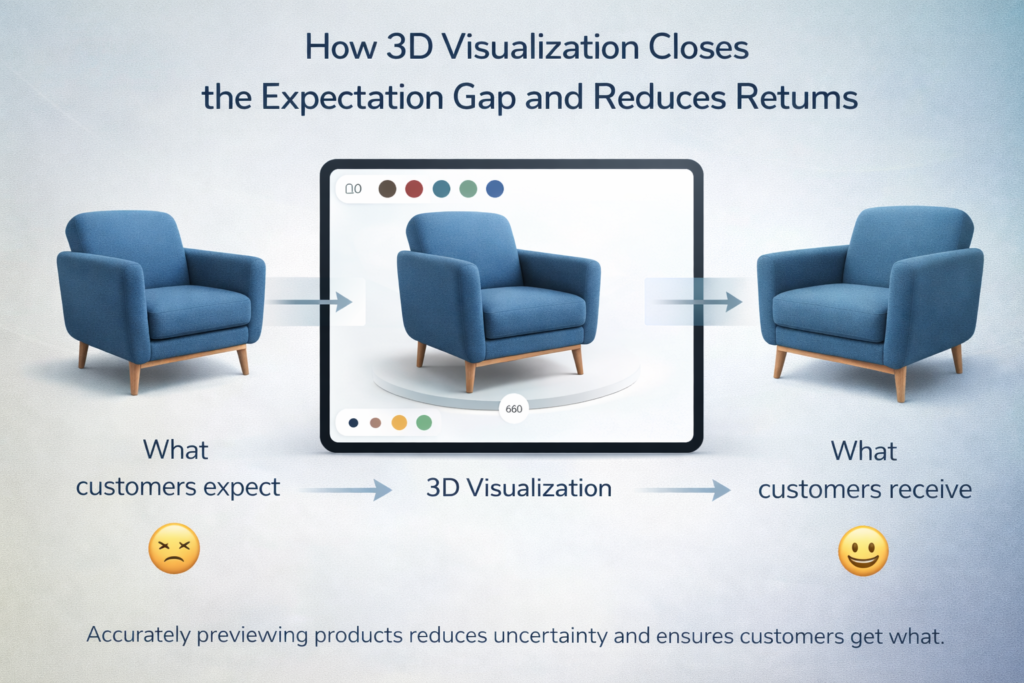
The path from online browsing to a returned package is paved with unmet expectations. 3D visualization systematically dismantles each point of failure.
1. Unparalleled Product Understanding and Detail Inspection
Static images, even from multiple angles, can hide flaws, misrepresent textures, or obscure scale. An interactive 3D model empowers the customer.
- Zoom & Texture Analysis: Shoppers can zoom in to see the weave of a fabric, the grain of wood, the stitching on a bag, or the finish on a metal surface. This eliminates surprises about material quality.
- 360-Degree Exploration: Viewing a product from the back, bottom, and inside reveals details often omitted in curated photos, ensuring there are no “hidden” disappointments.
2. Accurate Sense of Scale, Size, and Proportion
“Is this lamp too big for my nightstand?” “Will this sofa overwhelm my living room?” Size is a top reason for returns, especially in furniture, home decor, and electronics.
- AR for Spatial Context: Augmented Reality is the ultimate solution. Customers can place a life-sized 3D model of a chair in their actual living room. They can walk around it, see how it fits with their existing decor, and judge its proportion accurately. Companies like IKEA Place and Wayfair have leveraged this to dramatic effect, significantly reducing “it was too big/small” returns.
3. Realistic Material and Color Representation
Screen calibration, lighting in product photos, and monitor differences can drastically alter how a color appears. A “navy blue” sweater online might look black or purple on another screen.
- True-to-Life Rendering: Advanced 3D rendering simulates how materials interact with different types of light (e.g., sunlight vs. warm indoor lighting), providing a more honest representation of color and finish.
- Virtual Customization: Shoppers can change the color, material, or configuration of a product in real-time (e.g., a car with different paint jobs, a sofa with alternate fabric swatches). They buy the exact specification they visualized, leaving no room for “the color wasn’t what I expected.”
4. Enhanced Confidence in Product Function and Assembly
For products that require assembly or have moving parts, 3D animation can demonstrate functionality that photos cannot.
- Exploded Views & Animations: Showing how components fit together or how a recliner mechanism works builds confidence in product quality and usability, reducing returns based on perceived complexity or assumed malfunction.
5. Reduced “Bracketing” or Multi-Size Ordering
Common in apparel, “bracketing” is when a customer orders multiple sizes or colors with the intent of returning the ones that don’t fit or suit them. This is a major source of returns.
- Virtual Try-On (VT0) & AR Fit: For fashion, AR can overlay clothing or accessories on a user’s avatar or even their own image. While not perfect, it provides a much better size and style guide than a generic size chart, encouraging a single, correct purchase.
Quantifiable Benefits Beyond Return Reduction
While slashing return rates is the headline benefit, implementing 3D visualization delivers a powerful ripple effect across key business metrics.
- Increased Conversion Rates: Interactive content dramatically increases engagement and dwell time. A confident customer is a buying customer. Studies, including one from eBay, have shown that interactive 3D content can boost conversion rates by up to 40%.
- Higher Average Order Value (AOV): The ability to customize and visualize premium options (e.g., leather vs. cloth interior) encourages customers to upgrade. Clear understanding reduces hesitation on higher-ticket items.
- Decreased Customer Acquisition Cost (CAC): Superior shopping experiences generate word-of-mouth, improve organic social sharing (as users share their AR experiences), and enhance brand perception, making marketing spend more efficient.
- Enhanced Brand Authority & Innovation: Adopting cutting-edge technology positions a brand as a leader and builds trust. It signals a commitment to customer satisfaction and transparency.
- Sustainable Business Practices: Fewer returns mean fewer carbon emissions from reverse logistics, less packaging waste, and reduced inventory damage. This aligns with growing consumer demand for eco-conscious brands.
Implementing 3D Visualization: A Step-by-Step Strategic Guide
Transitioning to a 3D-powered storefront requires planning. Here’s a roadmap for e-commerce businesses.
Phase 1: Assessment & Planning
- Audit Your Catalog: Identify high-return-rate products, high-value items, and products where scale, detail, or configuration are critical (e.g., furniture, jewelry, electronics, custom goods).
- Define Goals & KPIs: Is your primary goal to reduce returns for a specific category by 15%? Increase AOV on customizable products? Set clear, measurable objectives.
- Choose Your Technology & Partners: Decide between building an in-house team or partnering with a specialized 3D visualization studio or SaaS platform (e.g., Vectary, Threekit, CGTrader). Consider your budget, volume of products (SKUs), and required interactivity level.
Phase 2: Content Creation & Integration
- Asset Creation: Develop high-fidelity 3D models. This can be done via 3D scanning of physical products or building models from scratch using CAD data or reference images.
- Platform Integration: Seamlessly embed the 3D viewers and AR experiences into your product pages. Ensure they are mobile-optimized, as a significant portion of AR usage is on smartphones.
- UX/UI Consideration: The 3D viewer should be intuitive and load quickly. Place it prominently above the fold, alongside the traditional image gallery.
Phase 3: Launch, Promotion & Analysis
- Educate Your Customers: Use tooltips, badges (“View in 3D”, “Try in Your Room”), and even short tutorial videos to encourage interaction with the new feature.
- Promote Across Channels: Showcase your 3D/AR capabilities in social media ads, email campaigns, and on the homepage. It’s a unique selling proposition.
- Monitor & Iterate: Use analytics to track engagement with 3D viewers, A/B test pages with and without 3D, and most importantly, monitor return rate metrics for the targeted product categories. Gather customer feedback and refine the experience.
Common Mistakes to Avoid with 3D Visualization
- Prioritizing Quantity Over Quality: A poorly rendered, low-polygon model that looks fake can damage trust more than having no 3D at all. Start with a few high-impact, high-quality models.
- Neglecting Mobile Performance: If your 3D viewer lags or crashes on mobile devices, you’ve lost the majority of your audience. Optimize file sizes and choose lightweight web viewers.
- Treating it as a Standalone Feature: The 3D model must be integrated into the holistic product story—complementing descriptions, specs, and reviews, not replacing them.
- Ignoring Data and Feedback: Implementing the technology without tracking its impact is a missed opportunity. Continuously analyze performance data.
- Overcomplicating the Interface: The interaction should be simple—drag to rotate, pinch to zoom. Avoid cluttering the UI with unnecessary buttons or controls that confuse the user.
Expert Tips and Best Practices for Maximum Impact
- Start with Your Hero Products: Apply 3D visualization to your bestsellers or most-returned items first to achieve the quickest ROI.
- Leverage 3D Assets Across Marketing: Use your high-quality 3D renders in digital ads, social media, and email campaigns for consistent, stunning visual content.
- Combine with High-Quality Media: Use 3D to show every angle, but also use video to demonstrate the product in real-life action. They work in tandem.
- Implement Clear Size Guides Alongside AR: For apparel, use AR/VTO as an advanced guide, but always keep a detailed, traditional size chart accessible.
- Future-Proof with Metaverse & Web3: The 3D models you create today are foundational assets for emerging virtual spaces, NFTs, and the broader metaverse ecosystem.
Frequently Asked Questions (FAQ)
Q1: Isn’t 3D visualization too expensive for small to medium e-commerce businesses?
A1: The cost has decreased significantly with the advent of SaaS platforms and outsourcing marketplaces. The ROI, calculated through reduced returns, increased conversions, and higher AOV, often justifies the initial investment. Many businesses start with a pilot project on a single product to test results.
Q2: How long does it take to create a 3D model of a product?
A2: It varies widely based on complexity. A simple product like a mug might take a few hours, while a highly detailed, configurable piece of furniture with multiple material options could take several days. Photogrammetry can speed up the process for existing physical products.
Q3: Can 3D visualization help with products that aren’t physical, like software or services?
A3: Absolutely. 3D animation and interactive graphics are excellent for explaining complex software interfaces, demonstrating architectural services, or visualizing data—building understanding and setting accurate expectations for the deliverable.
Q4: Does 3D content negatively affect my website’s loading speed?
A4: It can if not optimized properly. Using modern, efficient WebGL viewers and optimized 3D file formats (like glTF) is crucial. A fast-loading, interactive experience is non-negotiable for SEO and user experience.
Q5: What’s the difference between 360° photography and true 3D modeling?
A5: 360° photography is a series of 2D photos stitched together, offering rotation but no ability to zoom into fine details or change perspective. True 3D modeling creates a digital object that can be viewed from any angle, zoomed indefinitely, and often customized in real-time.
Q6: How does 3D visualization impact SEO?
A6: It positively impacts key SEO metrics like dwell time, pages per session, and reduced bounce rates—all signals Google considers for ranking. Additionally, unique, interactive content is more likely to earn backlinks and social shares.
Q7: Are there any industries where 3D visualization is particularly critical?
A7: Yes. Furniture & home decor, fashion & apparel, jewelry & watches, automotive parts, industrial equipment, and customizable goods (like sneakers or PCs) see exceptionally high returns on investment due to the critical importance of scale, fit, detail, and configuration.
Q8: Can I add 3D visualization to my existing Shopify, Magento, or WooCommerce store?
A8: Yes. Most major e-commerce platforms have dedicated apps or plugins from 3D visualization providers (like Vectary AR Product Visualizer for Shopify) that allow for relatively straightforward integration without needing to overhaul your entire site.
Q9: What technical skills does my team need to manage this?
A9: If using a full-service partner or a user-friendly SaaS platform, the required internal technical skill is minimal—often just basic content management system (CMS) knowledge for embedding code. Creating models in-house requires skilled 3D artists.
Q10: Is Augmented Reality (AR) just a trend, or is it here to stay?
A10: AR is a foundational technology for the future of retail. With Apple’s ARKit, Google’s ARCore, and the proliferation of capable smartphones, consumer access is ubiquitous. Its proven ability to reduce returns and increase confidence makes it a strategic investment, not a passing trend.
Conclusion and Future Outlook
The challenge of product returns in e-commerce is a symptom of a deeper issue: the historical limitation of the digital storefront. 3D visualization technology is not merely a cosmetic upgrade; it is a fundamental correction to the online shopping model. By restoring critical sensory information—scale, texture, spatial context, and functionality—it empowers consumers to make purchase decisions with the same confidence they would in a physical store.
The data and case studies are clear: investing in interactive 3D models and AR experiences directly translates to a healthier bottom line through drastically reduced return rates, higher conversion values, and stronger customer loyalty. As technology advances, with developments in haptic feedback, more accurate AI-driven virtual try-on, and integration into the metaverse, this gap between physical and digital will shrink to insignificance.
For forward-thinking e-commerce brands, the question is no longer if they should adopt 3D visualization, but how quickly they can implement it to build a more sustainable, profitable, and customer-centric business. The future of online retail is interactive, immersive, and informed—and it is being built in three dimensions today.
For advanced ecommerce growth strategies, technical insights, and scalable content frameworks, explore professional resources at rankifycontent.com.