Table of Contents
Introduction
In today’s competitive digital economy, launching a product online is no longer enough to guarantee success. Thousands of ecommerce stores compete for customer attention every day, offering similar products at comparable prices. This is where ecommerce product marketing becomes essential. It is the strategic process of promoting, positioning, and selling products online by understanding customer needs, communicating value, and using the right digital channels to drive demand.
Ecommerce product marketing focuses not only on acquiring customers but also on guiding them through the buying journey—from awareness and consideration to conversion and retention. Brands that invest in structured product marketing strategies consistently outperform those that rely solely on discounts or paid ads.
What Is Ecommerce Product Marketing?
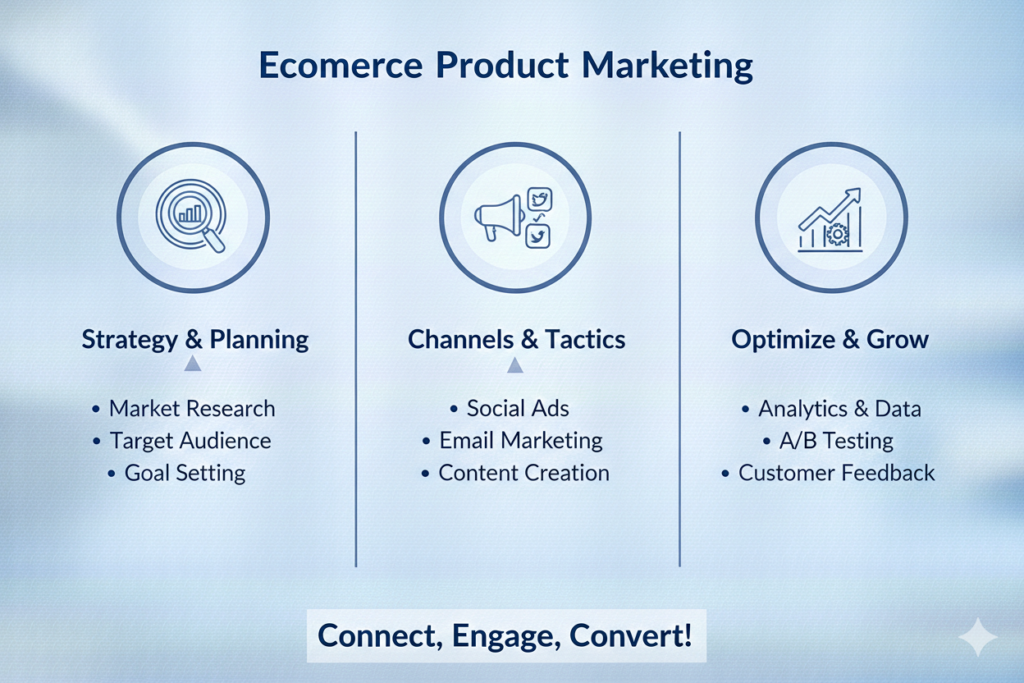
Ecommerce product marketing refers to the strategies and tactics used to promote products sold through online platforms. It involves identifying target customers, crafting compelling product messaging, selecting the right marketing channels, and optimizing product presentation to drive sales.
Unlike general digital marketing, product marketing is product-centric. It highlights specific benefits, solves customer problems, and clearly communicates why a product is better than alternatives. In ecommerce, this includes product pages, ads, emails, social content, search visibility, and post-purchase engagement.
Why Ecommerce Product Marketing Is Important
The importance of ecommerce product marketing lies in customer decision-making. Online shoppers cannot physically see or test products, so marketing must build trust, reduce uncertainty, and communicate value clearly. Without strong product marketing, even high-quality products struggle to convert.
Effective ecommerce product marketing increases brand visibility, improves conversion rates, and boosts average order value. It also supports customer retention by reinforcing product benefits after purchase, encouraging repeat buying and long-term loyalty.
Difference Between Ecommerce Marketing and Product Marketing
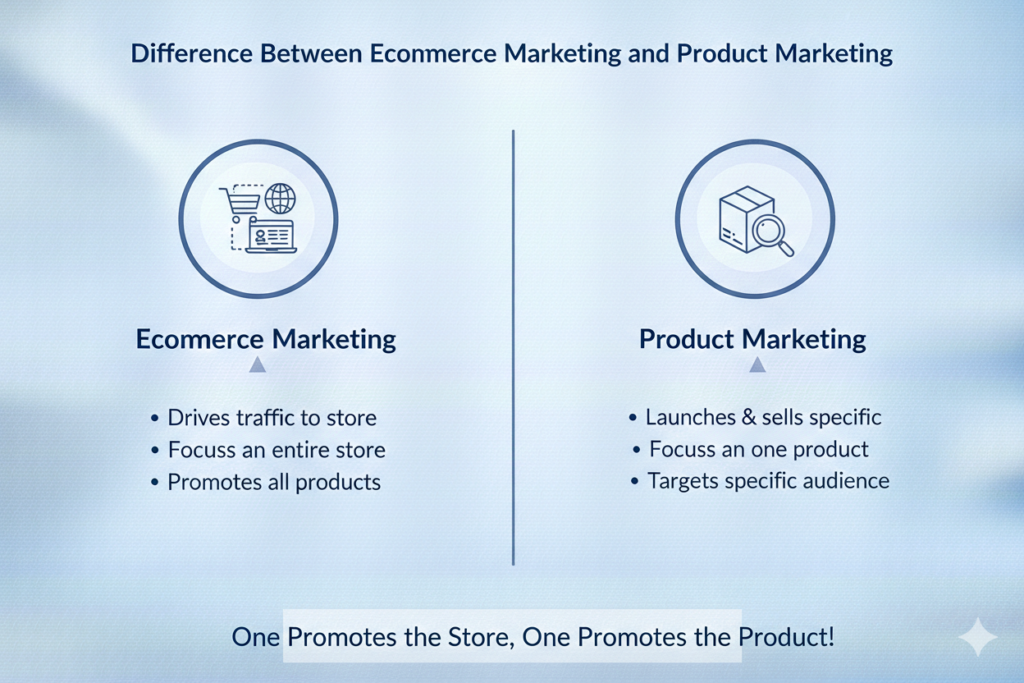
Ecommerce marketing focuses on driving traffic to an online store using channels like SEO, paid ads, and social media. Ecommerce product marketing, on the other hand, focuses on how individual products are positioned and sold once traffic arrives.
For example, ecommerce marketing brings users to a website, while product marketing ensures that product pages, descriptions, visuals, and offers convince users to buy. Both strategies work together, but product marketing directly influences conversions and revenue.
Key Elements of Ecommerce Product Marketing
Successful ecommerce product marketing is built on several core elements. Product positioning defines how a product is perceived in the market. Messaging explains the product’s benefits and value proposition. Visual presentation uses images and videos to showcase the product. Pricing and promotions influence buying decisions, while distribution channels ensure products reach the right audience.
When these elements are aligned, customers receive a clear, consistent message that builds confidence and drives action.
Role of Customer Research in Product Marketing
Customer research is the foundation of ecommerce product marketing. Understanding customer pain points, preferences, and motivations helps businesses create relevant messaging. Research methods include analyzing reviews, customer feedback, search behavior, and competitor offerings.
When product marketing is based on real customer insights, it becomes more persuasive and effective. Brands can highlight features that matter most and avoid generic or misleading claims that reduce trust.
Ecommerce Product Marketing and Product Pages
Product pages are the centerpiece of ecommerce product marketing. They act as digital sales representatives, answering customer questions and overcoming objections. Well-optimized product pages include clear titles, benefit-focused descriptions, high-quality visuals, social proof, and strong calls to action.
A poorly marketed product page can cause high bounce rates and abandoned carts, even if traffic levels are high. Product marketing ensures that every product page is designed to convert visitors into customers.
Visual Content in Ecommerce Product Marketing
Visual content plays a critical role in ecommerce product marketing. Since customers cannot physically interact with products, images and videos become the primary source of information. High-quality visuals help customers understand size, texture, usage, and results.
Videos, demonstrations, and lifestyle imagery increase engagement and conversion rates. Brands that invest in strong visual storytelling gain a competitive edge in crowded ecommerce markets.
Product Launch Marketing in Ecommerce
Launching a new product online requires a clear ecommerce product marketing plan. Pre-launch teasers, email campaigns, influencer previews, and early access offers help build anticipation. On launch day, coordinated marketing across multiple channels maximizes visibility and sales impact.
Post-launch marketing is equally important. Gathering reviews, optimizing messaging based on customer feedback, and retargeting interested users help sustain momentum beyond the initial launch phase.
SEO and Content Strategy for Ecommerce Product Marketing
Search engine optimization is one of the most sustainable channels in ecommerce product marketing. Customers actively search for products using problem-based, feature-based, and comparison keywords. Optimizing product pages with keyword-rich titles, benefit-focused descriptions, structured headings, and relevant internal links helps products rank higher in search results. Beyond product pages, supporting content such as buying guides, comparisons, and tutorials strengthens topical authority and attracts high-intent traffic.
Content marketing plays a complementary role by educating customers and building trust. Blogs, FAQs, and videos help answer pre-purchase questions and position products as solutions rather than commodities. When SEO and content work together, ecommerce product marketing generates consistent organic traffic that converts over time without relying entirely on paid ads.
Paid Advertising in Ecommerce Product Marketing
Paid advertising is a powerful accelerator in ecommerce product marketing, especially for new products or competitive niches. Platforms such as Google Ads, Facebook, Instagram, and TikTok allow brands to target customers based on intent, interests, and behavior. Product-focused ads highlight key benefits, pricing, and social proof to drive immediate action.
Successful ecommerce product marketing campaigns use clear visuals, concise messaging, and strong calls to action. Retargeting ads are particularly effective, as they re-engage users who viewed products but did not purchase. When combined with optimized product pages, paid ads deliver strong return on investment.
Social Media Marketing for Ecommerce Products
Social media has become a core channel in ecommerce product marketing due to its visual and interactive nature. Platforms like Instagram, TikTok, and Facebook enable brands to showcase products through short videos, reels, stories, and live demonstrations. These formats allow brands to demonstrate usage, benefits, and real-life results.
Social media also supports community-building and brand storytelling. Consistent posting, engagement with comments, and user-generated content help build authenticity. Ecommerce brands that treat social media as a conversation rather than just a promotion channel see higher engagement and stronger brand loyalty.
Influencer Marketing and Product Promotion
Influencer marketing is a key component of modern ecommerce product marketing. Influencers introduce products to targeted audiences through authentic reviews, tutorials, and demonstrations. This form of marketing works especially well because it feels more trustworthy than traditional advertising.
Micro-influencers often deliver higher engagement rates due to their niche audiences and closer relationships with followers. Partnering with influencers who align with brand values and target customers helps ecommerce businesses drive awareness, traffic, and conversions efficiently.
Conversion Rate Optimization in Ecommerce Product Marketing
Driving traffic is only half the equation; converting visitors into customers is where ecommerce product marketing truly delivers value. Conversion optimization focuses on improving product pages, checkout flows, and user experience. Clear value propositions, strong headlines, benefit-driven descriptions, and visible trust signals all influence purchase decisions.
Elements such as customer reviews, ratings, guarantees, and easy return policies reduce risk perception. Optimizing page speed, mobile usability, and checkout simplicity further increases conversion rates. Even small improvements in conversion can lead to significant revenue growth.
Upselling and Cross-Selling Strategies
Upselling and cross-selling are essential tactics in ecommerce product marketing for increasing average order value. Upselling encourages customers to choose a higher-value version of a product, while cross-selling recommends complementary items. These strategies work best when recommendations are relevant and timed appropriately.
For example, suggesting accessories on product pages or offering bundles during checkout enhances value without appearing aggressive. Personalized recommendations based on browsing or purchase behavior further improve effectiveness and customer satisfaction.
Email Marketing and Product Promotion
Email marketing remains one of the highest ROI channels in ecommerce product marketing. Product-focused email campaigns include launches, promotions, restock alerts, and personalized recommendations. Segmentation allows brands to tailor messages based on customer behavior, preferences, and purchase history.
Automated email flows such as abandoned cart reminders, post-purchase follow-ups, and replenishment notifications support continuous engagement. When used strategically, email marketing strengthens relationships and drives repeat purchases.
Common Mistakes in Ecommerce Product Marketing
Many ecommerce businesses struggle due to common product marketing mistakes. These include focusing only on features instead of benefits, using generic messaging, neglecting product visuals, and relying too heavily on discounts. Poor alignment between ads and product pages also leads to low conversion rates.
Another frequent mistake is ignoring post-purchase marketing. Successful ecommerce product marketing extends beyond the sale by reinforcing value, encouraging reviews, and nurturing repeat customers.
Pricing Strategies and Profit Optimization in Ecommerce Product Marketing
Pricing is one of the most influential elements of ecommerce product marketing because it directly affects conversion rates and profit margins. Online customers compare prices instantly, so ecommerce brands must strike a balance between competitiveness and perceived value. Successful product marketing does not rely on constant discounts; instead, it communicates why a product is worth its price through benefits, quality, differentiation, and trust signals.
Psychological pricing strategies such as tiered pricing, bundles, and limited-time offers are commonly used in ecommerce product marketing. Bundling complementary products increases perceived value and average order value, while tiered pricing encourages customers to upgrade. Clear pricing communication, free shipping thresholds, and transparent return policies further support purchase decisions and long-term profitability.
Customer Retention and Lifecycle Marketing
Customer acquisition is expensive, which makes retention a core focus of ecommerce product marketing. Lifecycle marketing ensures that customers continue to see value in products even after the first purchase. Post-purchase emails, usage tips, replenishment reminders, and personalized recommendations help customers get better results from products, increasing satisfaction and repeat purchases.
Loyalty programs, referral incentives, and exclusive offers are also powerful retention tools. Ecommerce brands that focus on lifetime value rather than one-time sales build stronger customer relationships and more predictable revenue streams. Retention-focused product marketing often delivers higher ROI than acquisition-only strategies.
Role of Data and Analytics in Product Marketing
Data plays a central role in ecommerce product marketing decision-making. Metrics such as conversion rate, average order value, customer acquisition cost, and lifetime value help marketers understand which products and campaigns perform best. Analyzing customer behavior across channels allows brands to refine messaging, pricing, and promotions.
Product-level analytics also reveal insights about customer preferences, seasonality, and demand patterns. Brands that consistently test and optimize product marketing strategies based on real data stay ahead of competitors and adapt faster to market changes.
Omnichannel Ecommerce Product Marketing
Modern ecommerce customers interact with brands across multiple touchpoints, including websites, social media, email, search, and ads. Ecommerce product marketing must maintain consistent messaging across all these channels. A product discovered on social media should deliver the same value proposition and experience when viewed on the website or in an email campaign.
Omnichannel consistency builds trust and reinforces brand identity. Customers are more likely to purchase when they receive coherent messaging and relevant product information regardless of where they interact with the brand.
Future Trends in Ecommerce Product Marketing
The future of ecommerce product marketing is shaped by personalization, automation, and experience-driven strategies. AI-powered personalization will continue to improve how products are recommended and marketed to individual users. Interactive content such as videos, quizzes, and virtual demonstrations will play a larger role in product discovery and conversion.
Another key trend is community-driven marketing, where brands build loyal audiences through education, transparency, and shared values. As customers become more selective, ecommerce product marketing will increasingly focus on authenticity, trust, and long-term relationships rather than short-term promotions.
External Industry Insights and Market Validation
Leading ecommerce platforms emphasize the importance of product-focused marketing strategies. Shopify highlights that successful ecommerce brands focus on product storytelling, clear value propositions, and customer experience to drive sustainable growth (external dofollow link: https://www.shopify.com/blog/ecommerce-marketing). Similarly, HubSpot explains that product-centered digital marketing significantly improves conversion rates and customer engagement when combined with data-driven strategies (external dofollow link: https://blog.hubspot.com/marketing/ecommerce-marketing).
These insights confirm that ecommerce product marketing is not just about promotion—it is about aligning product value with customer needs across the entire journey.
Internal Growth Strategy Integration
To maximize results, ecommerce product marketing should be integrated with SEO, catalog management, personalization, and conversion optimization strategies. You can explore more in-depth ecommerce growth techniques, platform guides, and marketing frameworks in our detailed resource hub (internal dofollow link example: https://rankifycontent.com/ecommerce-growth-strategies). When product marketing aligns with these systems, ecommerce businesses achieve scalable and sustainable growth.
Frequently Asked Questions (FAQs)
What is ecommerce product marketing?
Ecommerce product marketing is the process of promoting and positioning products sold online by highlighting their value, benefits, and differentiation. It focuses on guiding customers through the buying journey using product pages, content, ads, email campaigns, and post-purchase engagement to drive conversions and retention.
How is ecommerce product marketing different from digital marketing?
Digital marketing focuses on driving traffic through channels such as SEO, paid ads, and social media. Ecommerce product marketing, on the other hand, focuses on how individual products are presented, priced, and communicated once visitors arrive. Product marketing ensures that product pages and messaging convert traffic into customers.
Why is ecommerce product marketing important for online stores?
Ecommerce product marketing is important because online shoppers cannot physically experience products. Strong product marketing builds trust, reduces uncertainty, communicates benefits clearly, and increases conversion rates. Without it, even high-quality products may fail to sell.
What are the most effective ecommerce product marketing channels?
Effective ecommerce product marketing channels include SEO, content marketing, paid ads, social media, influencer marketing, email campaigns, and on-site optimization. The best results come from integrating multiple channels rather than relying on a single tactic.
How can ecommerce product marketing increase conversion rates?
Conversion rates improve when ecommerce product marketing focuses on clear value propositions, high-quality visuals, customer reviews, strong calls to action, and frictionless checkout experiences. Addressing customer objections directly on product pages also plays a major role.
Does ecommerce product marketing help with customer retention?
Yes, ecommerce product marketing plays a key role in customer retention by reinforcing product value after purchase. Post-purchase emails, usage tips, personalized recommendations, and loyalty programs encourage repeat purchases and long-term customer relationships.
How important is content in ecommerce product marketing?
Content is essential in ecommerce product marketing because it educates customers and builds trust. Product descriptions, blogs, videos, tutorials, and FAQs help customers understand products better and make informed buying decisions.
Can small businesses succeed with ecommerce product marketing?
Yes, small businesses can succeed by focusing on niche audiences, clear messaging, and authentic product storytelling. Ecommerce product marketing allows smaller brands to compete by emphasizing unique value rather than large advertising budgets.
What role does data play in ecommerce product marketing?
Data helps ecommerce product marketers understand customer behavior, identify high-performing products, and optimize campaigns. Metrics such as conversion rate, average order value, and customer lifetime value guide strategic decisions and continuous improvement.
What are future trends in ecommerce product marketing?
Future trends include AI-driven personalization, interactive product content, community-based marketing, omnichannel consistency, and experience-focused strategies. Ecommerce product marketing will continue to evolve toward deeper personalization and customer engagement.
Final Conclusion (With External & Internal Dofollow Links)
Ecommerce product marketing is the engine that turns online traffic into consistent revenue. By focusing on product positioning, clear messaging, strong visuals, and customer-centric strategies, ecommerce brands can guide users from discovery to purchase and beyond. In an increasingly competitive digital landscape, relying solely on ads or discounts is no longer enough.
Industry leaders such as Shopify and HubSpot consistently highlight the importance of product-driven marketing, personalization, and customer experience in ecommerce success (external dofollow links included above). When combined with SEO, lifecycle marketing, and data-driven optimization, ecommerce product marketing becomes a powerful driver of long-term profitability.
For brands and entrepreneurs looking to scale online, investing in structured and customer-focused ecommerce product marketing is not optional—it is a strategic necessity for sustainable growth.