Table of Contents
Introduction
You have built a great product. Your website functions. Orders come in. But something is wrong.
Traffic has plateaued. Conversion rates refuse to budge. Customer acquisition costs are rising faster than lifetime value. And despite your best efforts—the late nights spent learning Facebook Ads, the weekends dedicated to SEO, the endless A/B tests that yield inconclusive results—you are not growing at the trajectory you envisioned.
This is the moment when successful ecommerce founders face a defining decision: Do we build an in-house marketing team, or do we partner with an ecommerce marketing agency?
The answer is not obvious. Both paths have produced legendary successes and spectacular failures. Both require significant investment—of capital, time, and organizational focus. Both, chosen incorrectly, can set your business back years.
But here is what the data reveals: businesses that successfully partner with the right ecommerce marketing agency achieve outcomes that are virtually impossible to replicate through internal resources alone. A beauty brand grew email revenue from 27% to 45% of total store revenue, achieving 41x ROI through strategic agency partnership . A premium menswear brand reduced ad spend by 32% while increasing ROAS by 59% on Google PMax through integrated agency strategy . A luxury apparel brand doubled its return on advertising spend with expert agency guidance .
These are not anomalies. They are the predictable results of bringing specialized expertise, cross-industry pattern recognition, and disciplined execution to bear on ecommerce growth challenges.
This guide is your definitive resource. Drawing on verified case studies, industry benchmarks, and candid insights from agency founders and marketing executives, you will learn:
- The precise definition of an ecommerce marketing agency and how it differs from generalist digital agencies
- The five distinct agency types—full-service, specialized, platform-specific, B2B, and performance marketing—and which one matches your growth stage
- The documented ROI from real agency engagements, including specific percentage improvements across multiple channels
- The complete in-house versus agency decision framework, with 2026 cost benchmarks for both models
- A step-by-step agency selection methodology used by successful Shopify Plus merchants and enterprise retailers
- The five most expensive agency hiring mistakes and how to avoid them
- Expert tips on structuring engagements, measuring performance, and building long-term partnerships
Whether you are a founder running a seven-figure store, a marketing director evaluating your first agency partnership, or an established brand considering a switch, this guide provides the clarity and actionable frameworks you need.
What Is an Ecommerce Marketing Agency? A Precision Definition
An ecommerce marketing agency is a specialized business-to-business entity that provides strategic marketing services exclusively or primarily to companies selling products or services online .
Unlike generalist digital agencies that serve a broad range of industries, ecommerce marketing agencies possess deep expertise in the unique dynamics of online retail: product catalog optimization, shopping feed management, marketplace advertising, checkout conversion, and the complex interplay between paid, owned, and earned channels that drives ecommerce revenue .
Core Services of an Ecommerce Marketing Agency
While service offerings vary by agency specialization, the core capabilities include :
| Service Category | Specific Capabilities |
|---|---|
| Paid Advertising | Google Ads (Search, Shopping, PMax), Meta Ads (Facebook, Instagram), TikTok Ads, Pinterest Ads, retargeting campaigns |
| Search Engine Optimization | Technical SEO, product page optimization, content strategy, link building, local SEO for multi-location retailers |
| Email & SMS Marketing | Lifecycle flow setup, campaign strategy, segmentation, A/B testing, deliverability optimization |
| Conversion Rate Optimization | UX audit, checkout optimization, A/B testing, heat mapping, form optimization |
| Content & Creative | Product photography, video content, copywriting, user-generated content campaigns, brand storytelling |
| Marketplace Management | Amazon, Walmart, Etsy, eBay advertising and optimization |
| Analytics & Reporting | Multi-touch attribution, custom dashboarding, cohort analysis, LTV:CAC modeling |
How Ecommerce Agencies Differ from Generalist Agencies
This distinction matters because ecommerce is fundamentally different from other forms of digital marketing .
| Dimension | Generalist Agency | Ecommerce Marketing Agency |
|---|---|---|
| Primary focus | Brand awareness, lead generation | Transaction completion, revenue per visitor |
| Key metrics | Impressions, clicks, form fills | ROAS, AOV, LTV, conversion rate |
| Platform expertise | Broad platform knowledge | Deep platform specialization (Shopify, Magento, WooCommerce, BigCommerce) |
| Integration capability | Campaign-level | Platform-level (connected to inventory, cart, checkout) |
| Attribution understanding | Last-click or linear | Multi-touch, view-through, cross-device |
| Seasonal rhythm | Campaign calendar | Peak sales events (Black Friday, Cyber Monday, holiday) |
Critical insight: A generalist agency can generate traffic. An ecommerce marketing agency generates revenue-efficient traffic—visitors who not only arrive but convert, return, and increase in lifetime value over time .
The Five Types of Ecommerce Marketing Agencies
Not all ecommerce marketing agencies are created equal. Understanding the distinctions is essential to finding the right partner for your specific needs and growth stage .
Type 1 – Full-Service Ecommerce Agencies
Definition: Agencies offering end-to-end marketing solutions across multiple channels, often including strategy, creative, paid media, SEO, email, and analytics .
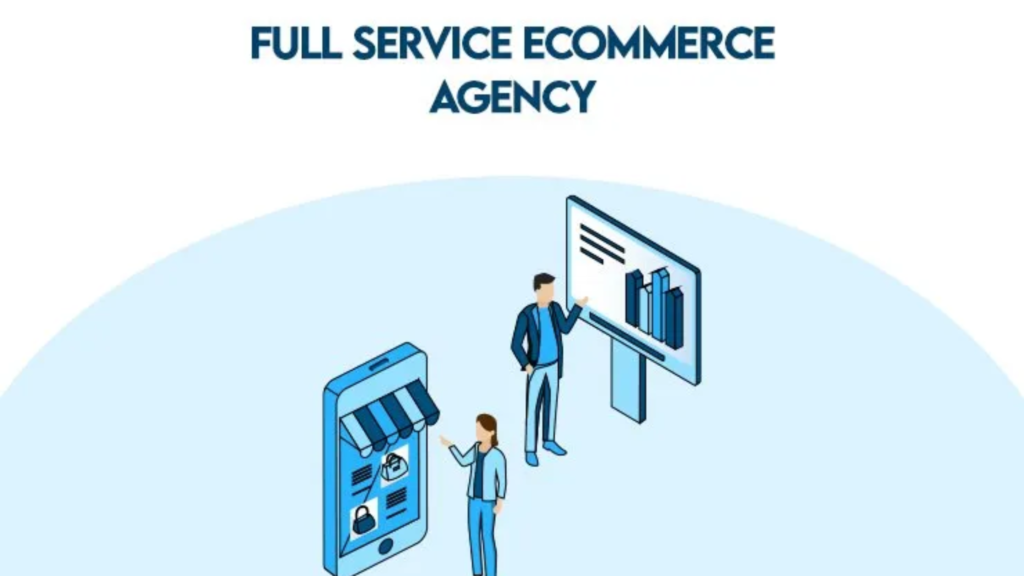
Best for: Mid-to-large businesses with aggressive growth goals and limited internal marketing resources. Brands seeking cohesive execution across all digital touchpoints.
Advantages:
- Single point of accountability for integrated strategy
- Consistent brand voice across channels
- No “finger-pointing” between multiple vendors
- Holistic optimization (e.g., SEO insights informing PPC strategy)
Considerations:
- Higher monthly retainers ($10,000–$30,000+)
- May have deeper expertise in some channels than others
- Requires strong internal liaison to maximize value
Example: When luxury apparel brand Mac Duggal needed to rethink its digital marketing strategy, it partnered with full-service agency Prospect Knight. The result: doubled return on advertising spend (ROAS) .
Type 2 – Specialized Ecommerce Agencies
Definition: Agencies focusing on one or two core marketing disciplines, developing deep expertise in specific channels .
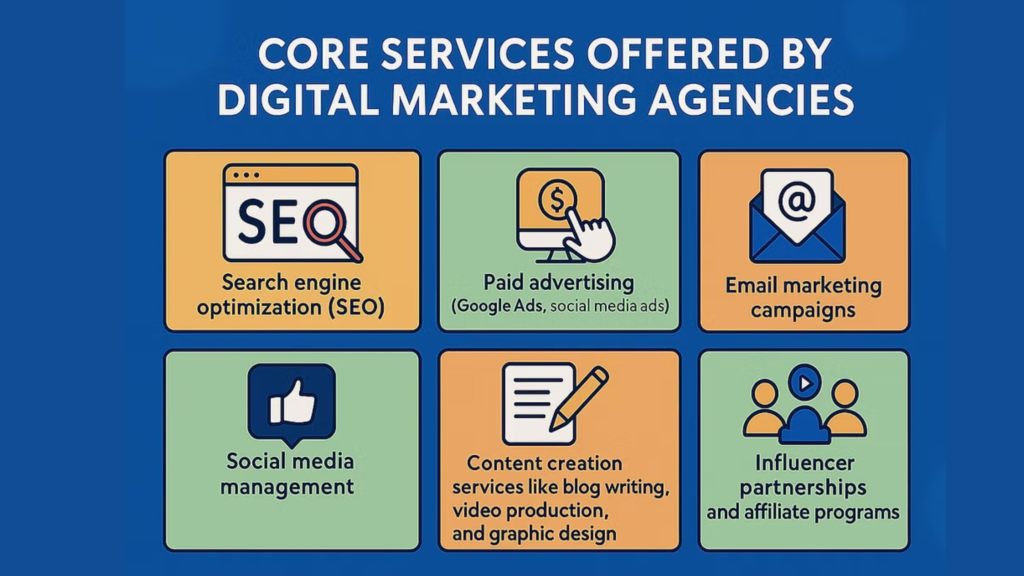
Common specializations:
- Email and SMS marketing (e.g., Chronos Agency)
- Paid media (Google/Meta/TikTok advertising)
- SEO and content marketing
- Conversion rate optimization
- Influencer marketing
Best for: Businesses with a solid marketing foundation seeking to scale a particular channel. Companies complementing an existing in-house team.
Advantages:
- Unmatched depth in their specialty
- Faster channel-specific results
- Often more cost-effective for targeted needs
Considerations:
- Requires coordination with other partners or internal resources
- Potential for channel silos if integration is not managed
Case study: A niche beauty brand engaged Chronos Agency, an email marketing specialist, to address low conversions. The brand had only basic flows, zero campaign strategy, and no segmentation. Following specialized agency engagement, email revenue grew from 27% to 45% of total store revenue, with 41x ROI and list growth from 100,335 to 221,055 subscribers .
Type 3 – Platform-Specific Agencies
Definition: Agencies certified and specialized in a single ecommerce platform—Shopify Plus, Magento (Adobe Commerce), BigCommerce, or WooCommerce .
Best for: Businesses requiring platform-specific expertise for migration, technical optimization, or leveraging platform-native marketing features.
Advantages:
- Deep platform knowledge and certified expertise
- Access to beta features and platform relationships
- Understanding of platform-specific conversion levers
Considerations:
- May be biased toward their platform
- Less cross-platform perspective
Example: Century-old luxury brand Belstaff partnered with Shopify Plus partners to migrate and unify their online and physical retail systems, eliminating complex data silos and connecting POS with NetSuite ERP .
Type 4 – B2B Ecommerce Agencies
Definition: Agencies specializing in the distinct marketing dynamics of business-to-business commerce: longer sales cycles, multiple decision-makers, account-based marketing, and complex customer portals .
Best for: Wholesalers, manufacturers, distributors, and businesses serving other businesses.
Advantages:
- Understanding of B2B buyer journeys
- Expertise in account-based marketing strategies
- Experience with CRM and ERP integration
Considerations: B2B marketing requires different metrics and timelines than B2C; ensure your expectations align.
Type 5 – Performance Marketing Agencies
Definition: Agencies focused exclusively on paid customer acquisition, typically compensated based on performance against targets.
Best for: Businesses with clear unit economics and the ability to scale rapidly with additional ad spend.
Advantages:
- Intense focus on ROAS and CPA
- Often more aggressive testing and optimization
- Alignment of incentives (performance-based compensation)
Considerations: Performance marketing is just one piece of the ecommerce puzzle; retention and lifecycle marketing require separate attention.
The Economic Case for Agency Partnership – Documented ROI
The decision to engage an ecommerce marketing agency ultimately comes down to one question: Does the return exceed the investment?
The following case studies provide concrete, documented answers.
Case Study 1 – Beauty Brand Email Transformation
The brand: Niche ecommerce beauty company selling vegan, cruelty-free nail products
The challenge: Low conversions, 9% open rates, only 6% revenue from email flows (benchmark: 30%+). Only basic flows in place, zero campaign strategy, no segmentation.
The agency: Chronos Agency (email marketing specialist)
The intervention:
- Implemented advanced flows covering all customer journey touchpoints
- Optimized flows with tested subject lines, designs, and cross-sell opportunities
- Intensive A/B testing (GIFs vs. static images, long vs. short hero images)
- Created on-brand email templates and regular campaign calendar
- Leveraged user-generated content and reviews
- Implemented Chronos standard segmentation for targeted engagement
- Total email revenue: 45% of store revenue (up from 27%)
- Flow email revenue: 31% of store revenue (up from 23%)
- Campaign email revenue: 14% of store revenue (up from 4%)
- Open rates increased by 25%
- List growth: from 100,335 to 221,055 subscribers
- 41x ROI
Key takeaway: Specialized agency expertise transformed a neglected channel into the brand’s primary revenue driver, delivering ROI that would be impossible to achieve through generalist efforts.
Case Study 2 – TexTale Profitability Turnaround
The brand: Premium men’s essential wear brand focused on sustainable wardrobe staples
The challenge: Despite healthy sales volumes, the brand faced profitability challenges due to inefficient paid media, overlapping promotions, and pricing misaligned with premium positioning. Marketing, creative, and ecommerce departments operated in silos.
The agency: Chronos Agency (integrated growth strategy)
- Optimized pricing models in alignment with cost of goods sold
- Developed promotion planning frameworks
- Provided commercial guidelines for profitability
- Delivered content strategies, video guidelines, and UI/UX improvements
- Full-service paid media management for Meta and Google PMax
- 3% net margin gain in H2 2024
- 32% reduction in ad spend year-over-year (while maintaining sales)
- 21.1% increase in ROAS on Meta
- 59% higher ROAS for Google PMax (compared to non-agency campaigns)
- 31.5% increase in AOV on Meta
- 22.8% increase in AOV on Google PMax
- 21% reduction in CPA for Google PMax
Key takeaway: Integrated strategy addressing pricing, promotion, creative, and media simultaneously delivered profitability improvements that channel-specific tactics alone could not achieve.
Case Study 3 – Mac Duggal ROAS Doubling
The brand: Luxury women’s apparel brand
The challenge: Need to rethink digital marketing strategy amid changing consumer behavior and competitive landscape.
The agency: Prospect Knight (full-service ecommerce marketing agency)
The result: Doubled return on advertising spend (ROAS)
Key takeaway: Even established brands with internal capabilities can achieve step-change improvements through expert agency partnership.
Case Study 4 – Jack Rogers Digital Transformation
The brand: Luxury footwear brand with legacy ecommerce platform
The challenge: Clunky, time-consuming platform limiting growth potential.
The agency: P3 Media (Shopify Plus Partner)
The result: Following migration and optimization, traffic increased by 60% and conversions improved by 30%
Key takeaway: Technical expertise combined with marketing strategy delivers compound growth.
Agency vs. In-House Marketing – The 2026 Decision Framework
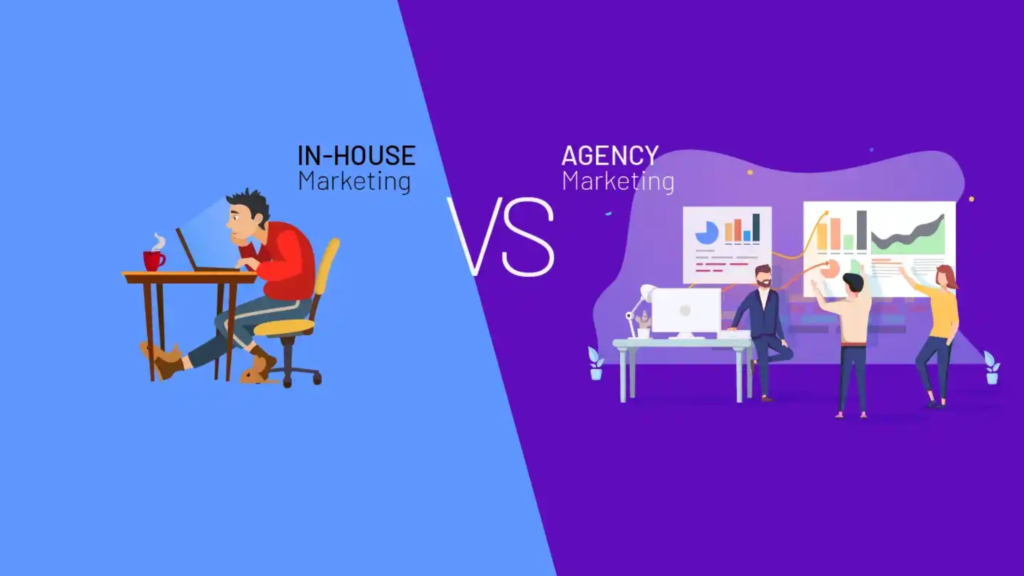
The choice between building an in-house team and partnering with an agency is not about which model is “better.” It is about which model is better for your specific business, at your specific stage, with your specific resources .
Side-by-Side Comparison
| Factor | In-House Team | Marketing Agency | Hybrid Model |
|---|---|---|---|
| Cost structure | Fixed salaries + benefits + overhead + software | Variable monthly retainer + ad spend | Base in-house + agency retainers |
| Typical monthly cost | $15,000–$40,000+ (2-4 person team) | $5,000–$20,000+ (depending on scope) | $10,000–$30,000+ |
| Channel expertise | Deep company knowledge, limited channel depth | Multi-channel specialists, broad experience | Internal insight + external specialization |
| Speed to competency | 3–6 months (recruitment, onboarding, training) | Immediate (proven processes) | Immediate for agency portion |
| Flexibility | Fixed team, difficult to pivot | Easy to scale up/down, switch focus | Maximum adaptability |
| Strategic perspective | Internal, potentially insular | Cross-industry, external benchmarking | Combined internal + external |
| Knowledge retention | Retained in-house | Lost if partnership ends | Partial retention |
When In-House Makes Sense
In-house marketing becomes the right choice when certain conditions are met :
- Proven channel performance: You have one or more channels with documented, profitable performance that can be scaled with additional dedicated resources.
- Clear scaling opportunity: You can see specific opportunities where adding more time and resource will materially increase output, not just maintain it.
- Daily integration requirements: Your marketing must be tightly integrated with sales, product development, or operations on a daily basis.
- Deep proprietary knowledge: Your business requires specialized product, market, or brand knowledge that is difficult to transfer to external partners.
- Budget for specialists: You can afford to hire channel specialists, not generalists. One person cannot effectively cover SEO, PPC, content, email, and social at a competitive level .
- Long-term commitment: You are prepared for the training, overhead, and management responsibilities of an internal team.
The risk of premature in-house hiring: As Tim Cameron-Kitchen, founder of Exposure Ninja, warns: “Until a particular marketing channel and an approach are proven, it doesn’t really make sense to take the risk on building out an in-house team. Agencies give you optionality. You can change the approach, change specialists, or change partners. Once someone is on payroll, you are committed” .
When an Agency Makes Sense
Hiring an ecommerce marketing agency is the better choice when :
- Proven product, unproven scaling: You have a product or service with proven demand, but you need expert help to scale acquisition efficiently.
- Channel expertise gaps: Your marketing team lacks specialized knowledge in key channels, and you need multi-channel depth.
- Speed and flexibility requirements: You want to move quickly without the time and cost of building permanent teams for each channel.
- Budget constraints: You need access to a full team of specialists at a fraction of the cost of hiring them internally .
- Fresh perspective needed: Your marketing has become stale, and you need external benchmarking and innovative approaches.
- Seasonal or project-based needs: You require surge capacity for peak seasons (Black Friday, holiday) without year-round fixed costs.
- You have a product with proven demand
- You can commit marketing budget for 6–12+ months (not a short-term test)
- You have clear internal ownership of marketing strategy and priorities
- You can give fast access to information and approvals
- You have identified specific gaps in your current marketing capabilities
- Your growth goals exceed what a small in-house team can realistically deliver
The Hybrid Model – Best of Both Worlds
Most successful growing businesses ultimately adopt a hybrid model :
- An in-house marketing lead who owns commercial context, internal priorities, and cross-functional alignment
- An agency or multiple agencies that own channel strategy, execution, optimization, and performance
The in-house lead brings understanding of product, market, sales process, and commercial goals. The agency brings specialist expertise across channels and turns those goals into coherent growth strategy and execution .
- You have strong internal understanding but need channel specialization
- You require a joined-up strategy across multiple channels
- You need specialist execution without building permanent teams for each channel
- You want external perspective and industry benchmarking
- You aim to scale faster than a small internal team can deliver
The True Cost of Agency vs. In-House (2026 Benchmarks)
Surface-level cost comparisons can be misleading. Let’s examine the complete economics.
In-House Team Costs
A fully-loaded in-house marketing team includes far more than salary :
| Role | Base Salary (US) | Fully-Loaded Cost* |
|---|---|---|
| Digital Marketing Manager | $60,000–$80,000 | $80,000–$105,000 |
| Social Media Manager | $55,000–$75,000 | $70,000–$98,000 |
| Content Marketing Manager | $65,000–$85,000 | $85,000–$110,000 |
| Email Marketing Manager | $65,000–$85,000 | $85,000–$110,000 |
| Paid Search Manager | $70,000–$90,000 | $90,000–$117,000 |
| SEO Manager | $65,000–$85,000 | $85,000–$110,000 |
*Fully-loaded includes benefits (20–30%), payroll taxes, equipment, training, software licenses, and management overhead .
To build a minimally functional in-house marketing team covering paid media, content, email, and social, you are looking at $300,000–$450,000+ annually—before ad spend.
Agency Cost Benchmarks
Agency costs are more straightforward :
| Agency Type | Typical Monthly Retainer | Annual Investment |
|---|---|---|
| Freelance/solo specialist | $2,000–$5,000 | $24,000–$60,000 |
| Boutique specialized agency | $5,000–$10,000 | $60,000–$120,000 |
| Full-service agency | $10,000–$20,000 | $120,000–$240,000 |
| Enterprise/performance agency | $20,000–$50,000+ | $240,000–$600,000+ |
The economic reality: For the cost of one mid-level in-house hire, you can access a full specialized agency team with expertise across multiple channels, established processes, and a track record of results .
Step-by-Step Guide – How to Select the Right Ecommerce Marketing Agency
Phase 1 – Internal Diagnosis (Before You Search)
The single greatest mistake in agency hiring is beginning the search before defining the problem .
Answer these questions first:
- What specific business metric is underperforming? (ROAS? AOV? Conversion rate? LTV? Retention rate?)
- Where in the customer journey does the failure manifest? (Acquisition? Cart abandonment? Post-purchase engagement? Repeat rate?)
- What channels are currently underperforming, and what have you already attempted?
- What is your budget for agency services? Be realistic about what you can sustain for 12+ months.
- What are your expectations for the partnership? How much involvement do you want? What level of reporting do you need?
- What is your timeline? Are you preparing for a specific event (Black Friday, product launch, peak season)?
Goal clarity is essential: As Behdad Jamshidi, founder of CJAM Marketing, notes: “It’s common for businesses to go through three to five agencies before finding one that truly delivers.” This cycle of onboarding, experimenting, and parting ways can set you back years .
Phase 2 – Agency Identification and Vetting
Source 1: Verified Partner Networks
- Shopify Experts Marketplace – 2,000+ vetted agencies and freelancers
- BigCommerce Partner Directory
- Adobe Solution Partner Program
Source 2: Industry Referrals
- Non-competing brands in your space
- Peer recommendations from ecommerce communities
- Industry conferences and events
Source 3: Direct Outreach
- Agencies whose case studies feature brands similar to yours
- Agencies whose content demonstrates deep expertise
Step 1: Portfolio and case study review
- Have they worked with businesses in your industry or with similar goals?
- What specific results did they achieve? (Look for quantified outcomes, not vague testimonials)
- Do the results seem sustainable and replicable?
Step 2: Team assessment
- Who will actually work on your account? (Not just the sales team)
- What are their credentials and experience?
- Is the team size appropriate for your scope of work?
Step 3: Platform expertise verification
- Do they understand your specific ecommerce platform?
- Have they completed certifications relevant to your tech stack?
Step 4: Communication and culture assessment
- How responsive are they during the sales process?
- Does their communication style align with your preferences?
- Do they ask thoughtful questions about your business?
Questions to ask potential agencies :
- “Walk me through your typical engagement process from onboarding to ongoing optimization.”
- “How do you structure reporting, and what metrics do you prioritize?”
- “Who will be our day-to-day contact, and what is their background?”
- “Can you provide references from current or former clients—particularly any where the relationship ended?”
- “What is your philosophy on [your specific channel of interest]?”
- “How do you handle attribution across multiple channels?”
- “What happens if we disagree on strategy?”
Phase 3 – Reference Verification with Precision
Generic reference checks yield generic insights. Director-level verification requires specific inquiry .
Ask references:
- “On a scale of 1-10, how would you rate their strategic thinking versus execution capability?”
- “Describe a time when a campaign underperformed. How did they respond?”
- “How accessible is the team during urgent situations (e.g., Black Friday issues, ad account problems)?”
- “What do you wish you had known before starting the engagement?”
- “Would you hire them again? Why or why not?”
Phase 4 – Engagement Structuring
A professional agency engagement is defined by scope, not vague promises .
Required elements of an agency SOW:
- Business objectives: The commercial outcomes the engagement is designed to achieve (e.g., “Improve ROAS by 20%,” not “Manage Google Ads”)
- Scope of work: Explicit definition of what the agency will do—and what they will not do
- Deliverables: Tangible outputs—campaigns, reports, strategies, optimizations
- Client responsibilities: What you and your team must provide (access, approvals, content, feedback)
- KPIs and reporting: How success will be measured, and at what cadence
- Timeline and milestones: Specific dates for specific deliverables
- Cost structure: Monthly retainer, setup fees, ad spend budget, performance incentives
- Termination provisions: Conditions under which either party can exit
Red flags in agency proposals :
- Guarantees of specific results in unrealistic timeframes
- Inability to articulate methodology or engagement process
- Resistance to speaking with current or former clients
- Unclear about who will actually work on your account
- Pressure to sign long-term contracts without performance clauses
Common Ecommerce Marketing Agency Mistakes (And How to Avoid Them)
Mistake 1 – Hiring an Agency Before You’re Ready
The error: Engaging an agency before you have proven product-market fit, clear unit economics, or the internal capacity to act on recommendations .
The consequence: As Tim Cameron-Kitchen warns: “Hiring an agency too early can actually be really damaging. The best SEO agency or best AI Search Optimization agency in the world will not be able to sell a bad product or something people don’t want” .
Avoidance: Ensure you have a product with proven demand, clear positioning, and the ability to scale before investing in agency partnership. An agency’s role is to scale demand, not create it from nothing.
Mistake 2 – Choosing Based on Price Alone
The error: Selecting the lowest-cost agency to “test the waters” or maximize short-term budget.
The consequence: You get what you pay for—inexperienced practitioners, junior resources, generic strategies, and ultimately, wasted ad spend that far exceeds the “savings” on agency fees.
Avoidance: Evaluate based on expertise, track record, and strategic fit. The cheapest option is almost never the most cost-effective when measured against opportunity cost.
Mistake 3 – Failing to Define Success Metrics
The error: Engaging an agency without agreeing on how success will be measured, leading to misaligned expectations and eventual disappointment.
The consequence: The agency celebrates activity (campaigns launched, reports delivered) while you measure results (revenue, ROAS, LTV). Both parties become frustrated.
Avoidance: Define KPIs in the contract. Agree on reporting cadence. Ensure both parties understand what “winning” looks like.
Mistake 4 – Micromanaging Execution
The error: Hiring experts and then telling them exactly how to do their job—approving every ad, editing every subject line, questioning every optimization.
The consequence: You pay agency rates for what amounts to administrative support. Strategic value is lost. The best talent will leave for clients who trust their expertise.
Avoidance: Set clear objectives, establish boundaries, and then give the agency room to execute. Provide feedback on results, not on tactics.
Mistake 5 – Short-Term Commitment Expectations
The error: Expecting transformative results in 60–90 days and terminating the engagement when they don’t materialize immediately.
The consequence: You cycle through agencies every quarter, never allowing enough time for strategies to mature, channels to optimize, or relationships to deepen.
Avoidance: As Exposure Ninja notes: “Our award-winning, strongest client results we’ve ever produced came from businesses that committed for 12 months or more” . Plan for a 12-month minimum partnership.
Mistake 6 – Ignoring Internal Readiness
The error: Engaging an agency without ensuring internal stakeholders have the time, authority, and willingness to collaborate.
The consequence: Slow approvals, delayed feedback, and missed opportunities. The agency’s momentum stalls; results suffer.
Avoidance: Before signing, ensure you have a designated internal lead with decision authority and dedicated time for agency collaboration. Agencies cannot succeed without responsive clients.
Mistake 7 – Falling for Vanity Metrics
The error: Celebrating impressions, clicks, and traffic while ignoring revenue, ROAS, and contribution margin.
The consequence: You feel good about marketing activity while the business fails to grow profitably.
Avoidance: Insist on revenue-based reporting. A great agency will want to be measured by commercial outcomes, not vanity metrics.
Expert Tips and Best Practices for 2026
1. Strategy Before Tactics
As Behdad Jamshidi emphasizes: “Having a clear marketing strategy is crucial before engaging with any agency” . The best agency relationships begin with strategy development, not channel execution.
2. Specialization Matters
Recognize the value of specialized agencies versus “Swiss Army knife” solutions. A specialist will typically outperform a generalist in their domain .
3. The 12-Month Minimum Commitment
Channel development, audience building, and learning algorithms take time. Plan for a 12-month minimum engagement to allow strategies to mature and ROI to compound.
4. Demand Falsifiable Hypotheses
Your agency should enter the engagement with hypotheses that can be proven wrong. “We believe cart abandonment is driven by surprise shipping costs” can be tested. “We will improve performance” cannot.
5. Insist on Knowledge Transfer
The engagement should leave your team more capable than it was found. Look for agencies that prioritize education and empowerment, not dependency.
6. Align Incentives
Consider performance-based compensation structures that align agency incentives with your commercial objectives. When the agency wins only when you win, magic happens.
7. Audit the “Senior-Heavy” Claim
Every agency claims senior-heavy delivery. Request the biographies of the specific individuals who will work on your engagement. Verify their experience, certifications, and case study involvement.
8. Conduct Quarterly Business Reviews
Don’t just review campaign performance. Review the partnership itself. What’s working? What’s not? What could each party do differently to improve outcomes?
9. Trust the Process, Verify the Results
The best agency relationships balance trust with verification. Trust their expertise and methodology. Verify through transparent reporting and independent analytics.
10. Plan for Transition
Even successful partnerships eventually evolve or end. Ensure your contract provides for data ownership, knowledge transfer, and smooth transition when the time comes.
Frequently Asked Questions (FAQ)
1. What is an ecommerce marketing agency?
An ecommerce marketing agency is a specialized business-to-business entity that provides strategic marketing services exclusively or primarily to companies selling products or services online. Services include paid advertising, SEO, email marketing, conversion optimization, content creation, and marketplace management .
2. What is the difference between a generalist agency and an ecommerce marketing agency?
Generalist agencies focus on brand awareness and lead generation across industries. Ecommerce marketing agencies specialize in the unique dynamics of online retail: product catalog optimization, shopping feed management, checkout conversion, and the complex interplay between channels that drives ecommerce revenue .
3. How much does an ecommerce marketing agency cost?
Costs range from $2,000–$5,000/month for freelance specialists to $10,000–$20,000/month for full-service agencies, and $20,000–$50,000+/month for enterprise performance agencies. Ad spend is typically separate .
4. Is an agency cheaper than an in-house marketing team?
Yes, for most growing businesses. The fully-loaded cost of a 2–4 person in-house team is $300,000–$450,000+ annually. For the same investment, you can access a full specialized agency team with multi-channel expertise, established processes, and a proven track record .
5. When should I hire an ecommerce marketing agency?
Hire an agency when: you have a product with proven demand; you lack specialized channel expertise; you need to scale faster than a small in-house team can deliver; you want external perspective and benchmarking; or you need surge capacity for peak seasons .
6. When should I build an in-house team instead?
Build in-house when: you have one or more channels with proven, profitable performance; you can clearly see scaling opportunities; your marketing requires daily integration with sales or operations; you have the budget to hire specialists (not generalists); and you are prepared for long-term commitment .
7. What is the hybrid agency-in-house model?
The hybrid model combines an in-house marketing lead (who owns commercial context and internal alignment) with an agency or multiple agencies (who own channel strategy, execution, and optimization). This combines internal insight with external specialization .
8. What ROI can I expect from an ecommerce marketing agency?
Documented case studies show: 41x ROI on email marketing; 59% higher ROAS on Google PMax; 31.5% increase in AOV; 32% reduction in ad spend while maintaining sales; and 30–60% traffic/conversion improvements .
9. What are the different types of ecommerce marketing agencies?
The five main types are: full-service agencies, specialized agencies (one or two channels), platform-specific agencies (Shopify, Magento, etc.), B2B ecommerce agencies, and performance marketing agencies .
10. How do I choose the right ecommerce marketing agency?
Define your goals first, then: review portfolios and case studies, assess team credentials, verify platform expertise, check references thoroughly, and ensure communication and culture alignment. Never skip reference verification .
11. What questions should I ask before hiring an agency?
Ask: Who will work on my account? What is your methodology? Can you provide relevant case studies? How do you structure reporting? What happens if we disagree on strategy? Can I speak with current or former clients?
12. How long should an agency engagement last?
Plan for a 12-month minimum commitment. The strongest results come from businesses that commit long-term, allowing strategies to mature, channels to optimize, and relationships to deepen .
13. What is the biggest mistake when hiring ecommerce agencies?
The biggest mistake is hiring before you’re ready—engaging an agency before you have proven product-market fit, clear unit economics, or internal capacity to act on recommendations. The second biggest: choosing based on price alone .
14. How do I measure agency performance?
Measure against agreed-upon KPIs tied to commercial outcomes: ROAS, CPA, AOV, LTV, conversion rate, revenue growth, and contribution margin. Avoid vanity metrics like impressions and clicks without revenue context .
15. Can I work with multiple specialized agencies?
Yes, many businesses do. This requires strong internal coordination or a lead agency to ensure integrated strategy. The risk is channel silos and finger-pointing when performance lags .
16. What is the difference between a full-service and specialized agency?
Full-service agencies offer end-to-end marketing across multiple channels. Specialized agencies focus deeply on one or two disciplines (email, paid media, SEO). Choose based on whether you need integrated strategy or channel-specific depth .
17. Do I need a platform-specific agency?
If you require deep platform expertise—migration, custom development, platform-native marketing features—a platform-specific agency (Shopify Plus Partner, Magento Specialist) is valuable. For standard marketing, general ecommerce expertise suffices .
18. What should be included in an agency contract?
Business objectives, scope of work, deliverables, client responsibilities, KPIs and reporting cadence, timeline and milestones, cost structure, and termination provisions. Both parties should understand what “winning” looks like .
19. How do I transition if my agency partnership isn’t working?
First, conduct a candid QBR to address issues. If transition is necessary, ensure contract provides for
Conclusion:
The decision to engage an ecommerce marketing agency is not a sign of weakness. It is not an admission that your internal team has failed. It is not a luxury reserved for enterprise brands with unlimited budgets.
It is, quite simply, one of the most leveraged investments a growing ecommerce business can make.
The numbers do not lie. A beauty brand transformed a neglected email channel from 6% to 45% of total revenue, achieving 41x ROI. A menswear brand reduced ad spend by 32% while increasing ROAS by 59%. A luxury apparel brand doubled its return on advertising spend. These are not outliers. They are the predictable outcomes of bringing specialized expertise, cross-industry pattern recognition, and disciplined execution to bear on ecommerce growth challenges.
But these outcomes are not automatic. They require something from you.
They require clarity. Before you search for an agency, you must define the problem with surgical precision. Which metric is underperforming? Where in the customer journey does the failure manifest? What have you already attempted? Agencies are not magicians. They are expert partners who need a clear brief to deliver exceptional results.
They require commitment. The strongest agency relationships are measured in years, not months. Channel development takes time. Audience building compounds slowly. Algorithms learn through iteration. The businesses that cycle through agencies every quarter never experience the compound returns of a mature partnership.
They require partnership. The best agencies cannot succeed without responsive clients. They need timely feedback, clear decisions, and access to information. If you hire experts and then micromanage their execution, you will pay agency rates for what amounts to administrative support. The magic happens when you set clear objectives and trust the process.
They require honesty. Be transparent about your budget, your constraints, and your expectations. A consultant cannot defend a recommendation they did not know was vulnerable. An agency cannot optimize for outcomes you have not articulated.
The path forward is clear:
- Diagnose before you search. Define the problem, the metric, and the opportunity. You are hiring a surgeon, not a general practitioner.
- Match agency type to need. Full-service for integrated transformation. Specialized for channel-specific scaling. Platform-specific for technical depth. Choose the model that fits your stage.
- Commit for the long term. Plan for 12 months minimum. The strongest results come from sustained partnership, not short-term experiments.
- Structure for outcomes. Define success metrics in the contract. Align incentives. Pay for performance where possible.
- Be a great partner. Respond promptly. Provide clear feedback. Give the agency room to execute. The best clients attract the best agency talent.
The ecommerce landscape in 2026 is more competitive, more complex, and more demanding than ever before. No single founder, no matter how talented, possesses perfect expertise across every channel. No internal team, no matter how dedicated, can match the cross-industry pattern recognition of a specialized agency that lives and breathes ecommerce marketing every day.