Table of Contents
Introduction
eBay product hunting is one of the most important steps for anyone who wants to build a successful selling business on eBay. Many sellers struggle not because they lack effort or marketing skills, but because they choose the wrong products. Selling on eBay is highly competitive, and success depends largely on finding products that have strong demand, reasonable competition, and healthy profit margins.
Unlike random product selection, eBay product hunting is a structured research process. It focuses on understanding buyer behavior, market trends, pricing patterns, and competition levels. When done correctly, product hunting reduces risk and increases the chances of consistent sales and long-term growth.
What Is eBay Product Hunting?
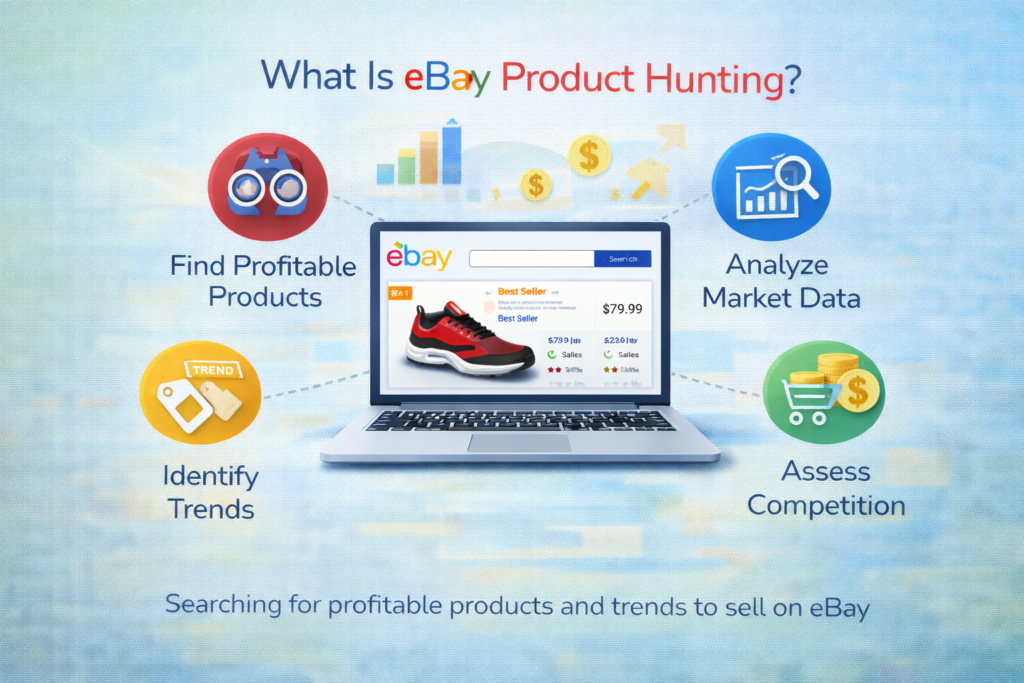
eBay product hunting refers to the process of researching, analyzing, and selecting products that are likely to sell well on eBay. It involves identifying products that people are actively searching for and purchasing, while also ensuring that competition and costs remain manageable.
Product hunting is not about copying bestsellers blindly. Instead, it is about discovering opportunities—products with demand gaps, under-served niches, or poor existing listings that can be improved. Effective product hunting combines data analysis with market insight.
Why eBay Product Hunting Is Critical for Success
On eBay, thousands of sellers may offer similar products. Without proper product research, sellers often enter oversaturated markets where profits are low and competition is intense. eBay product hunting helps sellers avoid these mistakes by identifying products with real earning potential.
Choosing the right product affects everything—from sourcing and pricing to advertising and customer satisfaction. A well-researched product is easier to market, attracts organic buyers, and generates repeat sales. This is why product hunting is the foundation of every profitable eBay business.
Understanding Buyer Intent on eBay
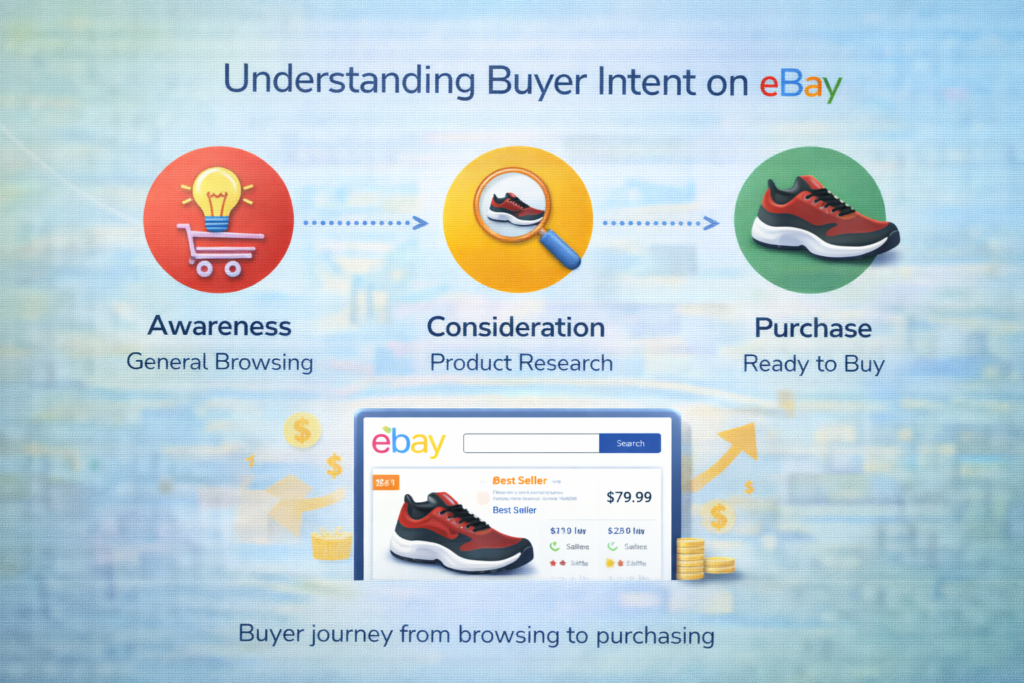
Successful eBay product hunting begins with understanding buyer intent. Buyers on eBay often search with clear purchase intent, meaning they already know what they want. This makes eBay different from purely browsing platforms.
Analyzing search terms, completed listings, and sold items helps sellers understand what buyers are actively purchasing. Products with consistent sales history indicate strong demand and reliable opportunities.
Demand Analysis for eBay Product Hunting
Demand is the first and most important factor in product hunting. If buyers are not purchasing a product, no strategy can make it profitable. Demand analysis involves checking how frequently products sell, not just how often they are listed.
In eBay product hunting, sold listings provide valuable insight into demand. Products with regular sales across multiple sellers often indicate a healthy market. Consistent demand is far more valuable than short-term trends.
Competition Analysis on eBay
Competition analysis helps sellers understand how difficult it will be to enter a market. High competition does not automatically mean failure, but it does require better pricing, listings, or differentiation.
When hunting products, sellers should look for categories where listings have weak titles, poor images, or unclear descriptions. These weaknesses signal opportunities for improvement and differentiation.
Pricing Strategy in eBay Product Hunting
Pricing plays a major role in determining profitability. Successful eBay product hunting involves understanding the average selling price, not just the lowest price available.
Sellers should analyze completed listings to see what buyers are actually willing to pay. Products with stable pricing and healthy margins after fees and shipping are ideal targets for eBay sellers.
New vs Used Products in eBay Product Hunting
One unique advantage of eBay is the ability to sell both new and used products. eBay product hunting should consider which condition performs better for a given product.
Some products sell better used due to affordability, while others perform best as new items. Understanding this distinction helps sellers position their products more effectively and increase sales potential.
Evergreen vs Trend-Based Products on eBay
Evergreen products have steady demand throughout the year, making them ideal for long-term selling. Trend-based products can generate fast sales but carry higher risk.
Smart eBay product hunting focuses primarily on evergreen products while selectively testing trends. This balanced approach reduces dependency on unpredictable demand spikes.
Beginner-Friendly Product Categories
For beginners, certain categories are easier to start with due to lower competition and fewer restrictions. Lightweight, non-fragile products with simple specifications are often easier to manage.
Choosing beginner-friendly categories reduces operational complexity and allows sellers to focus on learning the platform and optimizing listings.
Common Mistakes in eBay Product Hunting
A common mistake is selecting products based solely on personal interest rather than demand. Another frequent error is ignoring fees, shipping costs, or competition intensity.
Rushing product selection without proper analysis often leads to losses. Effective eBay product hunting requires patience, research, and data-driven decision-making.
Step-by-Step Process for eBay Product Hunting
Successful eBay product hunting always follows a clear and structured process. Random searching wastes time and leads to poor product choices. The first step is selecting a broad category that matches your budget, storage capacity, and shipping ability. Once the category is chosen, narrow it down to specific product types.
Next, analyze demand using sold listings rather than active listings. Sold listings show what buyers are actually purchasing, not just what sellers are trying to sell. Products with frequent recent sales indicate real demand and are strong candidates for further research.
Using Sold Listings for Accurate Demand Research
Sold listings are the most powerful feature for eBay product hunting. They provide direct proof of buyer interest and pricing behavior. A product that sells repeatedly across different sellers is far more reliable than a product with hundreds of unsold listings.
When reviewing sold listings, focus on sales frequency, consistency, and pricing range. Products that sell every few days or weekly indicate stable demand. This data helps eliminate guesswork and reduces the risk of choosing products with no real buyers.
How to Identify Low-Competition Products on eBay
Low-competition products are the hidden opportunities on eBay. These products usually exist in niches where sellers have weak listings, poor images, or unclear titles. Instead of avoiding competition completely, smart eBay product hunting looks for weak competition.
Signs of weak competition include low-quality photos, incomplete descriptions, poor keyword usage, and inconsistent pricing. If top sellers are not optimizing their listings, new sellers can outperform them with better presentation and customer focus.
Keyword-Based eBay Product Hunting
Keyword research plays an important role in discovering profitable products. Buyers on eBay search using specific terms that reflect strong buying intent. Finding products with consistent keyword searches helps ensure demand exists before listing.
Search suggestions, category filters, and sold listing keywords reveal what buyers are actively looking for. Products that appear repeatedly in search results and sales history are strong candidates for listing.
Price & Profit Analysis During Product Hunting
Finding demand alone is not enough. eBay product hunting must also include profitability analysis. Sellers should calculate total costs including product cost, shipping, eBay fees, packaging, and returns.
A product may sell frequently but still be unprofitable due to thin margins. The ideal products have stable selling prices and enough margin to cover all costs while leaving profit. Always analyze profit before committing inventory.
New vs Used Products: Strategic Selection
One advantage of eBay is flexibility in selling both new and used products. Product hunting should consider which condition performs better. Some items sell faster used due to affordability, while others require new condition for buyer trust.
Used products often face less competition and allow higher margins if sourced correctly. New products may require stronger branding and pricing strategies. Choosing the right condition improves success rates.
Trend-Based vs Evergreen Product Hunting
Evergreen products sell year-round and provide predictable income. Trend-based products can generate fast sales but are short-lived. Smart eBay product hunting prioritizes evergreen products while testing trends cautiously.
Evergreen products allow sellers to build stable stores and repeat customers. Trend products should be used strategically and not relied upon as the sole business model.
Manual vs Tool-Based Product Hunting
Product hunting can be done manually or with tools. Manual research builds strong market understanding, while tools save time and provide data insights. The best sellers combine both approaches.
Manual research helps identify customer behavior and listing weaknesses. Tools help validate demand, pricing, and competition. Together, they create a powerful product research strategy.
Product Validation Before Listing
Before listing a product, validation is essential. Sellers can test demand with limited inventory or a small listing run. This minimizes risk and confirms real buyer interest.
Validation ensures that time and money are invested in products with proven potential. Many successful sellers credit validation as the key to consistent eBay success.
Common Mistakes in Advanced eBay Product Hunting
One common mistake is copying competitors without improving listings. Another is ignoring shipping costs or return rates. Some sellers also chase trends blindly without validating demand.
Effective eBay product hunting is disciplined and data-driven. Sellers who follow structured research methods avoid costly mistakes and build sustainable businesses.
Scaling After Successful eBay Product Hunting
Once your eBay product hunting efforts identify products with consistent sales, the next step is scaling responsibly. Scaling does not mean adding dozens of products at once. Instead, it means increasing depth where data already proves success. This can include listing variations, quantity breaks, or expanding into closely related SKUs within the same niche.
Successful sellers scale by reinvesting profits into inventory and listing quality rather than rushing into unrelated categories. Controlled scaling protects seller metrics, maintains cash flow, and prevents operational overload.
Advanced Listing Optimization for Higher Conversions
Even the best products underperform without optimized listings. Advanced optimization focuses on buyer intent, clarity, and trust. Titles should include high-intent keywords naturally, images must clearly show condition and usage, and descriptions should answer common buyer questions upfront.
Optimized item specifics improve visibility in search filters. Clear return policies, fast handling times, and competitive shipping options further boost conversion rates. Strong listings are a force multiplier for eBay product hunting—turning good products into great sellers.
Inventory Management & Reordering Strategy
Inventory control is critical as sales increase. Overstocking ties up cash, while understocking causes missed sales and ranking drops. Sellers should track sell-through rate, lead times, and seasonal demand to plan reorders accurately.
A data-driven reordering strategy ensures consistent availability without excess risk. Many top sellers maintain a minimum and maximum stock level per SKU to balance cash flow and demand.
Pricing Optimization Without Racing to the Bottom
Price wars destroy margins. Instead of competing solely on price, successful sellers compete on value—better images, clearer descriptions, faster shipping, and strong service. Strategic pricing includes small tests to find the optimal balance between conversion rate and profit per sale.
Periodic price reviews help adapt to market changes. Bundles, quantity discounts, and promotions during high-traffic periods can increase average order value without permanently lowering prices.
Using Analytics to Guide Product Decisions
Analytics turn eBay product hunting into a repeatable system. Track metrics like impressions, click-through rate, conversion rate, sell-through, and return rate. These signals reveal which products deserve scaling and which should be paused or improved.
Data-driven sellers adjust titles, images, pricing, and inventory based on evidence—not assumptions—leading to steadier growth and fewer surprises.
Building a Brand on eBay
Branding matters even on marketplaces. Consistent visuals, reliable quality, and responsive support build trust and repeat purchases. Over time, buyers recognize your store and return for similar products, reducing dependence on constant new listings.
A simple brand identity—logo, store banner, consistent packaging—adds professionalism and supports premium pricing.
Risk Management & Policy Awareness
eBay policies evolve. Sellers should stay compliant with category rules, condition guidelines, and performance standards. Diversifying suppliers and avoiding reliance on a single SKU reduces operational risk.
Document processes for sourcing, listing, shipping, and customer service to maintain consistency as the business grows.
Frequently Asked Questions (FAQs)
What is the fastest way to do eBay product hunting?
Use sold listings to confirm demand, then validate pricing and margins. Speed comes from focusing on proof of sales, not guesses.
Are low-competition products always better?
Not always. Moderate competition with weak listings often offers the best opportunity because demand is proven and differentiation is possible.
Should beginners sell new or used products?
Both work. Used items often have less competition; new items scale better with suppliers. Choose based on sourcing and margins.
How many products should I test at once?
Start small. Test a few SKUs, analyze results, then scale winners. Quality beats quantity.
How long does validation take?
Typically a few weeks. Look for consistent sales signals rather than one-off purchases.
How do I know if a product is really profitable on eBay?
A product is profitable on eBay when its selling price minus product cost, shipping, eBay fees, and returns still leaves a healthy margin. Always check sold listings, calculate all costs, and aim for products with consistent sales rather than one-time spikes.
Is eBay product hunting different from Amazon product research?
Yes. eBay product hunting focuses more on sold listings, buyer intent, and flexible pricing, while Amazon research relies heavily on ranking and reviews. eBay allows easier entry with used items, auctions, and niche products, making it more beginner-friendly in many cases.
Can I do eBay product hunting without paid tools?
Yes. Many successful sellers use manual research, especially sold listings, category filters, and keyword suggestions. Paid tools save time, but they are not required to find profitable products if research is done properly.
How many sold listings should a product have to show demand?
There is no fixed number, but a good sign is multiple sales per week across different sellers. Consistent sales over time are more important than high volume in a short period.
Are trending products good for eBay product hunting?
Trending products can be profitable but risky. They often attract heavy competition quickly. Smart sellers use trends for short-term gains while relying on evergreen products for long-term stability.
What price range works best for beginners on eBay?
Beginner sellers usually do better in low-to-mid price ranges, where buyer trust is easier to build and financial risk is lower. Products should still allow enough margin after fees and shipping.
How important are product condition and item specifics?
Very important. On eBay, buyers pay close attention to condition (new, used, refurbished) and item specifics. Accurate details improve trust, visibility in search filters, and conversion rates.
Should I avoid categories with big brand sellers?
Not always. Large brands confirm demand, but competing directly with them is difficult. Instead, look for sub-niches or accessory products within those categories where big brands are less focused.
How long should I test a product before scaling it?
Most sellers test a product for 2–4 weeks. If sales are consistent and returns are low, the product is a good candidate for scaling. Avoid scaling based on just one or two sales.
Can eBay product hunting work for dropshipping?
Yes, but sellers must be careful. Product hunting is even more important in dropshipping because margins are thinner and shipping times matter. Choose products with reliable suppliers and clear buyer expectations.
What are the biggest mistakes beginners make in eBay product hunting?
Common mistakes include:
- Choosing products without checking sold listings
- Ignoring eBay fees and shipping costs
- Copying competitors without improving listings
- Scaling too fast without validation
Avoiding these mistakes greatly increases success chances.
How often should I do eBay product hunting?
Product hunting should be continuous. Markets change, competition increases, and new opportunities appear. Successful sellers regularly research new products while optimizing existing ones.
Can eBay product hunting become a long-term business strategy?
Yes. Many full-time sellers rely entirely on eBay product hunting. When combined with branding, inventory control, and customer service, it becomes a stable and scalable business model.
Final Conclusion:
Effective eBay product hunting is the foundation of a profitable and scalable eBay business. By focusing on real buyer demand, manageable competition, and healthy margins, sellers avoid common pitfalls and build predictable revenue. The most successful sellers combine structured research, disciplined validation, and continuous optimization.
Industry guidance supports this approach. eBay’s own seller education emphasizes data-driven research, listing quality, and customer experience as keys to long-term success (external dofollow link:
https://www.ebay.com/sellercenter). Likewise, market insights highlight the importance of analyzing sold data and optimizing listings to outperform competitors (external dofollow link:
https://www.shopify.com/blog/ebay-selling).
For more step-by-step frameworks on product research, validation, and scaling, explore our in-depth ecommerce resources (internal dofollow link example:
https://rankifycontent.com/ebay-product-research-guide).
In conclusion, eBay product hunting is not a one-time task—it’s a continuous system. Sellers who research carefully, validate intelligently, and scale responsibly build durable eBay businesses that grow year after year.