Table of Contents
Introduction: The Digital Revolution in Business-to-Business Trade
The landscape of B2B commerce has undergone a seismic shift. Gone are the days when business purchasing was solely reliant on phone calls, paper catalogs, and in-person sales reps. Today, we stand at the forefront of a digital transformation, where B2B ecommerce is no longer a luxury or a forward-thinking initiative—it is an absolute imperative for survival, growth, and market leadership. According to a report by Forrester, U.S. B2B ecommerce sales are projected to reach $3 trillion by 2027, accounting for over 20% of all B2B sales. This isn’t just a trend; it’s a fundamental restructuring of how businesses discover, evaluate, and procure the goods and services they need to operate.

But what exactly is B2B ecommerce? At its core, it is the online sale of products, services, or information between businesses. However, modern B2B ecommerce platforms are far more than simple digital storefronts. They are sophisticated, integrated commerce engines that handle complex pricing, multi-tiered customer roles, intricate product catalogs, and seamless backend integration with Enterprise Resource Planning (ERP), Customer Relationship Management (CRM), and supply chain systems.
This comprehensive guide delves deep into the multifaceted benefits of B2B ecommerce, moving beyond surface-level advantages to explore the strategic, operational, and financial impacts that a well-executed digital commerce strategy can deliver. Whether you are a manufacturer, distributor, or wholesaler, understanding and harnessing these benefits is key to thriving in the modern economy.
Understanding the Modern B2B Buyer and the Digital Imperative
To fully appreciate the benefits, one must first understand the modern B2B buyer. Today’s B2B decision-makers are digital natives. A landmark study by McKinsey & Company reveals that over 80% of B2B buyers prefer digital self-service and remote human interactions over traditional sales methods. These buyers:
- Conduct extensive online research before ever contacting a salesperson.
- Expect a consumer-like (B2C) shopping experience: intuitive, fast, and personalized.
- Demand real-time information on pricing, inventory, and order status.
- Use multiple devices throughout their purchasing journey.
Failing to meet these expectations means losing deals to competitors who offer a superior digital experience. Therefore, the primary benefit of B2B ecommerce is meeting your customers where they are. It’s about providing the seamless, efficient, and informed buying process they now demand as standard.
Core Benefits of B2B Ecommerce: A Deep Dive
Let’s explore the key advantages that a robust B2B ecommerce platform delivers across all facets of your business.
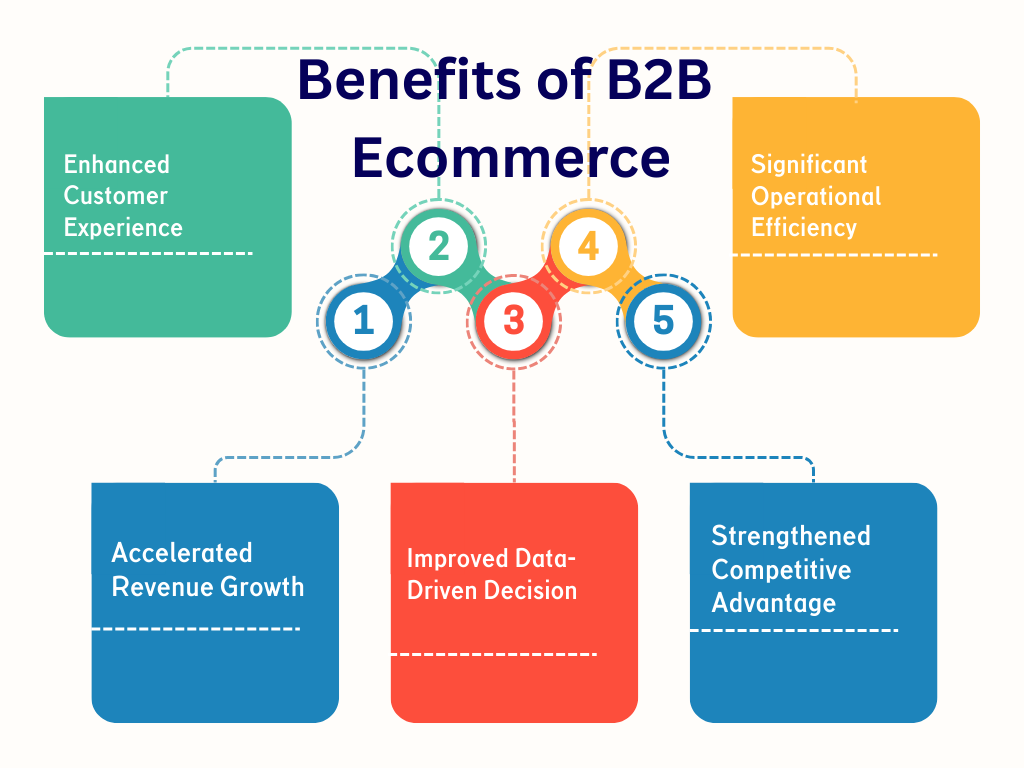
1. Enhanced Customer Experience and Satisfaction
This is the cornerstone of B2B ecommerce success. A superior online experience directly translates to increased loyalty and lifetime value.
- 24/7 Availability & Global Reach: Your digital storefront never closes. Customers can place orders, check specifications, or access invoices anytime, from anywhere in the world, breaking free from time-zone and geographical constraints.
- Personalization at Scale: Modern platforms use data to deliver personalized experiences. This includes custom pricing (based on negotiated contracts or customer tier), tailored product recommendations, dedicated catalogs, and pre-populated reorder lists. For example, a construction supplies distributor can show a contractor only the items relevant to their current project type.
- Streamlined Purchasing Process: Empower buyers with easy search, detailed product information (with CAD files, spec sheets, manuals), bulk ordering, saved carts, and quick reordering. This reduces friction and makes doing business with you effortless.
- Transparency and Self-Service: Customers gain instant access to order histories, real-time inventory levels, shipment tracking, and account statements. This transparency reduces the volume of routine inquiries to your customer service team.
2. Significant Operational Efficiency and Cost Reduction
B2B ecommerce automates manual, time-intensive processes, freeing your team to focus on higher-value activities.
- Automated Order Processing: Orders flow directly from the website into your ERP system without manual data entry. This eliminates errors, speeds up fulfillment, and reduces administrative overhead. According to IBISWorld, automation in order processing can reduce related costs by up to 60%.
- Reduced Burden on Sales and Service Teams: By deflecting routine transactions and inquiries to the self-service portal, your skilled sales reps can focus on complex negotiations, strategic account management, and solving high-level problems rather than processing POs.
- Lower Cost of Sales: While there is an initial investment in the platform, the cost per transaction online is significantly lower than traditional sales channels involving field reps, printed materials, and manual order management.
- Optimized Inventory Management: Integrated platforms provide a unified view of inventory across channels. Better demand forecasting, driven by online sales data, helps reduce carrying costs and minimize stockouts or overstock situations.
3. Accelerated Revenue Growth and Market Expansion
Ecommerce is a powerful engine for driving top-line growth, both from existing customers and new markets.
- Upselling and Cross-Selling: Algorithms can intelligently suggest complementary products or higher-tier items during the browsing and checkout process, increasing average order value (AOV). For instance, an industrial equipment seller can recommend specific maintenance kits when a customer buys a machine.
- Penetration of Existing Accounts: Make it easier for different stakeholders within a client company to purchase. The plant manager, the procurement officer, and the maintenance technician can all find what they need on your portal, driving deeper account penetration.
- Attraction of New Customers: Your website acts as a 24/7 salesperson. A strong SEO strategy (targeting keywords like “industrial parts supplier” or “wholesale distributor”) attracts businesses actively searching for solutions you offer. You can capture leads and sales from companies you may never have reached through traditional outbound sales.
- Launch into New Geographies: With multilingual and multi-currency capabilities, you can serve international markets with minimal incremental cost, testing new regions without establishing a physical sales force there first.
4. Improved Data-Driven Decision Making
A digital commerce platform is a goldmine of actionable data, providing insights previously locked in sales reps’ notebooks or disparate systems.
- Customer Behavior Analytics: Understand what products customers search for, what they view, what they abandon in carts, and their purchase frequency. This data is invaluable for marketing, merchandising, and inventory planning.
- Sales Performance Intelligence: Gain clear visibility into which products, categories, and customer segments are most profitable. Identify trends and forecast demand with greater accuracy.
- Marketing ROI Measurement: Track the performance of digital campaigns, content downloads, and lead sources directly to revenue, allowing for precise optimization of marketing spend.
5. Strengthened Competitive Advantage
In a crowded market, a superior digital experience is a powerful differentiator.
- Brand Perception and Modernity: A professional, easy-to-use ecommerce site positions your company as innovative, customer-centric, and forward-thinking.
- Faster Time-to-Market: Launch new products, promotions, or pricing strategies instantly across your entire customer base.
- Agility and Responsiveness: Digital platforms allow you to quickly adapt to market changes, competitor moves, or supply chain shifts, updating content and offers in real-time.
Actionable Strategy: Building Your B2B Ecommerce Roadmap
Implementing a successful B2B ecommerce platform requires careful planning. Here is a step-by-step guide to building your digital roadmap.
Step 1: Assemble Your Cross-Functional Team
Include stakeholders from sales, marketing, IT, customer service, and operations. Their input is crucial for defining requirements and ensuring adoption.
Step 2: Deeply Analyze Your Customer Journey
Map out every touchpoint a customer has with your business, from awareness to reorder. Identify pain points (e.g., “hard to find technical specs,” “slow quote process”) that your ecommerce site must solve.
Step 3: Define Core Requirements & Select a Platform
List must-have features: integration with your ERP/CRM, complex pricing models, customer-specific catalogs, quote management, etc. Evaluate dedicated B2B ecommerce platforms (like BigCommerce B2B, Shopify Plus, Adobe Commerce) against these needs, prioritizing flexibility and integration capabilities over superficial features.
Step 4: Prioritize Integration Over Aesthetics
Your #1 technical priority must be deep, bidirectional integration with your backend systems (ERP, PIM, CRM). Data accuracy (inventory, price, customer info) is more critical than a flashy design.
Step 5: Develop a Phased Rollout Plan
Start with a pilot for a segment of trusted customers. Gather feedback, iterate, and then expand functionality and user base. Consider launching core catalog and ordering first, followed by advanced features like custom price lists and payment portals.
Step 6: Train, Market, and Support
Train both your internal teams (sales, support) and your customers. Use email campaigns, webinars, and dedicated support to drive adoption. Clearly communicate the benefits to the buyer: “Save time on ordering,” “Access your contracts online.”
Common B2B Ecommerce Mistakes and How to Avoid Them
- Mistake: Treating it Like a B2C Project.
Avoidance: Recognize the complexity. Implement role-based access, quote workflows, and minimum order quantities from the start. Don’t force a B2C template onto a B2B process. - Mistake: Poor Product Information.
Avoidance: Invest in a Product Information Management (PIM) system. Provide rich content: high-res images, datasheets, CAD files, compliance certificates, and application guides. - Mistake: Ignoring the Sales Team.
Avoidance: Position the platform as a tool to augment sales, not replace them. Show reps how it frees them from admin tasks and provides them with better customer insights. Consider offering incentives for migrating accounts online. - Mistake: Underestimating the Need for Change Management.
Avoidance: Communicate the “why” clearly and consistently. Involve key users early, provide extensive training, and have a dedicated support channel for the launch phase. - Mistake: Neglecting Mobile Experience.
Avoidance: Ensure your site or platform is fully responsive. B2B buyers are increasingly using mobile devices for research and even purchasing, especially for on-the-go roles like field technicians or plant managers.
Expert Tips and Best Practices for Maximizing ROI
- Focus on Search: Implement robust, facet-driven search with synonyms and typo tolerance. Over 40% of B2B buyers start with a search box.
- Implement a Customer Portal: Go beyond a storefront. Offer a true portal with order tracking, documentation libraries, project-specific ordering, and collaborative tools.
- Leverage AI and Automation: Use AI for personalized product recommendations, predictive search, and intelligent chat support. Automate post-purchase communications like shipping confirmations and backorder notifications.
- Offer Flexible Payment Terms: Integrate with payment solutions that allow net terms, purchase orders, and ACH payments alongside standard credit cards to match existing business processes.
- Continuously Gather Feedback: Use surveys, user testing, and analytics to constantly refine the user experience. The digital journey is never “finished.”
The Future Outlook: Emerging Trends in B2B Ecommerce
The evolution continues. Key trends shaping the future include:
- Headless and Composable Commerce: Businesses are decoupling the front-end presentation layer from the backend commerce logic for greater flexibility, faster innovation, and omnichannel experiences.
- Marketplace Integration: B2B buyers are increasingly open to purchasing through digital marketplaces. Brands and distributors should consider participating in established B2B marketplaces or creating their own.
- Hyper-Personalization with AI: Moving beyond static pricing rules to dynamic, AI-driven personalization of entire experiences, content, and product assortments.
- AR/VR for Product Visualization: Allowing engineers or contractors to visualize industrial equipment in their space or see a 3D model of a complex part.
- Sustainability and Supply Chain Transparency: Buyers want to see the carbon footprint, ethical sourcing, and lifecycle information of the products they purchase, which ecommerce platforms can facilitate.
Frequently Asked Questions (FAQ)
Q1: Isn’t B2B ecommerce only for commoditized, low-cost products?
A: Absolutely not. While it excels for repeat MRO (Maintenance, Repair, and Operations) supplies, it’s increasingly used for complex, configured, and high-value items. The key is providing rich technical content, configurators, and integrating a seamless quote-to-order workflow for high-touch sales scenarios.
Q2: How do I handle complex pricing and negotiated contracts online?
A: Modern B2B platforms are built for this. They allow you to set up customer-specific or role-specific pricing, tiered volume discounts, and contract pricing that is invisible to unauthorized users. The customer logs in and sees only their agreed-upon prices.
Q3: Will an ecommerce site replace my sales team?
A: No, it should transform their role. It automates the transactional part, freeing sales reps to become trusted advisors, focus on strategic accounts, solve complex problems, and nurture relationships—activities that drive higher value.
Q4: What is the typical ROI for a B2B ecommerce investment?
A: ROI manifests in multiple ways: direct sales growth (often 20-40% increase in online-channel revenue), cost reduction (up to 60% in order processing costs), and increased customer satisfaction leading to higher retention. A clear business case should be developed based on your specific metrics.
Q5: How long does it take to implement a B2B ecommerce platform?
A: For a mid-market business with a clear strategy and clean data, a phased implementation can range from 4-9 months. The timeline heavily depends on the complexity of integrations, data quality, and the scope of features in the initial launch.
Q6: How do I ensure data security for my business customers?
A: Choose a platform compliant with major security standards (PCI DSS, SOC 2). Implement robust authentication, role-based access controls, and SSL encryption. Be transparent with your customers about your security measures.
Q7: Can I integrate my ecommerce site with my existing ERP system?
A: Yes, integration is non-negotiable and a core strength of leading B2B platforms. Most offer pre-built connectors or robust APIs (Application Programming Interfaces) for major ERP systems like SAP, Oracle NetSuite, Microsoft Dynamics, and Sage.
Q8: What’s the difference between a B2B and B2C ecommerce platform?
A: B2B platforms are built for business logic: multi-user account hierarchies, complex pricing, bulk ordering, quote management, and procurement workflow integration (like punchout). B2C platforms focus on individual shoppers, promotions, and simpler checkout.
Q9: How important is mobile optimization for B2B?
A: Critically important. A significant portion of B2B research and purchasing happens on mobile devices. A responsive, mobile-friendly site is essential for usability and SEO.
Q10: Where should we start if we’re new to B2B ecommerce?
A: Start with customer and internal stakeholder interviews to document needs. Then, audit your product data and assess your backend system’s integration readiness. Begin with a pilot program targeting a segment of your most digitally-ready customers to prove value and learn quickly.
Conclusion: Embracing the Digital Future of B2B Trade
The benefits of B2B ecommerce are profound and multidimensional. It is a strategic lever that simultaneously enhances customer experience, drives operational efficiency, accelerates revenue growth, and provides a decisive competitive edge. The transition from traditional sales models to a digital-first approach is not without its challenges, but the cost of inaction—lost customers, stagnant growth, and operational inefficiency—is far greater.
The future of B2B is digital, self-service, and personalized. By building a robust, integrated ecommerce presence centered on solving real customer problems, you are not just building a website; you are future-proofing your business, strengthening customer relationships, and unlocking a new era of scalable, data-driven growth. The time to act is now.
You may also benefit from our in-depth guide on scaling ecommerce businesses worldwide
https://rankifycontent.com/international-ecommerce-scaling).
Key Takeaways:
- B2B ecommerce meets the modern buyer’s demand for a seamless, 24/7, self-service digital experience.
- Core benefits span enhanced customer satisfaction, major cost reductions, accelerated revenue growth, and superior data insights.
- Success hinges on deep backend integration, a focus on B2B-specific functionality, and effective change management.
- The future points toward more personalization, agility, and immersive technologies in the B2B buying journey.
- Starting with a strategic, phased approach is crucial for realizing a strong return on investment and long-term competitive advantage.