Table of Contents
Introduction: The Digital Transformation of B2B Commerce
The landscape of B2B commerce has undergone a seismic shift. Gone are the days when business transactions were confined to phone calls, faxes, and lengthy in-person negotiations. Today, B2B ecommerce is not just a convenience; it’s a critical driver of efficiency, growth, and competitive advantage. With global B2B ecommerce sales projected to reach $20.9 trillion by 2027, dwarfing the B2C market, the platform you choose becomes the cornerstone of your digital strategy.
But what separates a basic online storefront from a true enterprise-grade B2B ecommerce platform? It’s the depth and sophistication of its features. A robust platform is more than a catalog—it’s an integrated commerce engine that manages complex pricing, multifaceted customer relationships, and intricate supply chains. This comprehensive guide will dissect the essential, advanced, and emerging features that define a modern B2B ecommerce solution. Whether you’re a manufacturer, distributor, or wholesaler, understanding these features is paramount to selecting a platform that will scale with your business, streamline operations, and deliver an exceptional customer experience.
Understanding the B2B Ecommerce Ecosystem
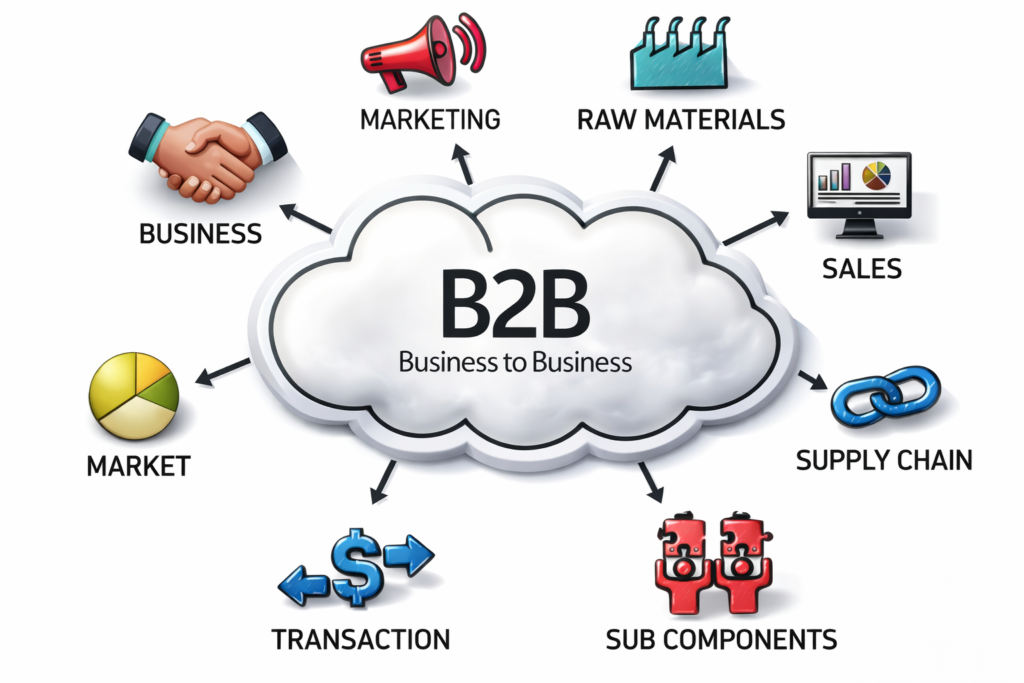
Before diving into features, it’s crucial to understand the unique demands of B2B transactions. Unlike B2C, B2B ecommerce is characterized by:
- Higher Order Values and Complexity: Transactions often involve custom quotes, bulk pricing, and complex configurations.
- Relationship-Driven Sales: Pricing and catalog visibility are often specific to each buyer, based on negotiated contracts.
- Intricate Buying Processes: Multiple stakeholders, approval workflows, and procurement integration are the norm.
- Demand for Self-Service: Buyers now expect the same ease of online research and purchasing they experience as consumers.
A true B2B platform must be architected to handle these complexities natively, not through a patchwork of B2C plugins.
Core & Foundational Features: The Non-Negotiables
These are the baseline capabilities any legitimate B2B ecommerce platform must possess.
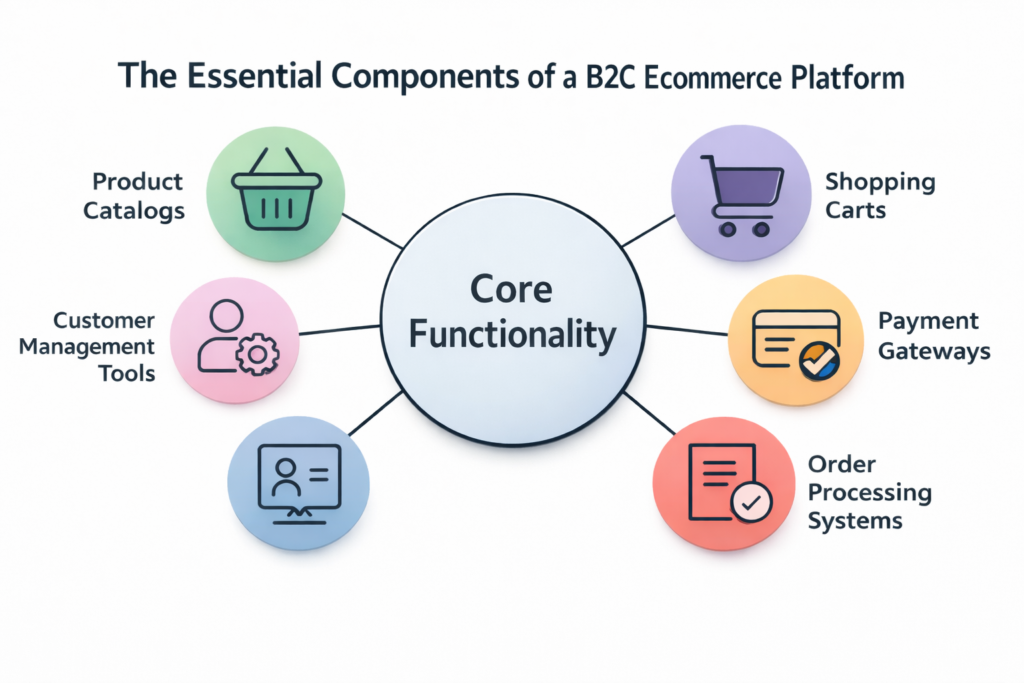
1. Robust Catalog & Product Information Management (PIM)
Your digital catalog is your sales floor.
- Complex Product Hierarchies: Support for categories, sub-categories, and bundles.
- Detailed SKU Management: Manage thousands of SKUs with rich attributes (dimensions, materials, compliance data).
- Custom Catalogs & Customer-Specific Pricing: Display tailored product selections and prices based on the logged-in user’s contract.
- Advanced Search & Filtering: Faceted search with filters for technical specifications, allowing buyers to find exact parts or materials.
- Integration with PIM Systems: For businesses with vast inventories, seamless integration with dedicated Product Information Management (PIM) software is essential for maintaining data consistency across all channels.
2. Advanced Customer Management
B2B relationships are multi-layered.
- Company & Account Structures: Model real-world hierarchies with parent companies, subsidiaries, and multiple ship-to addresses.
- Role-Based Buying Permissions: Define roles like “approver,” “purchaser,” and “view-only” within an account.
- Buyer-Specific Approval Workflows: Automate rules where orders over a certain value or for specific items require managerial approval before processing.
- Customer-Specific Credit Limits & Terms: Enforce negotiated payment terms and credit limits directly within the platform.
3. Sophisticated Pricing & Quoting Engine
Static pricing doesn’t work in B2B.
- Tiered & Volume Pricing: Automatically apply discounts when quantities reach predetermined thresholds.
- Contract & Customer-Specific Pricing: The cornerstone of B2B—each customer sees their negotiated price.
- Real-Time Custom Quotes (RFQ): Allow buyers to request quotes for configured or non-standard items, with a seamless workflow for sales reps to respond.
- Automated Discounts & Promotions: Apply seasonal, loyalty, or strategic account discounts.
4. Flexible Checkout & Order Management
The checkout must accommodate business procurement rules.
- Multiple Payment Terms & Methods: Accept payment via credit card, ACH, wire transfer, or on-account (pay on invoice) with net-30/60/90 terms.
- Purchase Order (PO) Number Integration: A mandatory field for most corporate buyers.
- Shipping & Tax Calculation: Real-time carrier rates, support for freight/shipping rules, and accurate tax calculation for business entities.
- Order History & Reordering: Allow buyers to view extensive history, track shipments, and easily reorder frequently purchased items.
Advanced & Strategic Features: Driving Efficiency and Growth
Moving beyond basics, these features transform a platform from a transaction processor into a strategic asset.
1. Self-Service Portal Capabilities
Empowering buyers reduces support costs and increases satisfaction.
- Quick Order & Reorder Pads: Let buyers enter SKUs and quantities in a spreadsheet-like interface for rapid ordering.
- Saved Shopping Lists & Carts: Users can save carts as lists for future orders or share them within their team.
- Real-Time Inventory & Lead Time Visibility: Display stock levels and expected restock dates to manage buyer expectations.
- Order Tracking & Account Management: A centralized portal for invoices, payment status, and communication.
2. Integration & Ecosystem Connectivity
Your ecommerce platform cannot be an island.
- ERP Integration: Bi-directional, real-time synchronization with Enterprise Resource Planning (ERP) systems like SAP, Oracle NetSuite, or Microsoft Dynamics is critical for accurate inventory, pricing, and order fulfillment. This is the single most important integration for most B2B companies.
- CRM Connectivity: Sync account and order data with Customer Relationship Management (CRM) platforms like Salesforce, giving sales teams a 360-degree customer view.
- PIM & CMS Integration: As mentioned, connecting to a PIM ensures rich product data, while a Content Management System (CMS) enables powerful marketing content alongside commerce.
- Modern API Architecture: A platform with a robust Application Programming Interface (API) allows for custom integrations with procurement systems (e.g., PunchOut), logistics providers, and other business tools.
3. Mobile Optimization & Responsive Design
B2B buyers are mobile. A platform must provide a full-featured experience on any device, not a stripped-down mobile site. This includes accessing catalogs, placing orders, and checking inventory on-the-go.
4. Robust Reporting & Analytics
Data-driven decisions require deep insights.
- Customer-Specific Reporting: Provide buyers with insights into their own spending patterns.
- Sales & Performance Dashboards: Track key metrics like customer lifetime value, average order value, top-selling products, and conversion rates.
- Abandoned Cart Analysis: Identify where in the checkout process business buyers are dropping off.
Cutting-Edge & Emerging Features: The Future of B2B Commerce
Leading platforms are incorporating features that redefine the buying experience.
1. Artificial Intelligence (AI) & Personalization
- Intelligent Search & Recommendations: AI-driven search that understands intent (e.g., “corrosion-resistant pipe for oil”) and recommends complementary or alternative products.
- Predictive Analytics: Forecast demand, suggest reorders, and identify cross-sell opportunities at the account level.
- Dynamic Content Personalization: Show relevant banners, promotions, and product highlights based on the buyer’s industry, past purchases, and role.
2. Headless & Composable Commerce Architecture
This is a paradigm shift in platform design.
- Headless Commerce: Decouples the front-end presentation layer (the “head”) from the back-end commerce engine. This allows businesses to build lightning-fast, custom storefronts using modern frameworks (React, Vue.js) while leveraging a powerful commerce API.
- Composable Commerce: Takes headless further by allowing you to select “best-of-breed” components (PIM, cart, search, payment) and assemble them like building blocks. This offers unparalleled flexibility but requires more technical expertise. Leading platforms in this space, like commercetools, are built on this principle.
3. Subscription & Replenishment Models
Automate repeat business for consumables and maintenance items.
- Flexible Subscription Options: Allow buyers to subscribe to products with customizable frequencies and quantities.
- Automated Replenishment: Trigger new orders based on usage data or inventory thresholds.
4. Enhanced Customer Experience (CX) Tools
- Live Chat & Co-Browsing: Integrate tools that allow sales or support reps to guide a buyer through a complex purchase in real-time.
- Augmented Reality (AR) / 3D Visualization: Particularly valuable for manufacturers, allowing buyers to visualize products in their space or see complex assemblies.
Step-by-Step Guide: Evaluating B2B Ecommerce Platform Features
Choosing a platform is a strategic decision. Follow this process:
- Audit Your Business Processes: Map out your current quote-to-cash workflow, pricing rules, customer hierarchies, and integration points (ERP, CRM).
- Gather Stakeholder Requirements: Involve sales, marketing, IT, finance, and customer service to list must-have and nice-to-have features.
- Create a Shortlist: Research platforms known for B2B strength (e.g., BigCommerce B2B, Adobe Commerce (Magento), Salesforce B2B Commerce, Shopify Plus, specialized solutions like OroCommerce).
- Demo with Real Data: Never accept a generic demo. Use your own product data, customer structure, and pricing scenarios.
- Evaluate the Total Cost of Ownership (TCO): Look beyond license fees. Consider implementation costs, ongoing maintenance, hosting, and the cost of required integrations.
- Check References & Scalability: Speak to similar-sized companies in your industry. Ask about performance during peak times and ease of adding new features.
Common Mistakes in B2B Platform Selection & How to Avoid Them
- Mistake 1: Choosing a B2C Platform with “B2B Boltons.”
- Avoidance: Select a platform with B2B functionality built into its core architecture. It will be more stable, scalable, and naturally support complex workflows.
- Mistake 2: Underestimating Integration Complexity.
- Avoidance: Prioritize platforms with pre-built connectors for your ERP/CRM or a proven, robust API. Factor integration work heavily into your budget and timeline.
- Mistake 3: Neglecting the Mobile Experience.
- Avoidance: Test the entire buying journey on mobile during demos. Ensure all key features (search, quoting, approval) work flawlessly.
- Mistake 4: Over-customizing Early.
- Avoidance: Leverage out-of-the-box features first. Excessive customization can lead to higher costs, upgrade difficulties, and instability. Use configuration over code where possible.
Expert Tips & Best Practices for Implementation
- Start with a Phased Rollout: Launch to a pilot group of customers first. Gather feedback, refine processes, and then expand.
- Invest in Data Migration & Cleanup: “Garbage in, garbage out.” Clean, structured product and customer data is the foundation of a successful launch.
- Train Both Internal Teams & Customers: Create training for your sales and support staff, as well as guided tutorials and resources for your buyers.
- Assign a Dedicated Project Owner: Ensure clear internal accountability for the platform’s success post-launch.
- Monitor Key Performance Indicators (KPIs): Track metrics like online revenue growth, customer adoption rate, average order value, and reduction in manual order errors.
Frequently Asked Questions (FAQ)
Q1: What is the key difference between a B2B and a B2C ecommerce platform?
A1: The core difference lies in handling complexity. B2B platforms are built for bulk/volume orders, tiered/customer-specific pricing, multi-level approval workflows, complex account structures, and deep integration with ERP/CRM systems. B2C platforms focus on individual shoppers, simple promotions, and standard checkout flows.
Q2: How important is ERP integration for B2B ecommerce?
A2: It is critically important, often the #1 priority. Real-time, bi-directional ERP integration ensures your online store reflects accurate inventory, pricing, and customer data. It automates order fulfillment and syncs financials, eliminating manual data entry and errors.
Q3: What is “PunchOut” or “Procurement PunchOut”?
A3: PunchOut is a protocol that allows a buyer’s procurement system (like Ariba, Coupa, or SAP MM) to connect directly to a supplier’s ecommerce catalog. The buyer “punches out” to the supplier’s site, adds items to a cart, and then “punches back” with the cart data into their own system for approval. It’s a vital feature for selling to large enterprises.
Q4: What is headless commerce, and should my B2B business consider it?
A4: Headless commerce separates the front-end user interface from the back-end commerce logic via APIs. It offers superior flexibility to create unique, fast buying experiences across websites, kiosks, or IoT devices. It’s ideal for businesses with specific UX requirements and in-house technical resources, but can be more complex to manage than a traditional monolithic platform.
Q5: Can I use Shopify or WooCommerce for B2B?
A5: Yes, but with caveats. Shopify Plus and various WooCommerce plugins add B2B features like net terms and customer-specific pricing. They can work for small to mid-sized businesses with simpler needs. However, for complex pricing, advanced workflows, and deep enterprise integrations, dedicated B2B platforms or enterprise solutions (Adobe Commerce, BigCommerce B2B Edition) are often more robust and sustainable.
Q6: How do I handle custom quotes and negotiated pricing online?
A6: A robust B2B platform will have a “Request for Quote” (RFQ) module. Buyers can configure products and submit quote requests. The system routes these to the appropriate sales rep, who can generate a custom price and send a formal quote back to the buyer, often convertible to an order with one click.
Q7: What are the security considerations for a B2B platform?
A7: Security is paramount. Ensure the platform is PCI DSS compliant for payments. Look for features like role-based access control, secure customer data storage, SSO (Single Sign-On) capabilities, and regular security patches. Cloud-based platforms often provide stronger, more up-to-date security than self-hosted solutions.
Q8: How can I drive adoption of our new B2B portal among customers?
A8: Combine marketing with education. Offer launch incentives, create detailed how-to videos and guides, host live training webinars, and ensure your sales team actively promotes the portal’s benefits (24/7 ordering, saved lists, order tracking) to their accounts.
Conclusion and Future Outlook
Selecting a B2B ecommerce platform is a foundational decision that will impact your operational efficiency, customer relationships, and revenue growth for years to come. The ideal platform seamlessly blends core transactional robustness with advanced self-service capabilities and strategic integrations.
The future of B2B ecommerce is intelligent, connected, and experiential. We will see greater adoption of AI-powered buying assistants, deeper marketplace functionalities where businesses can sell to and buy from each other on the same platform, and the continued rise of composable commerce, giving businesses unprecedented agility.
Your action plan is clear: thoroughly assess your unique business processes, prioritize features that solve real pain points for your team and your buyers, and choose a platform that is not just a fit for today, but a scalable partner for tomorrow’s digital business landscape. The investment in the right feature set is an investment in accelerated growth and lasting competitive strength.
For sellers looking to deepen their understanding of product research, optimization, and scaling strategies, explore our detailed ecommerce learning resources and guides
:https://rankifycontent.com/
This guide provides a comprehensive and timely overview of the essential features shaping B2B ecommerce platforms in 2026. As B2B buyers increasingly expect the same speed, personalization, and convenience found in B2C experiences, this article effectively explains what businesses must prioritize to remain competitive.
Best Blog for e-commerce I have read.
Very goo blog its informative and beautiful
Good Blog I am very happy when I read it so it’s good
Relationship-Driven Sales: Pricing and catalog visibility are often specific to each buyer, based on negotiated contracts
Best blog for Pricing and catalog visibility are often specific to each buyer, based on negotiated contracts
Beat blog for beauty product Combine marketing with education. Offer launch incentives, create detailed how-to videos and guides, host live training webinars, and ensure your sales team actively promotes the portal’s benefits (24/7 ordering, saved lists, order tracking) to their accounts
Great blog I really enjoyed reading this post. The information was clear and very helpful. Thank you sharing such useful content.