Table of Contents
Introduction: B2B Ecommerce Case Studies: Real-World Success Stories
For decades, the world of Business-to-Business (B2B) commerce operated on a foundation of relationships: handshakes, phone calls, printed catalogs, and faxed order forms. While personal relationships remain paramount, a digital revolution has fundamentally reshaped the landscape. Today, B2B ecommerce is not a peripheral channel but the central nervous system of global trade, projected to reach $20.9 trillion in sales by 2027, dwarfing the B2C market.
Yet, for many executives and decision-makers, the path to a successful digital transformation remains shrouded in uncertainty. What does a winning B2B ecommerce strategy actually look like? How do you migrate decades of legacy processes online? What tangible results can you expect?
This is where B2B ecommerce case studies become invaluable. They move beyond theory into the realm of proven results, offering a blueprint for success grounded in real challenges, strategic choices, and measurable outcomes. In this comprehensive guide, we will dissect compelling case studies across industries, extract universal lessons, and provide a framework for applying these insights to your own business. We will explore how leaders in manufacturing, distribution, and wholesale are leveraging digital storefronts, self-service portals, and integrated systems to drive unprecedented growth, operational efficiency, and customer loyalty.
Understanding the Modern B2B Ecommerce Landscape
Before diving into specific cases, it’s crucial to grasp what modern B2B ecommerce entails. It’s far more than just a “website to place orders.”
What is Modern B2B Ecommerce?
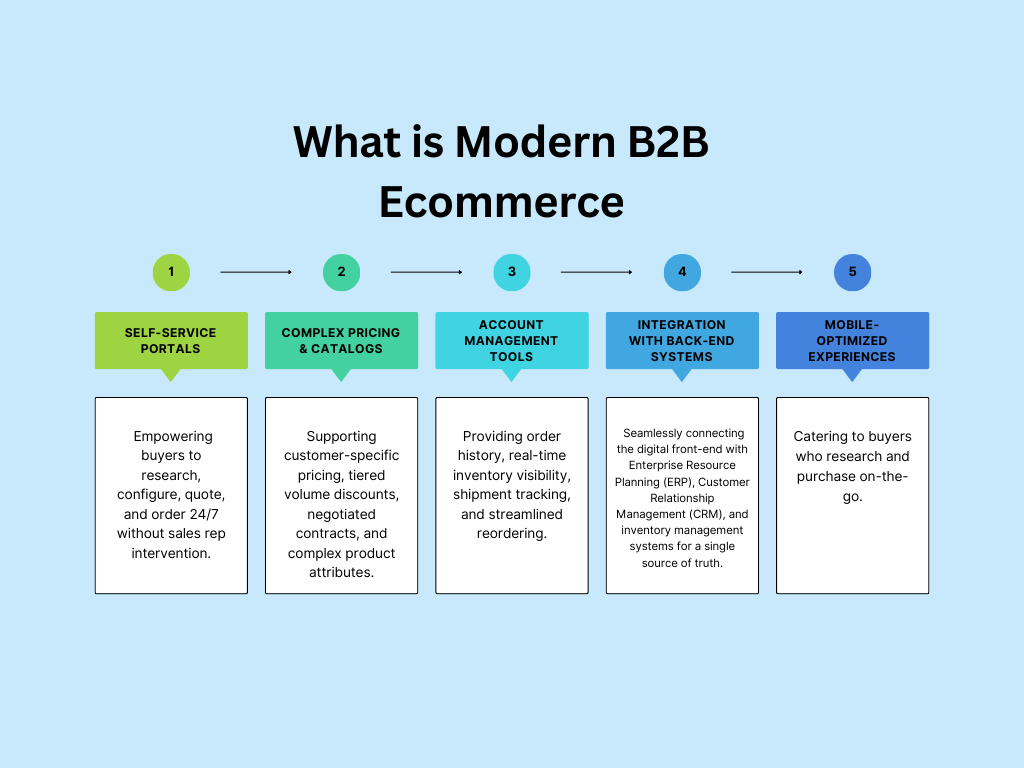
Modern B2B ecommerce is a sophisticated, multi-faceted digital ecosystem designed to serve the complex needs of business buyers. It prioritizes efficiency, accuracy, and personalized service at scale. Key characteristics include:
- Self-Service Portals: Empowering buyers to research, configure, quote, and order 24/7 without sales rep intervention.
- Complex Pricing & Catalogs: Supporting customer-specific pricing, tiered volume discounts, negotiated contracts, and complex product attributes.
- Account Management Tools: Providing order history, real-time inventory visibility, shipment tracking, and streamlined reordering.
- Integration with Back-End Systems: Seamlessly connecting the digital front-end with Enterprise Resource Planning (ERP), Customer Relationship Management (CRM), and inventory management systems for a single source of truth.
- Mobile-Optimized Experiences: Catering to buyers who research and purchase on-the-go.
The Critical Drivers of B2B Digital Transformation
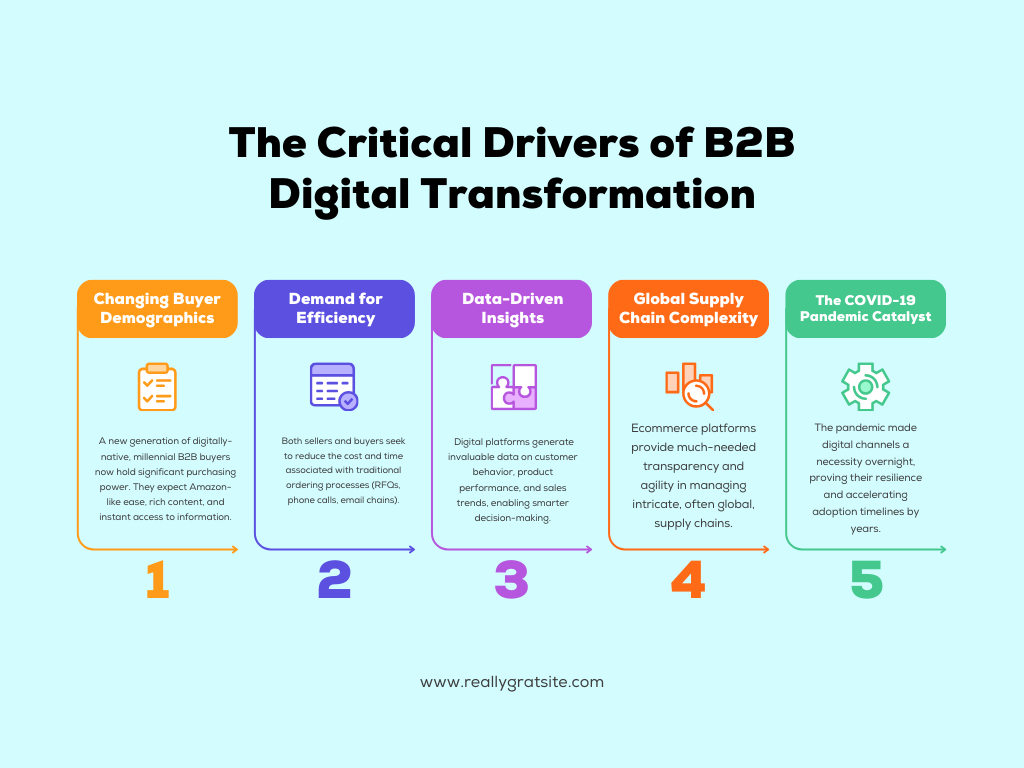
Several forces are accelerating the adoption of B2B ecommerce:
- Changing Buyer Demographics: A new generation of digitally-native, millennial B2B buyers now hold significant purchasing power. They expect Amazon-like ease, rich content, and instant access to information.
- Demand for Efficiency: Both sellers and buyers seek to reduce the cost and time associated with traditional ordering processes (RFQs, phone calls, email chains).
- Data-Driven Insights: Digital platforms generate invaluable data on customer behavior, product performance, and sales trends, enabling smarter decision-making.
- Global Supply Chain Complexity: Ecommerce platforms provide much-needed transparency and agility in managing intricate, often global, supply chains.
- The COVID-19 Pandemic Catalyst: The pandemic made digital channels a necessity overnight, proving their resilience and accelerating adoption timelines by years.
Deep-Dive B2B Ecommerce Case Studies
Let’s analyze specific companies that have successfully navigated this transformation, focusing on their challenge, strategy, and quantifiable results.
Case Study 1: Graybar – Modernizing a Century-Old Electrical Distributor
Graybar, a Fortune 500 distributor of electrical, communications, and data networking products, faced a classic challenge. With a vast catalog and a loyal customer base accustomed to personalized service, their legacy systems were struggling to keep pace with modern demands.
- The Challenge: An outdated ecommerce platform that couldn’t support robust search, personalized pricing, or mobile users. The disconnected experience was causing friction for both customers and internal sales teams.
- The Strategy: Graybar partnered with a headless commerce solution. This approach decoupled the front-end user experience from the back-end commerce logic, providing unparalleled flexibility. They focused on:
- Building a fast, intuitive, and mobile-first storefront.
- Implementing powerful search with filters for specifications, brand, and availability.
- Integrating deeply with their SAP ERP to ensure real-time pricing, inventory, and order status.
- Creating a “My Graybar” personalized dashboard for customers.
- The Results & Key Metrics:
- 50% increase in ecommerce sales within the first year.
- Mobile traffic surged by 90%, with a significant portion of orders placed via mobile devices.
- Dramatic improvement in customer and employee satisfaction due to reduced errors and faster order processing.
- Enhanced scalability to easily add new features and markets.
Case Study 2: Siemens – Transforming Industrial Manufacturing with Configure-to-Order
Siemens, a global industrial manufacturing powerhouse, sells highly complex, engineered products like circuit breakers and motor control systems. Their sales process was lengthy, relying heavily on manual configuration and engineering validation.
- The Challenge: A cumbersome, error-prone process for configuring specialized industrial equipment. This led to long sales cycles, reliance on technical experts for every quote, and potential for configuration errors in the final order.
- The Strategy: Siemens implemented a configure-price-quote (CPQ) module within their B2B ecommerce platform. They digitized their entire product knowledge base, creating intelligent “rules engines” that mimic expert logic.
- The Actionable Process:
- Product Knowledge Digitization: Engineers mapped all compatible components and technical specifications into a structured digital ruleset.
- Interactive Visual Configurator: Customers can visually select components, with the system automatically validating compatibility in real-time.
- Automated Quote Generation: The system instantly generates accurate, technically-validated quotes with detailed specs and pricing.
- Seamless Order Handoff: Approved quotes convert directly into orders fed into the manufacturing system (ERP).
- The Results & Key Metrics:
- Reduction in quote generation time from days to minutes.
- Elimination of configuration errors, reducing costly rework and delays.
- Empowerment of sales reps to handle more complex deals independently.
- Improved customer experience through transparency and speed.
Case Study 3: Benco Dental – Mastering Wholesale Distribution with a Customer-Centric Portal
As one of the largest dental distributors in the U.S., Benco Dental’s success hinges on serving a diverse clientele: dental practices, clinics, and laboratories. They needed to unify a fragmented digital experience.
- The Challenge: Multiple disjointed systems for ordering, account management, and educational content created a confusing experience for busy dental professionals. They lacked a single, branded destination.
- The Strategy: Benco developed “My Benco,” a unified, all-in-one customer portal built on a robust B2B ecommerce platform. The strategy centered on customer segmentation and personalized content.
- The Results & Key Metrics:
- Over 80% of all orders now flow through the ecommerce portal.
- Significant reduction in customer service calls for routine tasks like order status and tracking.
- Increased customer stickiness by integrating professional education resources and practice management tools alongside commerce.
- Enhanced data collection allowed for hyper-personalized product recommendations and promotions.
Extracting Universal Lessons: The Core Pillars of B2B Ecommerce Success
From these and countless other case studies, several non-negotiable pillars of success emerge.
Pillar 1: Deep Back-End Integration (ERP, CRM, PIM)
A beautiful storefront is useless if it shows incorrect stock or outdated prices. Integration is the backbone. Successful cases invariably feature seamless connections between their ecommerce platform and core business systems. This ensures:
- Real-Time Inventory: Prevents overselling and builds trust.
- Accurate Customer-Specific Pricing: Pulls directly from ERP contracts.
- Unified Customer Data: Links purchase history (ERP) with marketing interactions (CRM).
- Streamlined Operations: Orders flow automatically to fulfillment, invoices to accounting.
H2: Pillar 2: A Frictionless, Personalized User Experience (UX)
B2B UX must balance power with simplicity.
- Advanced Search & Filtering: Essential for large catalogs (e.g., filter by material, tolerance, certification).
- Quick Order & Reorder: Allow upload of spreadsheets or one-click reorder from history.
- Saved Carts & Lists: Enable teams to collaborate on purchases.
- Role-Based Permissions: Implement approval workflows for purchasers, requesters, and approvers.
Pillar 3: Content as a Commerce Driver
B2B buyers are researchers. They need rich content to make informed decisions.
- Technical Specifications & Data Sheets: Easily downloadable.
- CAD Drawings & 3D Models: For engineers and integrators.
- Case Studies & Application Guides: Show how your product solves problems.
- Compliance & Certification Documentation: Critical in regulated industries.
Pillar 4: Data-Driven Decision Making
Your platform is a goldmine of actionable intelligence.
- Track Customer-Level Metrics: Customer Lifetime Value (CLV), purchase frequency, average order value (AOV).
- Analyze Product Performance: Identify fast-moving items and stagnation points.
- Monitor Cart & Search Analytics: See where users struggle and abandon.
- Use data to personalize marketing, refine search algorithms, and optimize inventory.
Common Pitfalls and How to Avoid Them
Even with a solid strategy, companies can stumble. Here are frequent mistakes observed in B2B ecommerce transformations.
Mistake 1: Treating B2B Like B2C
- The Error: Assuming a simple, minimalist B2C-style store will work for complex B2B purchases.
- The Avoidance: Recognize and build for B2B complexities: multi-user accounts, approval chains, bulk pricing, and quote management. A platform like Adobe Commerce (Magento) or BigCommerce B2B Edition is built for these nuances.
Mistake 2: Underestimating the Importance of Change Management
- The Error: Rolling out a new platform without preparing internal teams (sales, customer service).
- The Avoidance: Involve key stakeholders from the start. Train sales reps on how the platform makes them more efficient (e.g., by handling routine orders) and show them how to use its data to sell smarter.
Mistake 3: “Build It and They Will Come” Mentality
- The Error: Investing six figures in a platform with no plan for driving adoption.
- The Avoidance: Develop a customer onboarding and activation plan. Use targeted email campaigns, webinars, and in-person training. Incentivize first-time online purchases. Make the transition beneficial and easy for the customer.
Mistake 4: Neglecting Mobile Experience
- The Error: Designing only for desktop in an increasingly mobile world.
- The Avoidance: Adopt a mobile-first or responsive design approach. Test the buying journey on tablets and smartphones. Ensure critical functions like checking inventory and placing quick reorders are flawless on mobile.
Expert Tips and Best Practices for Implementation
Drawing from industry leaders and successful implementations, here is a condensed guide to launching and scaling your B2B ecommerce channel.
Phase 1: Strategy & Planning (Months 1-2)
- Conduct a “Voice of the Customer” Audit: Interview key B2B customers. What frustrates them about ordering today? What would their ideal process look like?
- Define Key Performance Indicators (KPIs): Go beyond revenue. Define targets for online adoption rate, average order value (AOV), customer service ticket reduction, and sales team productivity.
- Assess & Clean Your Data: Your product data (in a PIM), customer data, and pricing data must be accurate and structured. Garbage in, garbage out.
Phase 2: Platform Selection & Design (Months 3-5)
- Choose a Platform with Native B2B Features: Evaluate platforms like SAP Commerce Cloud, Oracle CX Commerce, or the B2B suites of Shopify Plus and BigCommerce. Native support for quotes, accounts, and complex pricing is preferable to heavy customization.
- Design for Your Core User Stories: Map out the workflows for your most common transactions (e.g., “Procurement Manager reorders 50 standard parts,” “Engineer configures and requests a quote for a custom assembly”).
- Prioritize Integrations: Your integration architecture (often using APIs and middleware) is more critical than the front-end design. Get this right.
Phase 3: Launch & Iterate (Months 6-12+)
- Pilot with a Beta Group: Launch with a small group of trusted, supportive customers. Gather intensive feedback and fix issues before a full rollout.
- Market the Change Internally and Externally: Your launch is a marketing campaign. Communicate the benefits clearly.
- Adopt a Culture of Continuous Improvement: Use platform analytics and user feedback to prioritize a roadmap of enhancements post-launch. Ecommerce is never “finished.”
The Future of B2B Ecommerce: Emerging Trends
The evolution continues. Forward-thinking companies are already exploring these frontiers:
- AI-Powered Personalization & Search: Moving beyond rules-based systems to AI that predicts what a customer needs based on past behavior, similar companies, and even market trends.
- Marketplace Integration: B2B sellers are listing products on vertical B2B marketplaces (e.g., for manufacturing parts, medical supplies) to reach new buyers, similar to strategies on Amazon Business.
- Augmented Reality (AR) for Product Visualization: Allowing engineers to visualize a industrial motor in their facility or a medical professional to see a device in 3D before purchasing.
- Embedded Finance & Payments: Offering “Buy Now, Pay Later” (BNPL) options, dynamic credit lines, and seamless invoicing within the checkout flow to improve cash flow for buyers.
Frequently Asked Questions (FAQ)
FAQ: B2B Ecommerce Case Studies and Strategy
What is the average ROI for a B2B ecommerce platform?
While ROI varies, successful implementations often see a full payback within 12-24 months. Returns come from multiple streams: increased sales (especially from smaller customers), reduced cost per order (by 40-60% compared to phone/email orders), and higher sales team productivity.
How do you handle complex, negotiated B2B pricing online?
Modern B2B platforms integrate directly with your ERP, which houses all customer-specific contracts and pricing tiers. When a customer logs in, the storefront dynamically displays their negotiated prices, not public list prices.
Our sales team is resistant. How do we get buy-in?
Involve them early. Frame the platform as a tool to eliminate administrative drudgery (processing routine orders, checking stock) and equip them with data to become trusted advisors. Consider a compensation structure that credits them for online sales in their territory.
What is the difference between B2B and B2C ecommerce platforms?
Key differences include B2B support for multi-tiered user accounts with approval workflows, customer-specific catalogs and pricing, quote/negotiation management, minimum order quantities, and integration with procurement systems like PunchOut catalogs.
How important is mobile optimization for B2B?
Extremely. A significant percentage of B2B research begins on mobile, and busy professionals often place orders or check status from their phones. A poor mobile experience directly impacts conversion and customer satisfaction.
What are “PunchOut Catalogs” and are they still relevant?
Yes, very. A PunchOut catalog allows a buyer to “punch out” from their company’s procurement software (like Ariba or Coupa) directly into your B2B storefront, shop with their pre-approved budget, and “punch back in” with the cart as a formatted requisition. It’s a key integration for large corporate customers.
Should we build a custom solution or use a SaaS platform?
For most companies, a SaaS (Software-as-a-Service) platform like those mentioned is the faster, more secure, and more cost-effective choice. Custom builds are rarely justified except for highly unique, industry-specific processes that no commercial platform can address.
How do we measure the success of our B2B ecommerce site?
Track a blended set of KPIs: Financial (Online Revenue, AOV), Adoption (% of Customers Ordering Online, Order Frequency), Operational (Cost per Order, Order Accuracy), and Customer (Net Promoter Score, User Task Completion Rate).
What’s the first step in starting a B2B ecommerce project?
The first step is internal alignment and discovery. Form a cross-functional team (IT, Sales, Marketing, Operations). Document your “as-is” processes and pain points. Define your strategic goals before talking to vendors or developers.
How is AI being used in B2B ecommerce today?
Current applications include: Intelligent search that understands synonyms and intent, predictive product recommendations for cross-selling, dynamic chat bots for customer service, and analytics that forecast demand and identify at-risk customers.
Conclusion and Key Takeaways
The evidence from countless B2B ecommerce case studies is conclusive: digital transformation is no longer optional for distributors, manufacturers, and wholesalers. It is a strategic imperative for growth, resilience, and customer relevance. The journey involves more than technology—it requires a customer-centric mindset, deep operational integration, and a commitment to continuous improvement.
Key Takeaways:
- Start with the Customer: Digitize to solve their problems, not just yours. Frictionless, personalized experiences win.
- Integration is Non-Negotiable: Your ecommerce platform must be a seamless extension of your ERP, CRM, and inventory systems.
- Data is Your Compass: Use analytics to guide decisions, personalize experiences, and prove ROI.
- Manage Change Proactively: Success depends on preparing both your internal team and your customers for the new way of doing business.
- Think Evolution, Not Revolution: Start with a strong Minimum Viable Product (MVP) focused on core transactions, then iterate and expand based on feedback and data.
The future of B2B commerce is digital, automated, and intelligent. By learning from those who have successfully paved the way, you can build a digital channel that not only streamlines operations but becomes a powerful engine for sustainable competitive advantage and deeper customer partnerships. The time to act is now.
You may also benefit from our in-depth guide on scaling ecommerce businesses worldwide https://rankifycontent.com/international-ecommerce-scaling