Table of Contents
Introduction
B2B dropshipping in Canada is gaining strong momentum as Canadian businesses increasingly move toward digital procurement and flexible supply chains. Unlike B2C dropshipping, which focuses on individual consumers, B2B dropshipping serves business clients such as retailers, wholesalers, offices, healthcare providers, construction firms, and institutional buyers. This model allows sellers to supply products in bulk without owning or storing inventory.
Canada’s advanced logistics infrastructure, strong ecommerce adoption, and stable regulatory environment make it an ideal market for B2B dropshipping. With rising warehouse costs and the need for nationwide distribution across provinces, many Canadian businesses prefer dropshipping-based suppliers who can deliver reliably and cost-effectively.
What Is B2B Dropshipping in the Canadian Context?
B2B dropshipping in Canada is a business model where a seller markets and sells products to other businesses, while a third-party supplier located in Canada (or approved international supplier) handles inventory storage and order fulfillment. The seller focuses on sales, account management, pricing, and customer relationships rather than logistics.
In Canada, B2B dropshipping is commonly used for office supplies, packaging materials, industrial tools, safety equipment, electronics accessories, and healthcare-related products. These products often involve repeat orders, long-term contracts, and predictable demand, making the model suitable for sustainable growth.
How B2B Dropshipping Works in Canada
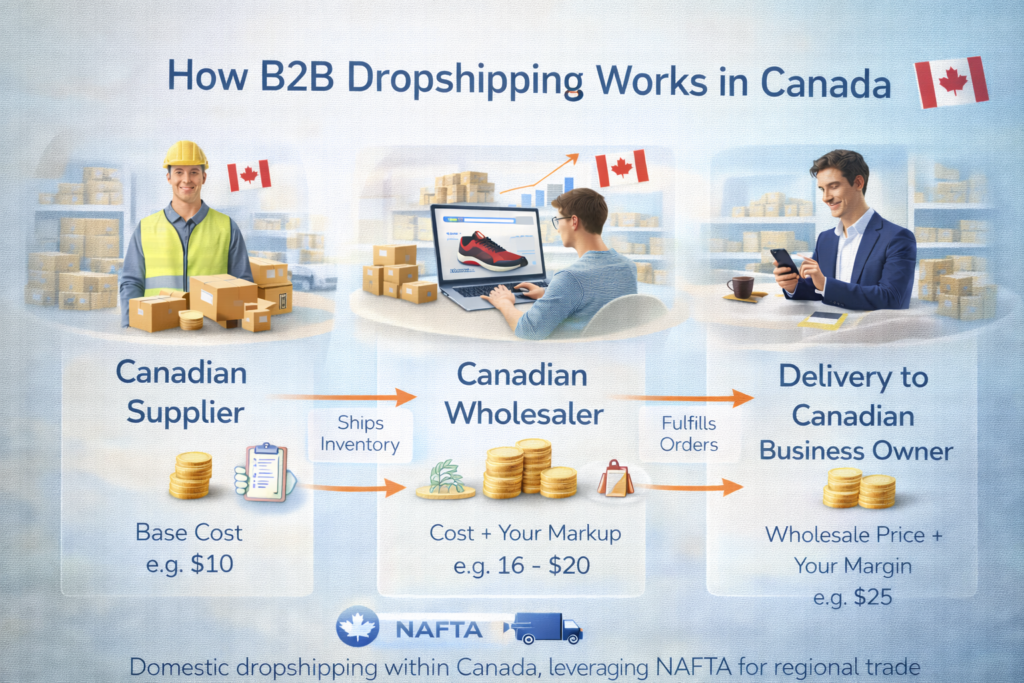
In a typical Canadian B2B dropshipping setup, the seller partners with domestic suppliers located in provinces such as Ontario, British Columbia, Alberta, or Quebec. When a business client places an order, the seller forwards the order to the supplier, who ships the product directly to the client anywhere in Canada.
The seller earns profit through wholesale margins or contract-based pricing. Because Canada has a vast geography, working with Canada-based suppliers significantly improves delivery times and reduces cross-border delays, which is a major advantage over international sourcing.
Difference Between B2B Dropshipping and Traditional Wholesale in Canada
Traditional wholesale in Canada requires businesses to purchase inventory upfront, store it, and manage distribution across provinces. This approach involves high capital investment, warehousing costs, and inventory risk.
B2B dropshipping in Canada removes these barriers. Sellers do not need to hold stock, allowing them to test new products, expand into new provinces, and scale operations without heavy upfront investment. This flexibility is especially valuable for small and mid-sized Canadian businesses.
Why B2B Dropshipping Is Growing in Canada
Several factors are driving the growth of B2B dropshipping in Canada. Rising real estate and warehouse costs, supply chain disruptions, and increased demand for flexible sourcing have pushed businesses toward dropshipping solutions.
Additionally, Canadian businesses increasingly prefer online ordering, transparent pricing, and reliable delivery. B2B dropshipping aligns perfectly with these expectations by offering efficiency, scalability, and nationwide reach.
Advantages of B2B Dropshipping in the Canadian Market
One of the biggest advantages of B2B dropshipping Canada is the ability to serve clients across multiple provinces without physical presence. This allows sellers to operate nationally while maintaining low overhead.
Another advantage is reduced risk. Because inventory is handled by suppliers, sellers avoid losses from unsold stock. Working with Canadian suppliers also improves compliance with local standards and customer expectations.
Common B2B Dropshipping Product Categories in Canada
In Canada, successful B2B dropshipping categories include office and workplace supplies, industrial tools, safety equipment, packaging materials, electronics accessories, and healthcare consumables.
Products that solve operational challenges for businesses and require frequent reordering perform best. Reliability, quality, and consistent availability matter more than trends in the Canadian B2B market.
Pricing Strategy for B2B Dropshipping in Canada
Pricing in B2B dropshipping Canada is typically volume-based. Canadian business buyers expect bulk discounts, transparent pricing, and flexible payment options. Sellers must calculate margins carefully, considering supplier costs, shipping, taxes (GST/HST), and service expenses.
Clear pricing structures and long-term contracts improve trust and client retention. Many Canadian businesses prefer predictable pricing over aggressive short-term discounts.
Tax & Regulatory Considerations in Canada
Operating B2B dropshipping in Canada requires compliance with federal and provincial tax laws. Sellers must understand GST/HST, provincial sales tax requirements, and business registration obligations.
Working with Canadian suppliers simplifies compliance and reduces complications related to customs and import duties. Proper registration and transparent invoicing are critical for building trust with Canadian business clients.
Challenges of B2B Dropshipping in Canada
Despite its benefits, B2B dropshipping in Canada comes with challenges. Shipping across large geographic distances can increase costs, and businesses expect reliable delivery timelines.
Another challenge is longer sales cycles. Canadian B2B buyers often take time to evaluate suppliers, negotiate pricing, and establish trust. Sellers must focus on professionalism, consistency, and relationship building.
Step-by-Step Guide to Starting B2B Dropshipping in Canada
Starting B2B dropshipping in Canada requires a structured and compliant approach because Canadian businesses value reliability, transparency, and professionalism. The first step is clearly defining your target business customers. You must decide whether you will serve retailers, offices, construction companies, healthcare providers, restaurants, or ecommerce resellers. Each segment has different product needs, ordering frequency, and pricing expectations.
The second step is business registration. In Canada, most B2B dropshippers register as a sole proprietorship, partnership, or corporation depending on scale and risk tolerance. Proper registration not only ensures legal compliance but also builds trust with Canadian suppliers and business buyers who prefer working with registered entities.
Finding Reliable B2B Dropshipping Suppliers in Canada
Supplier selection is the backbone of any successful B2B dropshipping Canada business. Canadian suppliers are often preferred because they offer faster domestic shipping, clearer tax handling, and better communication. Reliable suppliers usually provide stable inventory availability, bulk pricing, and predictable fulfillment timelines.
When evaluating Canadian suppliers, sellers should review product quality, warehouse locations, shipping partners, and return policies. Long-term supplier relationships are far more valuable than short-term cost savings in the Canadian B2B market.
Domestic vs International Suppliers for Canadian B2B Dropshipping
While international suppliers may offer lower prices, domestic Canadian suppliers provide stronger reliability and fewer complications. Shipping within Canada avoids customs delays, import duties, and unexpected fees that can frustrate B2B clients.
For B2B dropshipping in Canada, reliability and consistency usually outweigh slightly lower costs. Many Canadian businesses are willing to pay more for dependable local supply and predictable delivery schedules.
Choosing the Right Platform for B2B Dropshipping in Canada
The ecommerce platform you choose must support B2B-specific requirements such as bulk pricing, custom quotes, invoicing, and tax configuration for GST/HST. Many Canadian B2B dropshippers prefer platforms that allow account-based purchasing and flexible checkout options.
Scalability is critical. Your platform should handle increasing order volumes, multi-province tax rules, and supplier integrations without creating operational bottlenecks.
Building a Professional Canadian B2B Website
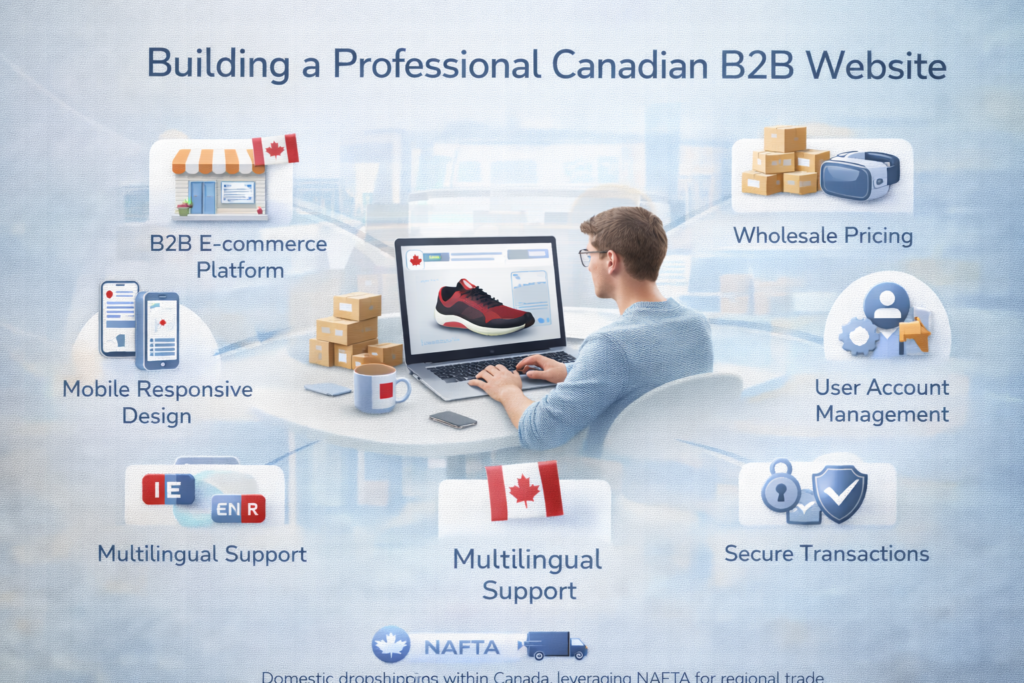
A professional website is essential for credibility in the Canadian B2B space. Unlike consumer-focused stores, B2B websites should emphasize clarity, trust, and functionality. Detailed product specifications, transparent pricing structures, and easy inquiry or quote request options are essential.
Canadian businesses expect clear information on delivery timelines, tax handling, and return policies. A well-structured website significantly improves conversion rates and trust.
Pricing & Margin Strategy for B2B Dropshipping Canada
Pricing in B2B dropshipping Canada is usually volume-based and negotiable. Canadian business buyers expect tiered pricing, bulk discounts, and predictable costs. Sellers must calculate margins carefully, factoring in supplier pricing, shipping costs, GST/HST, and customer service expenses.
Although margins per unit may be lower than B2C, higher order values and repeat business often result in stronger long-term profitability. Transparent pricing builds long-term client relationships.
Sales & Client Acquisition in the Canadian Market
Client acquisition is relationship-driven in the Canadian B2B environment. Email outreach, LinkedIn networking, industry directories, and local trade events are effective channels. Canadian buyers respond well to professional, respectful communication rather than aggressive sales tactics.
Instead of pushing products, sellers should focus on solving operational problems, ensuring reliability, and offering long-term value. Trust and consistency are key differentiators in Canada.
Contracting & Account Management
Many Canadian B2B clients prefer long-term contracts or supplier agreements. These agreements provide stable revenue and simplify planning. Contracts should clearly outline pricing terms, delivery expectations, and service levels.
Dedicated account management improves retention and satisfaction. Regular communication, order follow-ups, and proactive issue resolution help maintain strong business relationships.
Logistics & Fulfillment Across Canada
Canada’s large geography makes logistics planning essential. Suppliers with warehouses in multiple provinces can significantly reduce delivery times and shipping costs. Clear communication about delivery timelines is critical for B2B buyers.
Providing tracking details and proactive shipping updates builds confidence and reduces disputes. Logistics transparency is a competitive advantage in B2B dropshipping Canada.
Risk Management & Quality Control
Risk management is crucial in B2B dropshipping. Sellers must ensure product quality consistency, accurate inventory data, and compliance with Canadian standards. Quality issues or delays can quickly damage long-term client relationships.
Regular supplier reviews, test orders, and clear service-level agreements help minimize risk and protect brand reputation.
Scaling B2B Dropshipping Operations in Canada
Once your B2B dropshipping Canada business starts receiving consistent orders, the next phase is scaling in a controlled and strategic way. In the Canadian B2B market, scaling does not mean listing hundreds of new products quickly. Instead, it focuses on strengthening existing client relationships, expanding product ranges for current buyers, and securing repeat or contract-based orders.
Canada’s multi-province structure makes nationwide scaling possible without owning warehouses. By working with suppliers that ship across provinces, businesses can serve clients in Ontario, British Columbia, Alberta, Quebec, and beyond. Successful scaling depends on operational stability, not aggressive expansion.
Automation & Technology for Canadian B2B Dropshipping
Automation is essential for scaling B2B dropshipping in Canada efficiently. As order volume grows, manual processing becomes slow and error-prone. Automation tools help sync inventory, forward orders to suppliers, generate invoices, update tracking details, and manage taxes such as GST/HST.
Canadian B2B buyers expect accuracy, professionalism, and timely updates. Automation improves reliability while keeping operational costs under control. Sellers who automate early can grow without increasing staff proportionally.
Managing Long-Term B2B Client Relationships in Canada
In Canada, B2B success is built on trust and long-term relationships. Businesses prefer consistent suppliers over the cheapest option. Strong communication, predictable delivery, and quick issue resolution are critical for retention.
Dedicated account management, regular follow-ups, and customized pricing strengthen loyalty. Long-term clients reduce marketing costs and provide stable revenue, making relationship management one of the most valuable assets in Canadian B2B dropshipping.
Compliance, Documentation & Standards in Canada
Canadian B2B buyers often require proper documentation, including invoices with GST/HST, supplier certifications, and clear return policies. Sellers must ensure that their suppliers meet Canadian safety and quality standards, especially in regulated categories such as healthcare, industrial tools, or electronics.
Compliance builds credibility and enables sellers to work with larger organizations, institutions, and enterprise clients across Canada.
Common Mistakes in B2B Dropshipping Canada
A common mistake is treating B2B dropshipping like B2C. Aggressive sales language, unclear pricing, and unreliable delivery quickly damage trust. Another mistake is relying on a single supplier, which increases risk if issues arise.
Some sellers also scale too fast without automation or contracts. In Canada, sustainable growth depends on systems, transparency, and consistency.
Best Practices for Sustainable Growth
Successful B2B dropshipping Canada businesses focus on a few core principles: supplier reliability, transparent pricing, automation, and client relationships. Instead of chasing short-term wins, they build predictable operations that support long-term growth.
Clear communication, professional branding, and dependable fulfillment matter more than heavy discounts in the Canadian B2B market.
Frequently Asked Questions (FAQs)
Is B2B dropshipping legal in Canada?
Yes. B2B dropshipping is legal in Canada as long as businesses are properly registered and comply with tax and commercial regulations.
Do I need to charge GST/HST in B2B dropshipping Canada?
Yes. In most cases, GST/HST applies to B2B transactions, depending on province and buyer status. Proper invoicing is essential.
Can small businesses succeed with B2B dropshipping in Canada?
Yes. Small businesses can succeed by focusing on niche markets, reliable suppliers, and long-term client relationships.
Is B2B dropshipping profitable in Canada long term?
Yes. Although margins per unit may be lower than B2C, higher order values and repeat contracts make it profitable over time.
How long does it take to see results?
B2B sales cycles are longer. Results may take weeks or months, but once clients are secured, revenue becomes stable and recurring.
Which industries work best in Canada?
Office supplies, packaging, safety equipment, industrial tools, healthcare consumables, and electronics accessories perform particularly well.
What makes B2B dropshipping in Canada different from the USA?
The main difference is tax structure and logistics. Canada requires GST/HST compliance and often longer shipping distances between provinces. Canadian buyers also place strong emphasis on reliability, clear documentation, and professional communication rather than aggressive sales tactics.
Do Canadian B2B buyers prefer local suppliers?
Yes. Most Canadian businesses prefer suppliers located within Canada because it reduces shipping delays, customs issues, and unexpected costs. Local suppliers also improve trust and compliance.
Can I run a cross-border B2B dropshipping business between Canada and the USA?
Yes. Many businesses operate cross-border B2B dropshipping. However, sellers must manage customs documentation, duties, currency exchange, and cross-border tax compliance carefully.
Is bilingual content necessary for B2B dropshipping in Canada?
Bilingual (English & French) content is especially important when targeting Quebec-based businesses. While not mandatory nationwide, offering bilingual support improves credibility and reach in Canada.
How important are contracts in Canadian B2B dropshipping?
Contracts are very important. Canadian B2B buyers prefer clearly defined agreements covering pricing, delivery timelines, service levels, and return policies. Contracts reduce disputes and build long-term trust.
Can B2B dropshipping in Canada support white-label or private-label products?
Yes. Many Canadian suppliers offer white-label or private-label options, especially for packaging, office supplies, and industrial products. This helps sellers build stronger brands and differentiation.
How do I handle disputes with Canadian B2B clients?
Disputes should be handled professionally and promptly. Clear contracts, documented communication, and transparent policies help resolve issues quickly and protect business relationships.
Are Canadian businesses open to long-term supplier relationships?
Yes. Canadian businesses value stability and long-term partnerships. Once trust is established, clients often remain loyal for years, making retention more valuable than constant acquisition.
What payment methods are common in Canadian B2B transactions?
Common payment methods include bank transfers, invoicing, credit cards, and net payment terms (Net-15 or Net-30). Flexible payment options improve conversion and client satisfaction.
Can B2B dropshipping work for government or institutional buyers in Canada?
Yes, but it requires strict compliance, certifications, and supplier verification. Government and institutional buyers expect high transparency and reliability.
How do I protect my business from supplier failure?
Diversify suppliers, sign clear agreements, and regularly review performance. Avoid dependency on a single supplier to reduce operational risk.
Is B2B dropshipping future-proof in Canada?
Yes. With increasing digital procurement and supply-chain flexibility, B2B dropshipping aligns with Canada’s long-term ecommerce and business trends.
Final Extended Conclusion (With External & Internal Dofollow Links)
B2B dropshipping in Canada is a powerful and future-ready ecommerce model that allows businesses to grow without inventory risk while serving a nationwide market. As Canadian companies increasingly adopt digital procurement, demand for reliable B2B dropshipping suppliers continues to rise.
Market data shows strong growth in Canada’s B2B ecommerce sector, driven by efficiency and supply-chain flexibility:https://www.statista.com/topics/1122/b2b-e-commerce/).
Additionally, leading ecommerce platforms highlight automation and supplier integration as key drivers of B2B success:https://www.shopify.com/enterprise/b2b-ecommerce).
What separates successful Canadian B2B dropshippers from the rest is their focus on systems over shortcuts. Reliable suppliers, automation, tax compliance, and long-term client relationships create businesses that are resilient and scalable.
For readers who want to explore more strategies related to ecommerce operations and supplier sourcing, check our detailed guides:https://rankifycontent.com/b2b-ecommerce-canada
In conclusion, B2B dropshipping Canada is not a trend—it is a strategic business model. When executed with professionalism, compliance, and long-term vision, it offers predictable growth, strong client retention, and nationwide reach. Businesses that invest in the right foundations today will dominate the Canadian B2B ecommerce market tomorrow.