Table of Contents
Introduction
B2B dropshipping globally has become one of the most powerful ecommerce models for businesses operating across borders. As companies worldwide move toward digital procurement and flexible supply chains, B2B dropshipping enables sellers to supply products to other businesses without holding inventory or managing warehouses. This model is no longer limited to a single country—it now operates seamlessly across regions such as North America, Europe, Asia, and the Middle East.
The global shift toward ecommerce, combined with improved logistics, cross-border payments, and supplier networks, has accelerated the adoption of B2B dropshipping. Businesses can now source products internationally and deliver them directly to business clients anywhere in the world, reducing cost, risk, and operational complexity.
What Is B2B Dropshipping on a Global Scale?
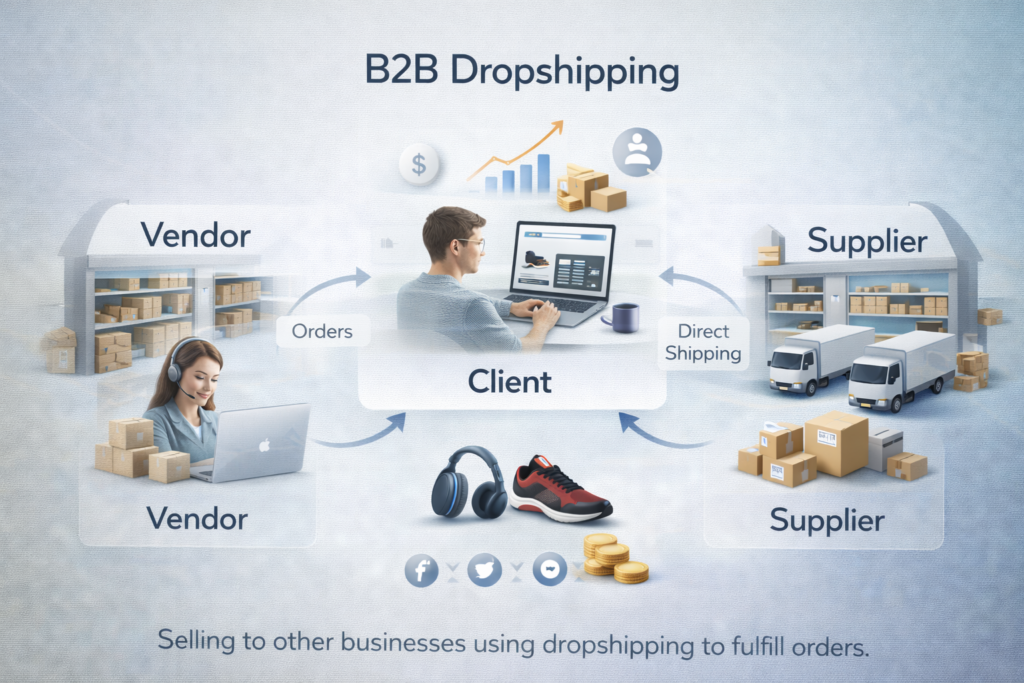
Global B2B dropshipping is a business model where a seller markets and sells products to other businesses worldwide, while third-party suppliers handle inventory storage and international fulfillment. The seller focuses on marketing, pricing, customer relationships, and order management, while logistics are managed by suppliers or fulfillment partners.
Unlike local B2B models, global B2B dropshipping must account for cross-border shipping, customs regulations, currency exchange, and international compliance. When managed correctly, it allows businesses to access international markets without establishing physical infrastructure in each country.
How Global B2B Dropshipping Works
In a global B2B dropshipping setup, sellers partner with suppliers located in different regions—such as Asia for manufacturing, Europe for specialized products, or North America for fast fulfillment. When a business customer places an order, the supplier ships directly to the buyer’s location, regardless of country.
The seller earns profit through wholesale margins, volume-based pricing, or long-term supply contracts. Advanced logistics networks and international couriers make it possible to deliver bulk orders efficiently across borders, making global B2B dropshipping scalable and sustainable.
Difference Between Local and Global B2B Dropshipping
Local B2B dropshipping focuses on domestic buyers and suppliers, offering simpler logistics and tax compliance. Global B2B dropshipping, however, expands reach but introduces complexity in shipping times, import duties, and regulatory requirements.
Despite these challenges, global B2B dropshipping provides access to larger markets, diversified revenue streams, and supplier flexibility. Businesses that master global operations gain a competitive advantage by serving clients across multiple regions.
Why B2B Dropshipping Is Growing Worldwide
The global growth of B2B dropshipping is driven by digital transformation, rising warehouse costs, and the need for agile supply chains. Businesses worldwide want flexible sourcing models that reduce capital investment while maintaining reliability.
Global disruptions have also encouraged companies to diversify suppliers across regions. B2B dropshipping allows businesses to adapt quickly to market changes without heavy infrastructure commitments.
Key Advantages of Global B2B Dropshipping
One major advantage of global B2B dropshipping is scalability. Businesses can enter new markets without setting up warehouses or local offices. This significantly lowers expansion costs and speeds up market entry.
Another advantage is supplier diversity. Sellers can source products from multiple countries, reducing dependency on a single region and improving supply chain resilience. This flexibility is especially valuable in global commerce.
Common Product Categories in Global B2B Dropshipping
Globally successful B2B dropshipping categories include industrial tools, electronics components, packaging materials, office supplies, safety equipment, healthcare consumables, and promotional products.
Products that are standardized, non-perishable, and frequently reordered perform best internationally. Reliability and consistency are more important than trends in global B2B markets.
Pricing Strategy in Global B2B Dropshipping
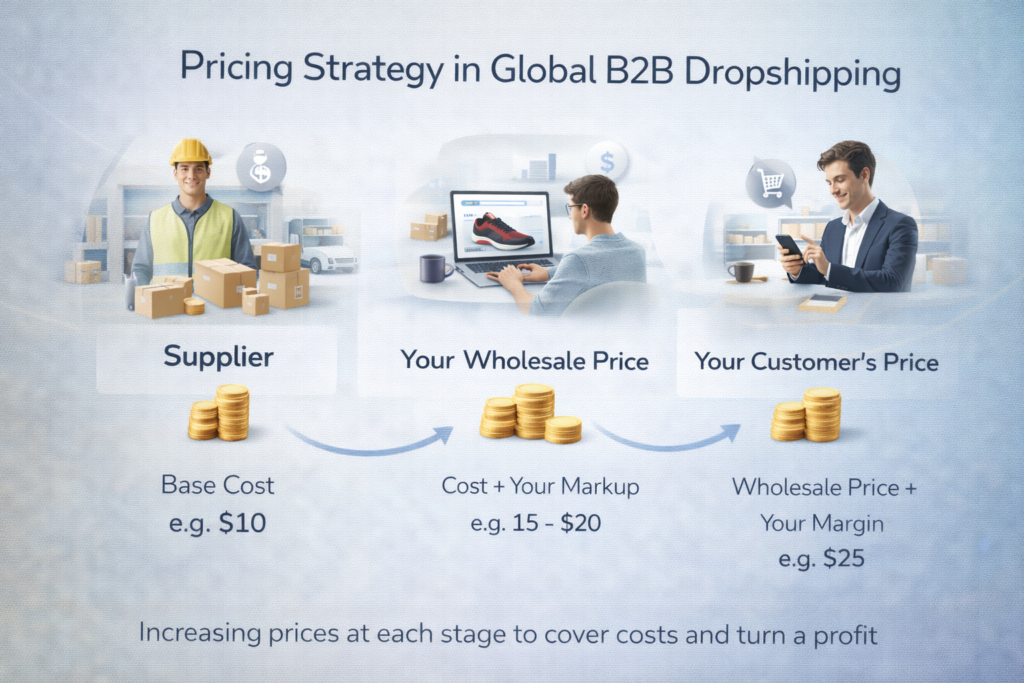
Pricing in global B2B dropshipping must account for shipping costs, customs duties, currency exchange, and regional market expectations. Many sellers use region-based pricing or volume-based contracts to remain competitive.
Transparent pricing and clear delivery timelines are critical when dealing with international business clients. Trust and clarity determine long-term success more than aggressive discounts.
Legal, Tax & Compliance Considerations Worldwide
Operating B2B dropshipping globally requires understanding international trade regulations, import/export rules, and tax obligations. Compliance varies by country, making documentation and transparency essential.
Working with experienced suppliers and logistics partners helps reduce compliance risks. Proper legal structure builds credibility with international clients and protects long-term operations.
Challenges of Global B2B Dropshipping
Despite its benefits, global B2B dropshipping faces challenges such as longer shipping times, customs delays, language barriers, and complex compliance requirements.
However, businesses that invest in strong systems, reliable partners, and clear communication can overcome these challenges and build stable international operations.
Step-by-Step Process to Start Global B2B Dropshipping
Starting B2B dropshipping globally requires a more structured approach than domestic dropshipping because it involves multiple countries, regulations, and logistics systems. The first step is identifying your target regions. Businesses should decide whether they want to focus on North America, Europe, Asia, the Middle East, or operate across multiple regions simultaneously.
Once regions are selected, the next step is defining the type of business customers you want to serve, such as retailers, distributors, wholesalers, corporate buyers, or institutions. Each customer type has different expectations regarding pricing, delivery time, documentation, and service quality. Clear positioning at this stage prevents operational confusion later.
Finding Reliable Global B2B Dropshipping Suppliers
Supplier selection is the backbone of global B2B dropshipping. Unlike B2C, where speed may dominate decisions, B2B buyers prioritize consistency, quality, and long-term reliability. Global suppliers may be located in manufacturing hubs like China, Vietnam, India, or in fulfillment-focused regions such as the USA and Europe.
When evaluating suppliers, businesses should assess product quality, production capacity, international shipping experience, certifications, and communication reliability. Long-term supplier relationships are far more valuable than short-term cost savings in global B2B operations.
Domestic vs International Fulfillment Strategy
One key decision in global B2B dropshipping is whether to use direct international shipping or regional fulfillment hubs. Direct shipping from manufacturers reduces cost but increases delivery time. Regional fulfillment improves speed but may increase operational complexity.
Many successful global B2B sellers use a hybrid model—manufacturing in one region while fulfilling orders from regional warehouses closer to customers. This strategy balances cost efficiency and delivery reliability.
Choosing the Right Platforms for Global B2B Dropshipping
A global B2B dropshipping business requires platforms that support multi-currency pricing, international tax handling, bulk orders, and invoicing. The platform should also integrate smoothly with suppliers and logistics partners.
Scalability is essential. As international order volume increases, systems must handle currency conversion, regional pricing rules, and documentation without manual intervention. Technology becomes a growth enabler rather than a cost.
Building a Global B2B Website & Sales Infrastructure
A professional website is critical for international credibility. Global B2B websites should emphasize trust, clarity, and accessibility. This includes clear product specifications, international shipping policies, delivery timelines, and compliance information.
Language localization, even if limited to English initially, should be written clearly for an international audience. As the business grows, regional landing pages or localized content can significantly improve conversion rates.
Pricing Strategy for Global B2B Dropshipping
Pricing in B2B dropshipping globally must consider shipping costs, import duties, currency fluctuations, and regional competition. Many businesses adopt region-specific pricing strategies to remain competitive while protecting margins.
Volume-based pricing and long-term contracts are common in international B2B markets. Transparent pricing builds trust and reduces friction in cross-border transactions.
Cross-Border Payments & Invoicing
Handling payments internationally is a critical component of global B2B dropshipping. Business buyers often prefer bank transfers, invoicing, or contract-based payment terms rather than instant card payments.
Sellers must ensure secure, transparent payment processes and clearly communicate payment terms. Currency clarity and invoicing accuracy are essential for trust in global transactions.
Sales & Client Acquisition in Global Markets
Global B2B sales rely heavily on relationship-building rather than aggressive advertising. Email outreach, LinkedIn networking, industry marketplaces, and trade platforms are effective channels for international client acquisition.
Sales messaging should focus on reliability, consistency, and value rather than low price. Global B2B buyers seek partners, not just suppliers.
Managing International Logistics & Delivery Expectations
International logistics is one of the biggest challenges in global B2B dropshipping. Clear communication around shipping timelines, customs processing, and delivery expectations is essential.
Providing tracking details, proactive updates, and contingency planning builds confidence with international clients. Reliability matters more than speed in most B2B contexts.
Risk Management in Global B2B Dropshipping
Global operations introduce risks such as supplier failure, customs delays, geopolitical disruptions, and currency volatility. Risk mitigation strategies include supplier diversification, clear contracts, and buffer timelines.
Businesses that plan for risk rather than reacting to it are more resilient and competitive in global markets.
Scaling B2B Dropshipping Operations in Canada
Once your B2B dropshipping Canada business starts receiving consistent orders, the next phase is scaling in a controlled and strategic way. In the Canadian B2B market, scaling does not mean listing hundreds of new products quickly. Instead, it focuses on strengthening existing client relationships, expanding product ranges for current buyers, and securing repeat or contract-based orders.
Canada’s multi-province structure makes nationwide scaling possible without owning warehouses. By working with suppliers that ship across provinces, businesses can serve clients in Ontario, British Columbia, Alberta, Quebec, and beyond. Successful scaling depends on operational stability, not aggressive expansion.
Automation & Technology for Canadian B2B Dropshipping
Automation is essential for scaling B2B dropshipping in Canada efficiently. As order volume grows, manual processing becomes slow and error-prone. Automation tools help sync inventory, forward orders to suppliers, generate invoices, update tracking details, and manage taxes such as GST/HST.
Canadian B2B buyers expect accuracy, professionalism, and timely updates. Automation improves reliability while keeping operational costs under control. Sellers who automate early can grow without increasing staff proportionally.
Managing Long-Term B2B Client Relationships in Canada
In Canada, B2B success is built on trust and long-term relationships. Businesses prefer consistent suppliers over the cheapest option. Strong communication, predictable delivery, and quick issue resolution are critical for retention.
Dedicated account management, regular follow-ups, and customized pricing strengthen loyalty. Long-term clients reduce marketing costs and provide stable revenue, making relationship management one of the most valuable assets in Canadian B2B dropshipping.
Compliance, Documentation & Standards in Canada
Canadian B2B buyers often require proper documentation, including invoices with GST/HST, supplier certifications, and clear return policies. Sellers must ensure that their suppliers meet Canadian safety and quality standards, especially in regulated categories such as healthcare, industrial tools, or electronics.
Compliance builds credibility and enables sellers to work with larger organizations, institutions, and enterprise clients across Canada.
Common Mistakes in B2B Dropshipping Canada
A common mistake is treating B2B dropshipping like B2C. Aggressive sales language, unclear pricing, and unreliable delivery quickly damage trust. Another mistake is relying on a single supplier, which increases risk if issues arise.
Some sellers also scale too fast without automation or contracts. In Canada, sustainable growth depends on systems, transparency, and consistency.
Best Practices for Sustainable Growth
Successful B2B dropshipping Canada businesses focus on a few core principles: supplier reliability, transparent pricing, automation, and client relationships. Instead of chasing short-term wins, they build predictable operations that support long-term growth.
Clear communication, professional branding, and dependable fulfillment matter more than heavy discounts in the Canadian B2B market.
Frequently Asked Questions (FAQs)
Is B2B dropshipping legal in Canada?
Yes. B2B dropshipping is legal in Canada as long as businesses are properly registered and comply with tax and commercial regulations.
Do I need to charge GST/HST in B2B dropshipping Canada?
Yes. In most cases, GST/HST applies to B2B transactions, depending on province and buyer status. Proper invoicing is essential.
Can small businesses succeed with B2B dropshipping in Canada?
Yes. Small businesses can succeed by focusing on niche markets, reliable suppliers, and long-term client relationships.
Is B2B dropshipping profitable in Canada long term?
Yes. Although margins per unit may be lower than B2C, higher order values and repeat contracts make it profitable over time.
How long does it take to see results?
B2B sales cycles are longer. Results may take weeks or months, but once clients are secured, revenue becomes stable and recurring.
Which industries work best in Canada?
Office supplies, packaging, safety equipment, industrial tools, healthcare consumables, and electronics accessories perform particularly well.
What makes B2B dropshipping in Canada different from the USA?
The main difference is tax structure and logistics. Canada requires GST/HST compliance and often longer shipping distances between provinces. Canadian buyers also place strong emphasis on reliability, clear documentation, and professional communication rather than aggressive sales tactics.
Do Canadian B2B buyers prefer local suppliers?
Yes. Most Canadian businesses prefer suppliers located within Canada because it reduces shipping delays, customs issues, and unexpected costs. Local suppliers also improve trust and compliance.
Can I run a cross-border B2B dropshipping business between Canada and the USA?
Yes. Many businesses operate cross-border B2B dropshipping. However, sellers must manage customs documentation, duties, currency exchange, and cross-border tax compliance carefully.
Is bilingual content necessary for B2B dropshipping in Canada?
Bilingual (English & French) content is especially important when targeting Quebec-based businesses. While not mandatory nationwide, offering bilingual support improves credibility and reach in Canada.
How important are contracts in Canadian B2B dropshipping?
Contracts are very important. Canadian B2B buyers prefer clearly defined agreements covering pricing, delivery timelines, service levels, and return policies. Contracts reduce disputes and build long-term trust.
Can B2B dropshipping in Canada support white-label or private-label products?
Yes. Many Canadian suppliers offer white-label or private-label options, especially for packaging, office supplies, and industrial products. This helps sellers build stronger brands and differentiation.
How do I handle disputes with Canadian B2B clients?
Disputes should be handled professionally and promptly. Clear contracts, documented communication, and transparent policies help resolve issues quickly and protect business relationships.
Are Canadian businesses open to long-term supplier relationships?
Yes. Canadian businesses value stability and long-term partnerships. Once trust is established, clients often remain loyal for years, making retention more valuable than constant acquisition.
What payment methods are common in Canadian B2B transactions?
Common payment methods include bank transfers, invoicing, credit cards, and net payment terms (Net-15 or Net-30). Flexible payment options improve conversion and client satisfaction.
Can B2B dropshipping work for government or institutional buyers in Canada?
Yes, but it requires strict compliance, certifications, and supplier verification. Government and institutional buyers expect high transparency and reliability.
How do I protect my business from supplier failure?
Diversify suppliers, sign clear agreements, and regularly review performance. Avoid dependency on a single supplier to reduce operational risk.
Is B2B dropshipping future-proof in Canada?
Yes. With increasing digital procurement and supply-chain flexibility, B2B dropshipping aligns with Canada’s long-term ecommerce and business trends.
Final Conclusion:
B2B dropshipping in Canada is a powerful and future-ready ecommerce model that allows businesses to grow without inventory risk while serving a nationwide market. As Canadian companies increasingly adopt digital procurement, demand for reliable B2B dropshipping suppliers continues to rise.
Market data shows strong growth in Canada’s B2B ecommerce sector, driven by efficiency and supply-chain flexibility: https://www.statista.com/topics/1122/b2b-e-commerce/
Additionally, leading ecommerce platforms highlight automation and supplier integration as key drivers of B2B success: https://www.shopify.com/enterprise/b2b-ecommerce
What separates successful Canadian B2B dropshippers from the rest is their focus on systems over shortcuts. Reliable suppliers, automation, tax compliance, and long-term client relationships create businesses that are resilient and scalable.
For readers who want to explore more strategies related to ecommerce operations and supplier sourcing, check our detailed guides: https://rankifycontent.com/b2b-ecommerce-canada
In conclusion, B2B dropshipping Canada is not a trend—it is a strategic business model. When executed with professionalism, compliance, and long-term vision, it offers predictable growth, strong client retention, and nationwide reach. Businesses that invest in the right foundations today will dominate the Canadian B2B ecommerce market tomorrow.
weed edibles online shop trusted store
Thank you for your reading and valueable imapct we can help you to post your link on this site taht is highly B2b Impact
Online games free https://super-mario-play.com
I want to propose to a girl proposal photographer in Barcelona
навесы из металлопрофиля навес для дачи
лечение зубов детям лечение зубов детям под наркозом
ремонт ванной комнаты ремонт ванна туалет ключ