Table of Contents
Introduction
Starting an online business no longer requires large capital or expensive inventory. In fact, many successful entrepreneurs begin with low cost products to sell that require minimal investment but offer strong profit potential. With the growth of ecommerce platforms, social media marketing, and global marketplaces, selling affordable products has become one of the easiest ways to enter online business.
Low cost products reduce financial risk, allow faster testing, and make it easier for beginners to gain experience. When selected strategically, these products can generate consistent profits, scale quickly, and even evolve into full brands over time.
What Are Low Cost Products to Sell?
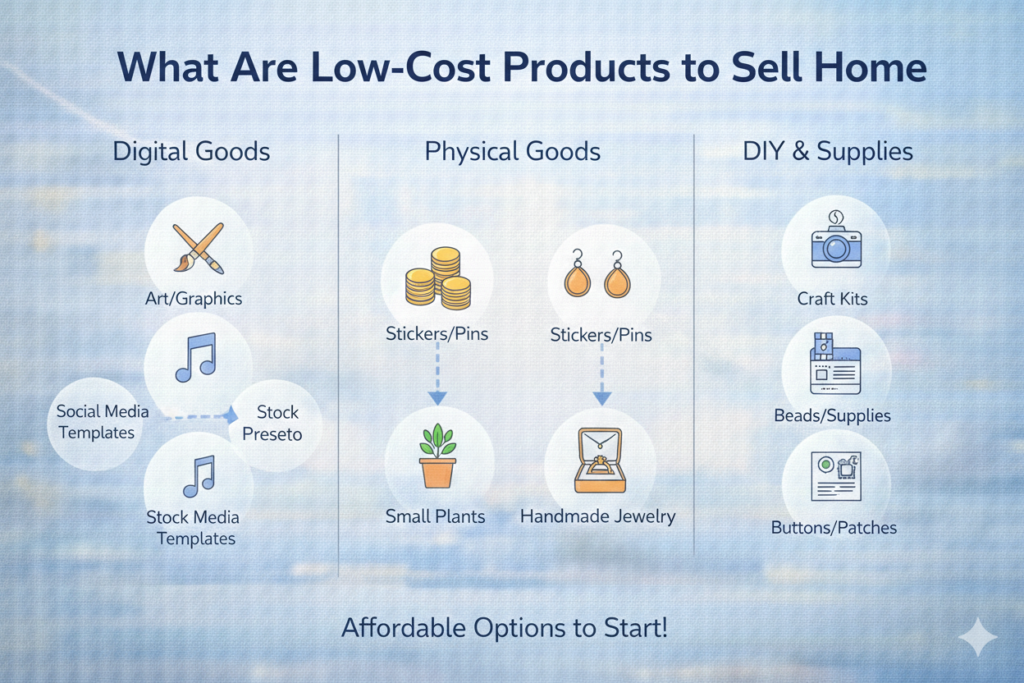
Low cost products to sell are items that can be sourced, manufactured, or created at a low price while still allowing room for profit after marketing and platform fees. These products are usually lightweight, simple to ship, and easy to market to a broad or niche audience.
Low cost does not mean low value. Many affordable products succeed because they solve everyday problems, provide convenience, or meet emotional needs. The key is finding products that customers perceive as useful or desirable, even at a small price point.
Why Low Cost Products Are Ideal for Beginners
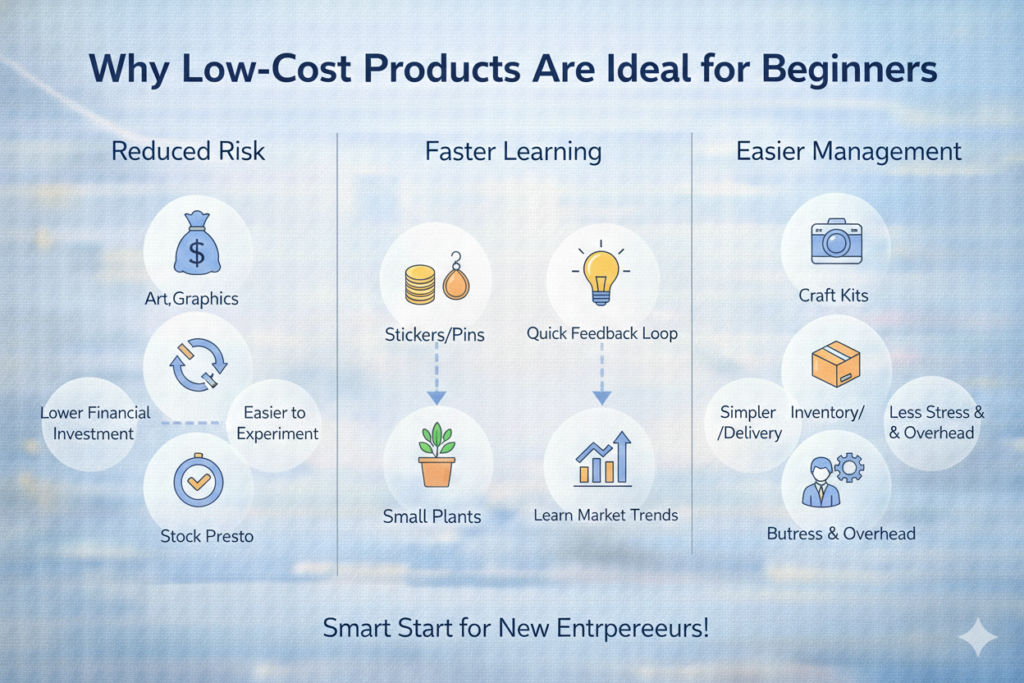
Low cost products are especially suitable for beginners because they require less upfront investment and lower financial risk. New sellers can test multiple product ideas without committing large amounts of capital, making it easier to learn what works.
Another advantage is flexibility. Sellers can experiment with pricing, branding, and marketing strategies without worrying about high losses. This makes low cost products to sell an excellent entry point into ecommerce, dropshipping, or marketplace selling.
Benefits of Selling Low Cost Products
One of the biggest benefits of selling low cost products is faster decision-making by customers. Affordable products reduce hesitation, leading to higher conversion rates. Customers are more likely to make impulse purchases when prices are low.
Additionally, low cost products often generate repeat purchases. When customers are satisfied with affordable items, they are more likely to buy again or recommend the product to others. This creates opportunities for long-term growth and brand loyalty.
Low Cost Products vs High-Ticket Products
High-ticket products can offer large profits per sale, but they usually require strong branding, trust, and customer education. In contrast, low cost products to sell rely on volume, simplicity, and accessibility.
While profit per unit may be smaller, low cost products can scale quickly. Sellers who manage costs effectively and optimize operations can generate significant revenue through consistent sales volume.
Characteristics of Profitable Low Cost Products
Not all cheap products are profitable. Successful low cost products share certain characteristics. They are lightweight, durable, easy to understand, and have clear demand. Products with simple designs and minimal variations are easier to manage and scale.
The best low cost products also have low return rates and minimal customer support requirements. This keeps operational costs low and protects profit margins over time.
Popular Categories for Low Cost Products to Sell
Several categories consistently perform well for low cost products. Accessories, small home items, beauty tools, phone accessories, fitness accessories, and pet products are common examples. These categories allow sellers to offer affordable solutions to everyday needs.
Office supplies, organizers, kitchen tools, and personal care accessories are also strong candidates. These items are widely used, easy to ship, and suitable for impulse buying.
Sourcing Low Cost Products
Sourcing is a critical step when choosing low cost products to sell. Sellers often source from wholesalers, manufacturers, or local suppliers to keep costs low. Bulk purchasing usually reduces per-unit cost and increases margins.
Quality control is important even for low cost items. Poor quality leads to negative reviews, refunds, and reputation damage. Successful sellers balance low cost with acceptable quality standards.
Pricing Strategy for Low Cost Products
Pricing low cost products requires careful planning. Prices must cover product cost, platform fees, shipping, and marketing while still remaining attractive to customers. Competitive pricing is important, but underpricing can hurt margins.
Many sellers use bundles, multipacks, or add-ons to increase average order value. This strategy allows low cost products to generate higher overall profits without raising individual prices too much.
Common Mistakes When Selling Low Cost Products
A common mistake is choosing products based only on price without considering demand or competition. Another error is ignoring hidden costs such as advertising, packaging, and platform fees.
Selling low cost products successfully requires research, testing, and continuous optimization. Sellers who treat it as a business rather than a quick win are more likely to succeed.
Best Low Cost Products to Sell Online
When identifying the best low cost products to sell, the focus should be on items that are inexpensive to source but highly useful in everyday life. Products that solve small problems or improve convenience often perform exceptionally well because customers do not hesitate to buy them. Examples include phone accessories, cable organizers, reusable kitchen tools, small beauty accessories, fitness bands, and simple home organizers.
These products usually have broad appeal and consistent demand. Because they are affordable, customers are more likely to make impulse purchases, which helps sellers achieve volume-based profitability even with smaller margins per unit.
Low Cost Products with High Demand
High demand is essential when selling low cost products. Items that are used daily or frequently replaced tend to perform better than novelty products. Personal care accessories, household cleaning tools, stationery items, pet accessories, and travel organizers are strong examples of low cost products to sell with consistent demand.
Seasonal demand should also be considered. Some low cost products perform extremely well during specific times of the year, such as fitness accessories at the start of the year or home organization products during moving seasons. Understanding demand cycles helps sellers plan inventory and marketing effectively.
Low Competition Product Opportunities
Low cost products become significantly more profitable when competition is manageable. Highly saturated products often lead to price wars, which reduce margins. Sellers should look for niches where existing products have poor reviews, limited variations, or outdated designs.
Reading customer reviews is one of the best ways to identify gaps in the market. Complaints about quality, durability, or usability indicate opportunities to launch improved versions. Many successful sellers build profitable businesses by slightly improving low cost products rather than inventing something entirely new.
How to Validate Low Cost Products Before Selling
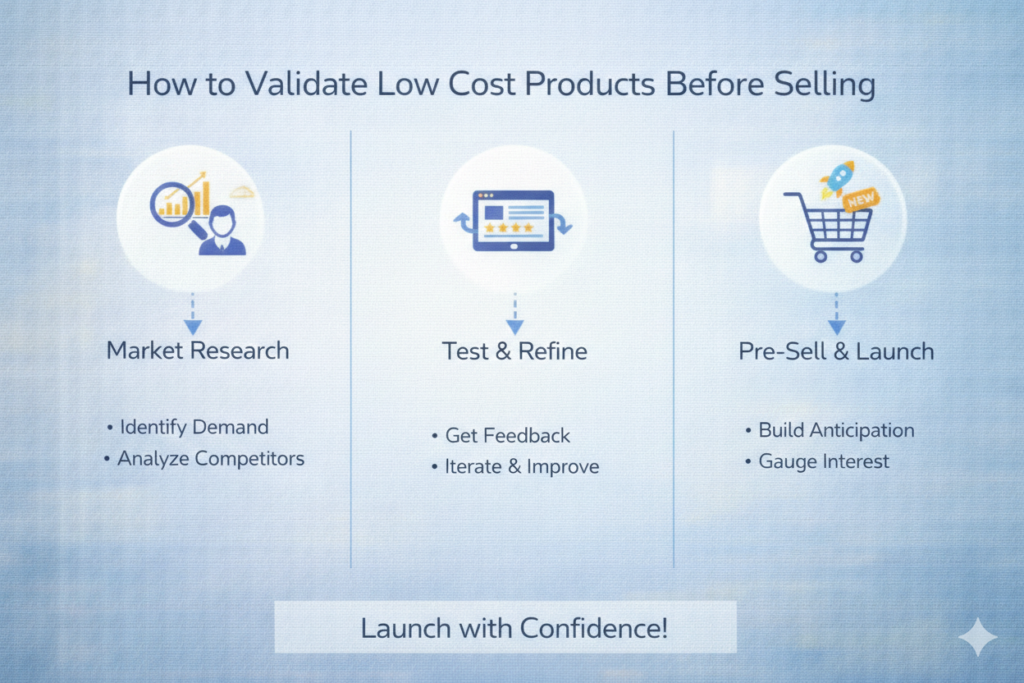
Validation is critical before committing to inventory. Sellers should analyze demand, pricing, competition, and potential margins. Simple validation methods include checking bestseller rankings, reviewing search trends, and analyzing customer feedback on existing listings.
Testing products with small quantities or limited ads helps reduce risk. Because low cost products to sell require less capital, sellers can test multiple ideas quickly and scale only those that show strong performance.
Where to Sell Low Cost Products
Low cost products can be sold across multiple platforms depending on the business model. Marketplaces offer built-in traffic, while ecommerce stores provide branding control. Social media platforms are also becoming powerful sales channels for affordable products.
Selling on multiple platforms reduces dependency on a single source of traffic. Many sellers start on one platform and expand once they identify winning products. Cross-platform selling also increases brand exposure and revenue stability.
Dropshipping vs Stocking Inventory
Low cost products are well-suited for both dropshipping and inventory-based models. Dropshipping reduces upfront investment and allows sellers to test products quickly. However, it may limit control over shipping times and quality.
Stocking inventory offers better quality control and faster delivery but requires upfront capital. Sellers often start with dropshipping to validate demand and later switch to inventory once a product proves profitable.
Packaging and Branding for Low Cost Products
Even affordable products benefit from good packaging and basic branding. Simple, clean packaging improves perceived value and customer satisfaction. Clear instructions and proper labeling reduce confusion and negative reviews.
Branding does not have to be expensive. A consistent logo, color scheme, and messaging can significantly increase trust, even for low cost products to sell. Over time, branding allows sellers to move away from pure price competition.
Increasing Profit Margins on Low Cost Products
Profit margins on low cost products can be improved through smart strategies. Bundling related products, offering multipacks, or adding small digital bonuses increases average order value. Upselling complementary products also boosts revenue.
Optimizing sourcing, negotiating with suppliers, and reducing packaging costs help protect margins. Small cost reductions can have a big impact when selling products at scale.
Common Challenges in Selling Low Cost Products
One of the biggest challenges is maintaining margins while competing on price. Rising advertising costs and platform fees can affect profitability. Sellers must continuously optimize listings, pricing, and operations.
Another challenge is quality perception. Customers may assume low price equals low quality. Clear product descriptions, good images, and honest messaging help overcome this barrier and build trust.
Scaling Low Cost Products for Long-Term Growth
Once you identify low cost products that generate consistent sales, the next step is scaling without damaging profitability. Scaling low cost products to sell requires careful planning because margins per unit are usually smaller. Instead of relying only on volume, successful sellers focus on operational efficiency, repeat customers, and increased average order value.
Scaling can include expanding product variations, offering bundles, or introducing complementary products within the same niche. This approach allows sellers to grow revenue without dramatically increasing marketing costs. Sellers who scale gradually and monitor performance closely are more likely to maintain stability and avoid cash flow issues.
Marketing Strategies for Low Cost Products
Marketing plays a crucial role in the success of low cost products. Because prices are affordable, customers often make quick decisions, especially when they clearly understand the value. Visual platforms, short-form content, and problem-solution messaging work especially well for low cost products to sell.
Content-based marketing, such as short videos, product demos, and user-generated content, helps build trust quickly. Clear images, simple messaging, and honest descriptions reduce buyer hesitation. For low cost products, simplicity often converts better than complex sales funnels.
Pricing and Profitability Management
Managing profitability is one of the biggest challenges when selling low cost products. Sellers must carefully calculate costs, including sourcing, packaging, shipping, platform fees, and advertising. Even small cost increases can significantly impact margins at scale.
Smart pricing strategies include bundle pricing, quantity discounts, and add-on products. These methods increase overall order value while keeping individual product prices attractive. Sellers who regularly review costs and adjust pricing stay profitable even in competitive markets.
Advertising on a Low Budget
Paid advertising can be effective for low cost products, but it must be managed carefully. Overspending on ads can quickly eliminate profits. Sellers should focus on highly targeted campaigns with clear goals, such as testing demand or promoting bundles.
Organic traffic sources—such as SEO, social media, and referrals—are especially valuable for low cost products to sell. Building organic visibility reduces reliance on ads and improves long-term sustainability.
Customer Retention and Repeat Sales
Customer retention is often overlooked when selling low cost products, yet it is one of the most powerful growth drivers. Because customers take less risk when buying affordable products, positive experiences often lead to repeat purchases.
Providing good packaging, clear instructions, and responsive support builds trust. Offering discounts for repeat buyers or launching related products encourages long-term relationships. Retention-focused strategies reduce marketing costs and stabilize revenue over time.
Common Mistakes That Limit Profitability
Many sellers fail by focusing only on low price rather than value. Competing solely on price leads to thin margins and constant pressure. Another common mistake is scaling too quickly without proper inventory and cash flow planning.
Ignoring customer feedback is also costly. Reviews often reveal improvement opportunities that can increase conversions and reduce returns. Successful sellers continuously optimize products based on real customer input.
Risk Management and Business Stability
Even with low investment, risk management is essential. Sellers should avoid relying on a single product, supplier, or platform. Diversifying products and sales channels reduces vulnerability to market changes or platform policy updates.
Keeping accurate records, tracking performance metrics, and maintaining cash reserves help protect the business. Sellers who plan for risks are more likely to sustain long-term success.
Future Opportunities for Low Cost Products
The demand for affordable, practical products continues to grow as consumers seek value-driven purchases. Trends such as online shopping, social commerce, and impulse buying create new opportunities for low cost products to sell.
Sellers who stay updated on consumer behavior and continuously test new ideas will remain competitive. Low cost products can serve as entry points into larger brands or broader product ecosystems.
Frequently Asked Questions (FAQs)
What are low cost products to sell?
Low cost products to sell are items that require minimal investment to source or produce while still offering profit potential. These products are usually affordable, lightweight, easy to ship, and designed for everyday use or impulse buying.
Are low cost products profitable?
Yes, low cost products can be highly profitable when sold at scale. While profit per unit may be smaller, consistent demand, repeat purchases, and smart bundling strategies can generate strong overall revenue.
What are the best categories for low cost products?
Popular categories include phone accessories, home and kitchen tools, beauty accessories, fitness items, pet products, stationery, and small organizers. These categories offer consistent demand and low sourcing costs.
Are low cost products good for beginners?
Absolutely. Low cost products to sell are ideal for beginners because they require less capital, lower risk, and allow faster testing of ideas. Beginners can learn ecommerce fundamentals without major financial pressure.
Where can I sell low cost products online?
Low cost products can be sold on marketplaces, ecommerce websites, and social media platforms. Many sellers start with platforms that offer built-in traffic and later expand to their own stores for branding control.
How do I increase profit margins on low cost products?
Profit margins can be improved by bundling products, offering multipacks, reducing sourcing costs, improving packaging, and increasing average order value through add-ons or complementary items.
What are common mistakes when selling low cost products?
Common mistakes include competing only on price, ignoring demand research, underestimating fees, poor quality control, and scaling too quickly without planning inventory or cash flow.
Can low cost products build a long-term business?
Yes. Many long-term ecommerce brands started with low cost products. With proper branding, customer retention, and expansion strategies, affordable products can evolve into sustainable businesses.
Is advertising necessary for low cost products?
Advertising can help, but it must be managed carefully. Organic traffic, content marketing, and social proof often work better for low cost products because margins are tighter.
What is the future of low cost products to sell?
As consumers continue to seek value and convenience, demand for affordable products is expected to grow. Low cost products will remain a strong entry point into ecommerce, especially when combined with smart marketing and branding.
Final Conclusion
Selling low cost products to sell is one of the most practical and beginner-friendly ways to enter the world of ecommerce. With minimal upfront investment, sellers can test ideas quickly, reduce financial risk, and gain valuable market experience. As consumer behavior continues to favor affordability, convenience, and impulse buying, low cost products remain a powerful opportunity for sustainable online business growth.
Throughout this guide, we explored how profitable low cost products are not defined by price alone, but by demand, utility, and smart execution. Products that solve small everyday problems, improve convenience, or offer repeat-use value tend to outperform generic cheap items. According to ecommerce insights published by Shopify, low-cost, high-utility products are among the easiest to scale when combined with efficient sourcing and simple branding (external dofollow link:
https://www.shopify.com/blog/product-ideas).
Similarly, industry research by Oberlo highlights that affordable products with strong perceived value often achieve higher conversion rates and repeat purchases, especially on social and marketplace platforms (external dofollow link:
https://www.oberlo.com/blog/products-to-sell-online). These insights confirm that low cost selling is not about competing on price alone—it’s about delivering value efficiently.
From a long-term perspective, low cost products can act as a foundation for larger ecommerce brands. Many successful sellers start with inexpensive products to validate demand and later expand into bundles, premium versions, or related product lines. By reinvesting profits into better packaging, branding, and marketing, sellers can gradually move away from pure price competition.
For readers who want to explore more ecommerce strategies, product research frameworks, and scalable business models, you can find detailed guides in our ecommerce learning resources section (internal dofollow link example:
https://rankifycontent.com/ecommerce-product-research). Aligning low cost products with proper sourcing, pricing, and marketing strategies is the key to long-term stability.
In conclusion, low cost products to sell offer a realistic and scalable path to online business success. Sellers who focus on demand validation, customer satisfaction, and continuous improvement—rather than shortcuts—are the ones who build profitable and resilient businesses over time.