Table of Contents
Introduction
The ecommerce industry is evolving faster than ever, driven by technology, changing consumer behavior, and global digital adoption. As businesses prepare for the future, understanding ecommerce industry trends 2026 has become essential for staying competitive in an increasingly crowded online marketplace. What worked in previous years may no longer be effective as customers demand faster, smarter, and more personalized shopping experiences.
Ecommerce in 2026 will not be defined by just selling products online—it will be shaped by automation, artificial intelligence, sustainability, and seamless omnichannel experiences. Brands that adapt early to emerging ecommerce industry trends 2026 will be better positioned to grow, scale, and retain customers in the long term.
Overview of the Ecommerce Industry in 2026
By 2026, ecommerce is expected to move beyond traditional online stores into fully integrated digital ecosystems. Consumers will interact with brands through websites, mobile apps, social media, voice assistants, and immersive digital environments. The ecommerce industry trends 2026 point toward convenience, speed, and personalization becoming non-negotiable expectations rather than optional features.
Businesses will no longer compete only on price. Instead, customer experience, trust, transparency, and value will determine success. Ecommerce platforms, payment systems, and logistics networks will continue to evolve to support global, real-time commerce at scale.
AI and Automation as Core Ecommerce Industry Trends 2026
One of the most influential ecommerce industry trends 2026 is the widespread adoption of artificial intelligence and automation. AI will power product recommendations, dynamic pricing, customer support chatbots, demand forecasting, and inventory management. These technologies will allow ecommerce businesses to operate more efficiently while delivering personalized experiences to customers.
Automation will reduce manual tasks across the ecommerce supply chain. From automated order fulfillment to AI-driven marketing campaigns, businesses will be able to scale faster with fewer resources. Ecommerce brands that leverage AI strategically will gain a significant competitive advantage.
Personalization and Customer Experience Evolution
Personalization is no longer a luxury—it is a core expectation. Ecommerce industry trends 2026 highlight a shift toward hyper-personalized shopping experiences where content, product suggestions, and offers are tailored to individual users in real time.
Data-driven personalization will allow ecommerce brands to understand customer preferences, behavior, and intent more accurately. This leads to higher conversion rates, improved customer loyalty, and stronger brand relationships. In 2026, generic shopping experiences will struggle to retain modern consumers.
Mobile-First and Omnichannel Commerce Growth
Mobile commerce will continue to dominate as smartphones become the primary shopping device worldwide. Ecommerce industry trends 2026 indicate that mobile-optimized experiences, fast loading times, and frictionless checkouts will be essential for success.
At the same time, omnichannel commerce will become standard. Customers expect seamless transitions between online stores, social media platforms, physical locations, and mobile apps. Ecommerce brands must integrate all touchpoints to deliver a consistent and connected shopping journey.
Rise of Social Commerce and Community-Driven Sales
Social commerce is emerging as a major driver within ecommerce industry trends 2026. Platforms that combine content, community, and commerce allow users to discover and purchase products without leaving their favorite apps. Influencer marketing, live shopping, and user-generated content will play a central role in purchase decisions.
Community-driven ecommerce builds trust and authenticity. Brands that foster engaged communities around their products will benefit from organic growth, repeat customers, and stronger brand advocacy.
Sustainability and Ethical Ecommerce Practices
Sustainability is becoming a key differentiator in ecommerce. Ecommerce industry trends 2026 show that consumers are increasingly aware of environmental and ethical issues. They prefer brands that demonstrate transparency, responsible sourcing, and eco-friendly practices.
Ecommerce businesses will need to adopt sustainable packaging, ethical supply chains, and clear communication about their values. Brands that ignore sustainability risk losing customer trust and relevance in future markets.
Payment Innovations and Digital Wallet Adoption
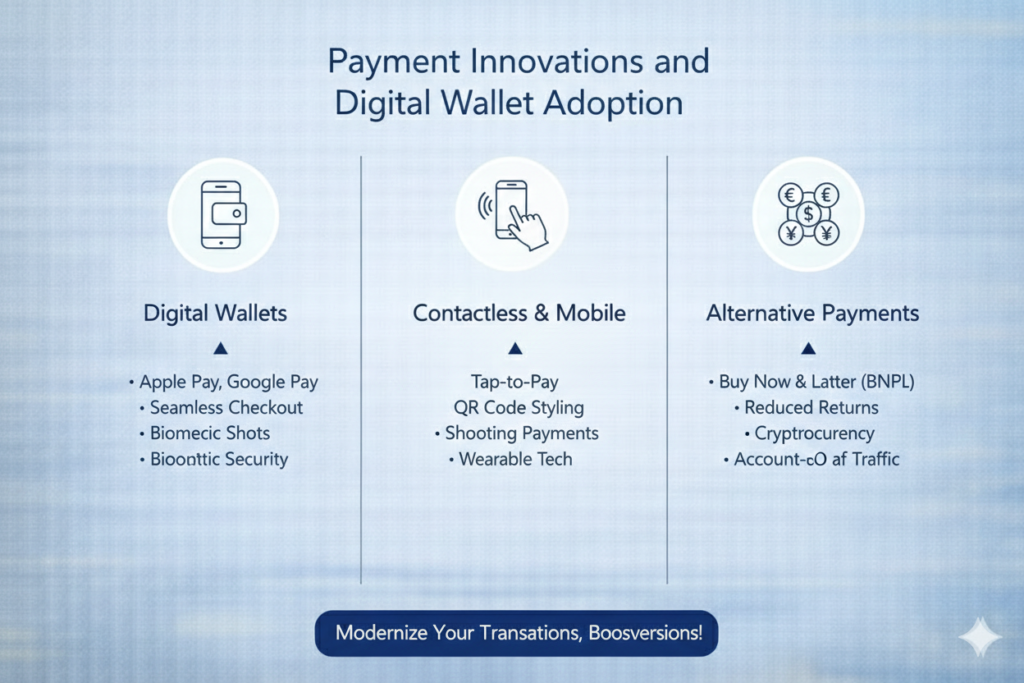
Payment technology will continue to evolve as part of ecommerce industry trends 2026. Digital wallets, buy-now-pay-later options, and alternative payment methods will become more widespread. Customers expect secure, fast, and flexible payment experiences across devices and regions.
Simplifying the checkout process will be critical. Ecommerce brands that reduce friction at payment stages will see higher conversion rates and lower cart abandonment.
Logistics, Speed, and Last-Mile Delivery Expectations
Fast and reliable delivery will remain a key factor influencing purchase decisions. Ecommerce industry trends 2026 emphasize improvements in logistics, fulfillment automation, and last-mile delivery solutions. Same-day or next-day delivery will become more common, especially in urban areas.
Customers will also demand transparency, including real-time tracking and clear delivery timelines. Ecommerce businesses must invest in logistics partnerships and technology to meet rising expectations.
Challenges Facing the Ecommerce Industry in 2026
Despite growth opportunities, ecommerce businesses will face challenges such as rising competition, customer acquisition costs, data privacy regulations, and platform dependency. Ecommerce industry trends 2026 suggest that brands must balance innovation with compliance and trust.
Businesses that rely heavily on a single platform or traffic source may face higher risks. Diversification, brand building, and owned audiences will become increasingly important for long-term stability.
Advanced Ecommerce Technologies Shaping 2026
One of the most transformative ecommerce industry trends 2026 is the deep integration of advanced technologies across the entire ecommerce value chain. Ecommerce platforms are evolving into intelligent ecosystems that can analyze customer behavior in real time, automate decisions, and continuously optimize performance. Technologies such as artificial intelligence, machine learning, cloud infrastructure, and big data analytics are no longer optional tools—they are becoming the foundation of competitive ecommerce operations.
In 2026, ecommerce systems will rely heavily on predictive capabilities. These systems will anticipate demand patterns, optimize pricing strategies, and manage inventory before shortages or overstocking occur. This technological shift will allow businesses to reduce operational costs, improve efficiency, and respond faster to market changes, creating a more resilient ecommerce environment.
Artificial Intelligence and Predictive Commerce
Artificial intelligence is at the heart of ecommerce industry trends 2026, driving a shift from reactive to predictive commerce. Instead of responding to customer actions after they occur, AI systems will analyze browsing history, purchase behavior, location data, and timing signals to predict what customers want next.
AI-powered recommendation engines will become more contextual and precise, increasing average order value and customer satisfaction. Dynamic pricing models will adjust prices in real time based on demand, competition, and customer intent. AI will also enhance fraud prevention and automate customer support, allowing businesses to scale operations while maintaining high service quality.
Augmented Reality (AR) and Immersive Shopping Experiences
Augmented reality is emerging as a game-changer within ecommerce industry trends 2026, particularly for categories where visualization is critical. Customers increasingly want confidence before purchasing, and AR helps bridge the gap between online and physical shopping.
In 2026, AR-powered virtual try-ons, 3D product views, and immersive showrooms will become more common and more accessible. Shoppers will be able to see how furniture fits into their living space, how clothing looks on their body type, or how cosmetics appear on their skin tone. These experiences reduce purchase hesitation, lower return rates, and increase trust—key success factors in modern ecommerce.
Headless Commerce and Composable Architectures
Headless commerce is gaining momentum as one of the most important ecommerce industry trends 2026. By separating the frontend user experience from backend commerce logic, businesses gain unmatched flexibility and performance. This architecture allows brands to deliver customized experiences across websites, mobile apps, social platforms, kiosks, and emerging digital channels.
Composable commerce further extends this concept by enabling businesses to select best-in-class tools for payments, search, personalization, and content management. In 2026, this modular approach will empower ecommerce brands to innovate faster, scale more efficiently, and adapt quickly to new customer touchpoints without rebuilding their entire systems.
Subscription, Membership & Recurring Revenue Models
Subscription-based ecommerce models are becoming increasingly popular as part of ecommerce industry trends 2026. Customers value convenience, predictability, and personalized experiences, while businesses benefit from recurring revenue and stronger customer relationships.
From digital subscriptions and replenishment services to exclusive memberships and premium access models, ecommerce brands are shifting focus toward lifetime value rather than one-time transactions. In 2026, subscription commerce will be deeply integrated with personalization, allowing businesses to tailor offerings based on individual usage and preferences.
Platform Diversification and Direct-to-Consumer Growth
While online marketplaces remain influential, ecommerce industry trends 2026 indicate a strong push toward diversification. Brands are becoming more aware of the risks associated with platform dependency, including rising fees, algorithm changes, and limited customer data access.
Direct-to-consumer (DTC) ecommerce will continue to grow as brands seek full control over branding, pricing, and customer relationships. In 2026, many businesses will adopt hybrid strategies—maintaining marketplace presence for visibility while investing heavily in their own ecommerce platforms to build long-term brand equity.
Voice Commerce and Conversational Interfaces
Voice commerce and conversational shopping are emerging trends that will gain wider adoption by 2026. As voice assistants and smart devices become more accurate and context-aware, consumers will increasingly use voice commands to search for products, reorder essentials, and track deliveries.
Conversational commerce through messaging apps and chat-based interfaces will further simplify the buying process. Ecommerce brands that optimize product data, content structure, and search intent for voice interactions will gain early advantages in these evolving channels.
Data Privacy, Security & Consumer Trust
As ecommerce platforms collect more data to power personalization and automation, data privacy and security are becoming critical concerns. Ecommerce industry trends 2026 highlight a shift toward transparency, ethical data use, and regulatory compliance as competitive differentiators.
Consumers are becoming more selective about which brands they trust with their personal information. Ecommerce businesses that prioritize secure payment systems, transparent data policies, and responsible data practices will build stronger, longer-lasting customer relationships.
New and Emerging Ecommerce Business Models
Ecommerce in 2026 will not be limited to traditional online stores. Creator-led commerce, community-driven brands, digital product ecosystems, and experience-based ecommerce models are becoming increasingly common.
Ecommerce industry trends 2026 show that successful brands will blend content, education, and commerce into seamless experiences. Instead of pushing products, businesses will focus on building communities, delivering value, and fostering engagement throughout the customer journey.
Strategic Preparation for Ecommerce Industry Trends 2026
Preparing for ecommerce industry trends 2026 requires more than adopting new tools—it demands a strategic mindset. Businesses must invest in scalable technology, develop data-driven capabilities, and build flexible systems that can evolve with customer behavior.
Equally important is human adaptability. Teams that embrace experimentation, continuous learning, and innovation will outperform those that resist change. Ecommerce success in 2026 will belong to brands that balance technological advancement with authentic customer relationships.
Ecommerce Marketing Trends Shaping 2026
Marketing will undergo a major transformation as part of the ecommerce industry trends 2026. Traditional advertising methods will become less effective as consumers grow more selective and privacy-conscious. Instead, value-driven, content-led, and community-focused marketing strategies will dominate. Brands will rely heavily on storytelling, education, and trust-building rather than aggressive promotions.
Personalized marketing powered by AI will become standard. In 2026, ecommerce brands will deliver tailored messages based on real-time behavior, intent, and lifecycle stage. Email marketing, video content, influencer partnerships, and short-form educational content will play a key role in acquiring and retaining customers. Authenticity will matter more than scale, and brands that focus on meaningful engagement will outperform those chasing reach alone.
Role of Content, Creators, and Community
One of the strongest ecommerce industry trends 2026 is the rise of creator-driven and community-led commerce. Customers increasingly trust creators, experts, and real users more than traditional brand advertising. Ecommerce brands will collaborate with niche creators who align with their values and audience rather than relying on celebrity endorsements.
Communities—built through social platforms, email lists, or private groups—will become powerful growth engines. Brands that invest in education, conversation, and feedback loops will create loyal customer bases that drive repeat purchases and organic growth. In 2026, community trust will be a major competitive advantage.
Sustainability and Ethical Ecommerce in 2026
Sustainability is no longer optional—it is a defining factor in ecommerce industry trends 2026. Consumers are actively choosing brands that demonstrate ethical sourcing, environmental responsibility, and transparency. Ecommerce businesses will be expected to reduce waste, adopt sustainable packaging, and communicate their impact clearly.
Ethical practices will also extend to labor, data usage, and supply chain transparency. Brands that align profit with purpose will gain stronger customer loyalty and long-term relevance. In contrast, companies that ignore sustainability risks may face reputational damage and declining trust.
Regulation, Privacy, and Compliance Challenges
As ecommerce becomes more data-driven, regulatory scrutiny will increase. Ecommerce industry trends 2026 highlight stricter data privacy laws, consumer protection regulations, and platform compliance requirements. Businesses will need to adapt quickly to regional and global regulations while maintaining seamless customer experiences.
Trust will become a currency. Clear privacy policies, ethical data usage, and secure payment systems will influence purchasing decisions. Ecommerce brands that proactively invest in compliance and transparency will build stronger relationships with increasingly cautious consumers.
Rising Competition and Customer Acquisition Costs
Competition in ecommerce will intensify further by 2026. With low barriers to entry, customer acquisition costs are expected to rise across most channels. Ecommerce industry trends 2026 suggest that brands can no longer rely solely on paid ads for growth.
Instead, businesses must invest in brand differentiation, organic traffic, SEO, retention strategies, and owned audiences. Long-term success will favor brands that build strong foundations rather than chasing short-term growth hacks.
Globalization and Cross-Border Ecommerce
Cross-border ecommerce will continue to expand as logistics, payments, and localization technologies improve. Ecommerce industry trends 2026 show that businesses will increasingly target global audiences, offering localized pricing, language support, and region-specific experiences.
However, globalization also introduces complexity, including compliance, taxes, and logistics coordination. Brands that plan international expansion strategically will unlock significant growth opportunities in emerging markets.
Key Risks Facing the Ecommerce Industry in 2026
Despite rapid growth, the ecommerce industry will face notable risks in 2026. Platform dependency, algorithm changes, supply chain disruptions, and economic uncertainty can impact even established brands. Ecommerce industry trends 2026 emphasize the importance of resilience and diversification.
Businesses that rely on a single platform, supplier, or traffic source will be more vulnerable. Building flexible systems, diversified revenue streams, and strong customer relationships will be critical risk management strategies.
How Businesses Can Prepare for Ecommerce Industry Trends 2026
Preparation is the difference between survival and leadership. To succeed in ecommerce industry trends 2026, businesses must adopt a forward-looking strategy that combines technology, branding, and adaptability. Investing in scalable platforms, data capabilities, and customer experience should be a priority.
Equally important is mindset. Teams that embrace innovation, experimentation, and continuous learning will adapt faster to change. Ecommerce in 2026 will reward brands that remain agile while staying true to customer needs and values.
Frequently Asked Questions (FAQs)
What are the key ecommerce industry trends 2026?
The key ecommerce industry trends 2026 include artificial intelligence–driven personalization, automation, omnichannel commerce, social and community-based selling, sustainable ecommerce practices, faster logistics, and advanced payment solutions. These trends focus on improving customer experience, efficiency, and trust.
How will artificial intelligence impact ecommerce in 2026?
Artificial intelligence will play a central role in ecommerce industry trends 2026 by powering product recommendations, predictive analytics, dynamic pricing, customer support chatbots, and demand forecasting. AI will help ecommerce businesses deliver more personalized and efficient shopping experiences.
Why is personalization important in ecommerce industry trends 2026?
Personalization is important because customers expect tailored experiences. In 2026, ecommerce brands that use data to personalize content, offers, and product recommendations will see higher conversion rates, stronger customer loyalty, and improved lifetime value.
How will social commerce evolve by 2026?
Social commerce will become more integrated into daily online activity. Ecommerce industry trends 2026 show that platforms combining content, influencers, and direct purchasing will drive discovery and sales. Live shopping and community-driven recommendations will continue to grow.
What role does sustainability play in ecommerce industry trends 2026?
Sustainability is a major factor in ecommerce industry trends 2026. Consumers prefer brands that use ethical sourcing, eco-friendly packaging, and transparent supply chains. Sustainable practices will influence purchasing decisions and long-term brand trust.
Will mobile commerce still dominate ecommerce in 2026?
Yes, mobile commerce will remain dominant. Ecommerce industry trends 2026 indicate that mobile-first design, fast loading speed, and frictionless checkout experiences will be essential as smartphones continue to be the primary shopping device worldwide.
How will ecommerce businesses handle rising competition in 2026?
To manage rising competition, ecommerce businesses must focus on branding, customer experience, retention, and owned audiences. Ecommerce industry trends 2026 suggest that relying only on paid ads will be risky, while long-term strategies like SEO and community-building will be more sustainable.
What challenges will ecommerce businesses face in 2026?
Major challenges include increasing customer acquisition costs, stricter data privacy regulations, platform dependency, and supply chain disruptions. Ecommerce industry trends 2026 highlight the need for diversification, compliance, and operational resilience.
Is omnichannel commerce necessary in 2026?
Yes, omnichannel commerce will be essential. Customers expect seamless experiences across websites, mobile apps, social media, and physical stores. Ecommerce industry trends 2026 emphasize consistent branding and smooth transitions between all customer touchpoints.
How can businesses prepare for ecommerce industry trends 2026?
Businesses can prepare by investing in scalable technology, adopting AI and automation, prioritizing customer experience, embracing sustainability, and building strong brands. Staying adaptable and customer-focused will be key to success in 2026.
Final Conclusion:
The ecommerce industry trends 2026 clearly highlight that online commerce is entering a new phase—one defined not just by growth, but by intelligence, responsibility, and experience. Ecommerce is no longer limited to selling products through websites; it is evolving into a fully connected digital ecosystem where technology, data, and customer trust work together to drive long-term value. Businesses that understand this shift will be better positioned to compete in an increasingly complex and saturated market.
As discussed throughout this guide, artificial intelligence, automation, personalization, and omnichannel commerce will become standard expectations rather than competitive advantages. Consumers in 2026 will demand faster delivery, seamless mobile experiences, ethical practices, and personalized interactions across every touchpoint. According to Shopify’s global ecommerce insights, brands that invest early in AI-driven personalization and flexible commerce infrastructure are more likely to achieve sustainable growth in the coming years (external dofollow link:
https://www.shopify.com/enterprise/ecommerce-trends).
At the same time, sustainability and transparency will strongly influence purchasing decisions. Research and industry forecasts published by Statista show that environmentally responsible ecommerce practices and ethical supply chains are becoming key drivers of customer loyalty worldwide (external dofollow link:
https://www.statista.com/topics/871/online-shopping/). This means ecommerce brands must balance innovation with responsibility to remain relevant in 2026 and beyond.
Another major takeaway from ecommerce industry trends 2026 is the importance of reducing dependency on single platforms or traffic sources. Brands that build direct relationships with customers through their own websites, email lists, and communities will have greater control over data, pricing, and long-term stability. Direct-to-consumer strategies, combined with content-led and community-driven marketing, will separate resilient brands from short-term sellers.
For businesses and entrepreneurs looking to stay ahead, continuous learning and strategic adaptation are essential. You can explore more in-depth guides on ecommerce strategy, digital products, Shopify growth, and future-ready business models in our ecommerce learning resources section (internal dofollow link example:
https://rankifycontent.com/ecommerce-growth-strategies). Aligning technology adoption with strong branding, customer experience, and ethical practices creates a solid foundation for long-term success.
In conclusion, the ecommerce industry trends 2026 are not just predictions—they are signals of how digital commerce will operate in the near future. Brands that act now by embracing innovation, prioritizing customer trust, and building flexible, sustainable systems will not only survive but lead the next generation of ecommerce. The future of online business belongs to those who are adaptable, data-driven, and genuinely customer-centric.