Table of Contents
Introduction
In the world of online business, success begins long before a product is marketed or sold. It starts with ecommerce product sourcing—the process of identifying, evaluating, and securing products that meet market demand while maintaining profitability and quality. Many ecommerce businesses fail not because of poor marketing, but because they source the wrong products or work with unreliable suppliers.
As global ecommerce expands, sourcing has become more complex and competitive. Businesses now have access to thousands of suppliers worldwide, but this abundance also increases risk. Strategic ecommerce product sourcing ensures that products are cost-effective, scalable, compliant, and aligned with customer expectations. Brands that invest time in sourcing build stronger foundations and gain long-term competitive advantages.
What Is Ecommerce Product Sourcing?
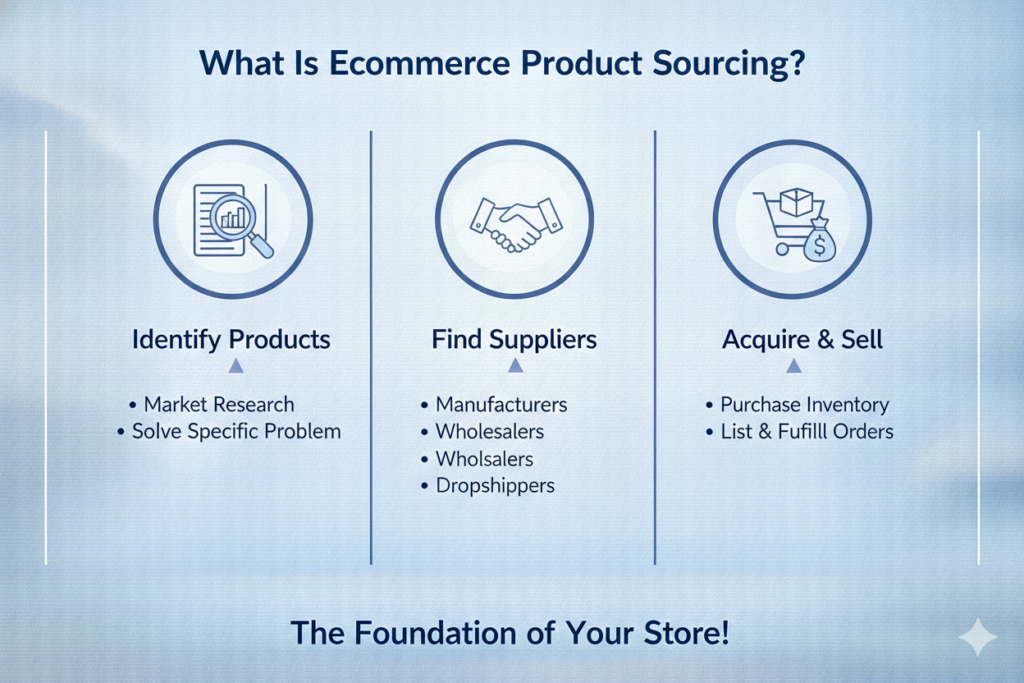
Ecommerce product sourcing is the systematic process of finding products from manufacturers, wholesalers, or suppliers and preparing them for sale through online platforms. This process includes supplier discovery, price negotiation, quality assurance, logistics planning, and long-term supplier management.
Product sourcing is not a one-time activity—it is an ongoing strategy. Market trends change, suppliers evolve, and customer expectations grow. Successful ecommerce businesses continuously refine their sourcing strategies to maintain quality, reduce costs, and improve delivery performance.
Why Ecommerce Product Sourcing Is Critical for Business Success
Ecommerce product sourcing directly influences profit margins, customer satisfaction, and brand credibility. Poor sourcing decisions can result in low-quality products, shipping delays, and negative customer reviews, which are difficult to recover from in competitive markets.
Strong sourcing strategies allow businesses to control costs, maintain consistent quality, and scale operations efficiently. When sourcing is done correctly, ecommerce businesses can focus on growth, branding, and customer experience instead of constantly fixing supply issues.
Objectives of Ecommerce Product Sourcing
The primary goal of ecommerce product sourcing is to deliver value to customers while maintaining healthy profit margins. This involves sourcing products that meet quality standards, match customer demand, and can be delivered reliably.
Other objectives include supplier reliability, production scalability, cost optimization, and risk management. Ecommerce brands that clearly define sourcing objectives are better equipped to evaluate suppliers and avoid costly mistakes.
Types of Ecommerce Product Sourcing Models (In-Depth)
There are multiple sourcing models used in ecommerce, each with different levels of risk and control. Wholesale sourcing involves buying products in bulk from distributors or manufacturers at discounted rates. This model offers higher margins but requires inventory management.
Dropshipping allows ecommerce sellers to source products directly from suppliers who ship orders to customers. While this reduces inventory risk, it offers lower margins and less control over quality and shipping times.
Private labeling is a popular model where businesses source generic products and brand them as their own. This approach offers higher margins, stronger branding, and better customer loyalty. Custom manufacturing provides the most control but requires significant investment and supplier coordination.
Domestic vs International Ecommerce Product Sourcing
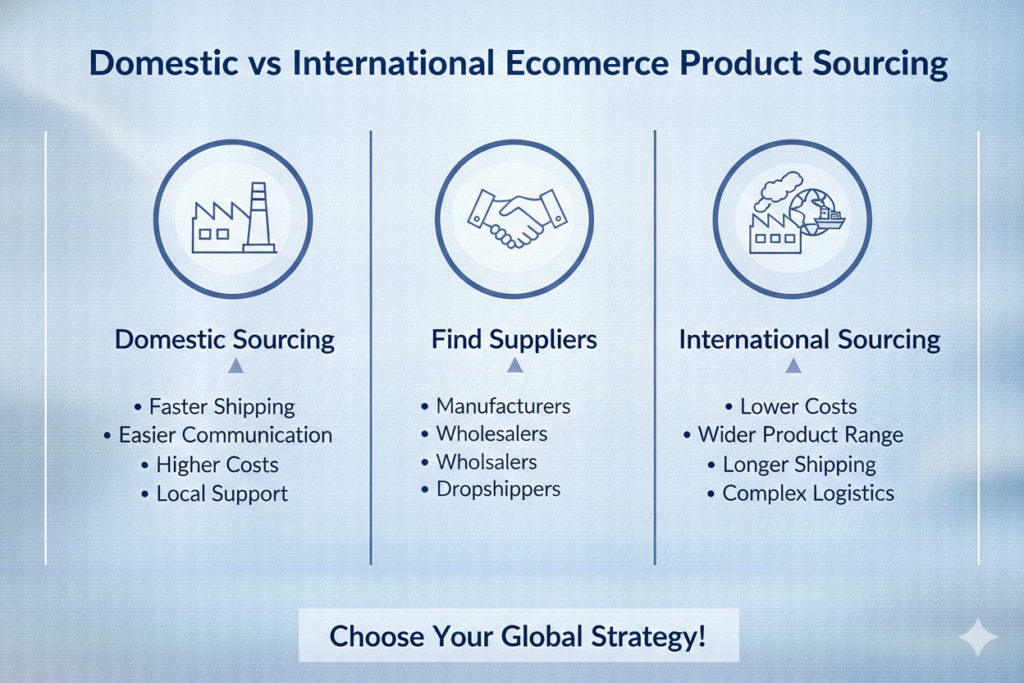
Domestic ecommerce product sourcing provides advantages such as faster shipping, easier communication, and better quality oversight. It is often preferred for premium products or brands focused on speed and reliability.
International sourcing, particularly from manufacturing hubs, offers cost advantages and wider product variety. However, it introduces challenges such as longer lead times, customs regulations, and quality assurance. Many successful ecommerce brands use a hybrid sourcing strategy to balance cost, speed, and reliability.
Importance of Market Research in Ecommerce Product Sourcing
Market research is the foundation of effective ecommerce product sourcing. Businesses must analyze customer demand, competition, pricing trends, and seasonality before selecting products. Sourcing products without proper research increases the risk of entering saturated markets or selling products with low demand.
Customer reviews, competitor listings, keyword research, and trend analysis tools provide valuable insights. Data-driven sourcing reduces uncertainty and increases the likelihood of product-market fit.
Supplier Evaluation and Relationship Building
Choosing the right supplier is one of the most critical steps in ecommerce product sourcing. Supplier evaluation involves assessing product quality, communication reliability, production capacity, pricing structure, and compliance standards. Requesting samples and conducting audits help verify supplier claims.
Long-term success depends on building strong supplier relationships. Trusted suppliers offer better pricing, customization options, and priority production as the business grows. Reliable partnerships reduce risk and improve operational efficiency.
Quality Control and Compliance in Product Sourcing
Quality control is essential in ecommerce product sourcing, especially for products related to health, electronics, or safety. Businesses must ensure products meet quality standards, certifications, and regulatory requirements in target markets.
Implementing quality checks at different stages of production and shipment prevents defects and returns. Compliance-focused sourcing protects brands from legal issues and builds customer trust.
Risks and Challenges in Ecommerce Product Sourcing
Ecommerce product sourcing involves several risks, including supplier inconsistency, quality variations, shipping delays, and cost fluctuations. Relying on a single supplier increases vulnerability to disruptions.
Successful ecommerce businesses mitigate these risks by diversifying suppliers, maintaining backup options, and monitoring supplier performance regularly. Proactive sourcing strategies ensure business continuity and resilience.
Strategic Role of Ecommerce Product Sourcing in Scaling
As ecommerce businesses scale, sourcing strategies must evolve. Products that work at a small scale may not be suitable for larger volumes. Scalable sourcing focuses on supplier capacity, automation, logistics optimization, and cost control.
Brands that plan sourcing with growth in mind avoid supply bottlenecks and customer dissatisfaction during expansion phases.
Best Platforms for Ecommerce Product Sourcing
Choosing the right sourcing platform is a critical step in ecommerce product sourcing because it directly affects cost, quality, and delivery reliability. Online sourcing platforms connect ecommerce businesses with manufacturers, wholesalers, and distributors across different regions. These platforms allow sellers to compare suppliers, review product catalogs, request samples, and negotiate pricing at scale.
For ecommerce beginners, sourcing platforms simplify supplier discovery and reduce entry barriers. For established brands, they provide access to private labeling, customization, and bulk production options. However, businesses must still conduct due diligence, as not all suppliers offer the same quality or reliability. Successful ecommerce product sourcing combines platform access with careful supplier evaluation.
Dropshipping as an Ecommerce Product Sourcing Model
Dropshipping is one of the most popular ecommerce product sourcing models because it requires minimal upfront investment. In this model, sellers list products on their online store, but suppliers handle inventory storage and shipping directly to customers. This approach reduces financial risk and allows rapid product testing.
However, dropshipping also has limitations. Sellers have less control over product quality, packaging, and shipping times. Profit margins are usually lower, and competition is high because many sellers source from the same suppliers. Ecommerce businesses using dropshipping must focus on niche selection, branding, and customer service to remain competitive.
Private Label Product Sourcing (Detailed Overview)
Private labeling is a more advanced ecommerce product sourcing strategy where businesses source generic products and sell them under their own brand. This model offers higher profit margins, stronger brand identity, and greater control over customer experience. Private labeling allows customization of packaging, design, and sometimes product features.
While private label sourcing requires higher upfront investment, it provides long-term benefits. Brands can differentiate themselves, build customer loyalty, and reduce direct price competition. For ecommerce businesses focused on scaling, private labeling is often the most sustainable sourcing model.
Custom Manufacturing and Direct Factory Sourcing
Custom manufacturing represents the highest level of control in ecommerce product sourcing. Businesses work directly with manufacturers to produce unique products based on specific designs and requirements. This model is ideal for brands that want exclusive products and full ownership of intellectual property.
The main challenges of custom manufacturing include higher minimum order quantities, longer production timelines, and increased complexity. However, for established ecommerce brands, the benefits often outweigh the risks. Custom manufacturing enables true differentiation and long-term competitive advantage.
Supplier Negotiation Strategies in Ecommerce Product Sourcing
Negotiation is a crucial skill in ecommerce product sourcing that directly impacts profitability. Many suppliers expect negotiation, especially for bulk orders or long-term partnerships. Successful negotiation focuses not only on price but also on payment terms, production timelines, customization options, and quality standards.
Building trust with suppliers improves negotiation outcomes. Clear communication, realistic expectations, and consistent order volumes often result in better pricing and priority treatment. Ecommerce businesses that approach suppliers as partners rather than one-time vendors achieve stronger long-term results.
Managing Costs and Profit Margins
Cost control is central to ecommerce product sourcing success. Beyond product price, businesses must account for shipping, customs duties, packaging, quality inspections, storage, and returns. Hidden costs can quickly erode profit margins if not managed carefully.
Smart sourcing strategies involve comparing multiple suppliers, negotiating shipping rates, and optimizing order quantities. Businesses should regularly review sourcing costs and adjust pricing strategies accordingly. A data-driven approach ensures sustainable profitability.
Risk Management in Ecommerce Product Sourcing
Every sourcing model carries risks, including supplier failure, quality inconsistency, shipping delays, and regulatory issues. Effective ecommerce product sourcing includes proactive risk management strategies such as supplier diversification, backup sourcing options, and quality assurance processes.
Businesses should avoid dependency on a single supplier whenever possible. Regular performance monitoring and contingency planning help maintain operational stability and protect customer experience during disruptions.
Ethical and Sustainable Product Sourcing
Modern consumers increasingly value ethical and sustainable business practices. Ecommerce product sourcing now includes considerations such as fair labor practices, environmentally friendly materials, and responsible manufacturing. Brands that prioritize ethical sourcing build stronger trust and brand loyalty.
Sustainable sourcing may involve higher initial costs, but it often results in long-term benefits such as improved brand reputation and customer retention. Transparency in sourcing practices also strengthens marketing and storytelling efforts.
Scaling Ecommerce Product Sourcing Operations
As ecommerce businesses grow, sourcing strategies must scale accordingly. Scaling involves increasing order volumes, improving supplier coordination, automating processes, and maintaining consistent quality. Products that work at small volumes may not scale effectively without reliable suppliers and logistics systems.
Successful scaling requires continuous evaluation of sourcing performance. Businesses that invest in scalable ecommerce product sourcing systems avoid supply chain bottlenecks and customer dissatisfaction during growth phases.
Tools and Software for Ecommerce Product Sourcing
As ecommerce businesses scale, managing product sourcing manually becomes inefficient. This is where sourcing tools and software play a critical role. Modern ecommerce product sourcing tools help businesses identify suppliers, compare prices, track orders, manage communication, and monitor supplier performance from a single dashboard.
Product Information Management (PIM) systems, supplier management tools, and inventory software help centralize sourcing data. These tools improve transparency, reduce errors, and support faster decision-making. For growing ecommerce brands, technology-driven sourcing is essential to maintain consistency and efficiency across expanding product catalogs.
Quality Control in Ecommerce Product Sourcing
Quality control is one of the most important aspects of ecommerce product sourcing, especially for categories such as electronics, beauty, health, and children’s products. Without proper quality checks, businesses risk selling defective or non-compliant products, leading to returns, negative reviews, and brand damage.
Effective quality control involves requesting samples, setting product specifications, and conducting inspections during production and before shipment. Some ecommerce businesses also use third-party inspection services to ensure consistency. Strong quality control practices protect both customers and long-term brand reputation.
Logistics, Shipping, and Fulfillment Considerations
Logistics is closely tied to ecommerce product sourcing. Even high-quality products can fail if shipping is slow, unreliable, or expensive. Businesses must consider shipping methods, delivery timelines, packaging requirements, and customs regulations during the sourcing process.
Strategic sourcing includes selecting suppliers with reliable logistics partners or fulfillment capabilities. Efficient shipping and fulfillment improve customer satisfaction and reduce operational stress. Ecommerce brands that integrate sourcing with logistics planning gain a competitive edge in delivery speed and reliability.
Compliance and Legal Considerations in Product Sourcing
Ecommerce product sourcing must comply with legal and regulatory requirements in target markets. This includes product safety standards, labeling laws, certifications, and import regulations. Non-compliance can result in fines, product bans, or account suspensions on ecommerce platforms.
Successful ecommerce businesses proactively verify compliance during sourcing. Working with certified suppliers and maintaining proper documentation reduces risk. Compliance-focused sourcing builds trust with customers and protects long-term operations.
Role of Ecommerce Product Sourcing in Branding
Product sourcing directly influences brand perception. Packaging quality, product consistency, and customization options all stem from sourcing decisions. Brands that source high-quality products with thoughtful packaging create stronger emotional connections with customers.
Private label and custom sourcing allow ecommerce businesses to differentiate their brand rather than compete solely on price. Strategic sourcing supports premium positioning, storytelling, and customer loyalty.
Future Trends in Ecommerce Product Sourcing
The future of ecommerce product sourcing is driven by technology, transparency, and sustainability. AI-powered sourcing tools are increasingly used to predict demand, identify suppliers, and optimize pricing. Automation reduces manual work and improves accuracy in supplier selection.
Sustainable sourcing is another growing trend. Consumers are demanding ethically produced products with transparent supply chains. Ecommerce brands that prioritize responsible sourcing gain trust and long-term loyalty. Additionally, nearshoring and regional sourcing are gaining popularity to reduce shipping delays and supply chain risks.
External Industry Insights and Market Validation
Industry leaders emphasize the importance of strategic sourcing in ecommerce success. Shopify highlights that reliable product sourcing and supplier relationships are critical for scaling ecommerce businesses efficiently:
https://www.shopify.com/blog/product-sourcing
Similarly, BigCommerce explains that effective product sourcing improves margins, reduces risk, and strengthens long-term ecommerce growth:
https://www.bigcommerce.com/articles/ecommerce/product-sourcing/
These insights confirm that ecommerce product sourcing is not just an operational task—it is a strategic growth driver.
Internal Growth Strategy Integration
To maximize performance, ecommerce product sourcing should align with pricing strategies, product marketing, and inventory management. You can explore more ecommerce growth frameworks, supplier strategies, and optimization guides in our dedicated resource section (internal dofollow link example:
https://rankifycontent.com/ecommerce-growth-strategies).
When sourcing decisions are integrated with marketing and operations, ecommerce businesses achieve better scalability and profitability.
Frequently Asked Questions (FAQs)
What is ecommerce product sourcing?
Ecommerce product sourcing is the process of finding, evaluating, and purchasing products from suppliers or manufacturers to sell through an online store. It includes supplier selection, price negotiation, quality control, logistics planning, and long-term supplier management to ensure profitability and customer satisfaction.
Why is ecommerce product sourcing important for online businesses?
Ecommerce product sourcing is important because it directly impacts product quality, pricing, profit margins, shipping speed, and brand reputation. Poor sourcing leads to customer complaints and losses, while strong sourcing builds trust, repeat purchases, and long-term business growth.
What are the most common ecommerce product sourcing models?
The most common ecommerce product sourcing models include dropshipping, wholesale sourcing, private labeling, and custom manufacturing. Each model has different levels of risk, control, investment, and scalability depending on business goals and resources.
Is dropshipping a good product sourcing strategy?
Dropshipping can be a good starting strategy for beginners because it requires low upfront investment and minimal inventory risk. However, it usually offers lower profit margins and less control over quality and shipping. Long-term ecommerce brands often move to private labeling or wholesale sourcing.
How do I find reliable suppliers for ecommerce product sourcing?
Reliable suppliers can be found through online sourcing platforms, industry trade shows, referrals, and direct manufacturer outreach. Always request samples, check certifications, review supplier communication, and test small orders before committing to large volumes.
How can I ensure product quality when sourcing internationally?
To ensure quality in international ecommerce product sourcing, businesses should request samples, define clear product specifications, conduct factory inspections, and use third-party quality inspection services. Consistent quality checks reduce returns and protect brand reputation.
What costs should be considered in ecommerce product sourcing?
Beyond product cost, ecommerce product sourcing includes shipping fees, customs duties, packaging, quality inspections, storage, returns, and currency fluctuations. Understanding total landed cost is essential for accurate pricing and profit planning.
Can ecommerce product sourcing be automated?
Yes, ecommerce product sourcing can be partially automated using sourcing platforms, supplier management software, Product Information Management (PIM) systems, and AI-powered tools. Automation improves efficiency, accuracy, and scalability for growing businesses.
How does ecommerce product sourcing affect branding?
Product sourcing directly influences branding through product quality, packaging, customization, and consistency. Private label and custom sourcing allow brands to differentiate themselves, build loyalty, and compete on value rather than price alone.
What are future trends in ecommerce product sourcing?
Future trends include AI-driven supplier discovery, sustainable and ethical sourcing, nearshoring, supply chain transparency, and automation. Ecommerce businesses that adapt to these trends gain resilience and customer trust.
Final Conclusion:
Ecommerce product sourcing is far more than a backend operational task—it is the strategic backbone of a successful online business. Every decision related to sourcing directly affects product quality, pricing power, delivery speed, customer satisfaction, and long-term brand credibility. In an increasingly competitive ecommerce landscape, businesses that treat sourcing as a strategic function rather than a shortcut gain a clear and lasting advantage.
As discussed throughout this guide, effective ecommerce product sourcing begins with thorough market research and continues through supplier evaluation, negotiation, quality control, logistics planning, and ongoing performance monitoring. Whether a business chooses dropshipping, wholesale, private labeling, or custom manufacturing, the success of that model depends on how well sourcing aligns with customer expectations and business goals. Poor sourcing decisions often result in high return rates, negative reviews, and shrinking margins, while strong sourcing builds trust and repeat customers.
Modern ecommerce product sourcing is also becoming more data-driven and technology-enabled. Automation tools, supplier management systems, and AI-powered sourcing platforms are helping businesses identify reliable suppliers, forecast demand, and reduce operational risks. At the same time, trends such as sustainable sourcing, ethical manufacturing, and supply chain transparency are reshaping how customers evaluate brands. Ecommerce businesses that adapt to these trends early position themselves as trustworthy and future-ready.
Another critical takeaway is scalability. What works for a small online store may fail at higher volumes if sourcing is not designed for growth. Scalable ecommerce product sourcing focuses on supplier capacity, consistent quality, diversified sourcing channels, and logistics efficiency. Brands that plan sourcing with expansion in mind avoid supply chain bottlenecks and protect customer experience during growth phases.
In conclusion, ecommerce product sourcing is not a one-time setup—it is an ongoing strategic process that evolves with market trends, customer behavior, and business scale. When combined with strong product marketing, competitive pricing, and efficient operations, a well-executed sourcing strategy becomes a powerful driver of profitability and long-term success. For ecommerce entrepreneurs and established brands alike, investing time, resources, and planning into ecommerce product sourcing is one of the smartest decisions they can make for sustainable growth in the digital marketplace.