Table of Contents
Introduction
As ecommerce stores grow, managing products becomes increasingly complex. Thousands of products, multiple categories, filters, and variations can quickly turn an online store into a confusing experience for customers. This is where ecommerce product taxonomy plays a critical role. A well-structured product taxonomy helps organize products logically, making it easier for customers to browse, search, and find exactly what they need.
Ecommerce product taxonomy is not only about organization—it directly impacts user experience, SEO, conversions, and scalability. Online stores that invest in a clear and consistent taxonomy structure perform better than those with messy or unclear product hierarchies.
What Is Ecommerce Product Taxonomy?
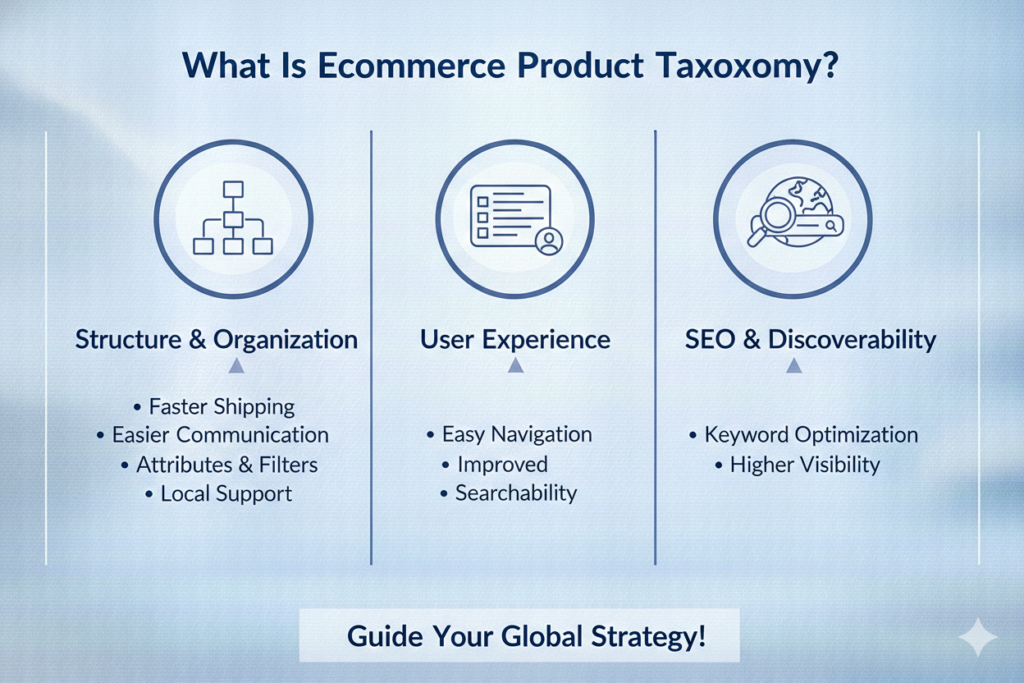
Ecommerce product taxonomy refers to the structured classification of products into categories, subcategories, and attributes within an online store. It defines how products are grouped, labeled, and connected, creating a logical hierarchy that reflects how customers think and shop.
Unlike simple categorization, taxonomy includes multiple layers such as primary categories, secondary categories, attributes, and filters. This structured system ensures that products are easy to navigate, searchable, and scalable as the catalog expands.
Why Ecommerce Product Taxonomy Is Important
The importance of ecommerce product taxonomy lies in customer behavior. Online shoppers expect intuitive navigation and quick access to relevant products. When taxonomy is poorly designed, customers struggle to find items, leading to frustration and abandoned sessions.
From a business perspective, ecommerce product taxonomy supports consistent product data, improves internal linking, and enables advanced filtering and personalization. It also lays the foundation for SEO-friendly site architecture and long-term growth.
Difference Between Product Taxonomy, Categories, and Tags
Many ecommerce store owners confuse categories, tags, and taxonomy. Categories are just one part of ecommerce product taxonomy. Taxonomy is the complete framework that includes categories, subcategories, attributes, and sometimes tags.
For example, “Electronics” may be a category, “Mobile Phones” a subcategory, and attributes like brand, storage, and color complete the taxonomy. This layered structure allows products to be classified accurately without duplication or confusion.
How Ecommerce Product Taxonomy Improves User Experience
A clear ecommerce product taxonomy significantly enhances user experience. Customers can browse logically organized categories, apply filters easily, and narrow down results quickly. This reduces cognitive load and helps users make faster purchase decisions.
When taxonomy matches customer expectations, navigation feels natural. Users spend more time exploring products, view more pages, and are more likely to convert. Poor taxonomy, on the other hand, leads to confusion and higher bounce rates.
Role of Ecommerce Product Taxonomy in Search Functionality
Search functionality depends heavily on product taxonomy. A strong ecommerce product taxonomy ensures that search results are relevant and accurate. When products are classified correctly, search engines can match queries with the right categories and attributes.
For example, a customer searching for “men’s running shoes” expects results filtered by gender, category, and use case. Without proper taxonomy, search results become irrelevant, damaging trust and usability.
Ecommerce Product Taxonomy and SEO
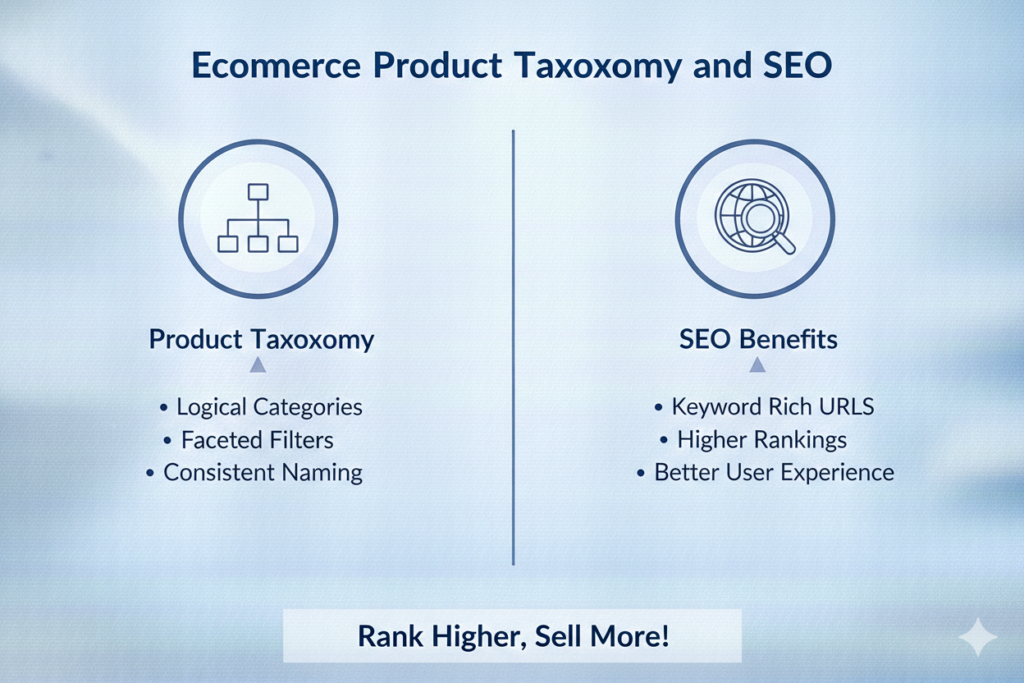
Ecommerce product taxonomy plays a vital role in SEO by creating a clean and logical site structure. Well-defined category and subcategory pages target high-intent keywords, while internal linking between taxonomy levels improves crawlability.
Search engines favor ecommerce websites with clear hierarchies and structured navigation. A strong taxonomy reduces duplicate content, improves indexing efficiency, and increases the visibility of category pages in search results.
Designing a Scalable Ecommerce Product Taxonomy
Scalability is one of the most important considerations in ecommerce product taxonomy. A good taxonomy should support future product expansion without requiring major restructuring. This means avoiding overly narrow categories and designing flexible hierarchies.
Successful ecommerce businesses plan taxonomy with growth in mind. They use broad parent categories, meaningful subcategories, and standardized attributes to ensure the taxonomy remains usable as the catalog grows.
Common Challenges in Ecommerce Product Taxonomy
Many ecommerce businesses struggle with taxonomy due to unclear naming conventions, inconsistent category usage, or overcomplicated hierarchies. Another common issue is designing taxonomy based on internal business logic rather than customer behavior.
These challenges lead to poor navigation, weak SEO performance, and operational inefficiencies. Addressing taxonomy issues early saves time and prevents costly restructuring later.
SEO Benefits of Ecommerce Product Taxonomy
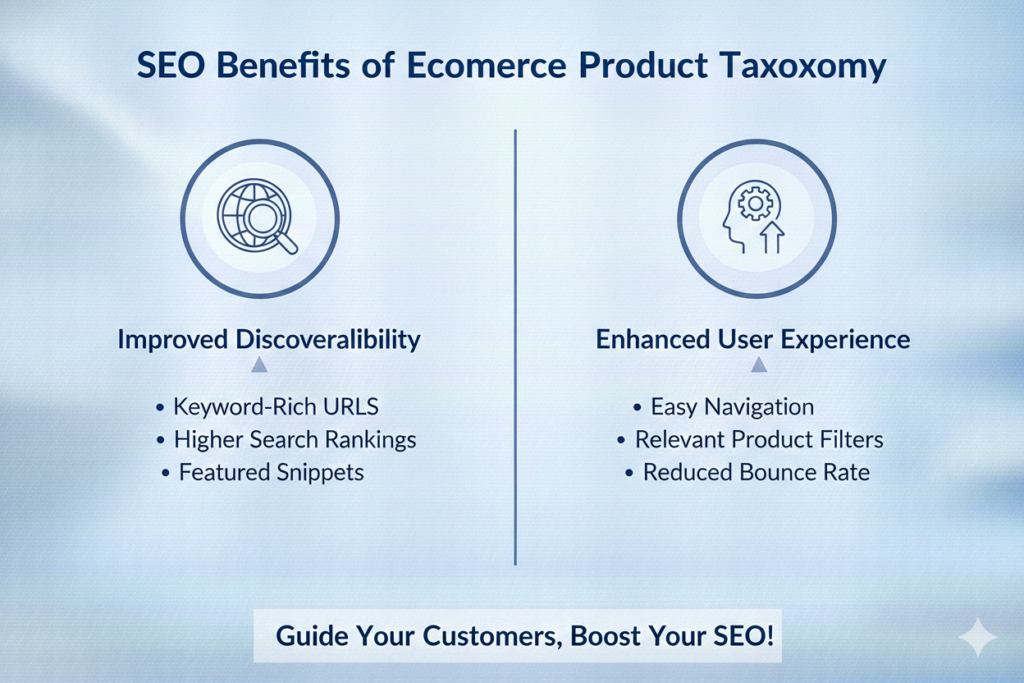
A well-designed ecommerce product taxonomy is one of the strongest foundations for long-term SEO success. Search engines rely on site structure to understand content relationships, and taxonomy provides that structure. When categories and subcategories are logically organized, search engines can clearly identify which pages are most important and how products relate to each other.
Category and subcategory pages created through taxonomy often rank better than individual product pages because they target broader, high-intent keywords. For example, a category like “Men’s Running Shoes” can attract users who are still comparing options, while individual products capture transactional intent. This layered keyword coverage increases overall organic visibility and brings users into the site at different stages of the buying journey.
Additionally, ecommerce product taxonomy reduces SEO risks such as thin content and duplicate URLs. Instead of creating multiple overlapping pages, taxonomy centralizes relevance, helping search engines crawl efficiently and index the right pages. Over time, this leads to higher rankings, more stable traffic, and better SEO scalability.
Ecommerce Product Taxonomy on Shopify
Shopify’s ecosystem makes ecommerce product taxonomy especially powerful when used correctly. Shopify uses collections, product types, vendors, and attributes to form its taxonomy structure. When store owners rely on automated collections powered by taxonomy rules, they eliminate manual errors and ensure consistency across the store.
For example, products can automatically appear in collections based on type, tags, or attributes. This allows merchants to create SEO-friendly category pages that update dynamically as new products are added. From a marketing perspective, this makes it easier to run campaigns like “New Arrivals,” “Best Sellers,” or “Seasonal Collections” without restructuring the site.
From a customer perspective, strong taxonomy on Shopify improves navigation, reduces confusion, and shortens the path to purchase. Customers can browse intuitively, apply filters, and trust that the store is well-organized—an important psychological factor in ecommerce conversions.
Ecommerce Product Taxonomy on WooCommerce
WooCommerce offers deeper customization for ecommerce product taxonomy, making it ideal for businesses with complex catalogs. WooCommerce allows store owners to define product categories, attributes, and even custom taxonomies tailored to industry-specific needs. This flexibility is especially useful for electronics, B2B stores, automotive parts, or configurable products.
With a strong taxonomy, WooCommerce stores can support advanced filtering systems that allow customers to narrow results by technical specifications, compatibility, or usage scenarios. This reduces decision fatigue and increases confidence during the buying process. Internally, taxonomy also simplifies inventory management, reporting, and integrations with third-party tools.
When taxonomy is aligned with SEO plugins and search enhancements, WooCommerce stores gain a significant advantage in discoverability and usability, especially for large-scale catalogs.
Ecommerce Product Taxonomy vs Product Tagging
While both taxonomy and tagging are classification methods, they serve very different strategic purposes. Ecommerce product taxonomy defines the core structure of the store, while tags are supporting labels that add flexibility.
Taxonomy answers the question: Where does this product belong?
Tags answer the question: What qualities or contexts describe this product?
For example, a product belongs to the taxonomy “Home Appliances > Kitchen > Blenders,” while tags such as “energy-efficient,” “compact,” or “new model” add contextual value. Overusing tags instead of building proper taxonomy leads to messy navigation, weak SEO, and poor scalability. Successful ecommerce stores always treat taxonomy as the backbone and tags as enhancements.
Role of Attributes in Ecommerce Product Taxonomy
Attributes are the functional layer of ecommerce product taxonomy. They define how products differ from each other and enable powerful filtering and comparison tools. Attributes such as size, color, material, compatibility, brand, or performance specifications are critical for customer decision-making.
When attributes are standardized and consistently applied, customers can easily filter large product lists and find exactly what they need. This improves usability and reduces friction, especially in stores with hundreds or thousands of SKUs. From a backend perspective, attributes also support automation, recommendations, and analytics.
Poorly managed attributes—such as inconsistent naming or missing values—break the taxonomy system and negatively affect both user experience and SEO. Well-managed attributes, on the other hand, transform taxonomy into a competitive advantage.
Impact of Ecommerce Product Taxonomy on Conversions
Ecommerce product taxonomy has a direct psychological impact on conversions. When customers feel oriented and in control, they are more likely to trust the store and complete purchases. Clear category paths, predictable navigation, and relevant filters reduce frustration and decision paralysis.
A strong taxonomy shortens the customer journey by guiding users naturally from broad categories to specific products. This clarity reduces bounce rates, increases time on site, and improves add-to-cart rates. In contrast, poor taxonomy creates confusion, leading customers to abandon the site even if the products are good.
Simply put, better taxonomy equals better conversion performance.
Common Ecommerce Product Taxonomy Mistakes
Many ecommerce businesses unintentionally damage performance through taxonomy mistakes. One major issue is designing taxonomy based on internal business logic instead of customer language. Categories that make sense internally may not match how customers search or browse.
Another common mistake is overcomplication—creating too many nested categories or redundant structures. This overwhelms users and weakens SEO signals. Inconsistent naming conventions, duplicated categories, and unmanaged attributes also degrade taxonomy quality over time.
The most successful ecommerce brands regularly audit and refine their taxonomy to ensure it remains clean, consistent, and customer-centric.
Best Practices for Building Ecommerce Product Taxonomy
Building an effective ecommerce product taxonomy starts with customer research. Businesses should analyze search queries, on-site behavior, and competitor structures to understand how customers think. Categories should be broad but meaningful, subcategories specific but not excessive, and attributes standardized.
Scalability must always be a priority. A good taxonomy should support growth without constant restructuring. Clear documentation, naming standards, and periodic reviews ensure taxonomy remains effective as product lines expand and markets evolve.
Tools and Automation for Ecommerce Product Taxonomy
As ecommerce catalogs expand, manually managing product taxonomy becomes inefficient and error-prone. This is where tools and automation play a crucial role. Modern ecommerce platforms and Product Information Management (PIM) systems help businesses centralize product data, standardize categories, attributes, and relationships, and maintain consistency across the store.
Automation allows products to be assigned to categories and attributes based on predefined rules. For example, a product with specific specifications can automatically inherit the correct taxonomy structure. This reduces manual effort, prevents inconsistencies, and ensures that new products fit seamlessly into the existing hierarchy. For growing ecommerce businesses, taxonomy automation is essential for scalability and operational efficiency.
AI-Driven Ecommerce Product Taxonomy
Artificial intelligence is transforming how ecommerce product taxonomy is built and maintained. AI-powered systems can analyze product descriptions, images, specifications, and customer behavior to automatically classify products into the correct categories and attributes. This is especially valuable for large catalogs where manual classification is not practical.
Machine learning models continuously improve taxonomy accuracy by learning from user interactions such as clicks, filters, and purchases. Over time, AI-driven taxonomy adapts to customer behavior, improving search relevance, filtering accuracy, and personalization. This intelligent approach makes ecommerce stores more responsive and customer-centric.
Ecommerce Product Taxonomy and Multichannel Consistency
Modern ecommerce businesses sell across multiple channels, including websites, marketplaces, and social commerce platforms. Ecommerce product taxonomy ensures consistency across all these touchpoints. A centralized taxonomy allows product data to remain uniform regardless of where customers encounter the product.
Consistent taxonomy across channels improves brand credibility and reduces customer confusion. It also simplifies reporting, inventory synchronization, and performance analysis. Businesses with strong multichannel taxonomy are better positioned to scale without losing control over product data.
Cost, Maintenance, and Scalability Considerations
Implementing ecommerce product taxonomy involves upfront planning and ongoing maintenance. While small stores can rely on basic taxonomy features built into ecommerce platforms, larger businesses often invest in advanced tools or PIM systems. These investments may seem costly initially, but they save significant time and resources in the long run.
A scalable taxonomy reduces the need for constant restructuring as the catalog grows. Maintenance becomes more manageable when categories, attributes, and naming conventions are standardized. Businesses that plan taxonomy with future growth in mind avoid expensive migrations and performance issues later.
Role of Ecommerce Product Taxonomy in Personalization
Personalization relies on structured data, and ecommerce product taxonomy provides that structure. Recommendation engines, personalized search results, and dynamic merchandising depend on accurate category and attribute data. When taxonomy is well-defined, personalization systems deliver more relevant results.
For example, customers browsing within a specific category or attribute set can receive recommendations that align with their interests. This increases engagement, average order value, and customer satisfaction. Without strong taxonomy, personalization efforts remain limited and inaccurate.
Future Trends in Ecommerce Product Taxonomy
The future of ecommerce product taxonomy lies in intelligent, adaptive systems. AI-driven classification, visual recognition, and real-time behavioral analysis will continue to improve how products are organized. Taxonomy will become more dynamic, adjusting automatically based on trends, seasonality, and customer preferences.
Another emerging trend is semantic taxonomy, where systems understand product meaning and relationships rather than relying solely on static rules. This evolution will make ecommerce navigation more intuitive and search experiences more human-like.
External Industry Insights and Validation
Leading ecommerce platforms emphasize the importance of structured product data and taxonomy. Shopify explains that well-organized product data improves navigation, filtering, and automation across ecommerce stores (external dofollow link:
https://www.shopify.com/enterprise/product-information-management).
Similarly, BigCommerce highlights that strong product taxonomy improves search accuracy, customer experience, and scalability for growing ecommerce businesses (external dofollow link:
https://www.bigcommerce.com/articles/ecommerce/product-catalog-management/).
These industry insights confirm that ecommerce product taxonomy is not a technical detail—it is a strategic business asset.
Internal Growth Strategy Integration
To maximize performance, ecommerce product taxonomy should be integrated with SEO, product tagging, recommendation engines, and conversion optimization strategies. You can explore more in-depth ecommerce structure, growth frameworks, and optimization techniques in our resource hub (internal dofollow link example:
https://rankifycontent.com/ecommerce-growth-strategies).
When taxonomy aligns with these systems, ecommerce businesses create a strong foundation for sustainable growth.
Frequently Asked Questions (FAQs)
What is ecommerce product taxonomy?
Ecommerce product taxonomy is the structured system used to organize products into categories, subcategories, attributes, and relationships within an online store. It defines how products are classified and presented so customers can easily browse, search, and filter items.
Why is ecommerce product taxonomy important?
Ecommerce product taxonomy is important because it improves navigation, search accuracy, SEO performance, and overall user experience. A clear taxonomy helps customers find products faster, reduces bounce rates, and supports higher conversion rates while making catalog management easier for businesses.
How is ecommerce product taxonomy different from product tagging?
Ecommerce product taxonomy is the core hierarchical structure of an online store, including categories and attributes. Product tagging is a flexible labeling system used to add contextual information. Taxonomy defines where a product belongs, while tags describe additional characteristics or use cases.
How does ecommerce product taxonomy affect SEO?
A well-structured ecommerce product taxonomy improves SEO by creating a clean site hierarchy, reducing duplicate content, and helping search engines understand product relationships. Optimized category and subcategory pages can rank for high-intent keywords and drive consistent organic traffic.
Can ecommerce product taxonomy improve conversions?
Yes, ecommerce product taxonomy directly impacts conversions. When products are logically organized and easy to filter, customers experience less frustration and more confidence. This smoother journey increases time on site, add-to-cart rates, and completed purchases.
What are common mistakes in ecommerce product taxonomy?
Common mistakes include creating too many categories, using internal business terms instead of customer language, inconsistent attributes, duplicate categories, and ignoring scalability. These issues confuse users, weaken SEO, and complicate store management.
Is ecommerce product taxonomy important for small online stores?
Yes, ecommerce product taxonomy is important for stores of all sizes. Small businesses benefit by building a clean structure early, which makes scaling easier later. A strong taxonomy foundation prevents costly restructuring as the product catalog grows.
How often should ecommerce product taxonomy be reviewed?
Ecommerce product taxonomy should be reviewed regularly, especially when new products are added, customer behavior changes, or the business expands into new categories. Periodic audits help maintain consistency, relevance, and performance.
Can ecommerce product taxonomy be automated?
Yes, ecommerce product taxonomy can be partially or fully automated using ecommerce platforms, Product Information Management (PIM) systems, and AI-based tools. Automation helps classify products accurately, maintain consistency, and scale efficiently for large catalogs.
Which ecommerce platforms support advanced product taxonomy?
Popular platforms such as Shopify and WooCommerce support ecommerce product taxonomy through collections, categories, attributes, and custom taxonomies. When configured properly, these platforms allow businesses to build scalable and SEO-friendly product structures.
Final Conclusion:
Ecommerce product taxonomy is the backbone of a scalable, searchable, and customer-friendly online store. By organizing products into clear categories, attributes, and relationships, businesses improve navigation, SEO performance, personalization, and conversions. As catalogs grow and customer expectations rise, strong taxonomy becomes essential rather than optional.
Industry leaders such as Shopify and BigCommerce consistently emphasize the role of structured product data and taxonomy in ecommerce success (external dofollow links included above). When combined with SEO, automation, and personalization strategies, ecommerce product taxonomy enables businesses to scale efficiently and compete effectively in data-driven markets.
For ecommerce brands looking to build future-ready online stores, investing in a well-planned ecommerce product taxonomy is a strategic decision that delivers long-term value.