Table of Contents
Introduction
In today’s competitive ecommerce environment, customers expect more than just a list of products. They want relevant suggestions, personalized experiences, and effortless discovery. This shift in consumer behavior has made the product recommendation engine for ecommerce one of the most powerful tools for increasing sales and customer engagement. Recommendation engines analyze user behavior, preferences, and data patterns to suggest products that customers are more likely to purchase.
Modern ecommerce platforms rely heavily on recommendation systems to personalize shopping journeys. From homepage suggestions to “you may also like” sections and personalized emails, recommendation engines influence almost every stage of the customer journey. Businesses that implement them effectively often see higher conversion rates, increased average order value, and stronger customer retention.
What Is a Product Recommendation Engine for Ecommerce?
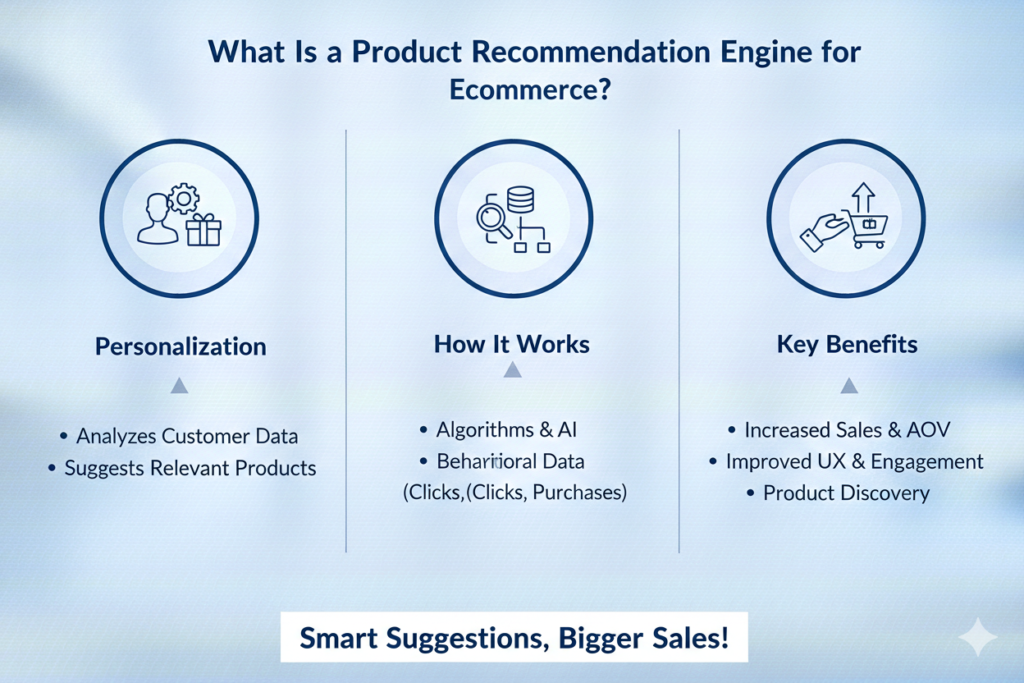
A product recommendation engine for ecommerce is a data-driven system that automatically suggests products to users based on various signals. These signals may include browsing behavior, purchase history, search queries, demographics, and interactions with the website. The goal is to present the most relevant products to each customer at the right time.
Unlike static product listings, recommendation engines adapt in real time. As users interact with an ecommerce store, the system continuously learns and refines its suggestions. This dynamic personalization makes shopping more intuitive and helps customers discover products they may not have found on their own.
Why Product Recommendation Engines Are Essential for Ecommerce
The importance of a product recommendation engine for ecommerce lies in its ability to reduce decision fatigue and guide customers toward relevant products. Online stores often carry thousands of items, which can overwhelm users. Recommendation engines simplify this process by narrowing down choices based on user intent.
From a business perspective, recommendation engines directly impact revenue. Personalized recommendations encourage cross-selling and upselling, increase time spent on site, and reduce bounce rates. They also improve customer satisfaction by creating a tailored shopping experience that feels helpful rather than intrusive.
How Product Recommendation Engines Work
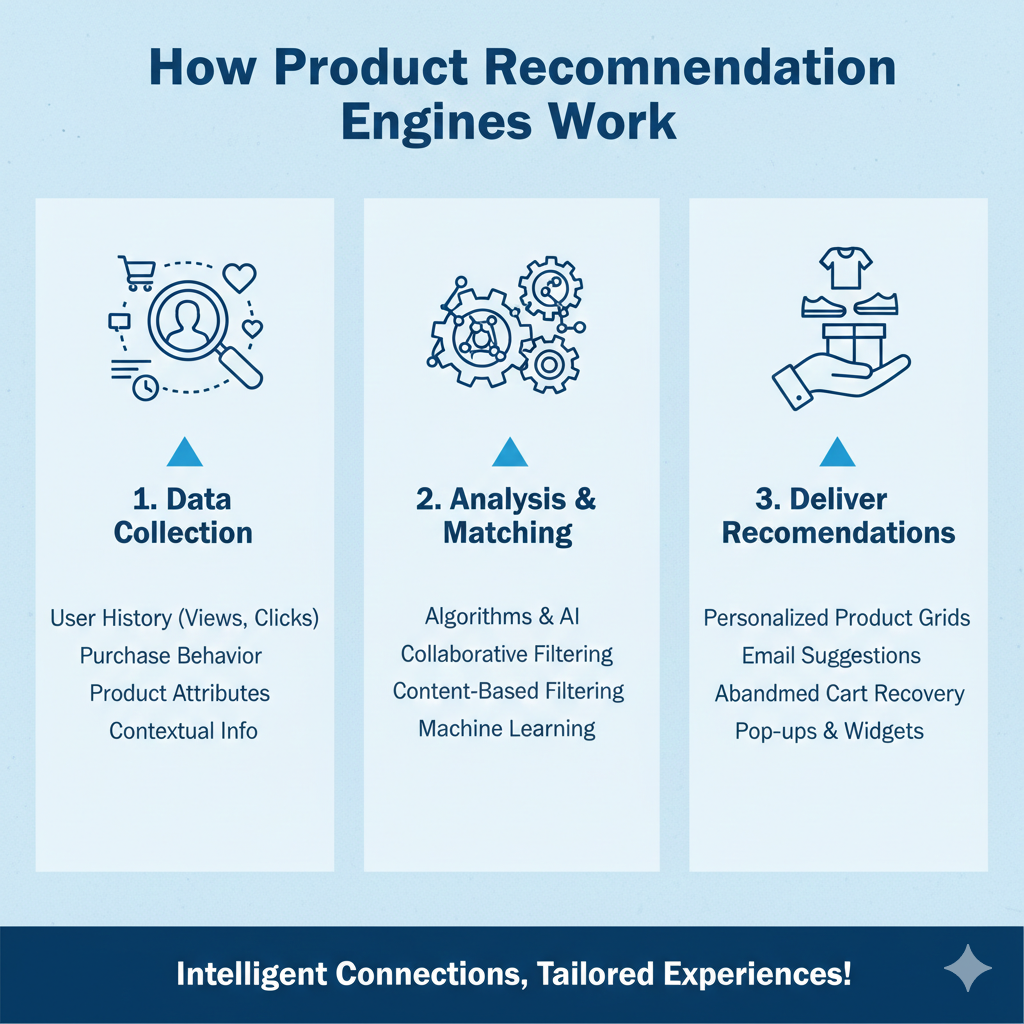
A product recommendation engine for ecommerce works by collecting and analyzing large volumes of data. This data includes user behavior such as clicks, views, purchases, and time spent on product pages. The engine processes this information using predefined rules or machine-learning algorithms to predict what products a user is most likely to be interested in.
Some recommendation engines rely on historical data, while more advanced systems use real-time behavior and contextual signals. Over time, the engine becomes more accurate as it learns from user interactions. This continuous learning process allows ecommerce businesses to deliver increasingly relevant recommendations.
Types of Product Recommendation Engines for Ecommerce
There are several types of product recommendation engines used in ecommerce, each serving a specific purpose. Rule-based recommendation engines use predefined logic, such as recommending best-selling products or related items. While simple to implement, they lack deep personalization.
More advanced engines use collaborative filtering, which analyzes user behavior patterns to recommend products based on similarities between users. Content-based recommendation engines focus on product attributes and user preferences. Hybrid recommendation engines combine multiple approaches to deliver more accurate and personalized results, making them increasingly popular in modern ecommerce stores.
Role of Artificial Intelligence in Ecommerce Recommendations
Artificial intelligence plays a crucial role in modern product recommendation engine for ecommerce solutions. AI-powered engines can process massive datasets, identify complex patterns, and adapt to changing user behavior in real time. This allows for highly personalized recommendations that go beyond basic “related products.”
AI also enables predictive recommendations, suggesting products before users explicitly search for them. This proactive approach enhances the shopping experience and increases the likelihood of impulse purchases, which significantly boosts revenue.
Impact on Customer Experience and Engagement
A well-implemented product recommendation engine for ecommerce improves customer experience by making shopping more relevant and efficient. Customers spend less time searching and more time discovering products they actually want. This convenience builds trust and encourages repeat visits.
Engagement metrics such as page views per session, time on site, and interaction rates often improve when personalized recommendations are present. Over time, this enhanced engagement translates into higher customer lifetime value and brand loyalty.
Use Cases of Product Recommendation Engines in Ecommerce
Product recommendation engines are used across multiple touchpoints in ecommerce. On the homepage, they showcase personalized product suggestions. On product pages, they recommend similar or complementary items. During checkout, they support upselling and cross-selling strategies. In email marketing, recommendation engines power personalized product suggestions based on browsing and purchase history.
Each of these use cases contributes to a seamless and personalized shopping journey, making recommendation engines a core component of ecommerce strategy.
SEO Benefits of a Product Recommendation Engine for Ecommerce
A product recommendation engine for ecommerce does more than personalize the shopping experience—it also contributes indirectly to search engine optimization. When customers engage with recommended products, they spend more time browsing the website, view multiple pages, and interact with product listings. These engagement signals, such as increased dwell time and lower bounce rates, are positive indicators for search engines and can help improve overall site rankings.
In addition, recommendation engines improve internal linking across product pages. By automatically connecting related or complementary products, they create a stronger internal link structure, helping search engines crawl and index ecommerce websites more efficiently. This improved discoverability supports long-term organic traffic growth.
Conversion Rate Optimization Through Product Recommendations
One of the strongest advantages of a product recommendation engine for ecommerce is its direct impact on conversion rate optimization. Personalized recommendations reduce friction in the buying process by guiding customers toward products that match their interests. Instead of searching manually, users are presented with relevant options at the right time.
When customers see products aligned with their preferences, purchase confidence increases. This often leads to higher add-to-cart rates and fewer abandoned sessions. Recommendation engines also support upselling and cross-selling by suggesting higher-value or complementary products, which improves overall sales performance.
Impact on Average Order Value and Revenue
A well-implemented product recommendation engine for ecommerce significantly increases average order value. By suggesting complementary items, bundles, or premium alternatives, recommendation engines encourage customers to add more products to their cart. For example, recommending accessories alongside a main product or offering upgraded versions can naturally increase order size.
Over time, these incremental increases in order value compound into substantial revenue growth. Ecommerce businesses that use recommendation engines strategically often see measurable improvements in both short-term sales and long-term profitability.
Product Recommendation Engines on Shopify Stores
Shopify merchants increasingly rely on product recommendation engine for ecommerce solutions to personalize customer journeys. Recommendation engines integrate seamlessly with Shopify stores to display personalized suggestions on homepages, product pages, and checkout flows. This personalization helps smaller Shopify stores compete with larger brands by delivering tailored shopping experiences.
Shopify-based recommendation engines also support marketing automation. Personalized product suggestions can be used in email campaigns, retargeting ads, and push notifications, creating a consistent and relevant experience across channels.
Product Recommendation Engines for WooCommerce and Custom Stores
WooCommerce and custom ecommerce platforms offer flexibility for advanced recommendation engine implementations. Businesses can customize recommendation logic based on user behavior, purchase history, or business rules. This flexibility allows ecommerce brands to create highly targeted and sophisticated recommendation strategies.
For large or complex catalogs, recommendation engines help customers navigate extensive product ranges more efficiently. By guiding users to relevant products, these systems reduce overwhelm and improve overall usability.
Role of Recommendation Engines in Customer Retention
Customer retention is a critical factor in ecommerce success, and product recommendation engine for ecommerce solutions play an important role in building long-term relationships. Personalized experiences make customers feel understood and valued, increasing the likelihood of repeat purchases.
Recommendation engines also support post-purchase engagement by suggesting related products after checkout or through follow-up emails. This ongoing personalization keeps customers connected to the brand and encourages repeat visits.
Common Mistakes When Implementing Recommendation Engines
Despite their benefits, recommendation engines can fail if implemented incorrectly. One common mistake is relying on generic or irrelevant recommendations that do not reflect user behavior. Poor data quality, lack of personalization, and overuse of recommendations can reduce trust and frustrate customers.
Another issue is failing to test and optimize recommendation strategies. Ecommerce businesses should continuously monitor performance metrics such as click-through rates, conversions, and revenue impact to ensure that recommendations remain effective and relevant.
Data Privacy and Ethical Considerations
As product recommendation engine for ecommerce systems rely on user data, privacy and transparency are essential. Businesses must ensure compliance with data protection regulations and clearly communicate how customer data is used. Ethical data practices build trust and encourage customers to engage more openly with personalized experiences.
Cost and Pricing of Product Recommendation Engines for Ecommerce
The cost of implementing a product recommendation engine for ecommerce varies based on the complexity of the system, level of personalization, data volume, and platform integration. Basic recommendation engines that rely on rule-based logic are generally more affordable and suitable for small ecommerce stores. These systems may recommend best-selling or related products using predefined rules.
Advanced AI-powered recommendation engines require higher investment because they use machine learning algorithms, real-time data processing, and behavioral analysis. However, these systems often deliver higher returns by significantly improving conversion rates, average order value, and customer retention. For growing ecommerce businesses, the long-term ROI of a recommendation engine usually outweighs the initial setup cost.
How to Choose the Right Product Recommendation Engine for Ecommerce
Selecting the right product recommendation engine for ecommerce requires a clear understanding of business goals and customer behavior. Businesses should evaluate whether the engine supports real-time personalization, multichannel recommendations, and scalability. Integration with existing ecommerce platforms, CRM systems, and marketing tools is also critical.
Data accuracy and transparency are equally important. A reliable recommendation engine should provide performance insights, allow testing of recommendation strategies, and adapt to changing user behavior. Choosing a solution that aligns with both technical requirements and business objectives ensures long-term success.
Role of Recommendation Engines in Omnichannel Ecommerce
Modern ecommerce extends beyond websites to mobile apps, email marketing, social commerce, and paid advertising. A product recommendation engine for ecommerce supports omnichannel strategies by delivering consistent and personalized recommendations across all customer touchpoints.
For example, products viewed on a website can be recommended later via email or retargeting ads. This continuity creates a seamless customer experience and increases the likelihood of repeat purchases. Omnichannel personalization is becoming a key differentiator in competitive ecommerce markets.
Future Trends in Product Recommendation Engines
The future of product recommendation engine for ecommerce technology is closely linked to advancements in artificial intelligence and predictive analytics. AI-driven engines are becoming more capable of anticipating customer needs before they are explicitly expressed. Predictive recommendations based on browsing intent, context, and historical behavior will play a major role in future ecommerce experiences.
Another emerging trend is hyper-personalization, where recommendations adapt not only to user behavior but also to real-time context such as location, device, and time of day. As data processing capabilities improve, recommendation engines will become faster, smarter, and more accurate.
External Industry Insights and Validation
Leading ecommerce platforms and technology providers highlight the importance of recommendation engines in driving online growth. Shopify emphasizes that personalized product recommendations help merchants increase conversions and customer engagement by showing relevant products at the right time (external dofollow link: https://www.shopify.com/enterprise/personalization). Similarly, McKinsey & Company reports that personalization technologies, including recommendation engines, can deliver significant revenue growth for digital businesses (external dofollow link: https://www.mckinsey.com/capabilities/growth-marketing-and-sales/our-insights/the-value-of-getting-personalization-right).
These insights confirm that product recommendation engines are not optional tools but strategic assets for modern ecommerce businesses.
Internal Growth Strategy Integration
For ecommerce businesses aiming to maximize the impact of recommendation engines, personalization should be combined with strong SEO, catalog management, and conversion optimization strategies. You can explore more practical ecommerce growth techniques and optimization guides in our detailed resources section (internal dofollow link example: https://rankifycontent.com/ecommerce-growth-strategies). Integrating recommendation engines with these strategies creates a scalable and performance-driven ecommerce ecosystem.
Frequently Asked Questions (FAQs)
What is a product recommendation engine for ecommerce?
A product recommendation engine for ecommerce is a software system that analyzes customer behavior, preferences, and data patterns to suggest relevant products. These recommendations appear across ecommerce touchpoints such as homepages, product pages, carts, emails, and ads, helping customers discover items they are more likely to purchase.
How does a product recommendation engine work in ecommerce?
A product recommendation engine works by collecting data such as browsing history, purchase behavior, clicks, and search activity. This data is processed using rule-based logic or machine learning algorithms to predict which products are most relevant for each user. Over time, the system learns from customer interactions and continuously improves recommendation accuracy.
Why is a product recommendation engine important for ecommerce stores?
A product recommendation engine for ecommerce is important because it improves personalization, reduces decision fatigue, and increases sales. By showing customers relevant products at the right time, recommendation engines boost conversion rates, increase average order value, and enhance overall customer experience.
Can a product recommendation engine increase average order value?
Yes, product recommendation engines significantly increase average order value by enabling upselling and cross-selling. For example, recommending accessories, complementary products, or premium alternatives encourages customers to add more items to their cart, resulting in higher revenue per transaction.
Is a product recommendation engine suitable for small ecommerce businesses?
Yes, product recommendation engines are suitable for both small and large ecommerce businesses. Small stores can start with basic rule-based recommendation systems, while growing businesses can adopt AI-powered solutions. Even simple recommendations can improve engagement and sales when implemented correctly.
Do product recommendation engines help with customer retention?
Product recommendation engines play a major role in customer retention by delivering personalized shopping experiences. Customers are more likely to return to stores that understand their preferences and consistently recommend relevant products, leading to higher repeat purchase rates and stronger brand loyalty.
Are product recommendation engines good for SEO?
Indirectly, yes. A product recommendation engine for ecommerce improves engagement metrics such as time on site, pages per session, and internal linking. These signals help search engines understand content relevance and user satisfaction, which can positively impact SEO performance over time.
Can product recommendation engines be used on Shopify and WooCommerce?
Yes, product recommendation engines can be integrated with popular ecommerce platforms such as Shopify and WooCommerce. Many tools and plugins support seamless integration, allowing merchants to display personalized recommendations without disrupting the checkout or user experience.
What data is required for a product recommendation engine?
Recommendation engines typically use data such as browsing behavior, purchase history, product interactions, and sometimes demographic information. Advanced engines also analyze real-time behavior and contextual signals to improve personalization while following data privacy regulations.
Are product recommendation engines the future of ecommerce?
Yes, product recommendation engines are considered a core part of the future of ecommerce. As customers demand more personalized and relevant shopping experiences, recommendation engines powered by AI and predictive analytics will become standard features in modern online stores.
Final Conclusion:
A product recommendation engine for ecommerce has become a critical component of successful online stores. By delivering personalized, data-driven product suggestions, recommendation engines improve customer experience, increase conversion rates, boost average order value, and strengthen long-term customer relationships. As ecommerce competition intensifies, businesses that fail to personalize risk losing relevance and engagement.
Industry leaders such as Shopify and research firms like McKinsey consistently highlight personalization as a major driver of ecommerce growth (external dofollow links included above). When combined with effective SEO, structured product catalogs, and data-driven marketing strategies, product recommendation engines become powerful tools for sustainable online success.
For ecommerce brands looking to scale, differentiate, and future-proof their stores, investing in a product recommendation engine for ecommerce is no longer optional—it is a strategic necessity.