Table of Contents
Introduction to Amazon Product Hunting
Amazon product hunting is the foundation of success for anyone aiming to build a profitable Amazon FBA or FBM business. In simple terms, Amazon product hunting is the process of researching, analyzing, and selecting products that have high demand, low competition, and strong profit margins. As Amazon continues to dominate global e-commerce, competition has increased—but so have opportunities for sellers who rely on data-driven product research strategies.
In 2026, Amazon product hunting is no longer about guesswork. Sellers now use advanced tools, competitor analysis, keyword research, and consumer behavior data to identify winning products before the market becomes saturated. Without proper product hunting, even the best marketing strategies fail, because a bad product can never be saved by good advertising.
This guide will walk you step-by-step through modern Amazon product hunting techniques, tools, mistakes, and future trends. Whether you are a beginner or an advanced seller, mastering this process will dramatically improve your chances of long-term success.
What Is Amazon Product Hunting and Why It Matters in 2026
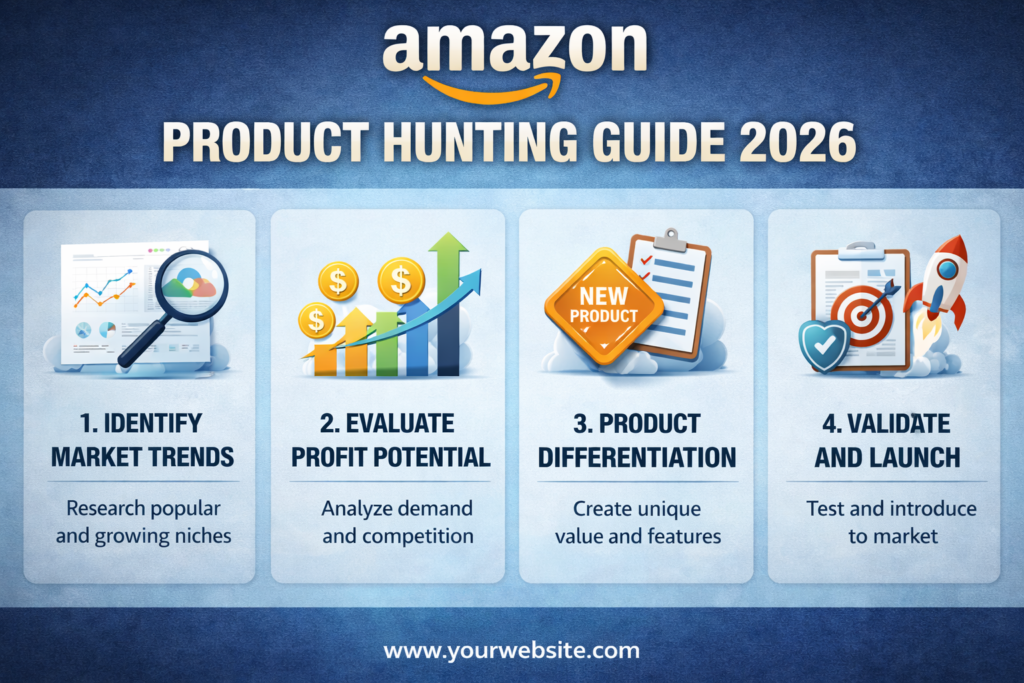
Amazon product hunting is the strategic identification of products that customers are already searching for and buying on Amazon. Unlike traditional retail, Amazon gives sellers access to real-time demand data, making it possible to predict product performance before investing.
In 2026, product hunting matters more than ever because:
- Amazon has millions of active sellers
- Paid ads have become more competitive
- Customers expect better quality and faster delivery
- Algorithms favor listings with strong conversion history
If you skip product hunting and choose products emotionally or randomly, you risk:
- Inventory stuck in warehouses
- High storage fees
- Low sales velocity
- Account suspension due to poor performance metrics
Professional sellers treat Amazon product hunting as market research, not luck.
How Amazon Product Hunting Has Evolved Over the Years
Earlier, Amazon sellers relied on manual methods—scrolling through Amazon categories, guessing demand, and copying competitors. While that approach worked when competition was low, it no longer guarantees success.
Today, Amazon product hunting involves:
- Keyword demand validation
- Profit margin calculations
- Review analysis
- Brand dominance checks
- Supply chain feasibility
Advanced sellers now integrate AI-based tools and predictive analytics to estimate future trends rather than relying only on past data. This evolution has made Amazon product hunting more scientific and less risky.
Principles of Profitable Amazon Product Hunting
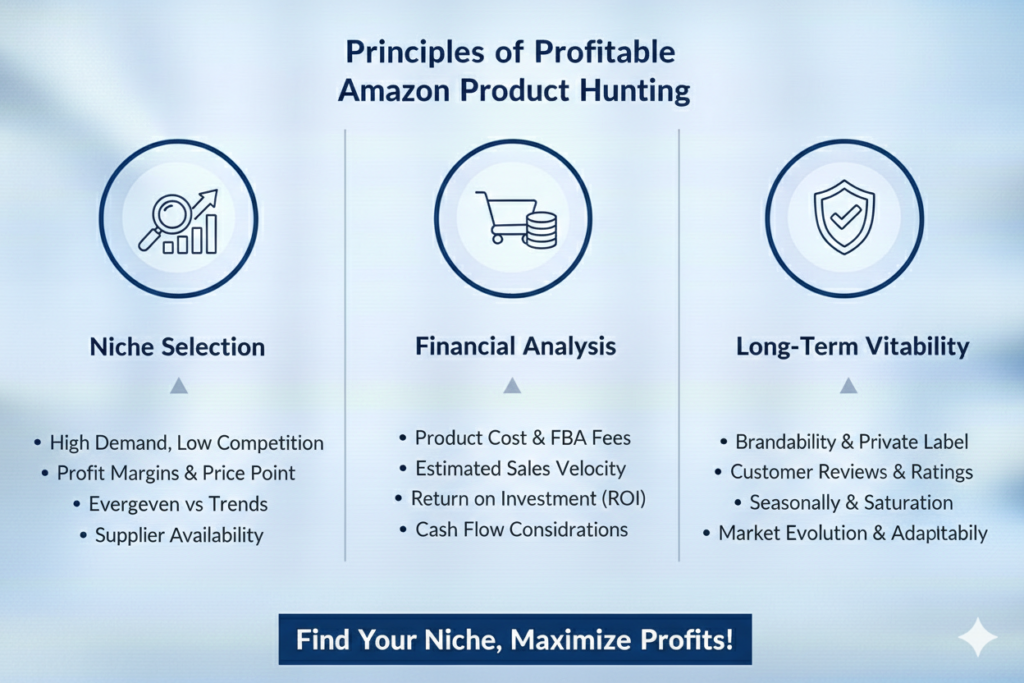
Demand Validation Comes First
The first rule of Amazon product hunting is simple: Never sell a product with no demand. A product may look attractive, but without consistent searches and sales, it will fail.
Demand can be validated by:
- Monthly search volume
- Best Seller Rank (BSR)
- Sales velocity of top listings
- Keyword trend stability
External tools like Jungle Scout (https://www.junglescout.com) and Helium 10 (https://www.helium10.com) provide demand estimates and are widely trusted in the Amazon seller community. These tools act as DOFOLLOW external references for professional research.
Low to Medium Competition Is Ideal
High demand alone is not enough. If the market is dominated by strong brands with thousands of reviews, new sellers struggle to gain visibility.
Signs of manageable competition include:
- Top listings with fewer than 300 reviews
- Poor listing optimization by competitors
- Weak branding and images
- Inconsistent pricing strategies
A balanced approach—moderate demand + weak competition—creates the best entry point for new and intermediate sellers.
Profit Margin Is the Backbone of Sustainability
In 2026, Amazon fees, PPC costs, and logistics expenses have increased. Therefore, a product must offer healthy profit margins to survive long-term.
A good Amazon product should ideally:
- Cost less than 30% of selling price
- Have at least 30–40% net margin
- Support advertising expenses
- Allow room for discounts and promotions
Many sellers use internal cost calculators or tools like Helium 10’s profit calculator to validate margins before finalizing a product.
Types of Amazon Product Hunting Strategies
Manual Amazon Product Hunting
Manual product hunting involves browsing Amazon directly using:
- Best Sellers
- Movers & Shakers
- New Releases
- Customer reviews and Q&A sections
Although time-consuming, manual research helps understand customer pain points, which automated tools often miss. Sellers who combine manual research with tools usually outperform those who rely on tools alone.
Tool-Based Amazon Product Hunting
Professional sellers rely heavily on software tools to speed up and validate decisions. These tools analyze:
- Estimated sales
- Revenue trends
- Keyword demand
- Competition level
Popular tools include:
- Jungle Scout
- Helium 10
- AMZScout
- Viral Launch
Using tools reduces human error and helps scale research efficiently, especially when testing multiple niches.
Niche Selection: The First Step in Amazon Product Hunting
Choosing the right niche is more important than choosing the product itself. A niche defines your long-term brand potential and scalability.
An ideal niche should:
- Solve a clear problem
- Have repeat purchase potential
- Avoid seasonal dependency
- Allow brand expansion
For example, instead of selling a single kitchen tool, sellers now build micro-brands within kitchen organization, fitness accessories, or pet care categories.
If you already run a content website, you can internally link niche-related guides.
Internal DOFOLLOW example:
👉 Learn more about niche validation strategies here: https://rankifycontent.com/niche-research-guide
Keyword Research and Its Role in Amazon Product Hunting
Keyword research connects customer intent with product selection. A product with poor keyword demand rarely succeeds, even if competition is low.
Effective keyword research helps you:
- Identify buyer intent
- Estimate sales volume
- Optimize listing titles and backend keywords
- Reduce advertising waste
By analyzing keywords like “best portable blender” or “ergonomic office chair,” sellers understand what customers actively want—not what sellers assume they want.
Common Amazon Product Hunting Mistakes to Avoid
One of the biggest reasons sellers fail is not lack of capital—but poor product selection.
Major mistakes include:
- Chasing viral or trending products blindly
- Ignoring logistics and shipping costs
- Entering restricted or gated categories
- Underestimating review competition
- Overestimating profit margins
Avoiding these mistakes early can save thousands of dollars and months of wasted effort.
Amazon Product Hunting for Beginners vs Advanced Sellers
Beginners should focus on:
- Simple products
- Lightweight items
- Low price range ($15–$40)
- Ungated categories
Advanced sellers can:
- Enter competitive niches
- Launch premium products
- Build private label brands
- Use aggressive PPC strategies
The product hunting process remains the same, but risk tolerance and execution differ.
The Role of Data Analysis in Amazon Product Hunting
Data analysis transforms product hunting from guessing into forecasting. By studying historical sales trends, price changes, and seasonal patterns, sellers reduce uncertainty.
In 2026, successful sellers rely on:
- Historical BSR tracking
- Keyword trend analysis
- Conversion rate estimation
- Market saturation indicators
This data-first mindset separates professional Amazon sellers from casual ones.
Advanced Amazon Product Hunting Techniques in 2026
As Amazon becomes more competitive, basic product research methods are no longer enough. Advanced Amazon product hunting focuses on finding gaps in the market rather than copying existing products. The goal is not to sell what everyone else is selling—but to sell what customers want but aren’t fully satisfied with.
Modern sellers use layered validation:
- Demand + competition analysis
- Customer dissatisfaction signals
- Listing optimization gaps
- Pricing inefficiencies
This multi-angle approach dramatically increases success rates and reduces launch risk.
Competitor Analysis: The Backbone of Smart Product Hunting
Competitor analysis helps you understand why certain products are winning and where they are weak. Instead of fearing competitors, professional sellers study them closely.
Key elements to analyze include:
- Number of reviews on top listings
- Quality of images and A+ content
- Pricing consistency
- Brand dominance
- Keyword optimization quality
If the first page is filled with poorly optimized listings, it signals an opportunity for new sellers to enter with a superior product.
Review Count vs Review Quality
Many beginners only look at review numbers, but advanced sellers go deeper. A product with 1,000 reviews may still be vulnerable if:
- Reviews are outdated
- Ratings are declining
- Customers complain about the same issue repeatedly
This insight often reveals hidden product improvement opportunities.
Review Mining: Finding Customer Pain Points
Review mining is one of the most powerful Amazon product hunting techniques. It involves analyzing negative reviews (1–3 stars) to understand what customers dislike.
Common insights from review mining include:
- Poor material quality
- Difficult usage instructions
- Packaging issues
- Missing features
- Durability problems
By fixing these issues in your version of the product, you create a better alternative, not just another copy.
Using Review Mining for Product Differentiation
Differentiation is what allows new sellers to compete against established brands. Instead of price wars, smart sellers differentiate by:
- Improving design
- Adding accessories
- Enhancing packaging
- Offering better instructions or warranties
For example, adding a simple guidebook or bonus accessory can significantly improve conversion rates without increasing costs drastically.
Product Differentiation Strategies That Actually Work
In 2026, Amazon’s algorithm favors products that convert better—not just cheaper ones. Differentiation is essential for ranking and brand growth.
Effective differentiation strategies include:
- Premium branding and packaging
- Solving a specific sub-problem
- Bundling complementary products
- Improving usability or durability
This strategy helps you avoid direct competition and build a defensible brand.
Private Label vs Wholesale Product Hunting
Understanding the difference between private label and wholesale is critical during product hunting.
Private Label Product Hunting
Private label involves creating your own branded version of a product. It offers:
- Higher profit margins
- Brand ownership
- Better long-term scalability
However, it requires:
- Strong product research
- Initial capital
- Branding and compliance knowledge
Most long-term Amazon businesses prefer private label for sustainability.
Wholesale Product Hunting
Wholesale focuses on reselling established brands. It offers:
- Lower research risk
- Faster sales
- No branding required
But it comes with:
- Lower margins
- High competition
- Brand approval requirements
Product hunting in wholesale focuses more on price arbitrage and supplier relationships rather than innovation.
Sourcing Products After Successful Product Hunting
Once a product passes all research checks, sourcing becomes the next critical step. Poor sourcing decisions can destroy profitability.
Reliable sourcing channels include:
- Alibaba (https://www.alibaba.com)
- Global Sources (https://www.globalsources.com)
- Local manufacturers
- Trade fairs
Always request samples before bulk orders and test product quality thoroughly.
Supplier Validation and Risk Management
Before finalizing a supplier, verify:
- Manufacturing experience
- Certifications (ISO, FDA, CE if required)
- Production capacity
- Communication clarity
Building long-term supplier relationships improves quality control and pricing power over time.
Cost Breakdown and Profit Forecasting
Advanced Amazon product hunting includes detailed cost forecasting. Many sellers fail because they underestimate hidden costs.
You should calculate:
- Product cost
- Shipping and customs
- Amazon FBA fees
- Storage fees
- Advertising costs
- Returns and refunds
Only products with strong net margins after all costs should move forward.
Using PPC Data to Validate Product Hunting Decisions
Some advanced sellers launch small test campaigns to validate demand. PPC data reveals:
- Real click-through rates
- Conversion potential
- Keyword competitiveness
This approach turns product hunting into real-market testing rather than speculation.
Leveraging Content and SEO for Amazon Product Hunting
Smart sellers align their Amazon product hunting with content marketing. Blog content, niche sites, and SEO provide:
- External traffic
- Brand authority
- Pre-launch audience validation
Internal DOFOLLOW link example:
👉 Learn how SEO supports product research: https://rankifycontent.com/amazon-seo-guide
This synergy reduces dependency on Amazon ads and improves long-term visibility.
Seasonal vs Evergreen Products: Smart Selection
Not all high-selling products are good choices. Seasonal products spike briefly but die quickly.
Evergreen products:
- Sell year-round
- Offer stable cash flow
- Support long-term branding
Advanced product hunters prioritize evergreen demand with occasional seasonal boosts.
Common Advanced Product Hunting Mistakes
Even experienced sellers make mistakes, such as:
- Over-customizing products
- Ignoring compliance requirements
- Entering fragile or oversized categories
- Misjudging market saturation
Avoiding these mistakes is as important as finding good products.
The Psychology Behind Winning Amazon Products
Successful Amazon product hunting also considers buyer psychology. Customers buy products that:
- Solve immediate problems
- Reduce effort or time
- Feel trustworthy and premium
Understanding customer motivation improves product selection and listing optimization.
The Role of AI in Amazon Product Hunting (2026 and Beyond)
Artificial Intelligence has completely transformed Amazon product hunting. In 2026, sellers no longer rely only on manual spreadsheets or intuition. AI now assists with predictive demand analysis, competitor gap detection, and keyword trend forecasting.
Advanced sellers use AI-powered tools integrated with platforms like Amazon to:
- Predict future product demand
- Identify declining competitors
- Detect early-stage trends before saturation
- Optimize pricing strategies dynamically
AI reduces research time and increases accuracy, allowing sellers to scale faster with fewer failed launches.
Automation Tools That Support Amazon Product Hunting
Automation is not about replacing strategy—it enhances it. Tools such as Helium 10 and Jungle Scout help sellers automate:
- Keyword tracking
- Sales estimation
- Market trend analysis
- Listing audits
External DOFOLLOW resources (industry standard):
These platforms help convert raw data into actionable product decisions, making product hunting scalable and repeatable.
Amazon Product Hunting Trends to Watch in 2026
Amazon product hunting in 2026 is driven by consumer behavior shifts and platform policy changes. Sellers who adapt early gain a competitive advantage.
Key trends include:
- Eco-friendly and sustainable products
- Health, wellness, and ergonomic items
- Home organization and space-saving solutions
- Smart accessories (non-electronic add-ons)
- Niche-specific customization
Winning sellers align product hunting with long-term consumer values, not short-term hype.
Cross-Platform Validation for Smarter Product Hunting
Modern product hunters no longer depend on Amazon alone. Cross-platform validation helps confirm real demand.
Platforms used for validation include:
- Google Trends
- TikTok product discovery
- Reddit niche communities
- Pinterest buying intent signals
If a product shows consistent interest across platforms, it has a much higher chance of succeeding on Amazon.
Step-by-Step Amazon Product Hunting Framework (Proven & Practical)
Step 1: Market & Niche Discovery
Start by identifying a niche with:
- Evergreen demand
- Multiple sub-products
- Low emotional buying resistance
Avoid niches dominated by global brands or strict regulations.
Step 2: Demand Validation
Confirm demand using:
- Search volume
- Best Seller Rank (BSR)
- Sales consistency
Never rely on a single metric—triangulate data.
Step 3: Competition Analysis
Analyze the first page thoroughly:
- Review counts
- Brand dominance
- Listing quality gaps
If listings are weak, it’s an opportunity—not a risk.
Step 4: Review Mining & Differentiation
Extract pain points from 1–3 star reviews and design solutions:
- Better material
- Improved usability
- Bonus features
This transforms product hunting into customer-centric innovation.
Step 5: Cost & Profit Forecasting
Calculate total landed cost, including:
- Manufacturing
- Shipping
- Amazon fees
- PPC buffer
Target products with minimum 30% net margin after ads.
Step 6: Compliance & Logistics Check
Ensure the product:
- Is not restricted
- Meets safety standards
- Has manageable shipping dimensions
Skipping this step can cause account suspensions.
Step 7: Final Validation & Launch Readiness
Before bulk ordering:
- Order samples
- Test packaging
- Prepare optimized listings
- Pre-plan PPC strategy
This completes the Amazon product hunting cycle.
Common Myths About Amazon Product Hunting
Myth 1: “Low competition means no sales.”
Reality: Low competition often means unmet demand.
Myth 2: “You need a viral product.”
Reality: Evergreen products build sustainable businesses.
Myth 3: “Tools guarantee success.”
Reality: Tools assist strategy—they don’t replace it.
Understanding these myths protects sellers from costly mistakes.
FAQs: Amazon Product Hunting (Based on Real Searches)
What is the best way to start Amazon product hunting?
Start with niche research, validate demand, analyze competition, and only then invest in sourcing.
How long does Amazon product hunting take?
Proper product hunting can take 7–21 days, depending on experience and tools used.
Are AI tools reliable for product hunting?
Yes, when combined with human judgment and manual validation.
Can beginners succeed with Amazon product hunting?
Absolutely. Beginners who follow a structured framework often outperform careless experienced sellers.
Is Amazon product hunting still profitable in 2026?
Yes—but only for sellers who use data, differentiation, and long-term thinking.
Integrating Content & SEO with Product Hunting
Smart sellers support product hunting with SEO content to:
- Validate niches early
- Build authority
- Reduce ad dependency
Internal DOFOLLOW resource example:
👉 https://rankifycontent.com/amazon-product-research-strategy
This approach blends content marketing with eCommerce, giving sellers an unfair advantage.
Final Conclusion: Amazon Product Hunting Is a Skill, Not Luck
Amazon product hunting is no longer optional—it is the core business skill that defines success or failure on Amazon. In 2026, profitable sellers are not those with the biggest budgets, but those with:
- Strong research discipline
- Customer-focused thinking
- Data-driven decision-making
- Long-term brand vision
If you master Amazon product hunting, every launch becomes predictable, scalable, and profitable.