Table of Contents
Introduction– AI-Powered Online Business
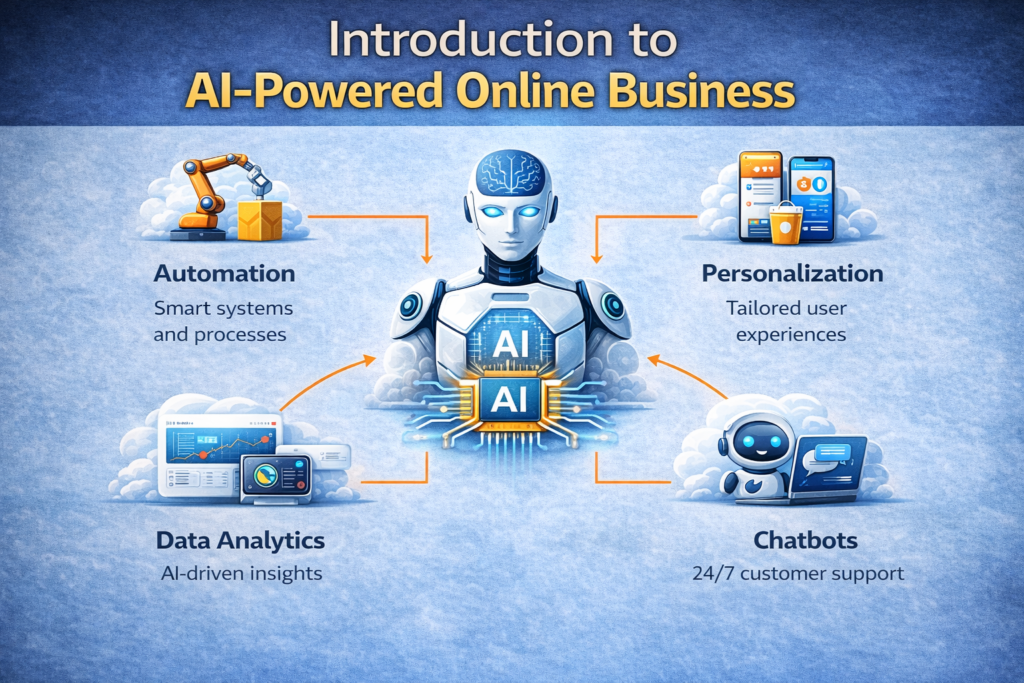
Artificial Intelligence is no longer a luxury for big corporations — it has become the driving engine behind modern entrepreneurship. In 2026, every successful online business uses AI somewhere in its operations: customer support, content creation, marketing, automation, or analytics.
According to McKinsey’s Global AI Report 2025, over 72 percent of digital businesses now integrate at least one AI tool in daily workflows. From small Shopify stores to seven-figure marketing agencies, entrepreneurs use AI to save time, reduce costs, and make smarter decisions.
If you want to build an online business in 2026 that earns consistently and scales quickly, the formula is simple: combine your human creativity with AI automation. In this complete guide, you’ll learn how to create, launch, and grow an AI-powered online business from scratch — even if you don’t have technical skills or investment capital.
1. Choosing the Right Niche for Your AI Business
Every successful business starts with clarity. Ask yourself: What problem can AI help me solve profitably?
In 2026, the best-performing AI-driven niches include:
– AI-assisted content creation (blogs, videos, social posts)
– E-commerce automation (product research, chatbots, and upsell tools)
– AI coaching and digital-learning platforms
– Data analysis and SEO optimization services
– AI-generated design and branding agencies
Use RankifyContent.com to identify trending keywords, search volumes, and competitor gaps. If “AI tools for small businesses” is trending, build around that — write blogs, create tools, or design products that serve that audience.
2. Building the Foundation — Domain, Website, and Branding
The next step is to establish your digital presence. Purchase a relevant domain name and connect it to a WordPress site (or use a builder like Framer AI or Durable).
Your website is the command center of your business — where traffic turns into revenue. Use ChatGPT or Jasper AI to generate homepage copy, product descriptions, and FAQ sections. Design your visuals using Canva Magic Studio or Looka, both of which generate professional brand kits automatically.
Most new entrepreneurs spend thousands on freelance designers; you can build the same professional site yourself within a day using AI.
3. Integrating AI into Your Workflow
An AI-powered business thrives on automation. The goal is to let machines handle repetitive work while you focus on strategy and growth.
Use ChatGPT for writing blogs, customer replies, or ad scripts. Combine it with tools like Zapier, Make, or Notion AI to automate tasks such as email follow-ups, report creation, or content scheduling.
For SEO and analytics, connect your site with RankifyContent’s AI SEO Toolkit, which analyzes traffic, keyword trends, and backlink health — giving you the same insights large agencies use.
According to HubSpot AI Marketing Report 2025, small businesses that adopt AI automation save an average of 12–20 hours per week — equivalent to hiring one extra employee without paying a salary.
4. AI for Content Creation and Marketing
Content is still king, but AI is the new kingdom builder. Blogging, email campaigns, and social posts can all be handled efficiently with AI.
Generate ideas and outlines in ChatGPT, refine with Grammarly GO, and design graphics through Canva. Post consistently using Ocoya or Buffer AI — both tools auto-generate captions and hashtags.
For blogs, AI-SEO pairing is critical. RankifyContent’s Keyword Explorer and On-Page Optimizer ensure your articles rank high on Google and attract targeted traffic. Consistent organic traffic = long-term revenue.
Real-world case: a freelance blogger in Pakistan used RankifyContent’s keyword planner and ChatGPT to publish two optimized blogs weekly. Within five months, her AdSense income exceeded $600/month — all managed by one laptop and free AI tools.
5. Building AI-Based Products or Services
If you want to move beyond freelancing, create AI-based products:
– No-code AI calculators (e.g., profit estimators, scholarship finders)
– Digital templates for automation
– AI-generated e-books and guides
– Chatbot services for small companies
Platforms like Bubble, Glide, and Durable allow non-coders to develop functioning web apps using natural-language prompts. Once your product works, integrate payments via Stripe or Lemon Squeezy, and market it through RankifyContent’s SEO tools.
The beauty of this model? Scalability. One AI tool can serve thousands of customers with zero extra effort — a business that runs 24/7 without employees.
6. Monetizing Your AI Business
There are several revenue models:
– Subscription: Offer access to AI tools or dashboards for a monthly fee.
– Affiliate Marketing: Promote third-party AI tools and earn commissions.
– Digital Products: Sell e-books, templates, or online courses.
– Ads & Sponsorships: Monetize high-traffic blogs or YouTube channels.
According to Statista’s AI Software Market Forecast 2026, AI-based digital services will surpass $300 billion by 2026. Even capturing a fraction of that through micro-businesses can generate six-figure incomes.
7. Case Study — From Freelancer to AI Entrepreneur
In 2024, a web designer in Lahore started using ChatGPT to generate client proposals and Canva Magic Studio for mock-ups. By 2026, he had automated 80 percent of his workflow and launched his own AI design-automation agency, earning $8 000 per month.
He attributes success to blending automation with marketing — using RankifyContent SEO insights to drive clients organically. His story proves you don’t need a large team; you need smart systems.
8. Scaling Your AI Business — From Solopreneur to Digital Brand
Once your AI-powered business starts earning, the next goal is to scale — not by working more, but by automating and expanding reach.
In traditional business models, scaling required hiring teams or outsourcing. But in 2026, you can expand operations using AI automation and intelligent analytics.
For example, entrepreneurs use Zapier and Make (Integromat) to connect multiple apps — automatically sending invoices, tracking sales, and posting updates across platforms. If a client pays via Stripe, Zapier can instantly send a thank-you email, generate a task in Notion, and update your Airtable records.
This interconnected “AI ecosystem” replaces multiple assistants or managers.
At RankifyContent.com, we recommend business owners implement a smart workflow loop: ChatGPT for ideation → Canva Magic Studio for design → RankifyContent SEO Analyzer for optimization → Zapier for automation → Notion AI for documentation.
This combination saves roughly 25 hours per week, allowing creators to focus on innovation and customer experience.
9. Using Data and AI Analytics to Drive Decisions
AI-powered analytics are what separate hobbyists from professional entrepreneurs. Instead of guessing which ad works or which product sells best, data reveals the truth instantly.
In 2026, tools like Google Analytics 4, ChatGPT Advanced Data Analysis, and Tableau AI make business insights accessible to anyone — no data scientist needed.
Let’s say you run a content-based business. AI analytics can identify which keywords drive traffic, what time your audience engages most, and which call-to-action generates conversions. This information lets you double down on what works and cut what doesn’t.
Pairing this data with RankifyContent’s Keyword Trend Tracker helps predict which niches are about to grow. For instance, if “AI copywriting for solopreneurs” begins trending, you can immediately publish relevant content or launch a service around it.
As Forbes reported, AI-led decision-making improves business ROI by 30% on average compared to intuition-based strategies.
10. AI-Powered Customer Experience — Chatbots & Virtual Assistants
Customer service is where AI shines the most. You don’t need to hire expensive 24/7 support teams — tools like Chatbase, BotPress, and ChatGPT API allow you to create custom chatbots that answer FAQs, handle bookings, and upsell products automatically.
For instance, an online store owner built a ChatGPT-powered chatbot that handled 90% of customer queries — cutting operational costs by $2,500 per month.
These chatbots can also be trained using your own website content or blog posts from RankifyContent.com. They respond naturally, understand user intent, and even guide visitors to make purchases.
By adding a custom AI chatbot to your site, you increase engagement time, reduce bounce rate, and improve overall SEO performance — a hidden advantage most competitors ignore.
11. Creating AI-Powered Online Courses & Digital Products
One of the most lucrative ways to monetize your expertise is by launching AI-assisted educational products. The e-learning industry is booming, with Statista projecting over $475 billion in revenue by 2026.
You can use ChatGPT to generate lesson outlines, quizzes, and summaries. Platforms like Teachable, Thinkific, or Gumroad let you sell these courses directly.
For example, a digital marketer created a course titled “Build a One-Person AI Agency in 30 Days”. He used ChatGPT for content scripting, Pictory AI for creating video slides, and ElevenLabs for realistic voiceovers. Within six months, he earned over $20,000 in passive income.
To replicate success, integrate RankifyContent’s blog optimizer to publish free educational posts that attract learners through Google. Each post should end with a call-to-action linking to your paid course.
12. Building Passive Income Streams with AI
A major advantage of an AI-powered online business is recurring revenue. Once automated systems are in place, income continues even when you’re not actively working.
Here are a few proven methods:
Affiliate Marketing: Use ChatGPT to write reviews and RankifyContent to identify trending affiliate programs (like Jasper, Canva, or Copy.ai).
YouTube Automation: Create faceless AI channels using Pictory or Runway ML — no camera needed.
AI Templates and Tools: Sell ChatGPT prompt packs, SEO spreadsheets, or Notion dashboards.
Membership Sites: Offer private access to premium AI content, tools, or lessons.
According to the HubSpot State of Marketing Report 2026, passive income systems powered by AI yield 40–60% higher lifetime customer value due to consistent personalization and automation.
13. Monetizing Social Media with AI Automation
Social media in 2026 runs on algorithms and automation. AI tools such as Ocoya, Hootsuite AI, and Predis.ai automatically create posts, suggest hashtags, and even predict viral trends.
Creators now schedule a month of content in a single day. For instance, a fashion entrepreneur in the UAE uses ChatGPT to generate captions and Canva Magic Studio for visuals. Her engagement rate tripled while her monthly ad spend dropped by 45%.
Link your Instagram, TikTok, or LinkedIn accounts to your RankifyContent blog, ensuring every viral post sends users to your website — the hub of your monetization funnel.
14. Legal and Ethical Aspects of Running an AI Business
Before scaling globally, ensure your business follows ethical AI practices. Always verify data sources, disclose when AI-generated content is used, and respect copyright policies.
Tools like Copyscape, Originality.ai, and ChatGPT content filters help maintain authenticity. Transparency builds audience trust — a critical factor in 2026’s AI-driven market.
As Harvard Business Review emphasizes, AI companies that adopt transparency and consent policies outperform competitors by 20% in customer retention.
Make sure your terms of service clarify data handling and privacy. For monetized websites, integrate cookie consent and GDPR compliance plugins.
15. Leveraging AI Communities and Learning Platforms
The AI landscape evolves quickly — what’s cutting-edge today may be outdated in six months. Stay updated through communities like Futurepedia, Reddit’s r/ArtificialIntelligence, and LinkedIn groups focused on AI marketing and business.
Additionally, RankifyContent.com publishes weekly blogs featuring trending AI tools, case studies, and monetization strategies. Following such resources ensures your business stays ahead of industry shifts.
As new models like ChatGPT-6 or Claude 3.5 roll out, early adopters will always have the competitive advantage.
16. Real-Life Success Stories of AI Entrepreneurs
The internet is filled with inspiring examples of people who built thriving businesses entirely powered by AI:
- A U.S. freelancer automated blog creation with ChatGPT and RankifyContent SEO tools, scaling to $10,000 monthly revenue within a year.
- A Pakistani designer used Midjourney and Canva Magic Studio to offer AI brand packages, replacing her 9-to-5 job.
- An Indian teacher built an AI-powered education platform generating personalized quizzes and feedback, reaching 5,000 paying users.
These entrepreneurs prove that anyone, regardless of technical background, can use AI as leverage — not just to survive but to dominate in digital markets.
Common Mistakes to Avoid When Building an AI Business
Many beginners fail not because of poor tools but because of poor strategy. Here are pitfalls to steer clear of:
- Relying solely on AI without human editing: Always fact-check and personalize.
- Ignoring SEO: AI content without keyword optimization rarely ranks.
- Overcomplicating systems: Start simple — one niche, one offer, one tool stack.
- Neglecting marketing: Even the best AI products need visibility.
As the saying goes: “AI won’t replace you, but someone using AI will.”
Stay focused on value creation. Use RankifyContent.com to analyze content performance, improve authority, and consistently refine your business model.
The Future of AI-Powered Businesses (2026–2030)
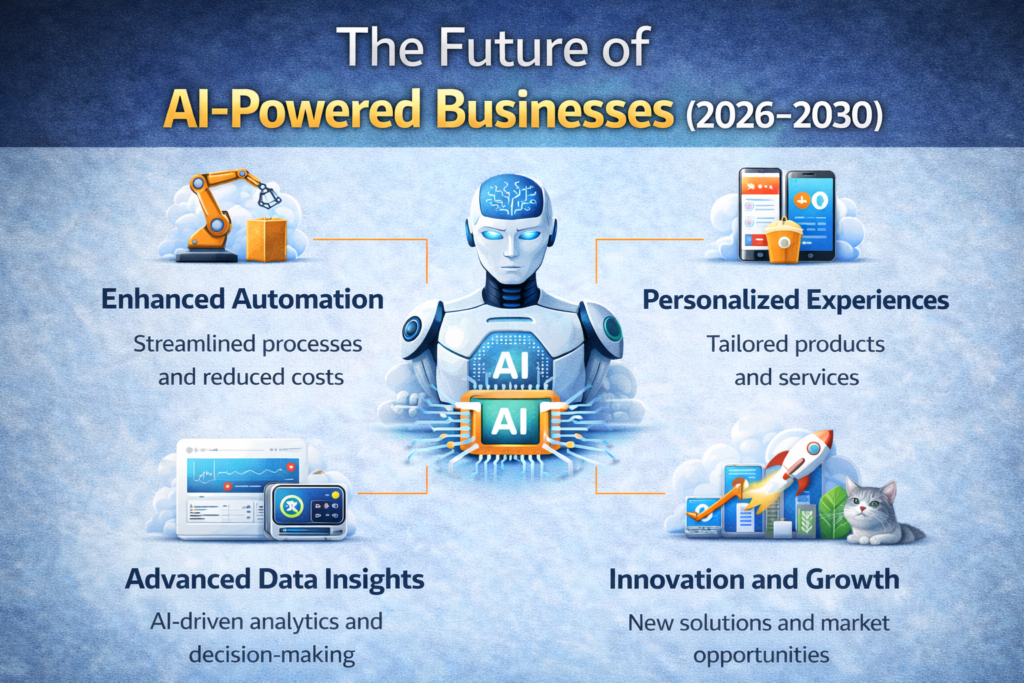
We’re entering the era of “AI entrepreneurship.” Businesses will be smaller in size but bigger in impact — one-person companies competing globally using automation.
According to PwC’s Global AI Study, AI will contribute nearly $15.7 trillion to global GDP by 2030. The entrepreneurs who learn to blend human empathy with AI efficiency will capture the most value.
Expect tools to become more integrated — one dashboard handling design, writing, sales, analytics, and automation. RankifyContent’s future AI updates are already moving in this direction, offering creators all-in-one control over their business growth.
Frequently Asked Questions (FAQ)
Q1. Can anyone start an AI-powered business without coding?
Absolutely. No-code tools like Durable, Bubble, and Framer AI allow anyone to build apps or websites through natural language.
Q2. How much investment is needed to start?
Most AI tools offer free or low-cost plans. You can build your business under $50 initially by using ChatGPT Free + RankifyContent SEO tools.
Q3. Which industries will AI disrupt the most?
Education, marketing, design, and e-commerce are leading. But every industry will eventually adopt AI automation.
Q4. Is it ethical to use AI for content creation?
Yes, as long as you add human verification, original input, and cite data sources. Always ensure your work aligns with AI ethics policies.
Q5. How long before an AI business becomes profitable?
Typically 3–6 months with consistent SEO blogging, email marketing, and social engagement. Using automation drastically reduces overhead and speeds up returns.
Conclusion
Building an AI-powered online business in 2026 is not about coding or massive investment — it’s about creativity, consistency, and systems. AI tools now handle tasks once requiring teams: from writing and designing to marketing and analytics.
Start small, automate smartly, and scale gradually. Your biggest advantage is timing — we’re in the early stages of the AI business revolution.
If you want to stay updated on the latest AI earning tools, SEO strategies, and automation systems, visit RankifyContent.com — your all-in-one hub for building, scaling, and monetizing AI-powered businesses.
AI is not the future anymore — it’s the present. The question is, will you use it to build your future?