Table of Contents
Best Ecommerce Tool for Beginners in 2025
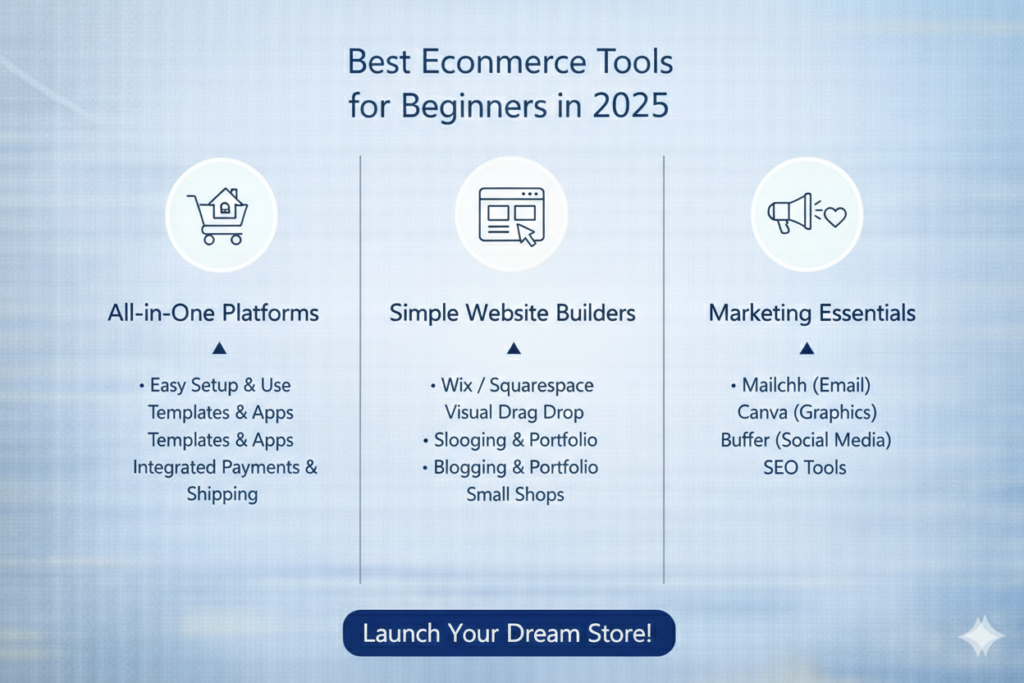
If you’re new to the world of online selling, choosing the best ecommerce tool for beginners can feel overwhelming. Between features, pricing, design flexibility, plugins, and technical demands, there’s a lot to weigh. But the right tool can make all the difference — saving you time, money, and frustration.
In this guide, we’ll walk you through the top beginner-friendly ecommerce tools to consider in 2025. We’ll compare pros and cons, share real examples, and give tips to pick the one that fits your needs. Whether you want a simple store today or a scalable shop for tomorrow, this article will help you make an informed choice.
We’ll also include a helpful FAQ section and conclusion to wrap it all up.
What to Look for in an Ecommerce Tool (for Beginners)
Before we jump into specific platforms, let’s understand the criteria you should use when evaluating ecommerce software. This ensures your choice will be robust enough to grow with you.
Here are key factors and semantic / LSI terms to consider:
- Ease of use / beginner friendly — drag & drop builders, intuitive UI
- Hosting included or self-hosted — all-in-one vs. open-source
- Design themes / templates
- Plugin / app marketplace
- Payment / checkout support
- Security & SSL, PCI compliance
- SEO tools, speed, mobile readiness
- Support & documentation
- Scalability / upgrade paths
- Total cost of ownership (subscription fees + transaction fees + add-ons)
These criteria will help you judge each tool objectively. Now let’s explore the contenders.
Top Beginner Ecommerce Tools to Consider in 2025
Below is a breakdown of some of the strongest options for beginners in 2025. We start with simpler, all-in-one choices, then look at more flexible or technical alternatives.
Shopify
Why it’s a top pick
- Shopify is often hailed as a top choice for beginners who want to get up and running quickly. vistaprint.com+3Zapier+3Shopify+3
- In 2025, Shopify has launched an AI Store Builder that lets you create a full storefront just by entering descriptive keywords—so even non-techies can start with minimal setup. Reuters
- It’s a fully hosted SaaS (software as a service) platform, which means you don’t have to manage servers or security.
Pros
- Very easy to use, even if you’ve never built a website
- Large app marketplace for adding new features
- Good support and documentation
- Scalable — many stores grow on Shopify
- Secure, fast hosting built in
Cons / things to watch out for
- Monthly subscription cost
- Transaction fees if you don’t use Shopify Payments
- Some features require apps (which may cost extra)
- Less flexibility than open-source platforms
Use case example
Imagine you want to sell a small line of fashion accessories. With Shopify, you can pick a theme, add your products, set up payments, and launch—all without much technical work. Later, if you want to grow with more custom functionality or integrations, Shopify’s ecosystem supports that.
WooCommerce (on WordPress)
Why it’s good for those comfortable with WordPress
- WooCommerce is a popular open-source plugin for WordPress. Wikipedia
- If you already have or want a WordPress website, WooCommerce integrates seamlessly.
Pros
- Full control and flexibility
- Massive number of plugins, themes, and community support
- No subscription fees (you’ll pay for hosting and extensions)
- Great for SEO (because WordPress is powerful in that regard)
Cons
- You need to manage hosting, security, backups, and updates
- Might be more challenging for non-technical beginners
- Some essential features may require paid extensions
- Performance depends heavily on your hosting
Use case example
You run a blog and want to expand into selling digital products, courses, or physical goods. You already know WordPress. Installing WooCommerce lets you transition smoothly without moving to a completely new system.
Wix (Ecommerce mode)
Why a drag & drop builder is appealing to non-technical users
- Wix is recognized for being beginner friendly with intuitive editing. Zapier+3TechRadar+3Tom’s Guide+3
- It comes with ecommerce features, so you don’t have to bolt on a separate store. TechRadar
Pros
- Very simple drag & drop interface
- Hosting & security handled
- Templates that look good out of the box
- Good for small to medium scale stores
Cons
- Less flexibility when your store grows very large
- App marketplace is not as rich as Shopify or WooCommerce
- Some performance limitations for heavy / large catalogs
Use case example
You want a modern, visually pleasing store to showcase art prints or small craft goods. With Wix, you can build pages, upload product images, and start selling quickly with minimal fuss.
Sellfy
Why Sellfy is ideal for first-time sellers or digital goods
- BloggingWizard labels Sellfy as “best ecommerce platform for beginners” because of its simplicity and all-in-one setup. Blogging Wizard
- It supports both physical and digital products, subscriptions, and print-on-demand. The Retail Exec+1
Pros
- Quick setup, minimal learning curve
- Built-in marketing tools (email, upsells, affiliate)
- No transaction fees (depending on plan)
- Good for creators, digital goods, and small product lines
Cons
- Less flexibility for complex stores
- Fewer third-party integrations than bigger platforms
- May not be ideal if you intend to scale massively
Use case example
You’re an eBook author or digital artist and want to sell downloads or prints. Sellfy lets you do exactly that with little setup overhead.
BigCommerce
Why it’s a powerful option even for beginners
- BigCommerce is known for combining ease of use with strong built-in commerce features. TechRadar+2BigCommerce+2
- It offers a higher level of native features without depending as heavily on apps.
Pros
- Excellent scalability
- Strong native features (multi-currency, multi-channel selling)
- Good performance and robust architecture
- SEO features built in
Cons
- Slightly steeper learning curve than the very simplest builders
- Cost can escalate with business growth
- Less design flexibility unless you dig into customization
Use case example
You plan to scale your store to multiple markets and sell globally. BigCommerce gives you more “out of the box” tools you don’t need to retrofit later.
Other Tools & Hybrid / Niche Options
- Ecwid by Lightspeed: Great for embedding a store into an existing website or starting with a free plan. Zapier+2Shopify+2
- OpenCart: A widely used open-source ecommerce platform. Wikipedia
- Magento / Adobe Commerce: Powerful, enterprise-level, but much more technical. Wikipedia
- Spree Commerce: Open-source, API-first platform. Wikipedia
- nopCommerce: C# / .NET-based open ecommerce solution. Wikipedia
These may be better suited to more technical users or those planning heavy customization, but it’s good to know them as you grow.
Side Tools That Enhance Your Ecommerce Setup
Your main ecommerce tool is just the foundation. To really succeed, you’ll want complementary tools for marketing, analytics, optimization, communication, and more. Here are some essential categories and examples for beginners:
| Category | Tool | Why it matters |
| Email Marketing & Automation | Mailchimp, Klaviyo | Helps you nurture customers and recover abandoned carts The Retail Exec+2Dokan+2 |
| SEO & Keyword Research | Ahrefs, SEMrush | To optimize product pages and content for search engines |
| Analytics | Google Analytics, Hotjar | Track user behavior and conversion funnels |
| Live Chat / Chatbot | Tidio, Drift | Provide customer support and answer questions |
| Popups & Lead Capture | OptinMonster | Collect email leads and upsell |
| Ads / PPC Tools | Google Ads with conversion tracking | To drive targeted traffic and monitor ROI Dokan+1 |
| Inventory / Order Management | ShipStation, OrderDesk | Helps automate fulfillment and shipping tasks |
Using just one or two of these tools alongside your main ecommerce platform can significantly boost your efficiency and bottom line.
How to Pick the Best Ecommerce Tool for You
Here’s a step-by-step approach to deciding on your best ecommerce tool for beginners in 2025:
- Define your goals & scale
Are you selling a few products locally, or do you plan global reach? If you want to scale quickly, pick a platform with upgrade paths. - Assess your technical comfort
If you don’t want to worry about hosting, choose a hosted SaaS (Shopify, Wix, BigCommerce). If you prefer full control, consider WooCommerce or OpenCart. - Estimate your budget
Consider subscription fees, transaction fees, hosting, domain, and costs of plugins or apps. - Check for needed features out of the box
For instance: multilingual, multi-currency, shipping rules, coupons, abandoned cart recovery. If your platform needs too many add-ons, it may get expensive. - Test the interface
Use free trials or demos. If the admin dashboard and store editor feel intuitive to you, that’s a big plus. - Look at future growth path
Can you add more channels (Amazon, Instagram), third-party integrations, or custom code later? - Evaluate support & community
A beginner platform should have strong documentation, tutorials, and responsive support.
As you walk through this, compare your top 2–3 candidates side by side using a scoring sheet (ease, cost, growth, support). Your “best ecommerce tool for beginners” is the one that scores highest given your constraints.
Real Comparison: Shopify vs WooCommerce vs Wix vs Sellfy vs BigCommerce (2025)
Let’s do a head-to-head comparison to see how they stack up in typical scenarios.
Setup & Ease
- Shopify: Very quick to set up; in 2025, with AI Store Builder, you can generate a store from keywords. Reuters
- Wix: Drag & drop, minimal learning curve
- Sellfy: Lightweight and fast — suited for simple stores
- WooCommerce: Setup needs hosting, plugin, theme setup
- BigCommerce: More configuration initially, but less need for add-ons later
Cost
- Shopify: Monthly fees + optional app costs + transaction fees
- Wix: Subscription plans, sometimes limitations or upgrade needed
- Sellfy: Subscription, sometimes no transaction fees depending on plan
- WooCommerce: Hosting + domain + paid plugins as needed
- BigCommerce: Subscription, but fewer paid apps required
Flexibility / Customization
- WooCommerce: Highest flexibility (open source)
- Shopify & BigCommerce: Highly extendable via apps & APIs
- Wix / Sellfy: Simpler, less room for deep customization
Scaling & Features
- BigCommerce: Strong for growing stores
- Shopify: Reliable scaling with many successful large stores
- WooCommerce: Scalable if hosting and architecture are well managed
- Wix / Sellfy: More suited to small-to-medium scale
Support & Ecosystem
- Shopify: Excellent support, large app marketplace
- WooCommerce: Large community, many tutorials
- BigCommerce: Strong enterprise and mid-market support
- Wix / Sellfy: Decent support; fewer third parties
Example Scenario
Suppose you begin with 20 products in your local area, and within a year you hope to sell internationally. You want a tool that’s easy to start with but won’t force you to migrate later. Shopify or BigCommerce are safer bets here, since they combine ease of use with growth potential. WooCommerce could work too, if you’re comfortable managing hosting or have access to developer support.
Tips & Best Practices to Get the Most Out of Your Tool
- Start with a minimal viable store — don’t try to build everything upfront.
- Use high-quality images and good product descriptions (SEO-friendly).
- Optimize for mobile — most shoppers browse on phones.
- Enable abandoned cart recovery and email reminders.
- Use analytics early; track where customers drop off.
- Use A/B testing on key pages.
- Keep your store performance fast (optimize images, caching).
- Use SEO best practices for your product titles, metadata, and URLs.
- Over time, integrate marketing tools (email, social, ads).
- Backup your site regularly, especially if you use self-hosted tools.
FAQs (Frequently Asked Questions)
Q: What is the single best tool for a complete beginner in 2025?
A: There is no one-size-fits-all, but Shopify often leads for beginners because it balances ease and growth potential. With its AI Store Builder (2025), the barrier to entry is even lower. Reuters
Q: Can I switch platforms later if my store outgrows the one I choose now?
A: Yes, but migrations can be tricky (data, SEO, URL structure). That’s why choosing a platform with upgrade paths and export/import abilities is essential.
Q: I already have a WordPress blog. Should I go WooCommerce?
A: If you’re comfortable managing hosting and technical aspects, WooCommerce integrates well with WordPress and gives you full control and SEO advantage.
Q: How much does it cost to run an ecommerce store?
A: Costs include platform subscription (if SaaS), hosting (if self-hosted), domain, payment/transaction fees, apps/extensions, marketing, and maintenance. For small beginners, expect a modest monthly budget to start.
Q: Do I need to know coding to use these tools?
A: No for most hosted options (Shopify, Wix, Sellfy). But some customization may require basic HTML, CSS, or app/plugin tweaking.
Q: Will SEO work well on these platforms?
A: Yes — all major platforms support SEO features. But your content, site structure, performance, and user experience matter more than the platform itself.
Q: What tools should I add later for marketing?
A: Email marketing (Klaviyo, Mailchimp), SEO tools (SEMrush, Ahrefs), live chat (Tidio), analytics (Google Analytics), ad tracking.
Conclusion
Choosing the best ecommerce tool for beginners in 2025 hinges on your goals, technical comfort, budget, and growth plans. There’s no universal “best,” but if I were advising a true beginner, here’s the approach I’d suggest:
- If you want the easiest possible setup and support, Shopify is hard to beat — especially with its AI Store Builder in 2025.
- If you already use WordPress and want full control, WooCommerce is a powerful option (but you’ll manage more yourself).
- For visual simplicity and minimal fuss, Wix or Sellfy offer compelling options.
- For eventual scale with many features built in, BigCommerce is worth serious consideration.
No matter which tool you select, success depends on execution — strong product presentation, effective marketing, consistent optimization, and good customer experience will decide whether your store grows or stagnates.