Table of Contents
Introduction: How Ecommerce Works?
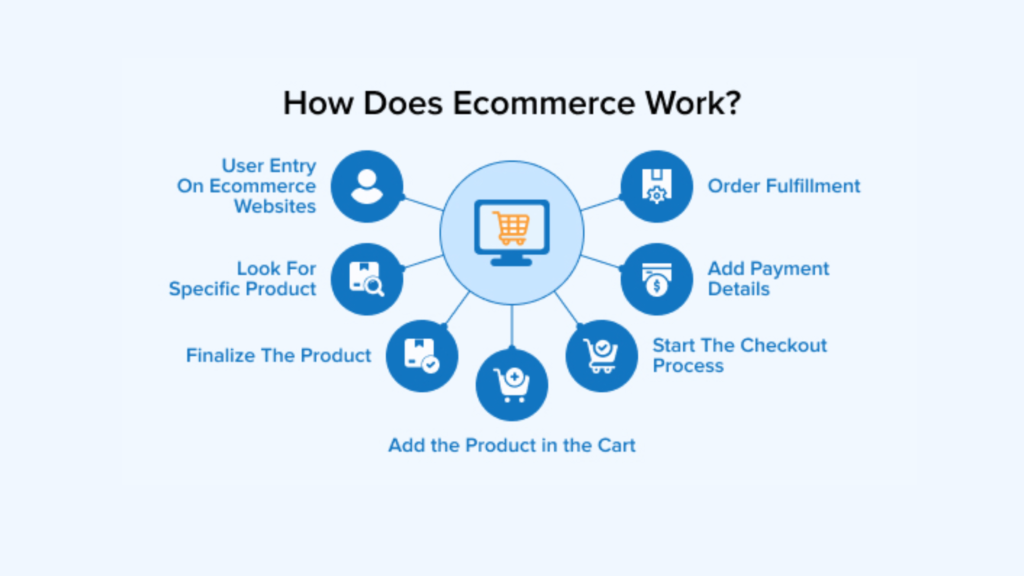
You browse a website. You add items to a cart. You enter payment details. Days later, a package arrives at your door.
This sequence is so familiar, so seamlessly integrated into modern life, that we rarely stop to consider the complexity behind it. But for anyone looking to start an online business—or simply understand the digital economy they participate in daily—the question “how does ecommerce work?” deserves a complete, transparent answer.
The scale of this system is staggering. Global ecommerce sales are projected to reach $6.8 trillion by 2028, with online purchases accounting for roughly 21% of all retail transactions worldwide . Approximately 85% of global consumers now shop online, and the number of ecommerce websites has more than doubled in recent years, growing from 9.7 million to 19.8 million .
Behind every successful transaction is a sophisticated digital ecosystem—a carefully orchestrated sequence of technologies, platforms, and processes working together to enable the frictionless exchange of value between buyers and sellers across geographic boundaries and time zones.
This guide is your definitive resource. Drawing on verified industry data, platform documentation, and expert insights, we will answer the question “how does ecommerce work?” with the depth and clarity it deserves. You will learn:
- The precise definition of ecommerce and the core transaction process
- The step-by-step journey of an online order, from browse to delivery
- The key technologies powering ecommerce: platforms, payment gateways, processors, and fulfillment systems
- The different types of ecommerce business models and how they operate
- How payment processing actually works behind the scenes—including the authorization and settlement stages
- How order fulfillment and shipping get products from warehouse to customer
- Common ecommerce mistakes and how to avoid them
- Expert tips for building and scaling a successful online business
Whether you’re an aspiring entrepreneur, a student of digital commerce, or simply curious about what happens when you click “buy now,” this guide provides the foundational understanding you need.
What Is Ecommerce?
Before diving into how ecommerce works, we must first understand what it is.
Ecommerce (electronic commerce) is the buying and selling of goods and services over the internet . It involves a transaction between two parties—usually a business and a consumer—where the payment and delivery of products or services are conducted online .
Ecommerce can take many forms, including:
- Online shopping (physical products)
- Digital downloads (software, ebooks, courses)
- Online subscriptions (streaming services, boxes)
- Online ticketing (events, travel)
- Internet banking and electronic payments
The Birth of Modern Ecommerce
The first legal online retail transaction occurred on August 11, 1994, when a Sting CD was sold through a website called NetMarket . One friend sold the CD to another over the internet, facilitating a sale between two people 300 miles apart. The New York Times documented this milestone in its August 12, 1994 issue, marking the start of consumer ecommerce as we know it .
From there, ecommerce exploded. Amazon and eBay launched in 1995, followed by PayPal in 1998. The introduction of Secure Socket Layers (SSL) encryption in 1994 made online purchasing safer, and customers grew more comfortable with digital transactions . Ecommerce platforms like Shopify later democratized the industry, allowing businesses to sell directly to consumers anywhere in the world .
The COVID-19 pandemic accelerated online shopping adoption by about five years, permanently changing consumer behavior toward digital commerce . Today, ecommerce is not just a channel—it’s the default mode of commerce for millions of businesses and billions of consumers.
The Core Ecommerce Transaction Process
At its simplest level, an ecommerce transaction follows a clear path from customer discovery to order delivery . Here’s how a typical online purchase works:
Step-by-Step Transaction Flow
Step 1: Discovery and Browsing
A customer finds your online store through search engines, social media, ads, or direct navigation. They browse your product catalog, view images and descriptions, and compare options.
Step 2: Add to Cart
The customer selects items and adds them to a virtual shopping cart. The cart maintains their selections as they continue shopping.
Step 3: Checkout
The customer proceeds to checkout, where they enter:
- Shipping address
- Billing information
- Payment details
- Any promo codes or special instructions
Step 4: Payment Processing
The system securely transmits payment information through a payment gateway to a payment processor. The processor communicates with the customer’s bank to authorize the transaction .
Step 5: Order Confirmation
If the payment is approved, the customer receives an order confirmation (typically via email). The merchant’s inventory system updates stock levels, and the fulfillment team receives order details .
Step 6: Fulfillment and Shipping
The order is picked from inventory, packaged, and handed to a shipping carrier for delivery to the customer .
Step 7: Delivery and Post-Purchase
The customer receives their order. They may receive tracking updates along the way. After delivery, they might receive follow-up emails requesting reviews or offering related products.
This entire sequence—from payment authorization to inventory updates to fulfillment routing—happens within seconds for digital systems, though physical delivery takes days.
The Three Pillars of Ecommerce Technology
Modern ecommerce operations rely on three core technology pillars working together seamlessly.
Pillar 1 – Ecommerce Platforms
An ecommerce platform is the software infrastructure that enables businesses to create and manage an online store . It handles essential functions like:
- Product catalog management and display
- Inventory tracking and updates
- Shopping cart functionality
- Order management
- Customer relationship management
- Integration with payment processors and shipping carriers
Modern platforms offer marketing automation, analytics, and personalization tools beyond these basics . They support selling across websites, social media, and marketplaces while keeping inventory and orders centralized.
Leading platforms:
- Shopify: SaaS platform with extensive app ecosystem; ideal for ease of use
- BigCommerce: Strong B2B capabilities and zero transaction fees
- WooCommerce: Open-source WordPress plugin; full control but requires hosting
- Adobe Commerce (Magento): Enterprise-grade; highly customizable
- Wix/Squarespace: Design-led options for micro-businesses
The best platform for your business depends on your size, complexity, technical resources, and growth plans .
Pillar 2 – Payment Processing Systems
Payment processing is the engine behind every transaction. It involves a network of technologies and financial institutions working together to move money securely from customer to merchant .
Key components of payment processing :
Pillar 3 – Fulfillment and Logistics
Order fulfillment includes all the steps involved in processing customer purchases, from receiving orders to managing inventory, packaging, delivery, and handling returns .
- Receive orders and payment: The system captures order details and confirms payment
- Select product from inventory: The item is retrieved from warehouse storage
- Package the product: Items are packed, often with branded materials (72% of consumers say packaging influences purchase decisions)
- Arrange delivery: A shipping carrier delivers to the customer
- Handle returns: Reverse logistics processes any customer returns
- In-house fulfillment: Small businesses handle their own orders, tracking, and shipping. Works well for low order volume and unique shipping needs.
- Third-party logistics (3PL): Outsourced fulfillment partners manage inventory, packaging, and shipping. Ideal for growing businesses that have outgrown in-house capacity.
- Dropshipping: The manufacturer or supplier fulfills orders directly to customers. No inventory holding required, but less control over shipping and customer service.
How Payment Processing Actually Works
Understanding the behind-the-scenes mechanics of payment processing is essential for anyone running an ecommerce business. Here’s the detailed breakdown.
The Authorization and Settlement Stages
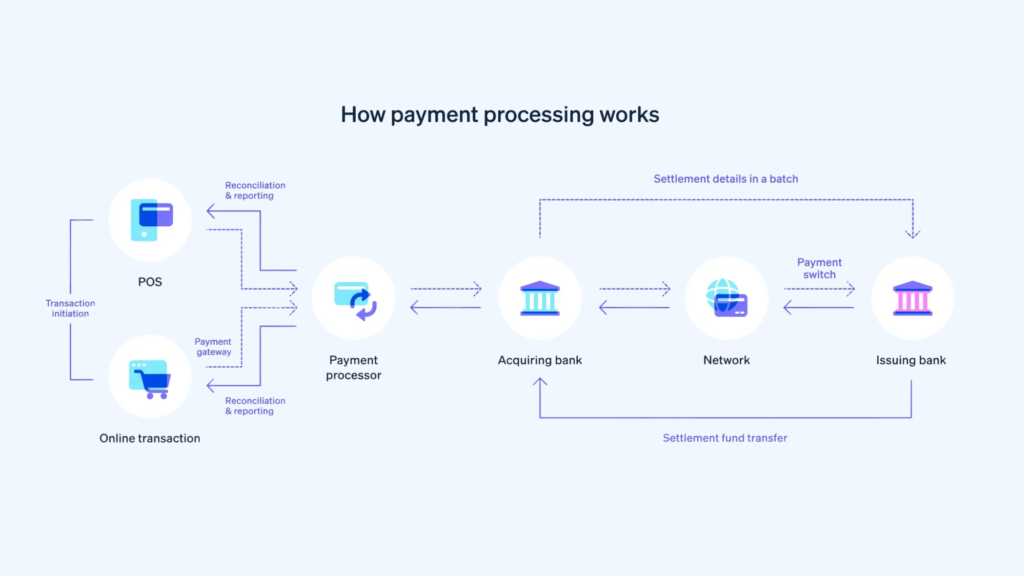
Payment processing involves two distinct stages: authorization and settlement .
Authorization (Approving the Sale):
- A customer makes a purchase on your website using a credit or debit card
- The payment gateway encrypts the card details and securely sends them to the payment processor
- The processor forwards the request to the customer’s issuing bank to check for sufficient funds or available credit
- The issuing bank responds with either an approval or a denial
- The processor relays that response back to your website. If approved, it also tells your merchant bank to credit your account
All of this happens within seconds, though the funds aren’t actually transferred yet.
Settlement (Getting Paid):
- The card issuer sends the funds to your merchant bank
- The merchant bank deposits the money into your account
- The funds are now available to you
The settlement process can take a few days. Sometimes your bank may let you access money before it’s officially transferred, or they may keep a portion in reserve in case of returns .
Payment Processing Fees Explained
Every time a customer makes a purchase, several parties take a cut :
| Fee Type | Who Gets It | Typical Structure |
|---|---|---|
| Interchange fee | Issuing bank | Percentage of sale (varies by card type, transaction size, industry) |
| Assessment fee | Card networks (Visa, Mastercard, etc.) | Percentage on top of interchange |
| Merchant account fee | Merchant bank | Percentage (varies by industry, sales volume, risk level) |
| Processor fee | Payment processor | Flat fee per transaction (e.g., $0.30) plus potential monthly fees |
These fees are often bundled and quoted as a single rate: for example, 2.9% + $0.30 per transaction .
| Model | How It Works | Example on $100 Sale |
|---|---|---|
| Flat-rate pricing | Fixed bundled rate regardless of card type | 2.9% + $0.30 = $3.20 total |
| Interchange plus | Actual interchange + fixed markup | 1.8% interchange + 2.0% + $0.10 = $3.90 total |
| Tiered pricing | Transactions grouped into tiers (qualified, mid-qualified, nonqualified) with varying fees | $2.50–$3.50 depending on classification |
Security in Payment Processing
Secure payment processing is non-negotiable. Key security measures include :
- SSL certificates: Encrypt data between a customer’s browser and your website
- PCI DSS compliance: Payment Card Industry Data Security Standard requirements for any business accepting credit cards
- Tokenization: Replaces sensitive card data with unique tokens
- 3D Secure (3DS): Adds authentication layer via one-time passcodes or biometric verification
- Fraud detection: Real-time risk scoring and transaction monitoring
Non-compliance with PCI DSS can result in financial penalties, restrictions on card processing capabilities, and reputational damage .
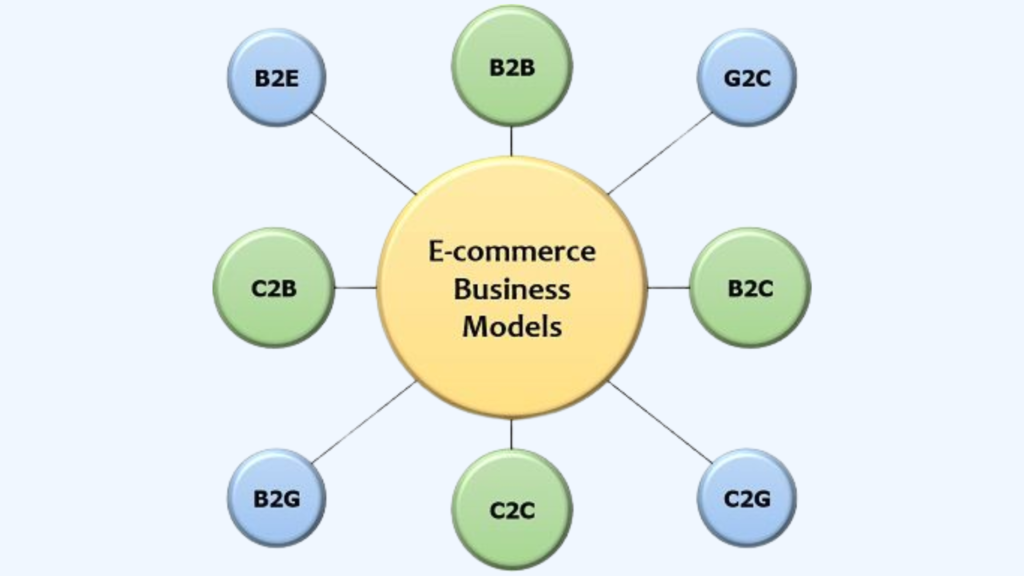
The Different Types of Ecommerce Business Models
Ecommerce isn’t one-size-fits-all. Understanding the different business models helps clarify how various types of online stores operate.
B2C (Business-to-Consumer)
The model most shoppers know best: companies selling products directly to individual consumers . This includes everything from online clothing stores to subscription boxes.
Examples: Nike.com, most Shopify stores, Warby Parker
Characteristics: Smaller order values, higher marketing intensity, emphasis on brand and emotional connection .
B2B (Business-to-Business)
Companies selling products or services to other businesses . These transactions typically involve larger orders, longer sales cycles, and more complex buying processes.
Examples: Grainger (industrial supplies), Alibaba, software companies selling to businesses
Market size: B2B ecommerce is projected to reach $36.16 trillion by 2026 . Modern B2B buyers expect consumer-grade digital experiences.
C2C (Consumer-to-Consumer)
Individuals selling directly to other individuals, typically through a third-party platform .
Examples: eBay, Poshmark, Facebook Marketplace, Etsy (for handmade goods)
Characteristics: Platform acts as intermediary; seller may not be a registered business; emphasis on trust and reputation systems .
DTC (Direct-to-Consumer)
A subset of B2C where brands sell exclusively through their own channels, bypassing wholesalers and marketplaces .
Examples: Casper, Dollar Shave Club, Allbirds
Characteristics: Full control over brand experience and customer data; responsibility for driving all traffic; emphasis on customer lifetime value.
C2B (Consumer-to-Business)
Individuals offering products or services to businesses .
Examples: Freelancers on Upwork or Fiverr, stock photographers licensing images, influencers promoting brands
Subscription Commerce
Businesses offering products or services on a recurring basis .
Examples: Birchbox, Netflix, meal kit services, software subscriptions
Characteristics: Predictable revenue streams; emphasis on retention and churn prevention.
Where Ecommerce Happens – Sales Channels
Ecommerce unfolds across various digital spaces, each offering different advantages .
Ecommerce Websites
Online stores created by brands to sell directly to consumers. Sellers have complete control over design, customer experience, and data.
Key characteristics:
- Full brand control
- Direct customer relationships
- No built-in traffic—you must drive visitors through marketing
Online Marketplaces
Platforms where multiple sellers can list their products, visited by large volumes of shoppers .
Examples: Amazon, eBay, Etsy
Key characteristics:
- Built-in traffic and audience
- Platform handles many technical aspects
- Less control over branding and customer data
Social Selling Channels
Social media platforms with integrated ecommerce features .
Examples: Instagram Checkout, TikTok Shop, Facebook Shops
Key characteristics:
- Large, engaged audiences
- Discovery and transaction in same environment
- Native to mobile behavior
Step-by-Step – How to Set Up an Ecommerce Operation
If you’re ready to start selling, here’s the practical path to building your ecommerce operation.
Step 1 – Choose Your Selling Method
Decide whether to start with an established marketplace or build your own website .
| Approach | Advantages | Considerations |
|---|---|---|
| Marketplace-first | Built-in traffic, lower technical barrier | Less control, fees, limited data access |
| Own website | Full control, customer ownership, higher margins | No built-in traffic; must drive visitors |
Many successful sellers start with marketplaces to validate demand, then build their own sites as they grow.
Step 2 – Select Your Ecommerce Platform
If building your own site, choose a platform based on your business model, technical resources, and budget .
Questions to ask:
- What’s my technical skill level?
- How many products will I sell?
- Do I need B2B functionality?
- What’s my budget for subscriptions and development?
Step 3 – Set Up Payment Processing
Connect payment services to accept customer payments securely .
Options:
- All-in-one solutions like PayPal, Stripe, or Square
- Platform-native payments (Shopify Payments, etc.)
- Custom gateway integration for advanced needs
Ensure your payment solution is PCI compliant and supports your customers’ preferred payment methods.
Step 4 – Plan Your Fulfillment Strategy
Decide how you’ll store inventory and ship products .
Considerations:
- Order volume (now and projected)
- Product size and special handling needs
- Geographic distribution of customers
- Budget for shipping and fulfillment
Step 5 – Set Up Financial Management
Use accounting software to track sales, expenses, and profitability from day one . Digital transactions can quickly become complex to manage manually.
Essential tools:
- Accounting software (Xero, QuickBooks)
- Payment reconciliation tools
- Profitability analytics
Step 6 – Establish Business Policies
Clear policies covering returns, refunds, privacy, and customer service protect both you and your customers .
Required policies:
- Return and refund policy
- Privacy policy (GDPR/CCPA compliant)
- Terms of service
- Shipping policy
Common Ecommerce Mistakes and How to Avoid Them
Mistake 1 – Not Understanding Your Unit Economics
The error: Launching without calculating true costs—product, shipping, payment fees, advertising, returns allowance.
The consequence: You lose money on every sale and don’t realize it until you run out of cash.
Avoidance: Map out complete unit economics before launch. Include every variable cost.
Mistake 2 – Choosing the Wrong Platform
The error: Selecting a platform based on popularity rather than business requirements.
The consequence: You force your business to conform to platform limitations or face expensive replatforming.
Avoidance: Evaluate platforms against documented requirements. Consider B2B needs, scalability, and total cost of ownership.
Mistake 3 – Ignoring Mobile Experience
The error: Designing for desktop and treating mobile as an afterthought.
The consequence: Over half of ecommerce traffic is mobile; poor mobile experience loses the majority of potential customers.
Avoidance: Design mobile-first. Test on actual devices. Ensure checkout works on small screens.
Mistake 4 – Forgetting Security
The error: Skipping SSL certificates, ignoring PCI compliance, or using insecure payment processing.
The consequence: Data breaches destroy customer trust and can result in massive fines.
Avoidance: Invest in secure payment gateways and SSL certificates. All major platforms include these features .
Mistake 5 – Poor Fulfillment Planning
The error: Underestimating shipping costs, timelines, and return complexity.
The consequence: Late deliveries, unhappy customers, and profit erosion.
Avoidance: Plan fulfillment strategy early. Use reliable carriers. Build return costs into your pricing model.
Mistake 6 – Ignoring Data and Analytics
The error: Launching without tracking key metrics—traffic sources, conversion rates, customer acquisition costs.
The consequence: You’re flying blind, unable to optimize what isn’t measured.
Avoidance: Install analytics before launch. Track KPIs religiously. Let data guide decisions.
Expert Tips and Best Practices for 2026
1. Know Your Numbers
If you don’t know your customer acquisition cost, lifetime value, and contribution margin, you are gambling. Build your dashboard. Review it weekly.
2. Diversify Your Channels
Don’t rely solely on one platform or traffic source. Sell across your own site, marketplaces, and social channels to reduce risk and maximize reach .
3. Prioritize Mobile
Over half of traffic is mobile. If your checkout doesn’t work flawlessly on phones, you’re losing customers.
4. Invest in Security
Customers need to feel confident their data is protected. Use secure payment gateways and SSL certificates. All modern platforms include these features .
5. Plan Fulfillment Strategically
Choose fulfillment methods that match your volume and customer expectations. Consider in-house for low volume, 3PL for growth, and dropshipping for testing .
6. Understand Your Payment Fees
Payment processing fees add up. Model them into your pricing. Compare flat-rate vs. interchange-plus pricing for your volume .
7. Build Retention Systems
It costs 5–7 times more to acquire a new customer than to retain an existing one. Use email marketing, loyalty programs, and post-purchase engagement.
8. Stay Compliant
Keep up with tax requirements, data privacy laws, and platform policies. Non-compliance can shut down your business.
9. Test Everything, Always
A/B test product pages, checkout flows, pricing, and marketing messages. Data beats opinions.
10. Start Simple, Scale Strategically
You don’t need 20 tools on day one. Start with platform, payment processing, and analytics. Add specialized tools as you grow.
Frequently Asked Questions (FAQ)
1. How does ecommerce work?
Ecommerce works through a series of integrated systems: an online storefront displays products, a shopping cart captures selections, a payment gateway processes transactions securely, and fulfillment systems handle delivery. Behind the scenes, payment processors communicate with banks to authorize and settle payments .
2. What are the main types of ecommerce?
The main types are B2C (business-to-consumer), B2B (business-to-business), C2C (consumer-to-consumer), C2B (consumer-to-business), and DTC (direct-to-consumer). Each involves different relationships between buyers and sellers .
3. How do online payments work?
When a customer pays online, their payment details are encrypted by a payment gateway and sent to a payment processor. The processor requests authorization from the customer’s bank. If approved, the funds are settled to the merchant’s account within 1–3 business days .
4. What is a payment gateway?
A payment gateway is technology that connects a website’s checkout to the payment processing network. It captures payment details, encrypts the data, runs fraud checks, and securely sends information for authorization .
5. How long does it take to get paid from online sales?
Authorization happens instantly, but settlement typically takes 1–3 business days for funds to appear in your account. Some payment providers offer faster access for a fee .
6. What is order fulfillment?
Order fulfillment includes all steps from receiving an order to delivering it to the customer: order processing, inventory selection, packaging, shipping, and handling returns .
7. Do I need a merchant account to accept online payments?
Many modern payment processors (like PayPal, Stripe, and Square) combine payment processing and merchant account services, allowing businesses to accept payments without setting up a separate account through a bank .
8. What is PCI compliance?
PCI DSS (Payment Card Industry Data Security Standard) is a set of security requirements for any business that accepts credit card payments. Compliance is mandatory and helps protect customer data .
9. How do I choose an ecommerce platform?
Choose based on your business model, technical resources, and growth plans. Key factors: ease of use, B2B capabilities, integrations, total cost of ownership, and scalability .
10. What’s the difference between in-house fulfillment and 3PL?
In-house fulfillment means you handle storage, packing, and shipping yourself. 3PL (third-party logistics) means outsourcing these tasks to a specialized company. Choose based on your order volume and operational capacity .
11. How does dropshipping work?
In dropshipping, you list products for sale but never hold inventory. When a customer orders, you forward the order to a supplier who ships directly to the customer. You profit on the price difference .
12. What are transaction fees in ecommerce?
Transaction fees are charges for processing payments, typically a percentage of the sale plus a fixed amount (e.g., 2.9% + $0.30). These cover interchange fees, assessment fees, and processor costs .
13. How do I handle international shipping?
International shipping requires understanding tariffs, customs requirements, and delivery timelines. Use fulfillment partners with global reach and stay informed on trade policies .
14. What is SSL and why do I need it?
SSL (Secure Socket Layer) encrypts data between a customer’s browser and your website, protecting sensitive information like payment details. It’s essential for security and customer trust .
15. Can I start an ecommerce business without technical skills?
Yes. Modern ecommerce platforms offer drag-and-drop tools that let you build stores without coding. Willingness to learn is more important than technical skills .
16. How do returns work in ecommerce?
Returns involve reverse logistics: customers send items back, they’re inspected for damage, and either restocked, refunded, or written off. Many 3PLs offer returns management services .
17. What is a 3PL?
A third-party logistics (3PL) company handles fulfillment operations for ecommerce businesses: storing inventory, packing orders, and shipping to customers. They often operate multiple fulfillment centers to reduce delivery times .
18. How do I accept payments on my website?
You can accept payments by integrating a payment gateway (like PayPal, Stripe, or Square) with your ecommerce platform. Most platforms offer built-in payment integrations .
19. What is the difference between authorization and settlement?
Authorization is approving the sale—checking that funds are available. Settlement is actually transferring the money from the customer’s bank to your account. Authorization happens instantly; settlement takes 1–3 days .
20. How do I protect customer payment data?
Use SSL certificates, PCI-compliant payment processors, tokenization, and fraud detection tools. Never store sensitive card data yourself—let your payment processor handle it .
Conclusion
Ecommerce is not magic. It’s not a single technology or process. It is an integrated system—a carefully orchestrated sequence of platforms, payment networks, fulfillment operations, and customer touchpoints working together to enable digital transactions.
When a customer clicks “buy now,” they initiate a chain of events that spans multiple technologies and organizations:
- An ecommerce platform displays products and manages the shopping experience
- A payment gateway encrypts sensitive data and initiates authorization
- A payment processor communicates with banks to verify funds and approve the transaction
- An inventory system updates stock levels in real-time
- A fulfillment operation picks, packs, and ships the physical product
- Shipping carriers transport the package across cities or continents
- Customer service systems track deliveries and handle any issues
All of this happens in seconds for digital authorization, and within days for physical delivery.
The organizations that succeed in ecommerce understand this system deeply. They don’t just pick a platform and hope for the best. They:
- Choose platforms that match their business model and growth trajectory
- Understand their payment processing costs and optimize accordingly
- Design fulfillment strategies that balance cost, speed, and customer experience
- Build security and compliance into their operations from day one
- Continuously measure and optimize every part of the transaction flow
The path forward:
- Start with the fundamentals. Understand the core transaction process before worrying about advanced tactics.
- Choose your platform wisely. This is the foundation everything else builds on.
- Master payment processing. Know your fees, your providers, and your security requirements.
- Plan fulfillment strategically. Match your method to your volume and customer expectations.
- Think beyond the transaction. Ecommerce includes discovery, purchase, delivery, and retention. Each stage matters.
The global ecommerce market will exceed $6.8 trillion by 2028 . Behind every dollar of that massive figure is the same integrated system described in this guide. The more deeply you understand how it works, the better equipped you’ll be to build, scale, and profit within it.