Table of Contents
Introduction: Why Your B2B Ecommerce Platform Is Your Most Critical Business Investment
In the rapidly evolving digital economy, the line between traditional B2B sales and dynamic online commerce has not just blurred—it has vanished. Today, 64% of B2B buyers now prefer to place orders via a digital commerce platform, a trend accelerated by generational shifts in purchasing teams and the demand for self-service efficiency. This isn’t merely about moving a catalog online; it’s about transforming your entire sales, supply chain, and customer relationship model. A B2B ecommerce development agency serves as the architect of this transformation, building not just a website, but a complex, integrated, and scalable commercial engine.
Choosing the right agency is a strategic decision with far-reaching implications for revenue, operational cost, and competitive advantage. This comprehensive guide will deconstruct the role of a B2B ecommerce development partner, outline the critical capabilities to seek, and provide a step-by-step framework for selecting an agency that will drive sustainable growth. We will move beyond buzzwords to explore the technical, strategic, and business imperatives of modern B2B digital commerce.
What Is a B2B Ecommerce Development Agency? Beyond the Code
A B2B ecommerce development agency is a specialized service provider that designs, builds, implements, and often maintains digital commerce platforms tailored to the unique complexities of business-to-business transactions. Unlike B2C-focused developers, these agencies possess deep expertise in the intricate requirements of B2B commerce.
Core Distinctions: B2B vs. B2C Ecommerce Development
Understanding these differences is fundamental to appreciating an agency’s specialization:
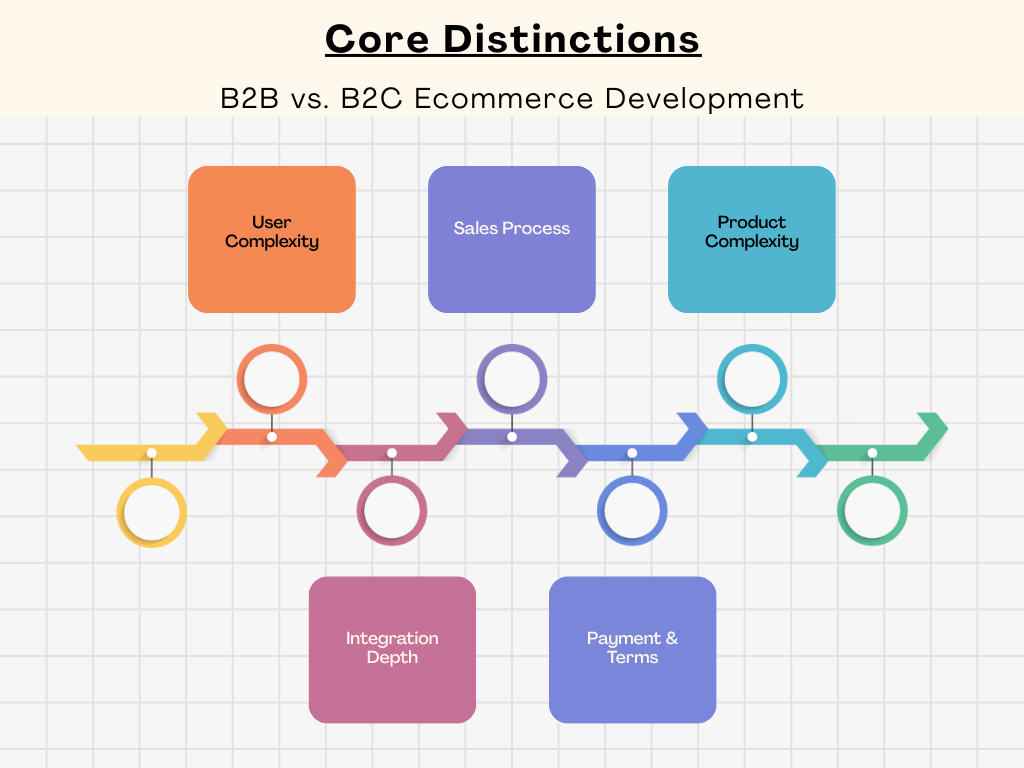
- User Complexity: B2B platforms must manage multiple user roles (buyer, approver, admin) with distinct permissions, often tied to complex customer-specific pricing and contracts.
- Sales Process: Transactions are rarely one-click. They involve quote generation, negotiation, bulk pricing tiers, request-for-quote (RFQ) workflows, and purchase order (PO) integration.
- Product Complexity: Catalogs must handle configurable products, kits, bundles, and large numbers of SKUs with detailed technical specifications.
- Integration Depth: Success depends on seamless connection with Enterprise Resource Planning (ERP), Customer Relationship Management (CRM), Product Information Management (PIM), and Supply Chain Management (SCM) systems. This is non-negotiable for real-time inventory, pricing, and customer data.
- Payment & Terms: Support for net-30/60/90 terms, credit limits, multiple payment methods, and invoicing is standard, unlike B2C’s upfront payment model.
A true B2B agency doesn’t just configure a theme; it engineers a business system.
The Essential Capabilities of a Top-Tier B2B Ecommerce Development Agency
When evaluating potential partners, scrutinize their competency across these seven pillars:
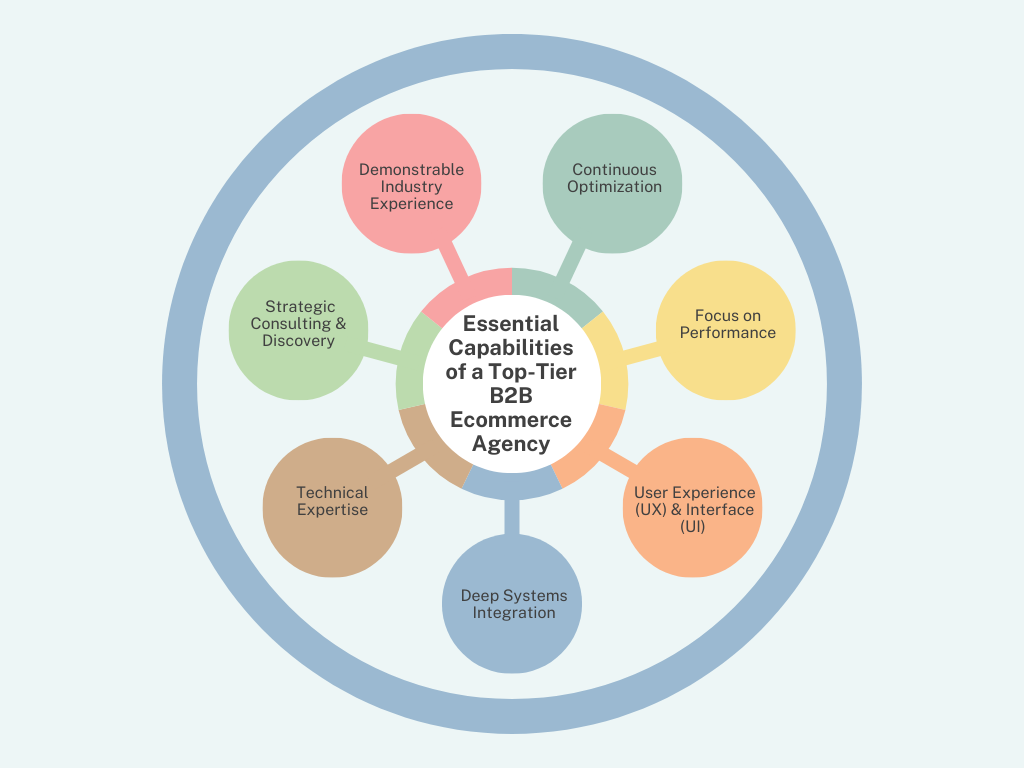
1. Strategic Consulting & Discovery
The best projects begin with deep discovery. The agency should act as a consultant, conducting workshops to map your customer journeys, sales processes, pain points, and growth objectives. They must understand your industry’s nuances—whether you’re in manufacturing, wholesale distribution, or SaaS.
2. Technical Expertise & Platform Specialization
Look for certified expertise in leading B2B ecommerce platforms:
- Adobe Commerce (Magento Commerce): Renowned for its robustness, flexibility, and deep B2B feature set out-of-the-box.
- BigCommerce B2B Edition: A strong SaaS option with powerful native B2B tools and excellent scalability.
- Shopify Plus: While B2C-leaning, its expanding B2B features and app ecosystem make it viable for certain models, especially when paired with apps like Handshake.
- Composable/Headless Solutions: Using a MACH architecture (Microservices, API-first, Cloud-native, Headless) with frameworks like Commerce Tools or Elastic Path. This is crucial for brands needing maximum flexibility and omnichannel ambitions.
- Custom Development: For highly unique processes, expertise in frameworks like React, Vue.js, Node.js, and Python/Django is key.
3. Deep Systems Integration Proficiency
This is the linchpin of B2B ecommerce. The agency must demonstrate a proven track record integrating with:
- ERP Systems: SAP, Microsoft Dynamics 365, Oracle NetSuite, Sage.
- CRM Systems: Salesforce, HubSpot, Microsoft Dynamics CRM.
- PIM Systems: Akeneo, inRiver, Salsify.
- OMS & WMS: Order and Warehouse Management Systems.
They should discuss integration patterns—real-time APIs vs. batch synchronization—and data governance.
4. User Experience (UX) & Interface (UI) Design for Complexity
The challenge is making complex workflows simple. The agency’s design team must specialize in B2B UX, creating intuitive interfaces for quick reordering, managing approved product lists, viewing tiered pricing, and submitting complex quotes. Mobile-responsive design is mandatory, as over 50% of B2B queries now happen on mobile devices.
5. Focus on Performance, Security & Scalability
B2B sites handle large data volumes and high-value transactions. The agency must prioritize:
- Site Speed: Optimizing for Core Web Vitals (LCP, FID, CLS) is critical for SEO and user retention.
- Security: Implementing SSL/TLS, PCI DSS compliance, regular security audits, and robust authentication.
- Scalability: Architecting the platform to handle seasonal traffic spikes and growing catalogues without performance degradation.
6. Post-Launch Support & Continuous Optimization
Launch is the beginning. A reliable partner offers structured retainer agreements for ongoing support, updates, security patches, and Conversion Rate Optimization (CRO). They should provide analytics dashboards and proactively suggest improvements.
7. Demonstrable Industry Experience & Case Studies
Ask for detailed case studies in your sector. An agency that understands the regulatory hurdles in pharmaceuticals, the catalog complexity in industrial parts, or the custom configuration needs in machinery brings invaluable context.
The Tangible Business Benefits of Partnering with a Specialized Agency
Investing in a expert agency delivers measurable ROI across your organization:
- Increased Sales Efficiency & Revenue: Automated online ordering reduces sales rep administrative overhead by up to 65%, allowing them to focus on high-value relationships. A 24/7 digital storefront can capture after-hours and international orders, directly boosting top-line revenue.
- Reduced Operational Costs: Streamlined order processing, fewer errors from manual entry, and lower customer service inquiry volumes significantly cut costs. According to a report by McKinsey, B2B companies can reduce the cost to serve by 30-50% with effective digital channels.
- Enhanced Customer Experience & Loyalty: Provide buyers with a self-service portal for order history, real-time inventory, shipment tracking, and easy reordering. This convenience and transparency foster stickiness and improve Net Promoter Scores (NPS).
- Improved Data-Driven Decision Making: A unified platform provides rich data on customer behavior, product performance, and sales trends. This intelligence informs marketing, inventory planning, and product development.
- Future-Proofing & Agility: A well-architected platform built by experts allows you to quickly adapt to market changes, add new sales channels (like marketplaces), or expand into new regions.
A Step-by-Step Guide to Selecting Your B2B Ecommerce Development Agency
Follow this structured process to make an informed, low-risk choice.
Step 1: Internal Assessment & Goal Setting
Before speaking to agencies, align internally.
- Define Business Objectives: Is the goal to reduce order error rates, expand into new markets, or enable sales teams?
- Map Key User Personas: Detail the needs of your buyers, approvers, and internal admins.
- Inventory Systems & Data: Document all systems (ERP, CRM, PIM) that must integrate with the new platform.
- Establish Budget & Timeline: Have realistic ranges for investment and go-live expectations.
Step 2: Agency Research & Longlisting
- Search with Specific Keywords: Use terms like “B2B Magento agency,” “ERP integration specialists,” or “manufacturing ecommerce developers.”
- Review Clutch, G2, and Case Studies: Look for detailed project descriptions, not just logos.
- Seek Peer Recommendations: Ask your network in similar industries for referrals.
- Create a Longlist of 8-10 Agencies that appear to match your technical and sector needs.
Step 3: The RFI/RFP Process
Send a detailed Request for Proposal (RFP). A strong agency will ask clarifying questions rather than provide a generic response. Your RFP should include:
- Company and project overview
- Detailed functional requirements
- Integration requirements list
- Goals for performance, security, and SEO
- Questions about their team, process, and post-launch support
Step 4: Deep-Dive Evaluation & Shortlisting
Narrow down to 3-4 agencies for comprehensive interviews.
- Request Detailed Discovery Workshops: A paid discovery phase is a good sign of depth.
- Evaluate Technical Proficiency: Have your IT lead discuss architecture, security, and DevOps (CI/CD) practices.
- Assess Cultural & Communication Fit: You will work closely for 6-12 months. Ensure communication styles align.
- Demand Client References: Speak directly to past clients, asking about challenges, budget adherence, and post-launch support.
Step 5: Final Proposal & Contract Scrutiny
- Compare Proposals: Look beyond price. Compare project methodologies (Agile vs. Waterfall), team structures, and outlined deliverables.
- Clarify Intellectual Property (IP): Ensure you own the final code, design, and content.
- Define Success Metrics & SLAs: The contract should include Service Level Agreements for support response times and uptime guarantees.
Common Pitfalls to Avoid When Choosing an Agency
- Prioritizing Cost Over Value: The cheapest option often lacks B2B specialization, leading to costly rework and a platform that fails to meet core business needs.
- Choosing a B2C-Focused Agency: They will underestimate the complexity of your workflows and integration needs.
- Vague Requirements & Scope: An unclear brief leads to misaligned expectations, scope creep, and budget overruns. Invest time in the discovery phase.
- Overlooking Post-Launch Support: Assuming the project ends at launch is a critical error. Plan and budget for ongoing maintenance from day one.
- Ignoring Internal Change Management: The agency can build a great platform, but your team and customers must adopt it. Ensure the agency provides training and change management support.
The Future of B2B Ecommerce: What Your Agency Should Help You Prepare For
Your chosen agency should be a guide to the future. Discuss their vision and capabilities regarding these trends:
- AI & Personalization at Scale: Using AI to predict buyer needs, personalize catalogs and pricing, and automate customer service via chatbots.
- Marketplace Integration: Enabling you to sell not only through your own site but also on major B2B marketplaces like Amazon Business or industry-specific vertical platforms.
- Augmented Reality (AR) & 3D Visualization: For complex products, allowing buyers to visualize configurations in their own environment—a game-changer for industries like furniture or industrial equipment.
- Subscription & Replenishment Models: Automating recurring purchases for consumable goods, creating predictable revenue streams.
- Sustainability & Supply Chain Transparency: Providing digital product passports and carbon footprint data, which are becoming key purchasing criteria.
Frequently Asked Questions (FAQ)
Q1: How much does it cost to hire a B2B ecommerce development agency?
A: Costs vary widely based on project complexity, platform choice, and agency location. A foundational project can start at $80,000 – $150,000, while large-scale, highly customized implementations with deep ERP integration can range from $250,000 to $1M+. Most agencies work on a fixed-project or time-and-materials basis.
Q2: How long does a typical B2B ecommerce platform development take?
A: A standard project typically takes 6 to 12 months from discovery to launch. Complex, enterprise-level projects with multiple system integrations can extend to 18 months or more. A phased, Agile approach allows for earlier delivery of high-value features.
Q3: Should we choose a headless/composable commerce approach for our B2B business?
A: Headless commerce (decoupling the front-end presentation layer from the back-end commerce engine) offers superior flexibility and omnichannel potential. It’s ideal if you need a highly unique user interface, plan to sell across many digital touchpoints (IoT, kiosks), or require frequent front-end experimentation. However, it is more complex and costly to implement and maintain than a traditional monolithic platform. A specialized agency can help you assess the ROI for your specific use case.
Q4: What is the most important factor in a successful B2B ecommerce project?
A: While technical execution is critical, clean, unified product and customer data is the most common make-or-break factor. A successful project starts with a robust PIM and a clear data integration strategy with your ERP. Garbage in, garbage out.
Q5: How do we ensure our new platform is SEO-friendly?
A: Your agency must bake SEO into the development process. This includes technical SEO (clean URL structures, site speed, mobile optimization), content strategy for product and category pages, and ensuring that all dynamic content (like inventory status) is crawlable and indexable.
Q6: Can we migrate our existing customer data and order history to the new platform?
A: Yes, a competent agency will have a structured data migration plan. This involves extracting, cleaning, transforming, and mapping data from your old system(s) to the new platform’s schema, preserving critical historical data for customer accounts.
Q7: What ongoing costs should we budget for after launch?
A: Post-launch, budget for:
- Platform hosting & licensing fees (if SaaS or licensed).
- Agency retainer for support, updates, and security patches (typically 15-25% of initial build cost annually).
- Payment gateway transaction fees.
- Budget for ongoing marketing, CRO, and feature enhancements.
Q8: What questions should we ask agency references?
A: Ask: “Was the project delivered on time and on budget?” “How did the agency handle unexpected challenges?” “How responsive is their support team post-launch?” and “Would you hire them again for another project?”
Conclusion: Building a Partnership for Digital Growth
Selecting a B2B ecommerce development agency is one of the most significant strategic decisions a B2B company can make. It is not a mere vendor selection but a choice of a long-term partner in your digital transformation journey. The right agency brings more than technical skill—it brings industry insight, strategic clarity, and a commitment to building a platform that becomes a core driver of efficiency, customer satisfaction, and revenue growth.
By following the rigorous evaluation framework outlined in this guide—focusing on strategic discovery, technical integration prowess, B2B-specific UX, and post-launch partnership—you position your business to invest not in a cost, but in a capability. In the digital-first B2B landscape, that capability is the foundation of sustainable competitive advantage. Begin your search not with an RFP, but with a clear vision of the business outcomes you need to achieve, and partner with an agency that demonstrates it can architect the path to get you there.
For sellers looking to deepen their understanding of product research, optimization, and scaling strategies, explore our detailed ecommerce learning resources and guides :https://rankifycontent..com/
Excellent and well-structured guide. It clearly highlights the key features shaping B2B ecommerce platforms in 2026 and explains why speed, personalization, and convenience—once associated mainly with B2C—are now critical for B2B success. A valuable read for businesses looking to stay competitive in a rapidly evolving digital landscape.