Table of Contents
What’s the Difference Between B2B and Retail Ecommerce? A Comprehensive Breakdown
In the digital marketplace, two dominant forces shape the global economy: Business-to-Business (B2B) and retail (B2C) ecommerce. While both involve online transactions, their operations, customer relationships, and strategic imperatives are worlds apart. For entrepreneurs, marketers, and business leaders, understanding the fundamental difference between B2B and retail ecommerce is not just academic—it’s critical for crafting effective sales strategies, building appropriate platforms, and achieving sustainable growth.
This long-form guide will serve as your definitive resource. We’ll move beyond surface-level definitions to explore the intricate mechanics, psychological drivers, and technological requirements that separate these two models. By the end, you’ll possess a clear framework to evaluate, strategize, and execute within either—or both—of these vital digital commerce spheres.
Defining the Core Models: B2B and B2C Ecommerce Explained
Before dissecting their differences, let’s establish clear, authoritative definitions for each model.
What is Retail Ecommerce (B2C)?
Retail ecommerce, commonly referred to as Business-to-Consumer (B2C), involves the direct sale of products or services from a business to individual end-users. The transaction is typically straightforward: a consumer visits an online store, selects an item, and completes a purchase for personal use. The journey is often short, emotionally driven, and transactional.
- Key Characteristics: Shorter sales cycles, lower average order values (AOV), mass marketing, and a focus on the individual’s experience and instant gratification.
- Examples: Amazon, Nike.com, Netflix, and your local boutique’s online store.
What is B2B Ecommerce?
B2B ecommerce involves the sale of products or services between businesses. These transactions are part of a supply chain, where the purchasing business may use the goods for production (raw materials), resell them (wholesale), or operate with them (office supplies, software). The process is complex, logic-driven, and built on long-term relationships.
- Key Characteristics: Longer sales cycles, higher AOV, complex pricing and contracts, multi-stakeholder approval processes, and a focus on ROI and efficiency.
- Examples: A manufacturer buying industrial components from Alibaba, a restaurant sourcing ingredients from Sysco, or a marketing agency purchasing a Salesforce subscription.
The Fundamental Differences: A Detailed Side-by-Side Analysis
The difference between B2B and retail ecommerce manifests across every facet of the business. The following breakdown provides a granular comparison.
1. The Target Audience & Buyer Psychology
- B2C (Retail):
- Who: Individual consumers.
- Psychology: Decisions are often emotional, impulsive, or desire-based. Marketing taps into aspirations, fears, trends, and lifestyle benefits. The buyer’s journey can be non-linear and influenced by social proof, influencer marketing, and brand sentiment.
- Motivation: Personal satisfaction, convenience, status, or solving an immediate personal need.
- B2B:
- Who: Businesses, represented by committees or professional buyers (procurement officers, department heads, IT managers).
- Psychology: Decisions are analytical, risk-averse, and based on business value. The process is rational, focusing on return on investment (ROI), total cost of ownership (TCO), efficiency gains, and reliability.
- Motivation: Increasing revenue, decreasing costs, improving operational efficiency, or mitigating business risk. According to a report by Gartner, B2B buying groups involve 6 to 10 decision-makers on average, highlighting the complexity of the process.
2. The Sales Cycle & Decision-Making Process
- B2C: The cycle is short—often minutes or hours. A consumer sees an ad, clicks, and buys. The path to purchase is simple: Awareness -> Consideration -> Decision. Frictionless checkout is paramount.
- B2B: The cycle is long and complex, stretching from weeks to years. It involves multiple stages: Need Recognition -> Specification -> Supplier Search -> Proposal Request -> Evaluation -> Order -> Post-Purchase Review. Each stage requires specific content and touchpoints, from whitepapers and webinars for early education to detailed quotes and contracts for final negotiation.
3. Order Value, Volume, and Pricing Structure
- B2C: Features lower Average Order Values (AOV) but higher transaction volume. Pricing is fixed, transparent, and often includes promotions (e.g., “20% off”). Think $50 for a pair of shoes.
- B2B: Features significantly higher AOV but lower transaction frequency. Pricing is rarely simple. It is often:
- Negotiated: Custom quotes based on volume and relationship.
- Tiered: Dependent on customer segment or order quantity.
- Contract-Based: Governed by annual agreements with specific terms.
- Credit-Based: Involves net-30, net-60 terms rather than immediate payment.
4. Relationship Dynamics & Customer Lifetime Value (CLV)
- B2C: Relationships can be transient. While brand loyalty exists, it’s easier for consumers to switch. CLV is important but often calculated across large segments. Communication is broad (email newsletters, social media).
- B2B: Relationships are everything. The goal is to become a strategic partner, not just a vendor. Customer Lifetime Value (CLV) is astronomically higher, justifying significant investment in account management and customer success. Communication is personalized and often involves dedicated account managers.
5. Marketing & Communication Strategies
- B2C Marketing: Broad, emotional, and brand-focused. Leverages channels like social media (Instagram, TikTok), influencer partnerships, PPC advertising, and content designed to entertain or inspire. The message is about “you” (the consumer).
- B2B Marketing: Narrow, educational, and value-focused. Employs Account-Based Marketing (ABM), LinkedIn outreach, search engine optimization (SEO) for high-intent keywords, and in-depth content like case studies, whitepapers, and data sheets. The message is about “your business” and its challenges.
6. Website & User Experience (UX) Requirements
- B2C Website: Prioritizes visual appeal, simplicity, and fast conversion. Features include stunning imagery, easy navigation, user reviews, one-click checkout, and cart abandonment reminders.
- B2B Commerce Platform: Functions as a complex procurement tool. Must support:
- Customer-Specific Logins & Pricing: Different buyers see different catalogs and prices.
- Complex Product Catalogues: With detailed specs, compliance documents, and bulk pricing.
- Quoting & Approval Workflows: Ability to request quotes and route orders for internal approval.
- Reorder Lists & Saved Carts: For repeat purchases.
- Integration with ERP/CRM: Such as SAP, Oracle, or Microsoft Dynamics, is non-negotiable for many B2B operations.
7. Logistics, Fulfillment, and Customer Support
- B2C: Standard shipping, returns to a central warehouse, and general customer support (email, chat) focused on the individual transaction.
- B2B: Logistics are complex. This may involve bulk shipping, drop-shipping to multiple locations, just-in-time (JIT) inventory, and custom packaging. Support is specialized, often requiring technical expertise and 24/7 availability for critical supply chain issues.
The Convergence of B2B and B2C: The Rise of B2B2C and the “Amazon Effect”
A critical modern trend is the blurring of lines between these models. The “Amazon Effect” has raised user experience expectations across the board. B2B buyers, who are also B2C consumers in their personal lives, now demand the same ease of use, transparency, and speed from their professional procurement tools.
This has given rise to B2B2C (Business-to-Business-to-Consumer) models, where a company sells to a business that then sells to the end consumer, often leveraging a unified platform. Furthermore, many traditional B2B companies are launching direct-to-consumer (D2C) arms to capture market share and gather data.
The key takeaway? While the fundamental difference between B2B and retail ecommerce remains, B2B platforms must increasingly adopt the UX best practices of B2C to meet evolving buyer demands.
Choosing Your Path: Is B2B or B2C Ecommerce Right for Your Business?
This decision is foundational. Consider these factors:
Choose B2C (Retail) Ecommerce if:
- Your product is for individual, personal use.
- Your sales message is emotional or lifestyle-oriented.
- You can build a strong consumer brand.
- You are prepared for fast-paced, high-volume marketing and competition.
Choose B2B Ecommerce if:
- Your product is a component, raw material, or service used in business operations.
- Your value proposition is based on ROI, efficiency, or technical superiority.
- You have the capacity for long sales cycles and complex client management.
- Your industry relies on relationships and contracts.
Many large companies, like Apple (selling iPhones to consumers and Macs to enterprises) or Adobe (Creative Cloud for individuals vs. enterprise licenses), successfully operate in both spheres with distinct strategies.
Common Strategic Mistakes and How to Avoid Them
For B2C Companies Trying to Sell B2B:
- Mistake: Using the same emotional, simple website and marketing for B2B buyers.
- Solution: Develop a separate storefront or portal with logged-in experiences, volume pricing, and professional content. Don’t ask a procurement officer to “Add to Cart” without a quote option.
For B2B Companies Ignoring B2C Expectations:
- Mistake: Maintaining a clunky, outdated portal because “that’s how it’s always been done.”
- Solution: Invest in a modern headless commerce platform that provides B2C-like UX on the front end with robust B2B functionality on the back end.
Universal Mistakes:
- Neglecting Mobile Experience: Over 50% of B2B queries are now made on mobile devices.
- Hiding Pricing (B2C) or Not Providing Quick Quotes (B2B): Create friction and erode trust.
- Underinvesting in Content: Both models require high-quality content, but of different types (inspirational vs. educational).
Expert Tips and Best Practices for Success in Each Arena
Winning at Retail (B2C) Ecommerce:
- Master Omnichannel: Integrate your online store with social commerce (Instagram Shops, TikTok Shop) and physical presence.
- Leverage User-Generated Content (UGC): Reviews, photos, and videos are the modern word-of-mouth.
- Optimize for Speed: Every second of load time impacts conversion. Use tools like Google PageSpeed Insights.
- Implement a Robust Post-Purchase Strategy: Engaging order confirmations, shipping updates, and win-back emails are crucial.
Winning at B2B Ecommerce:
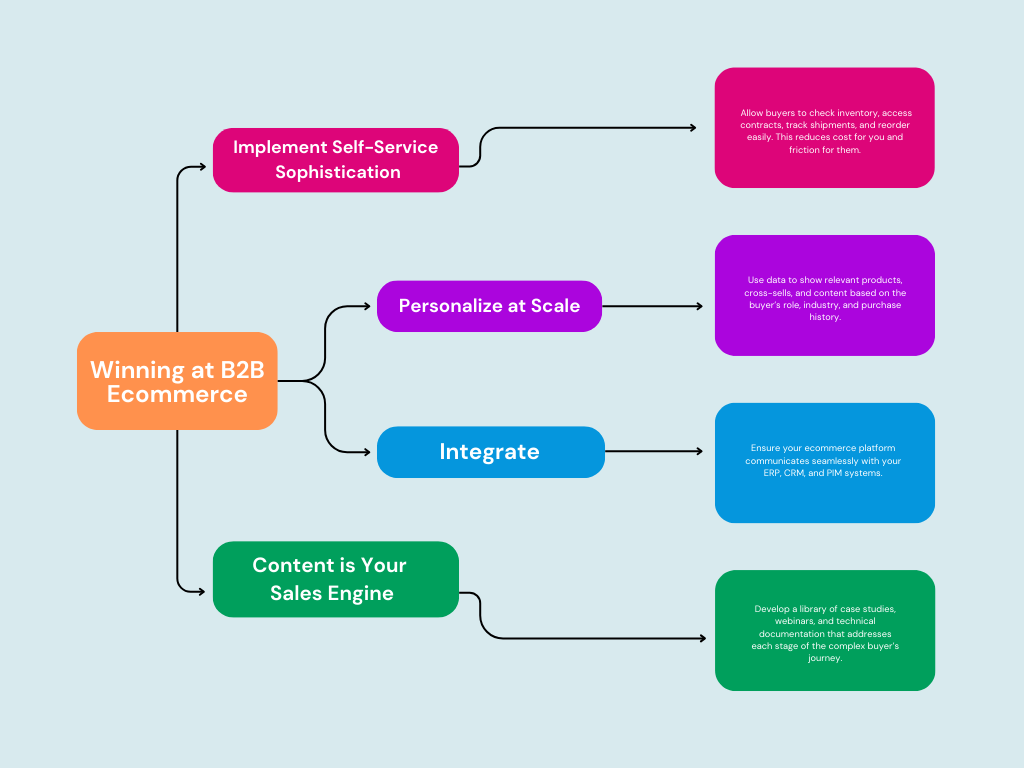
- Implement Self-Service Sophistication: Allow buyers to check inventory, access contracts, track shipments, and reorder easily. This reduces cost for you and friction for them.
- Personalize at Scale: Use data to show relevant products, cross-sells, and content based on the buyer’s role, industry, and purchase history.
- Integrate, Integrate, Integrate: Ensure your ecommerce platform communicates seamlessly with your ERP, CRM, and PIM systems.
- Content is Your Sales Engine: Develop a library of case studies, webinars, and technical documentation that addresses each stage of the complex buyer’s journey.
Frequently Asked Questions (FAQs)
1. Can a single business operate both B2B and B2C ecommerce successfully?
Absolutely. It requires a clear strategy, often involving separate brand identities, websites, and operational workflows to avoid channel conflict and cater to the distinct needs of each audience.
2. Which model has higher growth potential?
Both are massive. Statista projects global B2C ecommerce sales to reach $8.1 trillion by 2026. However, Forrester estimates the US B2B ecommerce market alone will hit $3 trillion by 2027, indicating that B2B often represents a larger total transaction volume.
3. Is B2B ecommerce more profitable than B2C?
It can be, due to higher order values and longer-term contracts. However, profitability depends on your margins, operational efficiency, and customer acquisition cost (CAC), which can be high in B2B due to long sales cycles.
4. What is the biggest challenge in B2B ecommerce?
Overcoming legacy processes and internal resistance to digitizing sales. Convincing a sales team that an online portal will complement, not replace, their relationship-building is a common hurdle.
5. Do B2B buyers really want a B2C-like experience?
Yes, but with critical B2B functionality. They want the searchability, ease, and transparency of Amazon, combined with their specific pricing, approval workflows, and integration needs. This is often called the “Amazonification of B2B.”
6. What is an EDI (Electronic Data Interchange), and is it still relevant for B2B?
EDI is the computer-to-computer exchange of business documents (purchase orders, invoices) in a standard format. It remains highly relevant for large enterprises with automated procurement systems, though modern APIs are increasingly used alongside or instead of traditional EDI.
7. How important is SEO for B2B vs. B2C?
Vital for both, but with different keyword strategies. B2C targets broad, high-volume commercial intent keywords (“best running shoes”). B2B targets long-tail, solution-oriented keywords (“industrial water filtration system for pharmaceutical manufacturing”).
8. Can I use Shopify or WooCommerce for B2B?
Yes, but with significant extensions and customization. Platforms like Shopify Plus or WooCommerce with B2B plugins can handle basic B2B functions. For complex, large-scale operations, dedicated B2B platforms like BigCommerce B2B Edition, Adobe Commerce (Magento), or SAP Commerce Cloud are often more suitable.
9. What is the role of a sales team in B2B ecommerce?
It evolves from order-taking to consultative selling and account management. The ecommerce platform handles routine reorders, freeing the sales team to focus on strategic accounts, complex solutions, and relationship deepening.
10. How do I start transitioning my wholesale business to B2B ecommerce?
Start with a pilot: digitize your catalog for key customers, enable online ordering for a subset of products, and gather feedback. Focus on replicating and improving the core functionalities your best customers need, then scale.
Conclusion: Key Takeaways and The Future of Digital Commerce
Understanding the difference between B2B and retail ecommerce is the first step toward dominating either space. To recap:
- B2C is Transactional: Focused on the individual, driven by emotion, and optimized for speed and volume.
- B2B is Relational: Focused on the business, driven by logic and ROI, and built on complexity and long-term partnership.
- Technology Diverges: B2C platforms prioritize UX and conversion; B2B platforms must be powerful procurement tools that integrate with core business systems.
- The Lines are Blurring: The future belongs to businesses that can deliver B2C-grade experiences within B2B contexts and strategically leverage both models where appropriate.
The future outlook points toward increased personalization, AI-driven buying recommendations, the integration of augmented reality for product visualization (especially in B2B for large equipment), and the continued dominance of omnichannel strategies. Regardless of your path, success will hinge on a deep, empathetic understanding of your buyer’s journey and the technological agility to serve them flawlessly.
By internalizing the distinctions and strategies outlined in this guide, you are now equipped to make informed decisions, build a competitive digital commerce presence, and capitalize on the immense opportunities in both the B2B and B2C ecommerce universes.
You may also benefit from our in-depth guide on scaling ecommerce businesses worldwide
https://rankifycontent.com/international-ecommerce-scaling