Table of Contents
Introduction: What’s the Challenges of B2B Ecommerce?
The B2B ecommerce sector is not just growing; it’s exploding. According to a report by Forrester, U.S. B2B ecommerce is projected to reach $3 trillion by 2027, significantly surpassing B2C sales. This digital transformation, accelerated by global shifts in buyer behavior, presents an unparalleled opportunity for manufacturers, distributors, and wholesalers. However, the journey from a traditional sales model to a thriving digital marketplace is fraught with complexities that far exceed those of B2C. The challenges of B2B ecommerce are multifaceted, stemming from intricate product catalogs, convoluted pricing, legacy systems, and deeply ingrained human relationships.
Unlike the relatively straightforward B2C transaction, B2B purchasing involves multiple stakeholders, lengthy sales cycles, complex approval workflows, and a critical need for integration with enterprise resource planning (ERP) and customer relationship management (CRM) systems. This blog post serves as a comprehensive guide for business leaders, digital strategists, and operations managers. We will dissect the core challenges of B2B ecommerce, provide data-backed insights, and deliver actionable strategies to build a scalable, efficient, and customer-centric digital sales channel that drives sustainable growth. For a foundational understanding of ecommerce models, you can explore the history and evolution of electronic commerce on Wikipedia.
B2B Ecommerce Challenges Explained
Transitioning to or optimizing a B2B ecommerce platform is not merely about listing products online. It requires a fundamental rethinking of sales, service, and operations. Let’s break down the most pervasive challenges.
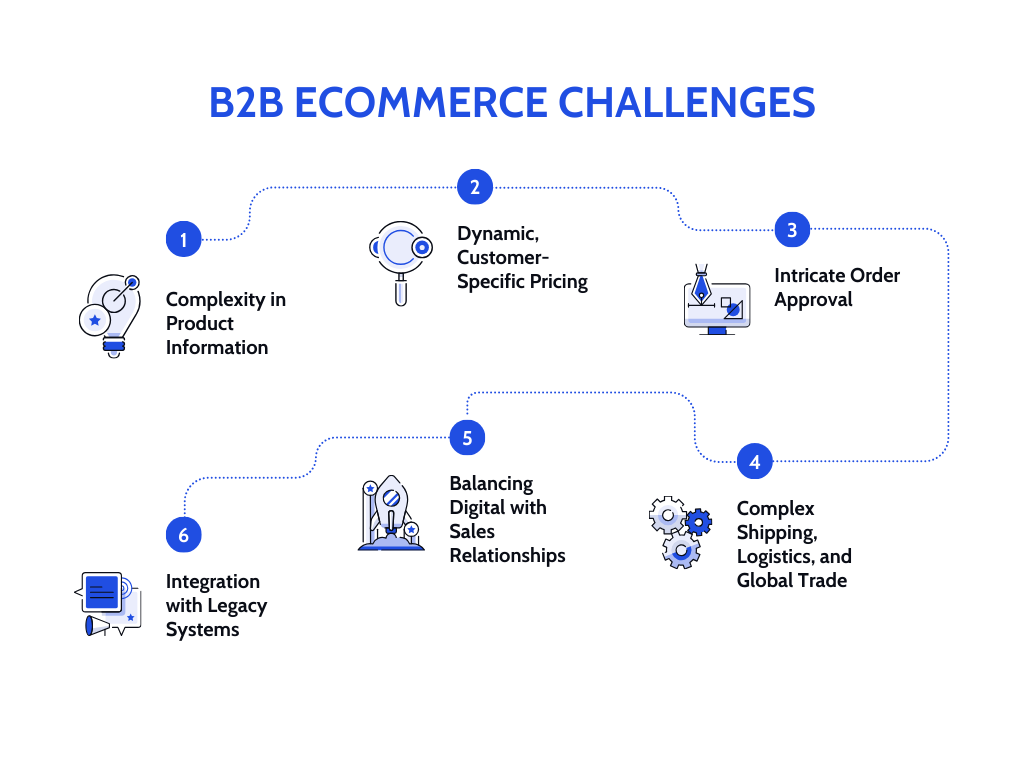
1. Complexity in Product Information & Catalog Management
B2B companies often manage thousands, if not millions, of SKUs with intricate variations (materials, sizes, configurations, compatibilities). Each product requires detailed, accurate, and technical specifications, safety datasheets (SDS), CAD drawings, and compliance documentation.
- The Challenge: Manually managing this data is error-prone and unsustainable. Inconsistent or incomplete product information leads to misplaced orders, increased returns, and eroded customer trust.
- The Impact: Sales teams waste time correcting errors, and customers may turn to competitors with more reliable digital catalogs.
2. Dynamic, Customer-Specific Pricing and Discounting
B2B pricing is rarely static. It varies by:
- Customer type (contractor vs. end-user)
- Negotiated volume discounts
- Historical purchase value
- Current contract terms
- Geographic location
The Challenge: Implementing this logic in an ecommerce platform requires deep integration with CRM and ERP systems to ensure real-time, accurate pricing for each logged-in buyer. Displaying generic or incorrect prices is a quick way to lose a customer or erode margins.
3. Intricate Order Approval and Workflow Processes
A B2C customer clicks “Buy Now.” A B2B purchase often involves a requester, a technical evaluator, a procurement manager, and a financial approver—all before an order is finalized.
- The Challenge: Your ecommerce platform must mirror this complex internal workflow. It needs features like multi-tiered approval routing, budget checking, purchase order (PO) number acceptance, and the ability to save a cart for later review by a team.
- The Consequence: Without these workflows, businesses bypass the platform, reverting to phone and email, defeating the purpose of digitization.
4. Integration with Legacy Systems (ERP, CRM, PIM)
The heart of B2B operations lies in backend systems: ERP (SAP, Oracle NetSuite, Microsoft Dynamics) for inventory, orders, and accounting; CRM (Salesforce, HubSpot) for customer data; and PIM (Product Information Management) for catalog data.
- The Challenge: A “Frankenstein” stack of disconnected systems creates data silos. Real-time synchronization of inventory levels, order status, and customer data is critical. Poor integration leads to stockouts, overselling, and frustrated customers.
- The Solution: APIs (Application Programming Interfaces) are the lifeline. Investing in a platform with robust, pre-built connectors or a flexible API-first architecture is non-negotiable.
5. The Human Element: Balancing Digital with Sales Relationships
B2B sales have long been built on personal relationships. Sales reps fear that ecommerce will cannibalize their commissions or disintermediate their role.
- The Challenge: Overcoming internal resistance and redesigning incentive structures. The goal is not to replace sales reps but to empower them. Ecommerce should handle routine, low-touch transactions, freeing reps to focus on complex solutions, key accounts, and strategic growth.
- The Strategy: Implement a hybrid model. Use the platform for lead generation, configure-price-quote (CPQ) tools for reps, and clear attribution models to credit online sales influenced by specific account managers.
6. Complex Shipping, Logistics, and Global Trade
B2B orders are larger, heavier, and often require specialized freight (LTL – Less Than Truckload), palletized shipping, and multi-drop deliveries. For global businesses, this expands to include:
- Incoterms management
- Customs documentation and duties calculation
- Multi-currency and multi-language support
The Challenge: Providing accurate, real-time shipping quotes and delivery timelines for these complex scenarios is a massive technical and logistical hurdle. Unexpected costs are a primary cause of cart abandonment in B2B ecommerce.
Actionable Strategies: Overcoming B2B Ecommerce Obstacles Step-by-Step
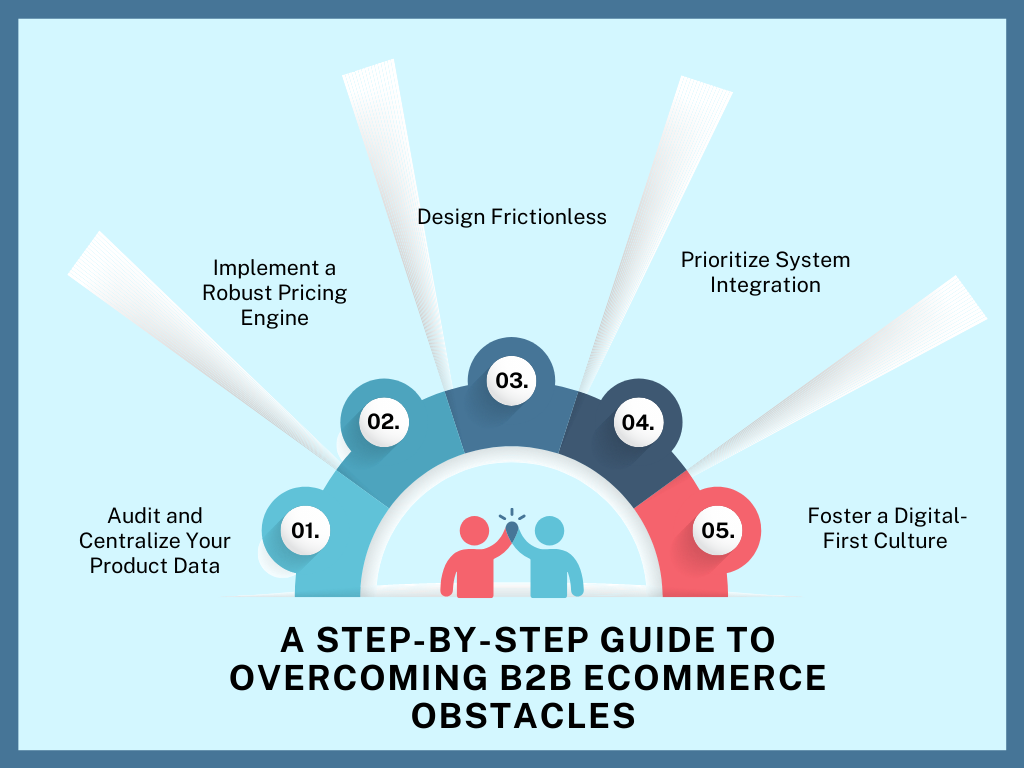
Understanding the challenges is half the battle. Here is a strategic roadmap to navigate and overcome them.
Step 1: Audit and Centralize Your Product Data
- Conduct a Data Cleanse: Identify all product information sources and consolidate them.
- Invest in a PIM System: A Product Information Management (PIM) system acts as a single source of truth for all product data, enabling you to syndicate consistent, enriched information to your ecommerce site, marketplaces, and print catalogs.
- Enrich with Digital Assets: Go beyond text. Incorporate high-resolution images, 360° views, videos, and downloadable technical specs.
Step 2: Implement a Robust Pricing Engine
- Define Pricing Rules: Document all customer segments, volume tiers, and contract-based pricing logic.
- Choose the Right Technology: Select an ecommerce platform with a strong B2B pricing engine or integrate a dedicated Configure-Price-Quote (CPQ) solution.
- Ensure Real-Time Sync: Integrate this engine directly with your CRM and ERP so pricing is always accurate and instantly updated when contract terms change.
Step 3: Design Frictionless, Yet Controlled, Buying Journeys
- Map Customer Workflows: Interview your buyers to understand their internal approval processes.
- Leverage B2B Ecommerce Features: Implement:
- Quick Order & Reorder Lists: For fast replenishment.
- Quote Request & Management: Convert online inquiries into sales-managed quotes.
- Approval Workflow Builders: Allow companies to set their own rules within your platform.
- Secure PO Payment: Seamlessly accept and validate purchase orders.
Step 4: Prioritize System Integration with an API-First Approach
- Inventory & Order Sync: Ensure your site displays live inventory levels and pushes confirmed orders directly to your ERP for fulfillment.
- Customer Data Harmony: Sync account hierarchies, contact roles, and shipping addresses between CRM and ecommerce.
- Consider a Composable Architecture: For ultimate flexibility, consider a headless commerce approach, where the front-end presentation layer is decoupled from the backend commerce logic, allowing for best-of-breed integrations.
Step 5: Foster a Digital-First Culture with Aligned Incentives
- Rep-Facing Tools: Provide your sales team with a branded portal where they can configure products, generate quotes, and track their accounts’ online activity.
- Revise Compensation: Develop a blended compensation model that credits reps for online sales within their territory or from accounts they manage.
- Continuous Training: Position ecommerce as a tool that makes reps more effective, not obsolete.
The Pros and Cons of Investing in B2B Ecommerce
Pros:
- 24/7 Sales Channel: Generates revenue outside business hours and across time zones.
- Increased Operational Efficiency: Automates routine order processing, reducing errors and administrative costs.
- Enhanced Customer Experience (CX): Provides self-service access to information, order history, and tracking, meeting modern buyer expectations.
- Data-Driven Insights: Gain unparalleled visibility into buying patterns, popular products, and customer behavior to inform strategy.
- Scalability: Efficiently handles growth in order volume and customer count without a linear increase in support staff.
Cons:
- High Initial Investment: Costs include platform licensing, integration, data migration, and change management.
- Implementation Complexity: The depth of integration and customization required can lead to lengthy, challenging deployments.
- Internal Resistance: Can face pushback from sales teams and stakeholders accustomed to traditional methods.
- Ongoing Maintenance: Requires dedicated IT and marketing resources for updates, content management, and support.
- Security Concerns: Handling large transactions and sensitive customer data increases the risk and impact of cyber threats.
Common B2B Ecommerce Mistakes and How to Avoid Them
- Mistake: Treating it like a B2C store.
- Avoidance: Never launch without core B2B functionalities like customer-specific pricing, bulk ordering, and quote requests.
- Mistake: Underestimating the importance of data quality.
- Avoidance: Start with a PIM initiative. Clean, structured, and enriched product data is the foundation of trust.
- Mistake: “Big Bang” launch instead of a phased approach.
- Avoidance: Start with a pilot customer segment or a subset of best-selling products. Test, learn, and iterate before a full-scale rollout.
- Mistake: Neglecting mobile experience.
- Avoidance: Over 60% of B2B buyers use mobile during the research phase. Ensure your site is fully responsive and offers a streamlined mobile purchasing experience.
- Mistake: Ignoring post-purchase experience.
- Avoidance: Provide proactive shipment tracking, easy returns/RMA processes, and seamless access to invoices. The post-order experience drives lifetime loyalty.
Expert Tips and Future-Proof Best Practices
- Personalize at Scale: Use AI and customer data to show relevant product recommendations, content, and promotions based on role, industry, and purchase history.
- Embrace Marketplaces: List your products on relevant B2B marketplaces (e.g., Amazon Business, Alibaba) to expand reach while driving traffic back to your dedicated site.
- Invest in Content Marketing: Create high-value, educational content (blogs, whitepapers, webinars) that addresses your buyers’ pain points and establishes your authority. This is crucial for SEO and lead generation.
- Prioritize Security & Compliance: Implement SSL certificates, PCI-DSS compliance for payments, and robust data protection measures (like GDPR adherence) to build unshakeable trust.
- Adopt an Agile Mindset: The digital landscape evolves rapidly. Regularly gather user feedback, analyze site analytics, and be prepared to adapt your platform and strategies.
Frequently Asked Questions (FAQ) on B2B Ecommerce Challenges
Q1: What is the single biggest challenge in B2B ecommerce?
A: There’s no single answer, but the most common breaking point is system integration. An ecommerce platform that doesn’t seamlessly sync with the company’s ERP, CRM, and inventory systems will create more problems than it solves, leading to data chaos and operational inefficiency.
Q2: How do you handle complex B2B pricing online?
A: Through a combination of a robust B2B ecommerce platform and deep backend integration. Customers log into a personalized portal where prices are dynamically displayed based on pre-negotiated contracts, customer tier, order volume, and real-time promotions, all pulled directly from the ERP/CRM.
Q3: Can B2B ecommerce replace sales reps entirely?
A: No, and it shouldn’t try. The most successful models are hybrid. Ecommerce automates transactional purchases and nurtures leads, while sales reps focus on high-value consulting, complex solution selling, and strategic account management. The digital channel acts as a powerful tool for the sales team.
Q4: What are the key features to look for in a B2B ecommerce platform?
A: Essential features include: customer-specific pricing and catalogs, quote management, multi-level approval workflows, quick order forms, purchase order payment, robust ERP/CRM integrations, and strong account management tools.
Q5: How important is mobile optimization for B2B ecommerce?
A: Extremely important. Modern B2B buyers, from warehouse managers to procurement officers, use mobile devices to check inventory, place urgent orders, and look up specifications on the go. A poor mobile experience directly impacts sales and customer satisfaction.
Q6: How do you measure the success of a B2B ecommerce site?
A: Beyond standard metrics like traffic and conversion rate, focus on B2B-specific KPIs: Average Order Value (AOV), customer lifetime value (LTV), percentage of revenue from online channels, reduction in cost per order, and customer self-service adoption rate.
Q7: What role does content marketing play in B2B ecommerce?
A: A critical role. In-depth product guides, case studies, technical blogs, and comparison sheets help buyers in the research and consideration stages. This content builds trust, improves SEO rankings for long-tail keywords, and positions your brand as an expert, ultimately driving qualified traffic to your product pages.
Q8: Is headless commerce a good fit for B2B?
A: Yes, particularly for large, complex businesses. Headless commerce offers unparalleled flexibility to create unique, fast customer experiences across various digital touchpoints (web, IoT, kiosks) while seamlessly integrating with a suite of specialized backend systems, making it ideal for complex B2B environments.
Q9: How do you manage global B2B ecommerce challenges?
A: By implementing a global commerce platform that supports multiple languages, currencies, and localized payment methods. It must also integrate with global tax calculation software (like Avalara) and provide accurate landed cost estimates, including duties and shipping, before checkout.
Q10: What’s the future of B2B ecommerce?
A: The future is AI-driven, hyper-personalized, and ecosystem-connected. Expect widespread use of AI for predictive buying, dynamic pricing, and chat-based procurement. Integration will extend beyond ERP to include supply chain platforms, IoT devices, and augmented reality for product visualization, creating a fully connected digital supply chain.
Conclusion: Turning Challenges into Competitive Advantages
The challenges of B2B ecommerce are significant, but they are not insurmountable. They represent the growing pains of an industry transitioning from analog relationships to digital-first partnerships. By recognizing these hurdles—from data complexity and system integration to cultural shifts—businesses can approach digital transformation with clarity and purpose. As highlighted in industry analyses, the shift towards digital is not a trend but a fundamental restructuring of B2B sales models, a perspective supported by research from https://www.mckinsey.com/capabilities/growth-marketing-and-sales/our-insights/the-future-of-b2b-sales-is-digital McKinsey & Company on the future of B2B sales.
The key is to view these challenges not as barriers but as opportunities to build a superior, more efficient, and more resilient business model. Success hinges on a strategic foundation built on accurate data, seamless technology, and a customer-centric culture. For businesses embarking on this journey, understanding the legal and regulatory frameworks surrounding digital commerce, such as those outlined by the https://www.ftc.gov/business-guidance/advertising-marketing/electronic-commerce U.S. Federal Trade Commission on e-commerce</a>, is a crucial step in building a trustworthy platform.
You may also benefit from our in-depth guide on scaling ecommerce businesses worldwide https://rankifycontent.com/