Table of Contents
What is 3D E-commerce?
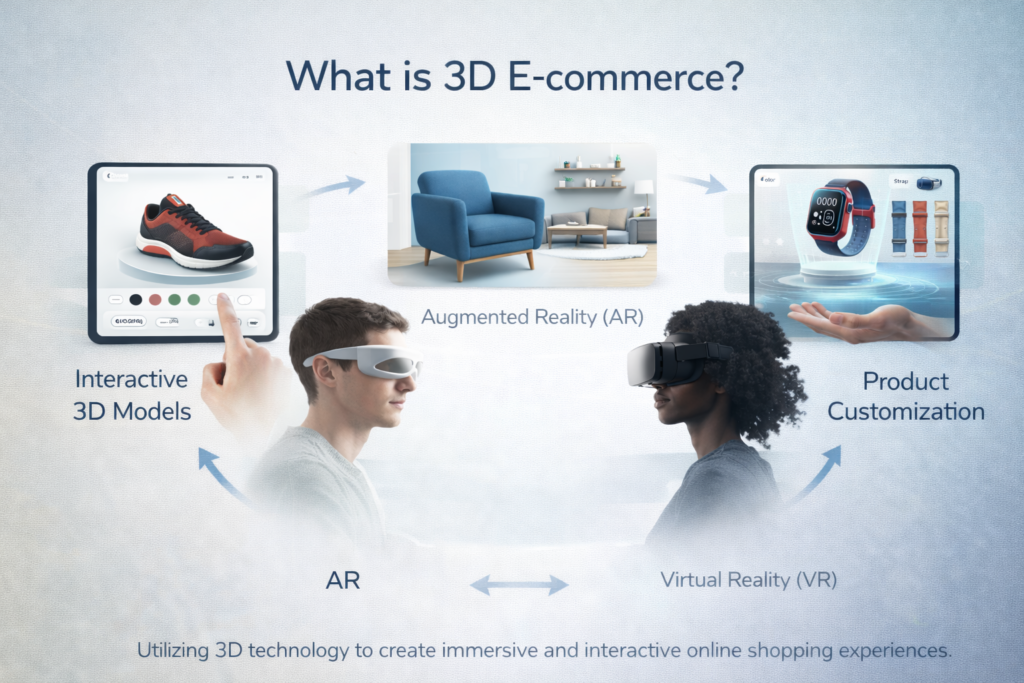
Imagine picking up a ceramic vase from a virtual shelf, rotating it to see the intricate glaze in the light, and placing it on a digital replica of your own coffee table to check for size and style. This is not a scene from a sci-fi movie; it is the reality of 3D e-commerce, a transformative technology redefining how consumers discover, interact with, and purchase products online.
At its core, 3D e-commerce is the integration of three-dimensional (3D) models, augmented reality (AR), virtual reality (VR), and real-time 3D visualization into the online shopping experience. It moves beyond static 2D images and pre-recorded videos, allowing customers to interact with photorealistic, digital twins of products in an immersive, contextual, and information-rich environment. From furniture and fashion to electronics and industrial parts, this technology is bridging the “imagination gap” that has long plagued online retail, leading to higher confidence, reduced returns, and unprecedented engagement.
In this definitive guide, we will explore every facet of what 3D e-commerce is, how it works, its immense benefits, and how your business can leverage it to build a future-proof online store. Whether you’re a retailer, marketer, or developer, understanding this shift is crucial for staying competitive in the next decade of digital commerce.
The Anatomy of 3D E-commerce: Core Technologies and How It Works
To truly grasp what 3D e-commerce is, we must dissect the technological stack that powers it. It’s a synergy of several advanced digital tools creating a seamless user experience.
The Pillars of 3D Online Shopping
- 3D Modeling and Product Configuration: This is the foundational layer. Physical products are digitally recreated as accurate, high-fidelity 3D models using techniques like photogrammetry, 3D scanning, or manual modeling in software like Blender or Autodesk Maya. These models are then optimized for web performance—often using formats like glTF (GL Transmission Format) or USDZ (Apple’s Universal Scene Description)—to ensure they load quickly in a browser without sacrificing detail.
- WebGL and Real-Time 3D Rendering: WebGL (Web Graphics Library) is a JavaScript API that renders interactive 3D and 2D graphics within any compatible web browser without plugins. It is the engine that powers the in-browser 3D viewers you encounter on product pages. Platforms like Three.js and libraries from companies like Vectary or ThreeKit make it easier for developers to implement these viewers.
- Augmented Reality (AR): AR overlays digital 3D models onto the user’s real-world environment via their smartphone or tablet camera. This “see-it-in-your-space” functionality, powered by ARKit (iOS) and ARCore (Android), is a game-changer for categories like home décor, furniture, and sneakers. It answers the critical question: “Will this look good in my room?”
- Virtual Reality (VR) and Immersive Commerce: Taking immersion a step further, VR places the user inside a fully digital environment, such as a virtual showroom or store. Using a VR headset, customers can walk around, pick up products, and experience them at a 1:1 scale. While currently more niche, it represents the frontier of experiential commerce.
- Product Configurators: These are interactive tools that allow customers to customize a product in real-time. Using the underlying 3D model, users can change materials (e.g., leather type on a sofa), colors, components, and engravings, seeing a photorealistic update instantly. This is hugely popular in automotive, luxury goods, and bespoke furniture.
The User Journey in a 3D E-commerce Store
A typical 3D e-commerce experience flows like this:
- A customer lands on a product page for a modern lounge chair.
- Instead of just scrolling through galleries, they click an interactive 3D viewer.
- They use their mouse or finger to rotate the chair 360 degrees, zoom in on the stitching detail, and perhaps open a drop-down menu to change the fabric from charcoal wool to teal velvet.
- Intrigued, they click the “View in Your Room” AR button.
- Their phone camera activates, and they place a life-sized, perfectly scaled model of the chair in their living room. They walk around it, viewing it from different angles.
- Confident in the style, size, and color, they add it to cart and checkout.
This interactive, confidence-building journey is the essence of modern 3D e-commerce.
The Tangible Benefits: Why 3D E-commerce is a Game-Changer
The adoption of 3D commerce isn’t just about being technologically trendy; it delivers measurable, bottom-line results for businesses and superior experiences for customers.
For Businesses
- Significant Reduction in Returns: Returns are the trillion-dollar problem for e-commerce. A major cause is products not matching expectations. By allowing customers to inspect and visualize products accurately, 3D and AR can dramatically cut return rates. IKEA reported that their IKEA Place AR app led to a significant decrease in returns for this very reason. IKEA has been a pioneer in leveraging AR for furniture placement.
- Increased Conversion Rates and Average Order Value (AOV): Interactive experiences are engaging experiences, and engaged customers buy more. A 3D product model can increase conversion rates by up to 40% compared to standard 2D imagery. Configurators empower customers to create their ideal product, which often increases the AOV as they add premium customizations.
- Enhanced Brand Perception and Differentiation: Implementing cutting-edge 3D commerce signals that your brand is innovative, customer-centric, and trustworthy. It creates a memorable “wow” factor that differentiates you from competitors still relying on static images.
- Reduced Sample and Photoshoot Costs: For physical products, creating a perfect 3D model eliminates the need for multiple physical samples and expensive, logistically complex photoshoots for every color variant. Once the digital asset is created, it can be rendered in any environment or configuration indefinitely.
- Richer Data and Customer Insights: Interaction with a 3D model provides valuable data: which angles users zoom in on most, which customizations are most popular, and how long they engage. This data is gold for product development, marketing, and inventory forecasting.
For Customers
- Bridges the “Imagination Gap”: Customers no longer have to guess how a product will look, fit, or feel. They can verify it interactively, restoring the tactile and spatial assessment typically only available in physical stores.
- Builds Confidence and Trust: Transparency builds trust. A shopper who can inspect every angle of a product feels more informed and confident in their purchase decision, reducing pre-purchase anxiety.
- Empowers Personalization and Co-Creation: Product configurators turn shoppers into co-creators. This deep level of personalization leads to greater emotional attachment to the product and higher satisfaction.
- Makes Shopping Fun and Engaging: Interactive 3D commerce transforms a transactional process into an entertaining experience. It’s “shoppable content” at its best, increasing dwell time and brand affinity.
Real-World Use Cases and Industry Applications
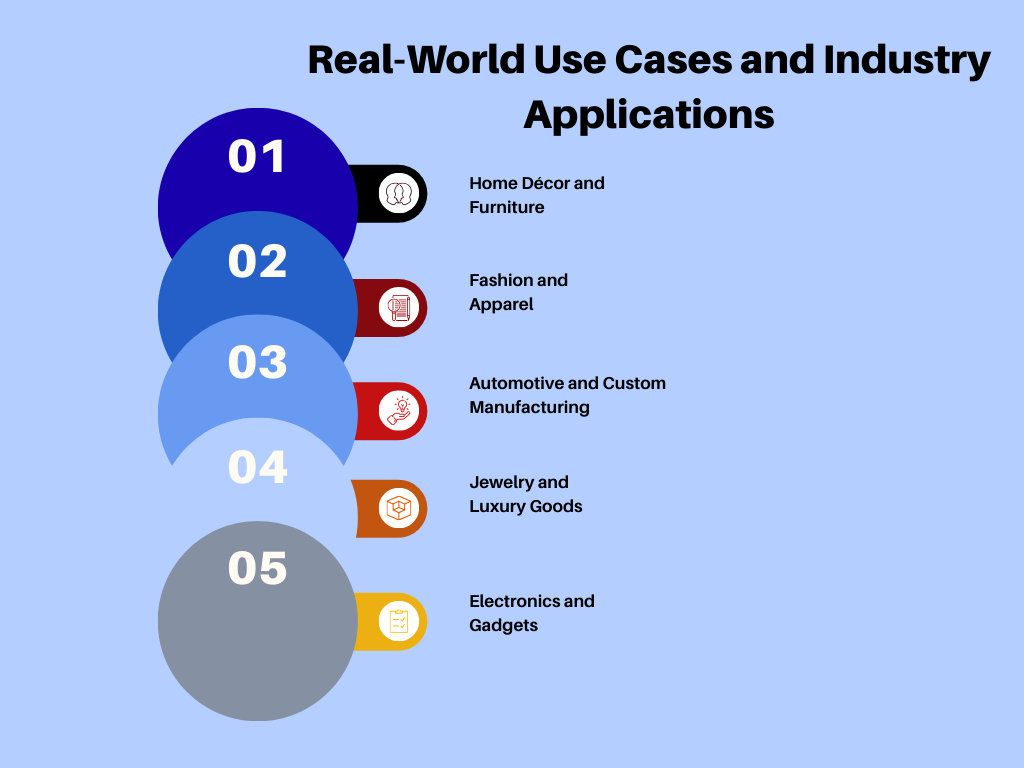
3D e-commerce isn’t a one-size-fits-all solution, but its applications are vast and growing.
Home Décor and Furniture
The quintessential use case. Brands like Wayfair and Anthropologie use AR and 3D viewers to let customers visualize sofas, rugs, and art in their actual spaces. This solves the critical sizing and style-matching problem.
Fashion and Apparel
Virtual try-on for sunglasses, watches, makeup (via AR filters), and even clothing is exploding. Brands like Warby Parker (eyeglasses) and Gucci (sneakers) allow users to “wear” products using their camera. For apparel, advanced solutions are developing realistic fabric drape simulation.
Automotive and Custom Manufacturing
Car manufacturers like BMW and Audi have used 3D configurators for years. Customers can build their dream car, changing paint, wheels, interior trim, and seeing a photorealistic model update in real-time. This same principle applies to custom bicycles, PCs, and industrial equipment.
Jewelry and Luxury Goods
High-value items demand scrutiny. 3D viewers allow customers to appreciate the craftsmanship of a ring or watch, examining diamond settings and metal finishes from all angles in stunning detail, replicating the in-boutique experience.
Electronics and Gadgets
Exploring the ports on a laptop, the hinge mechanism of a smartphone, or the interior layout of a gaming console becomes possible with an interactive 3D model, providing technical customers with the detailed information they crave.
Implementing 3D E-commerce: A Step-by-Step Strategy
Transitioning to a 3D-enabled store requires planning. Here is a strategic roadmap.
Step 1: Audit and Prioritize Your Product Catalog
Not every product needs a 3D model. Start with products where:
- Size, scale, and spatial fit are critical (furniture, appliances).
- Customization is a key selling point (shoes, bags).
- The product is high-consideration/high-value (luxury goods, electronics).
- Returns are historically high due to “not as described” issues.
Step 2: Choose Your 3D Asset Creation Method
- 3D Scanning/Photogrammetry: Best for capturing existing complex objects. Uses multiple photographs or specialized scanners to create a model.
- Professional 3D Modeling: Artists build the model from scratch using CAD data or reference images. Highest quality and most flexible for configurators.
- AI-Assisted or Automated Modeling: Emerging tools use AI to generate 3D models from 2D images. Quality is improving and is cost-effective for large catalogs of simpler products.
Step 3: Select a 3D Commerce Platform
You don’t need to build the rendering engine from scratch. Evaluate SaaS platforms like:
- Vectary: User-friendly for creating and embedding 3D/AR experiences.
- ThreeKit: Focuses on enterprise-level photorealistic configurators and AR.
- Adobe Substance 3D: Part of the Adobe ecosystem, strong for material creation and model texturing.
- Shopify’s Native 3D Features: For merchants on Shopify, you can now directly upload 3D models (in
.glbformat) to product pages, which are automatically converted for AR viewing.
Step 4: Integrate and Optimize for Performance
Work with developers to integrate the 3D viewer into your product pages. Performance is non-negotiable. Ensure models are optimized (polygon count, texture resolution) to load in under 3 seconds. Use lazy loading so the 3D viewer only loads when needed.
Step 5: Promote and Educate Your Customers
Don’t assume users will find the 3D feature. Use clear call-to-actions: “Rotate 3D Model,” “View in Your Room.” Consider tutorial tooltips. Highlight this capability in your marketing (social media, email) as a key benefit.
The Challenges and Common Mistakes to Avoid
While powerful, 3D e-commerce implementation has pitfalls.
Technical and Operational Challenges
- High Initial Cost and Complexity: Creating high-quality 3D assets, especially for large catalogs, requires investment in software, skills, or agency services.
- Performance and Load Times: Unoptimized 3D models can cripple page speed, destroying SEO and user experience. Balancing quality and performance is key.
- Platform Fragmentation: Ensuring a consistent AR/3D experience across different devices, operating systems, and browsers can be tricky.
Strategic Mistakes
- Prioritizing Quantity Over Quality: A few stunning, highly interactive 3D models are better than hundreds of low-quality, unusable ones. Start small and excel.
- Treating It as a Gimmick, Not a Tool: The technology should solve a customer problem (visualization, confidence), not just be a cool feature. Integrate it thoughtfully into the purchase funnel.
- Ignoring Mobile Experience: Most AR interactions happen on mobile. If your 3D experience isn’t flawless on smartphones, you’re missing the biggest opportunity.
- Neglecting Analytics: Failing to track engagement metrics with your 3D models means you’re flying blind, unable to prove ROI or improve the experience.
Expert Tips and Best Practices for 2026 and Beyond
To succeed with 3D commerce, follow these industry-tested principles.
- Start with Your Hero Products: Apply 3D to your bestsellers or most problematic products first to maximize impact and learn quickly.
- Invest in Photorealism: The closer the digital twin is to reality, the greater the trust and reduction in returns. Pay attention to materials, lighting (PBR – Physically Based Rendering), and fine details.
- Make Interaction Intuitive: The 3D viewer should have clear, simple controls (rotate, zoom, pan). Consider auto-rotation on idle to showcase the product.
- Combine Media Types: Don’t replace 2D images and video; complement them. Use a hybrid approach: hero image -> 2D gallery -> interactive 3D viewer -> AR button -> product video.
- Future-Proof with Metaverse & Web3: Consider how your 3D assets could be used in virtual worlds (the metaverse) or as part of digital ownership (NFTs). Creating a single, high-quality “digital twin” asset now prepares you for these emerging channels.
The Future of 3D E-commerce
The trajectory is clear: 3D and immersive experiences will become the standard, not the exception.
- AI-Powered 3D Generation: AI will drastically reduce the cost and time of creating 3D models, making the technology accessible to small businesses.
- Spatial Commerce: The convergence of AR, VR, and the metaverse will lead to persistent virtual stores where users’ avatars can shop together.
- Hyper-Personalization with Avatars: Users will try on clothing using their own accurate 3D body scan avatar, guaranteeing perfect fit.
- Live-Sync 3D Configuration: Sales reps and customers could co-configure a complex product (like a car) in a live video call, with both seeing the same 3D model update in real-time.
- Integration with IoT: Your AR app could scan your living room, recognize your existing IKEA furniture via image recognition, and recommend complementary new items that match your established style.
Frequently Asked Questions (FAQ) About 3D E-commerce
What is the difference between 3D e-commerce and AR e-commerce?
3D e-commerce is the broad category of using 3D models online. AR e-commerce (Augmented Reality) is a subset that places those 3D models into the user’s real-world environment via a camera. All AR commerce uses 3D, but not all 3D commerce uses AR (e.g., a rotatable model on a white background).
How much does it cost to implement 3D e-commerce?
Costs vary widely. A single high-quality 3D model can range from $50 to $5,000+ depending on complexity. SaaS platform subscriptions can be from $50 to $5,000+ per month. The total cost depends on catalog size, quality requirements, and whether you build in-house or outsource.
Do customers actually use 3D and AR features?
Yes, engagement is high and growing. Shopify reported that products with 3D models have a 94% higher conversion rate than those without. Users who interact with AR are 65% more likely to make a purchase.
Is 3D e-commerce good for SEO?
Indirectly, yes. While the 3D model itself isn’t directly indexed, the technology significantly improves key ranking factors: it reduces bounce rate, increases dwell time, and improves user engagement signals—all of which Google considers. Furthermore, it can generate unique, link-worthy content for your site.
What file formats are used for 3D e-commerce?
The dominant format for the web is glTF (.glb or .gltf), as it is efficient and widely supported. For Apple’s AR ecosystem, USDZ is the standard. For high-end rendering and interchange, FBX and OBJ are still common in creation pipelines.
Can I add 3D commerce to my existing Shopify/WooCommerce/Magento store?
Absolutely. Most major platforms now have apps, plugins, or native support. Shopify has built-in 3D/AR support. For WooCommerce and Magento, numerous third-party extensions enable 3D viewers and AR functionality.
Does 3D e-commerce work on all devices?
Modern implementations using WebGL work on most desktops and smartphones. AR functionality requires a device with a capable camera and AR support (most iOS devices via ARKit and modern Android via ARCore). Always provide a fallback (like a 360° spin video) for incompatible devices.
How do I measure the success of my 3D commerce implementation?
Track metrics like:
- 3D Viewer Engagement Rate: % of page visitors who interact with the model.
- Time Spent with 3D/AR.
- Conversion Rate Lift for products with vs. without 3D.
- Return Rate Reduction for products with 3D/AR.
- Impact on Average Order Value (especially with configurators).
Is 3D e-commerce only for big brands?
Not anymore. While early adopters were large enterprises, the democratization of tools (like Vectary, Spline) and the rise of AI-powered 3D generation are making it accessible and affordable for SMBs and DTC brands.
What’s the next big trend after 3D product viewers?
The move towards fully immersive virtual stores and social commerce in 3D environments. Imagine browsing a digital mall with friends or attending a virtual product launch where you can immediately inspect and buy items in 3D. The lines between content, community, and commerce are blurring in 3D space.
Conclusion and Key Takeaways
What is 3D e-commerce? It is the inevitable evolution of online shopping from a flat, static catalog into a dynamic, interactive, and spatial experience. It represents a fundamental shift from “showing” a product to “experiencing” it, fundamentally altering the relationship between consumer and digital product.
Key Takeaways:
The future is immersive: As AI, the metaverse, and spatial computing evolve, 3D commerce assets will become the foundational currency for all digital customer interactions. This shift is part of a larger technological convergence, aspects of which are explored in research aggregated by the https://www.nsf.gov/ National Science Foundation (NSF)</a> on human-computer interaction and future internet architectures.
3D e-commerce solves real problems: It builds customer confidence, reduces costly returns, and increases conversion rates by closing the imagination gap. This aligns with broader e-commerce growth trends monitored by institutions like the https://www.commerce.gov U.S. Department of Commerce</a>, which reports on the digital economy’s expansion and evolving consumer behaviors.
It’s a synergy of technologies: Combining 3D modeling, real-time WebGL rendering, and Augmented Reality creates a powerful toolkit. The https://www.khronos.org Khronos Group</a>, as the open consortium maintaining the WebGL standard, provides the foundational specifications that make browser-based 3D possible and reliable.
Start strategically: Begin with high-impact products, prioritize quality and performance, and integrate the experience seamlessly into your existing customer journey. The underlying principle of enhancing user experience is central to modern web development, as outlined in resources like the https://www.w3.org World Wide Web Consortium (W3C)</a> accessibility and usability guidelines, which ensure technologies are inclusive and effective.
For advanced ecommerce growth strategies, technical insights, and scalable content frameworks, explore professional resources at rankifycontent.com.