Table of Contents
Introduction: Ecommerce in the USA in 2026
Ecommerce in the United States has reached a stage of advanced structural maturity by 2026, where success is driven less by experimentation and more by precision, systems, and execution. The modern US ecommerce landscape is shaped by AI-driven operations, data-led decision-making, and significantly higher consumer expectations for speed, convenience, and reliability. Online businesses are no longer competing only on price or product range; they are competing on fulfillment speed, customer experience, and operational efficiency.
Automation and artificial intelligence now play a central role in US ecommerce operations. From predictive demand forecasting and inventory optimization to personalized product recommendations and AI-powered customer support, technology has become deeply embedded in how ecommerce businesses scale and compete. These advancements allow brands to operate leaner, respond faster to market changes, and deliver more relevant experiences to customers.
From a market perspective, the US ecommerce industry continues to expand at a strong and steady pace. By 2026, the market is projected to reach approximately $1.17 trillion to $1.38 trillion in total value, with online retail expected to account for over 18% of total retail sales. This confirms ecommerce as a permanent and dominant force within the American retail economy rather than a temporary shift or alternative channel.
At the same time, consumer expectations have intensified. US shoppers now expect rapid delivery, transparent pricing, frictionless checkout experiences, and easy returns as standard features, not competitive advantages. Businesses that fail to meet these expectations face declining conversion rates and customer loyalty. As a result, ecommerce success in the USA requires a carefully designed ecosystem that integrates technology, logistics, marketing, compliance, and customer-centric strategy.
This guide provides a detailed and practical explanation of ecommerce in the USA in 2026. It covers market structure, business models, major platforms, ecommerce development, SEO, warehousing and fulfillment, and sustainable growth strategies. The goal is to offer a complete, long-form resource that supports long-term business planning, search engine visibility, and real-world execution.
Understanding the Ecommerce Ecosystem in the USA
The ecommerce ecosystem in the United States is built on strong digital infrastructure, advanced logistics, and strict consumer standards. Unlike emerging markets where ecommerce adoption is still growing, the US market is already saturated. This means businesses must compete on quality, reliability, and efficiency rather than novelty.
Several factors define the US ecommerce ecosystem. First, internet and smartphone penetration are extremely high, making online shopping accessible to nearly every consumer demographic. Second, payment systems are advanced, allowing customers to pay using credit cards, digital wallets, buy-now-pay-later options, and mobile payments. Third, nationwide shipping networks enable delivery across all states, often within one to three days.
At the same time, competition is intense. Almost every niche, from fashion to electronics to health products, has dozens or even hundreds of competitors. As a result, US ecommerce success depends on operational excellence, strong branding, and customer-centric strategies.
Recommended ecommerce tech stack: https://rankifycontent.com/ecommerce-tech-stack
Ecommerce Business Models in the USA
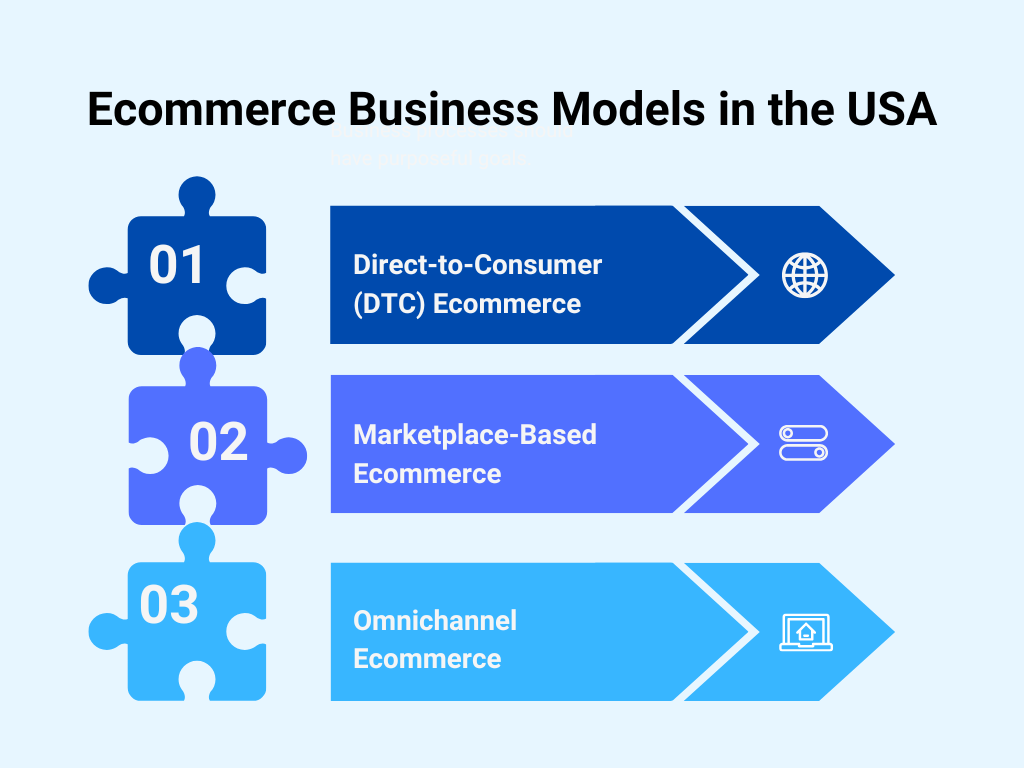
Direct-to-Consumer (DTC) Ecommerce
Direct-to-consumer ecommerce is one of the most popular business models in the USA. In this model, brands sell directly to customers through their own websites instead of relying solely on third-party marketplaces. DTC allows businesses to control branding, pricing, marketing, and customer relationships.
In the US market, successful DTC brands invest heavily in website experience, search engine optimization, paid advertising, email marketing, and fulfillment operations. They focus on building long-term customer relationships rather than one-time sales. Subscription models, loyalty programs, and personalized communication are commonly used to increase customer lifetime value.
However, DTC ecommerce also comes with challenges. Customer acquisition costs in the USA are high, especially on paid advertising platforms. Brands must carefully manage margins, conversion rates, and retention strategies to remain profitable.
Marketplace-Based Ecommerce
Marketplaces play a central role in US ecommerce. Platforms such as Amazon, Walmart, eBay, and Etsy provide access to massive customer bases and built-in trust. Many ecommerce businesses use marketplaces to validate products, generate early sales, or scale volume quickly.
Marketplace ecommerce works well for standardized products, competitive pricing, and high-volume sales. However, it comes with limitations. Sellers must follow strict platform policies, pay commissions and fulfillment fees, and often have limited access to customer data. Brand differentiation is also more difficult on marketplaces.
For this reason, many US ecommerce businesses adopt a hybrid approach, using marketplaces for reach and volume while building their own DTC websites for brand control and higher margins.
Omnichannel Ecommerce
Omnichannel ecommerce integrates online stores, marketplaces, social commerce, and physical retail locations. Customers can browse products online, purchase in-store, or order online and pick up locally. This approach improves convenience and brand consistency.
In the USA, omnichannel strategies are increasingly used by established brands and retailers. However, omnichannel ecommerce requires advanced inventory management systems, real-time order synchronization, and unified customer data. Without proper systems, omnichannel operations can become inefficient and costly.
Major Ecommerce Platforms and Companies in the USA
Ecommerce Website Platforms
Choosing the right ecommerce platform is one of the most important decisions for any online business in the USA. The platform determines how products are managed, how payments are processed, and how scalable the business can become.
Shopify is the most widely used ecommerce platform in the USA for small and medium-sized businesses. It offers secure hosting, fast checkout, built-in payment solutions, and a large ecosystem of apps. Shopify is ideal for brands that want to launch quickly and scale without heavy technical complexity.https://www.shopify.com/
WooCommerce is a WordPress-based ecommerce solution preferred by content-driven websites. It offers flexibility and full ownership but requires more technical maintenance. WooCommerce is popular among businesses that prioritize blogging, SEO, and custom functionality. https://woocommerce.com
BigCommerce serves growing and mid-market businesses with advanced built-in features such as B2B pricing, multi-storefront capabilities, and API-based integrations. https://www.bigcommerce.com/
Adobe Commerce (Magento) is designed for enterprise-level ecommerce businesses with complex catalogs, custom workflows, and large-scale integrations. While powerful, it requires experienced development teams and higher budgets. https://business.adobe.com/products/magento/magento-commerce.html
Ecommerce Marketplaces
Marketplaces are a major driver of ecommerce sales in the USA. Amazon remains the dominant player, setting standards for delivery speed, pricing transparency, and customer service. Walmart Marketplace continues to grow rapidly, especially for US-based sellers. eBay and Etsy serve specific niches such as refurbished products, collectibles, and handmade goods.
Marketplaces are often used as demand-capture channels rather than brand-building platforms. Businesses must carefully manage pricing, inventory, and fulfillment to remain competitive.
Ecommerce Website Development in the USA
Ecommerce website development in 2026 focuses on performance, security, scalability, and user experience. A professional ecommerce website must load quickly, function flawlessly on mobile devices, and guide users smoothly from product discovery to checkout.
Modern ecommerce development follows a mobile-first approach. Most US consumers browse and shop using smartphones, making mobile optimization essential. Websites must also meet accessibility standards to ensure usability for all customers.
Security is another critical aspect of ecommerce development. SSL certificates, secure payment processing, and strong data protection practices are mandatory in the US market. Customers are highly sensitive to security issues and abandon websites that appear unsafe.
Ecommerce Technology Stack
A reliable ecommerce technology stack supports daily operations and long-term growth. In the USA, a typical ecommerce stack includes a frontend storefront, payment gateways, analytics tools, marketing automation, shipping software, and tax compliance systems.
Payment gateways such as Stripe, PayPal, and digital wallets allow secure and flexible transactions. Analytics tools like Google Analytics 4 help track traffic, conversions, and customer behavior. Email and SMS platforms support retention and customer engagement. Shipping automation tools integrate with carriers to generate labels and track orders. Tax compliance software helps businesses manage complex US sales tax requirements.
A well-integrated technology stack reduces manual work, improves accuracy, and enables scalability.
Ecommerce SEO Strategy in the USA
Search engine optimization is one of the most important growth channels for ecommerce businesses in the USA. SEO drives high-intent traffic from users actively searching for products, categories, and solutions.
Ecommerce SEO starts with keyword research. Businesses must identify buyer-intent keywords for category pages and informational keywords for blog content. Category and collection pages act as traffic hubs and should be optimized with clear headings, descriptive content, and internal links.
Product pages must include unique descriptions, optimized titles, structured data, and high-quality images. Duplicate content from manufacturers should be avoided, as it reduces ranking potential.
Technical SEO is equally important. Ecommerce websites must have clean site architecture, fast page speed, mobile usability, secure HTTPS connections, and proper handling of filters and faceted navigation.
Content marketing supports ecommerce SEO by addressing informational and comparison-based searches. Buying guides, tutorials, FAQs, and product comparisons help users make informed decisions and build trust.
Conversion Rate Optimization (CRO)
Conversion rate optimization focuses on turning website visitors into paying customers. In the US ecommerce market, even small improvements in conversion rates can significantly increase revenue.
Effective CRO strategies include clear value propositions, high-quality product visuals, transparent shipping and return policies, customer reviews, and simplified checkout processes. Trust signals such as security badges and money-back guarantees also play a key role.
A/B testing is commonly used to experiment with layouts, headlines, pricing displays, and call-to-action buttons. CRO is an ongoing process rather than a one-time task.
Warehousing and Fulfillment in the USA
Warehousing and fulfillment are critical components of ecommerce success in the USA. Customers expect fast and reliable delivery, and fulfillment performance directly impacts reviews, refunds, and repeat purchases.
Ecommerce businesses must choose fulfillment models that align with their order volume, product type, and growth plans.
Fulfillment Models
Self-fulfillment involves managing inventory, packing, and shipping internally. This model offers control over packaging and quality but requires significant investment in space, labor, and systems.
Third-party logistics (3PL) providers store inventory and handle order fulfillment on behalf of ecommerce brands. This model allows businesses to scale quickly without owning warehouses. 3PLs often provide multi-warehouse networks, enabling faster delivery across the USA.
Marketplace fulfillment programs such as Amazon FBA and Walmart Fulfillment Services handle storage, shipping, and customer service for marketplace orders. While convenient, these programs involve higher fees and less control.
Returns Management and Customer Support
Returns are a standard part of US ecommerce. Customers expect easy and transparent return processes. Clear return policies reduce hesitation during checkout and increase conversion rates.
Efficient returns management includes automated return portals, defined inspection processes, and restocking or refurbishment workflows. Poor returns handling leads to negative reviews and lost trust.
Customer support is equally important. Professional support through email, live chat, and help desks builds credibility and improves retention. In the US market, slow or unresponsive support can quickly damage a brand’s reputation.
Ecommerce Marketing and Business Growth Strategies
Successful ecommerce brands in the USA use diversified marketing strategies to reduce dependency on a single channel. SEO and content marketing provide long-term traffic, while paid search and social media ads generate immediate demand.
Email and SMS marketing play a major role in retention and repeat purchases. Personalized campaigns, abandoned cart reminders, and post-purchase follow-ups increase lifetime value.
Influencer and affiliate marketing are also widely used in the USA. Partnering with creators helps brands reach new audiences with higher trust.
Scaling Ecommerce Businesses in the USA
Scaling ecommerce operations requires systems, not just increased sales. Businesses must invest in inventory forecasting, analytics, automation, and standard operating procedures.
Multi-warehouse fulfillment becomes important as order volume grows. Distributing inventory across regions reduces shipping times and costs. Advanced analytics help businesses identify profitable products, channels, and customer segments.
Scaling without proper systems often leads to operational failures, customer dissatisfaction, and margin erosion.
Legal, Tax, and Compliance Considerations
US ecommerce businesses must comply with various legal and regulatory requirements. Sales tax compliance is complex and varies by state. Businesses must also maintain clear privacy policies, terms and conditions, and consumer protection disclosures.
Payment processors and platforms impose additional compliance requirements. Meeting these standards builds trust and reduces risk.
Frequently Asked Questions (FAQs)
What is ecommerce in the USA?
Ecommerce in the USA refers to buying and selling products or services online through websites, mobile apps, and marketplaces.
Is ecommerce profitable in the USA in 2026?
Yes, ecommerce is profitable, but success depends on execution, logistics, SEO, and customer retention rather than quick tactics.
Which ecommerce platform is best for beginners?
Shopify is generally the best platform for beginners due to ease of use and scalability.
Do I need a warehouse to start ecommerce?
No, many businesses start with 3PL services or marketplace fulfillment before investing in warehouses.
How important is SEO for ecommerce success?
SEO is critical for long-term growth because it delivers high-intent traffic and reduces reliance on paid ads.
What makes the US ecommerce market different from other countries?
The US ecommerce market is more mature and competitive than most global markets. Consumers have high expectations for delivery speed, customer service, return policies, and payment security. Strong logistics infrastructure, advanced digital payments, and strict consumer protection laws make execution quality more important than experimentation.
How big is the ecommerce market in the USA in 2026?
By 2026, the US ecommerce market is projected to reach approximately $1.17 trillion to $1.38 trillion, with online retail accounting for more than 18% of total retail sales. This growth reflects ecommerce’s permanent role in the US retail economy.
Is it still possible to start a new ecommerce business in the USA?
Yes, new ecommerce businesses can still succeed in the USA, but competition is intense. Success depends on niche selection, strong branding, efficient fulfillment, SEO-driven traffic, and customer retention rather than relying only on paid advertising.
Which ecommerce business model works best in the USA?
There is no single best model. Direct-to-consumer (DTC) works well for brand building and higher margins, marketplaces are effective for volume and fast validation, and omnichannel strategies suit established businesses with physical retail presence.
How important is AI in ecommerce operations today?
AI plays a critical role in modern US ecommerce. It is used for demand forecasting, inventory optimization, personalized product recommendations, pricing strategies, fraud detection, and AI-powered customer support. Businesses that adopt AI-driven operations gain efficiency and scalability advantages.
What are the biggest challenges for ecommerce businesses in the USA?
Major challenges include high customer acquisition costs, intense competition, complex logistics, rising fulfillment expenses, returns management, and maintaining profitability while meeting high consumer expectations.
Do ecommerce businesses in the USA need to collect sales tax?
Yes, most ecommerce businesses selling to US customers are required to collect and remit sales tax, depending on economic nexus rules that vary by state. Proper tax compliance is essential to avoid legal and financial issues.
How fast do US consumers expect delivery?
Delivery expectations have increased significantly. Many US consumers expect delivery within two to three days as a standard option, with same-day or next-day delivery increasingly common in urban areas.
Is SEO still effective for ecommerce in the USA?
SEO remains one of the most effective long-term growth channels for US ecommerce. It drives high-intent traffic, reduces dependency on paid ads, and supports sustainable customer acquisition when combined with quality content and technical optimization.
What role does warehousing play in ecommerce success?
Warehousing directly impacts delivery speed, shipping costs, and customer satisfaction. Multi-warehouse or 3PL-based fulfillment strategies help ecommerce businesses meet fast delivery expectations across different US regions.
Are marketplaces like Amazon still important in 2026?
Yes, marketplaces remain extremely important for demand capture and volume. However, many businesses use marketplaces alongside their own websites to reduce dependency and build long-term brand equity.
How important are returns in US ecommerce?
Returns are a standard expectation in the US. Clear, simple, and fair return policies increase conversion rates and trust. Poor returns management often leads to negative reviews and customer churn.
Can international sellers operate ecommerce businesses in the USA?
Yes, international sellers can run ecommerce businesses in the USA, but they must comply with US tax laws, shipping regulations, platform policies, and consumer protection standards.
What skills are most important for running an ecommerce business in the USA?
Key skills include digital marketing, SEO, data analysis, supply chain management, customer experience design, and financial planning. Successful businesses treat ecommerce as an integrated system rather than separate tasks.
Is ecommerce growth in the USA slowing down?
Growth is stabilizing rather than slowing. While explosive growth phases have passed, ecommerce continues to expand steadily, with higher emphasis on profitability, efficiency, and operational maturity.
What is the future outlook for ecommerce in the USA?
The future of US ecommerce is shaped by AI-driven automation, faster fulfillment, omnichannel integration, and increased focus on customer lifetime value. Businesses that adapt to these trends will remain competitive in the long term.
Conclusion:
Ecommerce in the USA in 2026 represents a mature yet opportunity-rich environment for businesses that prioritize structure, efficiency, and long-term value creation. With the market approaching trillion-dollar scale and online retail capturing a growing share of total consumer spending, ecommerce is no longer optional for modern brands. It is a core commercial channel that demands professional execution and strategic investment.
The combination of AI-driven operations, advanced logistics networks, and heightened consumer expectations has fundamentally reshaped how ecommerce businesses must operate. Brands that succeed are those that invest in scalable technology stacks, optimize fulfillment and warehousing, build strong SEO and content foundations, and focus on customer retention rather than short-term sales spikes.
At the same time, the competitive nature of the US market means that growth without systems is unsustainable. Businesses must align ecommerce development, marketing, inventory management, and customer support into a single cohesive operation. Those that neglect any one of these pillars often experience rising costs, operational failures, and declining customer trust.
Ultimately, building a successful ecommerce business in the USA requires a long-term mindset. Companies that adapt to technological change, meet rising expectations for speed and service, and continuously optimize their operations are best positioned to thrive. As ecommerce continues to claim a larger share of US retail sales, brands that focus on execution, transparency, and customer experience will define the next phase of digital commerce growth.
This makes 2026 not just a year of opportunity, but a defining moment for ecommerce businesses ready to operate at scale in the United States.