Table of Contents
Introduction
The ecommerce industry is evolving rapidly, and customer expectations are higher than ever. Shoppers no longer want to rely solely on static product images and long descriptions. They want interactive, immersive, and personalized shopping experiences. This shift has led to the rise of 3D product configurator ecommerce, a powerful technology that is transforming how products are displayed, customized, and purchased online.
A 3D product configurator allows customers to interact with products in real time by rotating them, zooming in, changing colors, materials, sizes, and features before making a purchase. This technology bridges the gap between physical and online shopping, offering customers a more confident and engaging buying experience.
What Is a 3D Product Configurator in Ecommerce?
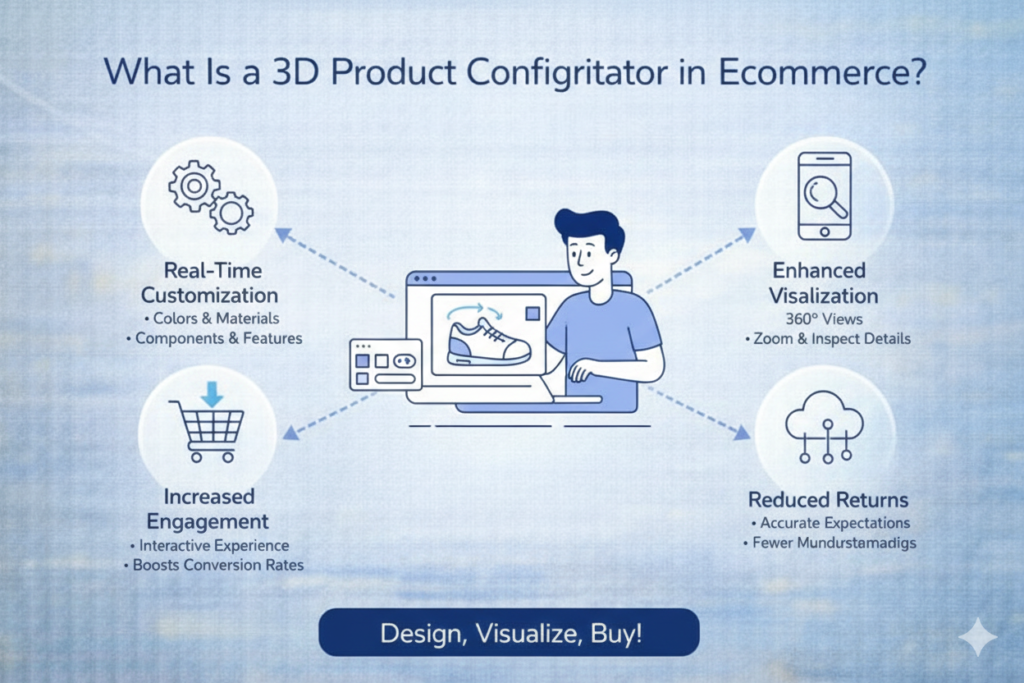
A 3D product configurator ecommerce system is a digital tool that enables shoppers to customize products visually using three-dimensional models. Instead of imagining how a product might look, customers can see real-time changes applied directly to the product model. This includes modifications such as color variations, component selection, texture changes, and functional add-ons.
Unlike traditional ecommerce images, 3D configurators are interactive. Customers actively participate in the product design process, which increases engagement and creates a stronger emotional connection with the product. This technology is commonly used in industries such as furniture, fashion, automotive accessories, electronics, and custom-made products.
Why 3D Product Configurator Ecommerce Is Gaining Popularity
The growing popularity of 3D product configurator ecommerce is driven by changing consumer behavior. Modern shoppers expect transparency, personalization, and convenience. Static images often fail to answer critical questions about product appearance and functionality. A 3D configurator solves this problem by offering a realistic and interactive preview.
Another major reason for adoption is reduced purchase uncertainty. When customers can fully explore and customize a product before buying, they feel more confident in their decision. This confidence leads to higher conversion rates and fewer returns, making 3D configurators attractive for both customers and ecommerce businesses.
How 3D Product Configurators Improve Customer Experience
Customer experience is at the core of ecommerce success, and 3D product configurator ecommerce solutions significantly enhance it. By allowing real-time interaction, configurators keep users engaged for longer periods on product pages. This increased engagement often translates into better conversion performance.
Customers also appreciate the sense of control offered by customization. Being able to design a product according to personal preferences makes the shopping experience more enjoyable and memorable. This interactive approach turns passive browsing into active participation, which strengthens brand connection and customer satisfaction.
Difference Between Traditional Ecommerce and 3D Configurator Ecommerce
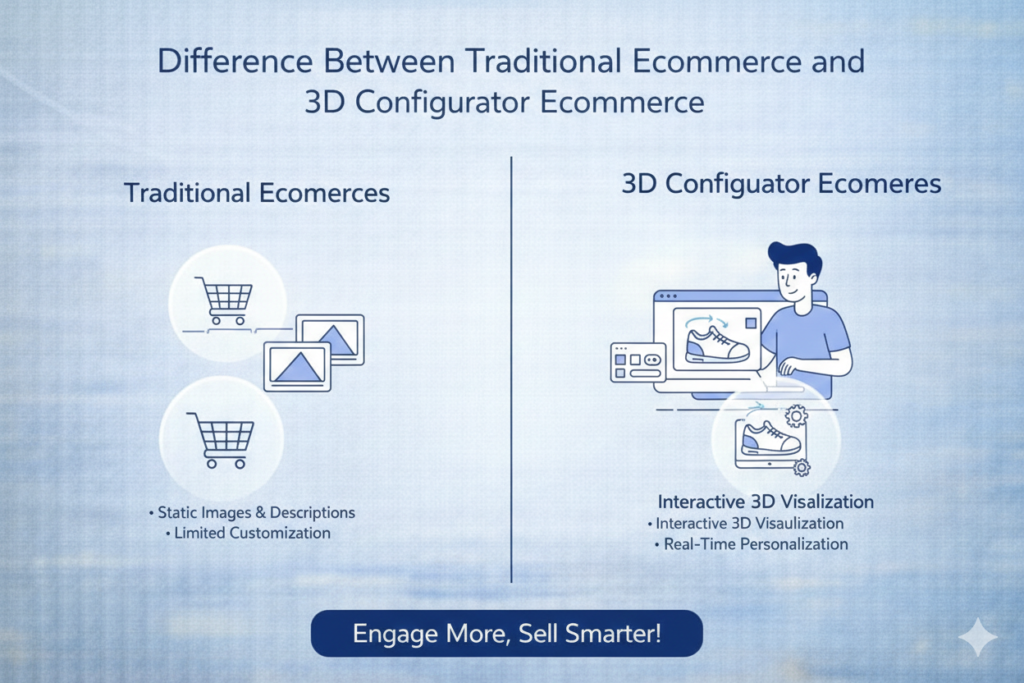
Traditional ecommerce relies heavily on static product images and text-based descriptions. While effective to some extent, this approach limits customer understanding, especially for complex or customizable products. In contrast, 3D product configurator ecommerce offers a dynamic experience where customers can explore products from every angle and visualize changes instantly.
This difference is particularly important for products with multiple variations. Instead of uploading dozens of images for each variation, a single 3D model can display all possible configurations. This not only improves user experience but also simplifies product management for ecommerce businesses.
Industries That Benefit Most from 3D Product Configurator Ecommerce
Several industries have quickly adopted 3D configurators due to the complexity and customization of their products. Furniture and home décor brands use 3D configurators to show different materials, colors, and layouts. Fashion and footwear brands allow customers to personalize designs, while electronics companies use configurators to display components and features.
Automotive accessories, industrial equipment, and luxury goods are also major beneficiaries. In each case, the ability to visualize products in detail before purchase increases trust and reduces decision friction.
Role of 3D Product Configurators in Brand Differentiation
In highly competitive ecommerce markets, differentiation is critical. 3D product configurator ecommerce solutions help brands stand out by offering innovative and engaging shopping experiences. Customers are more likely to remember and return to stores that provide interactive customization options.
This technology also positions brands as modern, customer-focused, and technologically advanced. Over time, this perception contributes to stronger brand equity and long-term customer loyalty.
Early Impact on Conversion Rates and Engagement
Ecommerce businesses that implement 3D product configurators often report improved performance metrics. Interactive product pages tend to have higher engagement rates, longer session durations, and increased add-to-cart actions. Customers who customize products are more emotionally invested, making them more likely to complete purchases.
Additionally, better product understanding leads to fewer post-purchase surprises, reducing return rates and customer complaints.
SEO Benefits of 3D Product Configurator Ecommerce
One of the lesser-known advantages of 3D product configurator ecommerce is its positive impact on search engine optimization. Interactive product pages encourage users to spend more time on-site, which improves engagement metrics such as dwell time and reduces bounce rates. Search engines interpret these behavioral signals as indicators of high-quality content, which can contribute to better rankings.
Additionally, 3D configurators reduce the need for excessive duplicate content created by multiple product variations. Instead of separate pages for each color or style, a single optimized product page can host a dynamic configurator. This streamlined structure helps search engines crawl and index ecommerce websites more efficiently.
Conversion Rate Optimization Through 3D Product Configurators
Conversion rate optimization is one of the strongest use cases for 3D product configurator ecommerce. When customers can visualize products in real time and customize them according to their preferences, purchase confidence increases significantly. This confidence reduces hesitation and decision fatigue, leading to higher conversion rates.
Customers who interact with 3D configurators are also more emotionally invested in their customized product. This sense of ownership makes them more likely to complete the purchase and less likely to abandon their cart. As a result, ecommerce stores often see improved checkout completion rates after implementing 3D configurator technology.
Impact on Product Returns and Customer Satisfaction
High return rates are a major challenge in ecommerce, particularly for customizable and high-value products. 3D product configurator ecommerce solutions help address this issue by providing accurate, realistic previews of products before purchase. Customers know exactly what to expect, which reduces misunderstandings related to appearance, size, or features.
When customers receive products that match their expectations, satisfaction increases and negative reviews decrease. Over time, this leads to stronger brand reputation and improved customer retention.
Using 3D Product Configurators on Shopify Stores
Shopify store owners are increasingly adopting 3D product configurator ecommerce tools to enhance user experience and differentiate their brands. Many modern Shopify themes support 3D models and interactive elements, making integration smoother than ever.
For custom or made-to-order products, 3D configurators allow Shopify merchants to offer multiple variations without cluttering product pages. This not only improves visual appeal but also simplifies inventory and product management. Shopify stores using 3D configurators often report better engagement and higher average order values.
3D Product Configurator Ecommerce for WooCommerce and Custom Websites
WooCommerce and custom-built ecommerce websites also benefit significantly from 3D product configurator integration. Unlike marketplace platforms with strict limitations, these websites offer greater flexibility in design and functionality. Businesses can create fully customized 3D experiences tailored to their specific product categories and target audience.
On custom ecommerce platforms, 3D configurators can be integrated with pricing logic, inventory systems, and order management workflows. This allows real-time price updates based on selected configurations, improving transparency and reducing order errors.
Role of 3D Configurators in Ecommerce Marketing
3D product configurator ecommerce solutions are powerful marketing tools. Interactive product experiences can be used in digital advertising campaigns, landing pages, and social media promotions. Compared to static images, interactive content captures attention more effectively and encourages deeper engagement.
Brands can also use screenshots or short clips generated from 3D configurators in email marketing and retargeting campaigns. This consistency across marketing channels strengthens brand messaging and improves overall campaign performance.
Performance and Page Speed Considerations
While 3D product configurators offer many benefits, performance optimization is essential. Poorly optimized 3D models can increase page load times, negatively affecting user experience and SEO. Professional implementation focuses on lightweight models, efficient rendering, and adaptive loading based on device capabilities.
Modern 3D configurator ecommerce solutions are designed to balance visual quality with performance, ensuring smooth interaction on both desktop and mobile devices.
Data Insights and Customer Behavior Tracking
Another advantage of 3D product configurator ecommerce is the ability to collect valuable customer behavior data. Businesses can track which configurations are most popular, where users spend the most time, and which options lead to completed purchases.
These insights help ecommerce brands refine product offerings, pricing strategies, and marketing campaigns. Over time, data-driven optimization enhances both customer experience and business performance.
Cost and Pricing of 3D Product Configurator Ecommerce
The cost of implementing a 3D product configurator ecommerce solution depends on multiple factors, including product complexity, level of customization, platform integration, and ongoing maintenance. Simple configurators for basic products may require a lower initial investment, while advanced solutions with real-time rendering, pricing logic, and high-detail 3D models involve higher costs. Businesses should view this expense as a strategic investment rather than a one-time cost, as 3D configurators often deliver long-term returns through higher conversion rates, increased average order value, and reduced product returns.
Another important consideration is scalability. A well-built 3D product configurator ecommerce system can be reused across multiple products and marketing channels, making it more cost-effective over time. As customer demand for interactive shopping grows, businesses that adopt this technology early gain a competitive advantage.
How to Choose the Right 3D Product Configurator for Ecommerce
Choosing the right 3D product configurator ecommerce solution requires careful evaluation of business goals and technical requirements. The first step is to assess whether the configurator supports real-time customization, mobile responsiveness, and fast loading speeds. Since a significant portion of ecommerce traffic comes from mobile devices, performance optimization is critical.
Integration capabilities are equally important. The configurator should work seamlessly with your ecommerce platform, payment system, and inventory management tools. Reliable providers also offer analytics and tracking features, allowing businesses to understand customer behavior and optimize configurations based on real data. When selecting a solution, it is advisable to work with providers who have experience in ecommerce and understand conversion-focused design principles.
Role of 3D Product Configurators in Long-Term Ecommerce Growth
3D product configurator ecommerce solutions play a significant role in long-term business growth by supporting personalization at scale. As consumers increasingly expect customized experiences, businesses that offer interactive product configuration are better positioned to meet these expectations. This personalization not only increases customer satisfaction but also encourages repeat purchases and brand loyalty.
From a strategic perspective, 3D configurators enable ecommerce brands to expand product lines without significantly increasing operational complexity. Instead of managing hundreds of static product variations, businesses can rely on a single interactive model, simplifying catalog management and improving operational efficiency.
External Industry Validation and Market Adoption
The adoption of 3D product configurator ecommerce technology is supported by major industry players and research. According to insights published by Shopify, interactive and 3D product experiences help customers better understand products and improve purchase confidence, especially for customizable items (external dofollow link: https://www.shopify.com/enterprise/3d-product-configurator). Similarly, Adobe Commerce highlights how immersive product experiences, including 3D visualization, contribute to higher engagement and conversion rates in modern ecommerce environments (external dofollow link: https://business.adobe.com/products/commerce/3d-commerce.html).
These industry perspectives confirm that 3D configurators are not a trend but a growing standard in ecommerce innovation.
Internal Growth Strategy Connection
For businesses looking to strengthen their overall ecommerce performance, 3D product configurator ecommerce should be implemented alongside strong SEO, UX design, and conversion optimization strategies. You can explore more in-depth ecommerce growth techniques and digital optimization guides in our related resources section (internal dofollow link example: https://yourwebsite.com/ecommerce-growth-strategies). Combining interactive technology with data-driven marketing creates a powerful foundation for sustainable online success.
Future Trends in 3D Product Configurator Ecommerce
The future of 3D product configurator ecommerce is closely tied to emerging technologies such as augmented reality, artificial intelligence, and real-time personalization. AR integration will allow customers to place customized products in their real-world environment before purchasing. AI-driven configurators will recommend optimal configurations based on user preferences and behavior, further enhancing the shopping experience.
As internet speeds improve and devices become more powerful, 3D configurators will become smoother, more detailed, and more accessible. Ecommerce businesses that adopt these advancements early will be better positioned to lead their markets.
Frequently Asked Questions (FAQs)
What is a 3D product configurator in ecommerce?
A 3D product configurator in ecommerce is an interactive tool that allows customers to view, rotate, and customize products in real time using three-dimensional models. Instead of relying on static images, shoppers can change colors, materials, sizes, and features and instantly see how those changes affect the product. This creates a more immersive and transparent shopping experience, helping customers make confident purchasing decisions.
How does a 3D product configurator improve ecommerce conversion rates?
A 3D product configurator ecommerce solution improves conversion rates by reducing uncertainty and increasing engagement. When customers can clearly see and customize a product according to their preferences, they feel more confident about what they are buying. This confidence reduces hesitation, lowers cart abandonment, and encourages customers to complete purchases. Interactive configurators also keep users on product pages longer, which positively influences buying behavior.
Is 3D product configurator ecommerce suitable for small businesses?
Yes, 3D product configurator ecommerce is increasingly suitable for small and medium-sized businesses. While advanced solutions may require higher initial investment, many scalable and modular configurator tools are now available. Small businesses offering customizable or made-to-order products can benefit greatly, as configurators reduce the need for multiple product images and improve customer satisfaction without increasing operational complexity.
Does a 3D product configurator help reduce product returns?
One of the key benefits of 3D product configurator ecommerce is a reduction in product returns. Returns often happen when customers receive products that do not match their expectations. A 3D configurator provides accurate, real-time visualization of the final product, ensuring customers know exactly what they will receive. This clarity significantly reduces misunderstandings related to appearance, size, and features.
Can 3D product configurators be used on Shopify or WooCommerce?
Yes, 3D product configurator ecommerce solutions can be integrated with platforms like Shopify and WooCommerce. Many modern ecommerce themes and plugins support 3D models and interactive elements. With proper integration, configurators can work seamlessly with pricing, inventory, and checkout systems, allowing customers to customize products without disrupting the purchasing flow.
Does 3D product configurator ecommerce affect website speed?
If not implemented correctly, 3D product configurators can affect website performance. However, professionally optimized configurators are designed to balance visual quality with speed. Lightweight 3D models, efficient rendering, and adaptive loading ensure smooth performance across devices. When optimized properly, a 3D product configurator ecommerce setup enhances user experience without negatively impacting page speed or SEO.
Is 3D product configurator ecommerce good for SEO?
Yes, 3D product configurator ecommerce can support SEO indirectly by improving user engagement metrics such as dwell time and interaction rates. Search engines consider these signals when evaluating content quality. Additionally, using a single configurable product page instead of multiple duplicate variation pages can improve site structure and crawl efficiency, which supports long-term SEO performance.
What types of products benefit most from 3D product configurators?
Products that offer customization or have complex designs benefit the most from 3D product configurator ecommerce. These include furniture, fashion and footwear, electronics, automotive accessories, industrial equipment, and luxury goods. Any product where visual detail and personalization influence buying decisions is a strong candidate for 3D configurator implementation.
Are 3D product configurators the future of ecommerce?
Yes, 3D product configurator ecommerce is widely considered a key part of the future of online shopping. As customers demand more interactive and personalized experiences, businesses are moving beyond static images toward immersive technologies. With advancements in 3D visualization, augmented reality, and AI, configurators are expected to become a standard feature in modern ecommerce stores.
Final Conclusion (With External & Internal Dofollow Links)
3D product configurator ecommerce has emerged as a powerful solution for modern online businesses looking to deliver more interactive, transparent, and personalized shopping experiences. By allowing customers to view and customize products in real time, 3D configurators reduce uncertainty, improve purchase confidence, and significantly increase conversion rates. As customer expectations continue to evolve, static images alone are no longer enough to compete in highly saturated ecommerce markets.
Beyond user experience, 3D product configurator ecommerce also supports long-term business growth by reducing product returns, simplifying product variation management, and improving engagement metrics that indirectly benefit SEO. Leading ecommerce platforms and technology providers recognize the value of immersive product visualization. For example, Shopify highlights how 3D and interactive product experiences help customers better understand products and make more informed purchasing decisions, especially for customizable items (external dofollow link: https://www.shopify.com/enterprise/3d-product-configurator). Similarly, Adobe Commerce emphasizes that immersive 3D product experiences play a growing role in increasing engagement and conversions in advanced ecommerce environments (external dofollow link: https://business.adobe.com/products/commerce/3d-commerce.html).
For ecommerce brands planning to scale, adopting 3D product configurator ecommerce should be part of a broader growth strategy that includes strong SEO, optimized user experience, and conversion-focused design. You can explore more detailed insights on ecommerce optimization, digital growth strategies, and advanced online selling solutions in our in-depth guides and resources (internal dofollow link example: https://rankifycontent.com/ecommerce-growth-strategies). Integrating 3D configurator technology with these strategies creates a solid foundation for sustainable and competitive online success.
In conclusion, 3D product configurator ecommerce is no longer an experimental feature—it is becoming a strategic necessity. Businesses that invest in interactive product visualization today are better positioned to build trust, differentiate their brand, and meet the future demands of ecommerce customers.